Perfect Peace (Isaiah 26:1-9)

In that day, everyone in the land of Judah will sing this song:

Our city is strong!
    We are surrounded by the walls of God’s salvation.
Open the gates to all who are righteous;
    allow the faithful to enter.
You will keep in perfect peace
    all who trust in you,
    all whose thoughts are fixed on you!
Trust in the Lord always,
    for the Lord God is the eternal Rock.
He humbles the proud
    and brings down the arrogant city.
    He brings it down to the dust.
The poor and oppressed trample it underfoot,
    and the needy walk all over it.

But for those who are righteous,
    the way is not steep and rough.
You are a God who does what is right,
    and you smooth out the path ahead of them.
Lord, we show our trust in you by obeying your laws;
    our heart’s desire is to glorify your name.
In the night I search for you;
    in the morning I earnestly seek you.
For only when you come to judge the earth
    will people learn what is right. (New Living Translation)

Peace comes through trust; faith is the smooth path to settled rest and wholeness of being.

We all, of course, want peace. Personal peace. Family peace. National peace. World peace. And yet, so many of us lack peace to the degree that we have to medicate ourselves to get any sleep.

Avoiding family seems normal, just to keep the peace. National peace almost sounds oxymoronic. World peace is merely wishful thinking for far too many people. Perhaps we are in such a befuddled conundrum because of this reason:

We already possess what we so desperately want. The search for peace is really the search within.

“I am leaving you with a gift—peace of mind and heart. And the peace I give is a gift the world cannot give. So don’t be troubled or afraid.”

Jesus (John 14:27, NLT)

The Christian needs to understand that Jesus has left us his peace. He gave it to us. We have it. Perhaps we have misplaced it? Maybe its lost in that huge stack on the desk?  Most likely, we plain old forgot about it.

God’s peace is here with us. Right now. This very minute. We have exactly what we want.

This peace is about far more than the absence of war, conflict, and/or infighting. Perfect peace is the settled and restful calm and confidence of being with God, of an intimate union with the divine.

Peace neither occurs by happenstance nor magically appears. Peace was achieved for us; it’s a gift which needs to be unpacked, used, and enjoyed. Practices of peace and peacemaking must be acknowledged and engrafted into our lives if we are going to experience it on the daily practical level (Romans 14:13-15:7).  

Like the delivery guy who leaves a package in an odd place, we could be searching for the ongoing gift of peace somewhere on our property. It’s there – it just seems so darned elusive. Yet, peace, the perfect peace that is harmony and unity, can neither be found in perfect circumstances nor in idyllic families and faith communities. Divine peace is the security of relationship with God, smack in the middle of life’s crud.

As the divine life takes root and grows within us, our hearts are healed with that presence, and we experience peace. It’s the kind of peace which drives fear and anxiety away; the kind of peace which only comes through trusting God.

Therefore, there’s no need to try and miraculously conjure up peace with positive thoughts.

It is the glorious, gracious, and mystical union between the divine and the human which creates peace. All obstacles have been surmounted and tossed into the trash for the garbage guy to haul away. And, no, you did not accidentally throw your peace in the dumpster. There really is no need for any dumpster diving. God’s already done that work for you and me.

In such topsy-turvy times as these, I come back again and again to deep spiritual convictions which inform what I do each day. One of those underlying creeds is this:

The Lord is trustworthy, no matter whether my faith or the faith of others is small or great. It isn’t faith itself that heals, saves, or grants peace – it is God.

It isn’t about the level of faith, but about where the faith is placed.

For the Christian, faith itself doesn’t mean much if it isn’t in Jesus. If I place a large and sincere faith in an inanimate object such as money; in a position of power; or, even in my own independence, my faith isn’t worth much. 

If I have a huge faith in a doctor or a psychiatrist to heal my body or my mind, I will quickly discover there are limits to their abilities. 

If I have a confident faith that my family will meet all my needs, my faith will eventually run into failure when they let me down. 

If all my faith eggs are in the church basket, my faith will eventually face a crisis because it is a misplaced faith.  Furthermore, the answer I provide for others is not simply getting them to attend church or to adopt my moral code.

God’s love remains continually steadfast, even if my trust is fickle and inconsistent.

We know with certainty that circumstances change; everyday seems to bring new levels and permutations of unprecedented alterations to our lives – and through it all, the Lord remains as the ever-present Sovereign, responding to even the slightest mustard seed of faith.

A woman in the crowd had suffered for twelve years with constant bleeding. She had suffered a great deal from many doctors, and over the years she had spent everything she had to pay them, but she had gotten no better. In fact, she had gotten worse. She had heard about Jesus, so she came up behind him through the crowd and touched his robe. For she thought to herself, “If I can just touch his robe, I will be healed.” Immediately the bleeding stopped, and she could feel in her body that she had been healed of her terrible condition.

Jesus realized at once that healing power had gone out from him, so he turned around in the crowd and asked, “Who touched my robe?”

His disciples said to him, “Look at this crowd pressing around you. How can you ask, ‘Who touched me?’”

But he kept on looking around to see who had done it. Then the frightened woman, trembling at the realization of what had happened to her, came and fell to her knees in front of him and told him what she had done. And he said to her: 

“Daughter, your faith has made you well. Go in peace. Your suffering is over.”

(Mark 5:24-34, NLT)

May your trust in the Lord open the way of perfect peace for you, now and always. Amen.

Hope for the Grieving (Jeremiah 31:15-22)

Orthodox icon of Rachel weeping for the children

This is what the Lord says:

“A voice is heard in Ramah,
    mourning and great weeping,
Rachel weeping for her children
    and refusing to be comforted,
    because they are no more.”

This is what the Lord says:

“Restrain your voice from weeping
    and your eyes from tears,
for your work will be rewarded,”
declares the Lord.
    “They will return from the land of the enemy.
So there is hope for your descendants,”
declares the Lord.
    “Your children will return to their own land.

“I have surely heard Ephraim’s moaning:
    ‘You disciplined me like an unruly calf,
    and I have been disciplined.
Restore me, and I will return,
    because you are the Lord my God.
After I strayed,
    I repented;
after I came to understand,
    I beat my breast.
I was ashamed and humiliated
    because I bore the disgrace of my youth.’
Is not Ephraim my dear son,
    the child in whom I delight?
Though I often speak against him,
    I still remember him.
Therefore my heart yearns for him;
    I have great compassion for him,”
declares the Lord.

“Set up road signs;
    put up guideposts.
Take note of the highway,
    the road that you take.
Return, Virgin Israel,
    return to your towns.
How long will you wander,
    unfaithful Daughter Israel?
The Lord will create a new thing on earth—
    the woman will return to the man.” (New International Version)

The bereavement of losing someone you care about is awful. A parent experiencing the death of a child is next level grief. There is no bereavement like it.

As a hospital chaplain, I occasionally attend to a grieving mother who just lost her baby. I have shown up for premature and stillborn deaths, full term births, then death, sudden infant death, and more. The grief is indescribable.

On some level, there is no comfort – and never will be. I know that, for me, providing grief support to mothers who are enduring the death of a baby or young child has profoundly changed me and forever impacted my soul. So, I can only imagine what it’s like for a mother.

Many Christians will recognize the verse of Rachel weeping for her children as part of the early story surrounding Jesus:

An angel of the Lord appeared to Joseph in a dream. “Get up,” he said, “take the child and his mother and escape to Egypt. Stay there until I tell you, for Herod is going to search for the child to kill him.”

So he got up, took the child and his mother during the night and left for Egypt,where he stayed until the death of Herod. And so was fulfilled what the Lord had said through the prophet: “Out of Egypt I called my son.”

When Herod realized that he had been outwitted by the Magi, he was furious, and he gave orders to kill all the boys in Bethlehem and its vicinity who were two years old and under, in accordance with the time he had learned from the Magi. Then what was said through the prophet Jeremiah was fulfilled:

“A voice is heard in Ramah,
    weeping and great mourning,
Rachel weeping for her children
    and refusing to be comforted,
    because they are no more.”(Matthew 2:13-18, NIV)

It’s really hard to have hope when you’re in the throes of lamenting the death of children. We need hope. It’s necessary to life. We cannot survive, let alone thrive, without it.

It is possible to simultaneously experience hopelessness and hope. At the same time, we hold both despair and desire, anguish and anticipation, in our hearts. While we may never forget who we have lost, we make it through our days believing that another child can change the world for the better. We place our faith in the Christ child, in Jesus.

Wily old King Herod massacred innocent toddlers in order to ensure the destruction of Jesus. Behind his atrocity was the devil himself who knew that Jesus was the coming King who would one day bring salvation. But the old King’s sinister plan didn’t work. 

Reflecting on a vision of Christ’s birth, the Apostle John stated:

The dragon stood in front of the woman who was about to give birth, so that it might devour her child the moment he was born. She gave birth to a son, a male child, who “will rule all the nations with an iron scepter.” And her child was snatched up to God and to his throne. (Revelation 12:4-5, NIV)

Satan wars against God’s Son and God’s people, whose roots go all the way back to the first prophecy of Christ:

And I will put enmity
    between you and the woman,
    and between your offspring and hers;
he will crush your head,
    and you will strike his heel.” (Genesis 3:15, NIV)

There has been bad blood, ever since the Fall of humanity, between the serpent and the seed of the woman. The Old Testament Israelites were continually being threatened with extermination; they were constantly tempted to conform to pagan ways for handling their suffering and grief. 

Herod was just another in a long line of demonically animated men trying to perpetuate the kingdom of darkness. The devil knows that his time is short; and he uses twisted persons like Herod for his insidious schemes.

Many people experience hell on earth because Satan is on a rampage; mothers and their children are often the collateral damage.

The holiday season is a hard time of year for many people, filled with depression instead of joy, grieving over lost loved ones for whom you will not spend another Christmas with. And yet, there is a reunion coming, the hope of a bodily resurrection in which we will be with Jesus and God’s people forever.

Satan’s most powerful weapon, death, has lost its sting because of Jesus. Death does not have the last word; resurrection does. And this hope for the future helps us in the present to keep going and not give up.

The prophet Jeremiah was dealing with children lost in war to the invading Babylonians. His words are a lament in the context of the hope that captivity and exile will not be forever. 

Matthew wants us to see that the exile is over for us; Jesus has arrived, and the tears that were shed will shortly dry up. There may be a time of suffering that we must endure, but there is glory ahead.

Jesus is the Great Deliverer who brings us out of the grip of death, grief, and lament and into the promises of God. Christ is our hope. Amen, and amen.

The Time Is Ripe (Galatians 4:1-7)

What I am saying is that as long as an heir is underage, he is no different from a slave, although he owns the whole estate. The heir is subject to guardians and trustees until the time set by his father. So also, when we were underage, we were in slavery under the elemental spiritual forces of the world. 

But when the set time had fully come, God sent his Son, born of a woman, born under the law, to redeem those under the law, that we might receive adoption to sonship. Because you are his sons, God sent the Spirit of his Son into our hearts, the Spirit who calls out, “Abba, Father.” So you are no longer a slave, but God’s child; and since you are his child, God has made you also an heir. (New International Version)

The three greatest persons in biblical history – Abraham, Moses, and Jesus – are connected. God entered into a covenant with Abraham and promised to bless everyone on the earth through his progeny. God gave Moses the Law as a sort of school teacher and guide, alongside Abraham’s covenant. God fulfilled the covenant promise in Jesus. Thus, everyone who is led and tutored toward Christ, inherits all of God’s promises.

Under the Law

The Apostle Paul, speaking to a group of new believers who were confused about the relation between the Law and Christ, helped them understand with a metaphor. It’s like a boy who is the heir to a great estate. Someday, it will all be his. But now, he’s too young to possess it. So, during his childhood, he’s subject to trustees who oversee the estate, and teachers who instruct him in how to actually use the wealth once he actually inherits it.

While the boy is in the middle of the guidance, he’s not in control of much, just like the servants on the estate. The child will remain in this state until his time comes, until the date in which his father says he can take possession of the inheritance.

Before Christ, people were under the Law. They were heirs to God’s great kingdom promises. Yet, they needed the Law to guide and instruct them until it was time for them to receive the inheritance. Much like a present day kid in school, they see themselves in a sort of bondage, even though it’s a necessary part of their lives.

It’s bondage in the sense that the Law, the schoolmaster, has no power or ability to give the inheritance nor to save them from their current condition. In other words, the Law is good, yet lacks the potency to actually deliver one from sin, death, and hell.

What’s more, the elemental spirits of the age, namely Satan and his wicked spirits, wormed their way into the process of guidance and twisted the Law for their own advantage, to keep people in bondage. Just as the guardian of the boy may mistreat him in ways his father never intended, so the devil has exploited the Law in order to have it be a tyrannical presence over people.

Whereas God intended the Law to reveal humanity’s sin and drive them to a Savior, evil uses the Law to shame people and drive them to despair. The Law was meant for good, to be a gracious leading of people to the Messiah; yet Satan co-opted the Law to bring condemnation to folks and keep them under his insidious thumb.

In Christ

But when the time was ripe, God sent the Son so that people would be done with their guardians and inherit divine promises. To use yet another metaphor, when the scaffolding on a building has served it’s intended purpose in construction, it’s taken down; it’s no longer needed. It would be weird if the shiny new building were erected, and the owner decided to keep the scaffolding beside the structure.

The Law of Moses had done its work of preparing people for Christ. So, God sent Jesus, the Son, to redeem humanity, to transform slaves into sons and daughters. The Lord adopted us and granted us full rights as children of the King.

Christ redeemed us from the curse of the Law by becoming a curse for us—because it is written, Everyone who is hung on a tree is cursed.

Galatians 3:13, CEB

Jesus is uniquely qualified to be such a Redeemer of humanity. He is God’s Son, born of a human mother. Therefore, as both divine and human – the God Man – Jesus is the person for whom all the covenant promises of God have their fulfillment.

In the past God spoke to our ancestors many times and in many ways through the prophets, but in these last days he has spoken to us through his Son. He is the one through whom God created the universe, the one whom God has chosen to possess all things at the end. He reflects the brightness of God’s glory and is the exact likeness of God’s own being, sustaining the universe with his powerful word. After achieving forgiveness for the sins of all human beings, he sat down in heaven at the right side of God, the Supreme Power. (Hebrews 1:1-3, GNT)

In Christian trinitarian theology, God is Three in One, the Holy Trinity. God sent the Son into the world, of which believers celebrate the incarnation of Christ each year at Christmas. God sent the Spirit into our hearts; and from that place we cry “Abba! Father!” The Spirit testifies with our own spirit that we are truly adopted children of God. (Romans 8:15-16)

The Spirit is like the seal on a document, proving that our inheritance papers are all in order. And, much more than that, the Spirit also does this sealing work with affection. Christianity is not merely a legal transaction; it’s an experience of grace and love in which we enter into a new life, free from bondage, and alive to all the possibilities that humanity was originally meant for.

Both our status and our sensibilities are changed. It happens because of God’s good grace and purpose, fulfilled in Christ and impressed on us by the Spirit.

Conclusion

The French philosopher and writer, Blaise Pascal (1623-1662), once said that there is a God-shaped vacuum in the heart of each person which needs to be filled:

“There was once in man a true happiness, of which all that now remains is the empty print and trace. This he tries in vain to fill with everything around him, seeking in things that are not there the help he cannot find in those that are, though none can help, since this infinite abyss can be filled only with an infinite and immutable object; in other words by God himself.” Blaise Pascal, Pensées

If we want to find happiness, satisfaction, and goodwill, then the empty void within us creatures and within the systems and the cultures we create, needs to be filled with our Creator.

The Christian season of Advent is an appropriate time to reconnect with the infinite and the immutable. The time is ripe to be filled not only with love and goodness, but with the very source of Love itself.

May it be so, to the glory of God.

Messages of Hope (Zechariah 8:1-17)

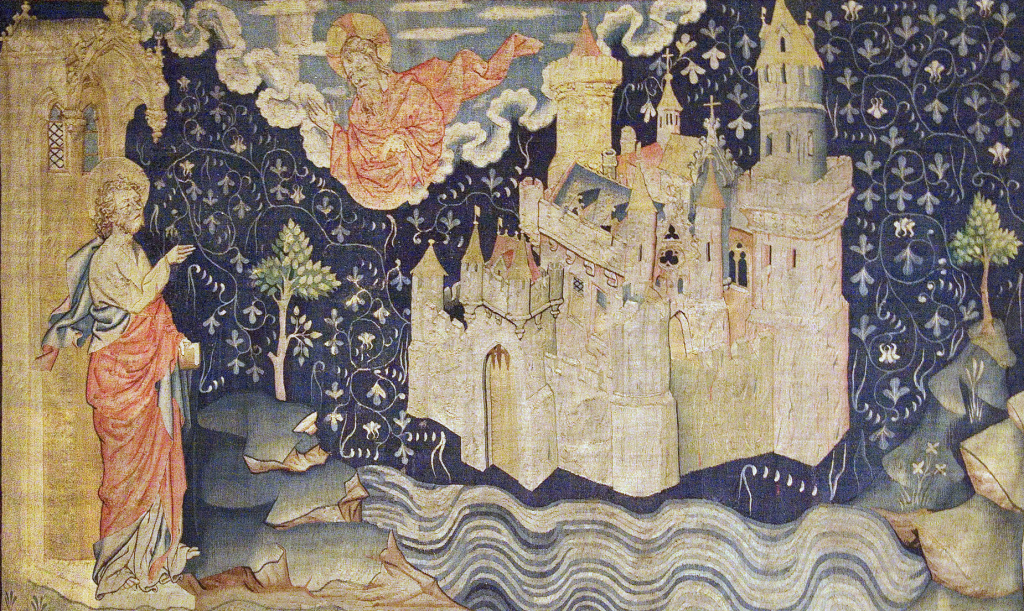
A 14th century tapestry of the Apostle John’s vision of the New Jerusalem

The word of the Lord Almighty came to me.

This is what the Lord Almighty says: “I am very jealous for Zion; I am burning with jealousy for her.”

This is what the Lord says: “I will return to Zion and dwell in Jerusalem. Then Jerusalem will be called the Faithful City, and the mountain of the Lord Almighty will be called the Holy Mountain.”

This is what the Lord Almighty says: “Once again men and women of ripe old age will sit in the streets of Jerusalem, each of them with cane in hand because of their age. The city streets will be filled with boys and girls playing there.”

This is what the Lord Almighty says: “It may seem marvelous to the remnant of this people at that time, but will it seem marvelous to me?” declares the Lord Almighty.

This is what the Lord Almighty says: “I will save my people from the countries of the east and the west. I will bring them back to live in Jerusalem; they will be my people, and I will be faithful and righteous to them as their God.”

This is what the Lord Almighty says: “Now hear these words, ‘Let your hands be strong so that the temple may be built.’ This is also what the prophets said who were present when the foundation was laid for the house of the Lord Almighty. Before that time there were no wages for people or hire for animals. No one could go about their business safely because of their enemies since I had turned everyone against their neighbor. But now I will not deal with the remnant of this people as I did in the past,” declares the Lord Almighty.

“The seed will grow well, the vine will yield its fruit, the ground will produce its crops, and the heavens will drop their dew. I will give all these things as an inheritance to the remnant of this people. Just as you, Judah and Israel, have been a curse among the nations, so I will save you, and you will be a blessing. Do not be afraid, but let your hands be strong.”

This is what the Lord Almighty says: “Just as I had determined to bring disaster on you and showed no pity when your ancestors angered me,” says the Lord Almighty, “so now I have determined to do good again to Jerusalem and Judah. Do not be afraid. These are the things you are to do: Speak the truth to each other and render true and sound judgment in your courts; do not plot evil against each other, and do not love to swear falsely. I hate all this,” declares the Lord. (New International Version)

The name “Zechariah” means “Yahweh remembers.” The Lord indeed remembers the divine covenant which was established. And God will fulfill all promises made.

The Lord is determined to do good – not really because people so much deserve it but because it is God’s character to be good, and thus, do good, even when there is little goodness on the earth to be found.

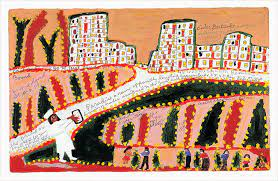
New Jerusalem by Sister Gertrude Morgan (1900-1980)

God’s judgment is but for a moment; but the Lord’s promise, salvation, and peace shall endure forever. God’s wrath is quite real and certain, yet it is a brief extension of the Lord’s steadfast love. Rebellion and judgment are never the last words; forgiveness and grace are:

Many times he [Yahweh] delivered them [the Israelites],
    but they were rebellious in their purposes
    and were brought low through their iniquity.
Nevertheless, he regarded their distress
    when he heard their cry.
For their sake he remembered his covenant
    and showed compassion according to the abundance of his steadfast love.
He caused them to be pitied
    by all who held them captive. (Psalm 106:43-46, NRSV)

All of the Old Testament prophets end their message of impending judgment with the final note of hope. That is, it won’t always be this way. There are better days ahead. The Lord’s coming is not all wrath; it’s mercy and hope. Notice the five brief messages of hope which Zechariah gives the people:

1. Yahweh burns with jealousy for Zion

Throughout the Bible, God likens the relationship to the Israelites much like a lover – as if the Lord were married to them. God’s covenant relationship with people is at the heart of understanding the whole of Scripture. Whenever they stray from divine promises, Yahweh is offended and hurt. 

God is an emotional Being, which is why we have emotions as people created in his image. Early humanity strayed so far from God that it hurt:

The Lord saw that humanity had become thoroughly evil on the earth and that every idea their minds thought up was always completely evil. The Lord regretted making human beings on the earth, and he was heartbroken. (Genesis 6:5-6, CEB)

Yet, God was gracious, sparing Noah and his family. The Lord took a group of Noah’s descendants, Abraham’s family, and set godly covenant affection on them. Through the Israelites, God hoped to lead the entire world to right relations. Yet, they, too, came to fail the gracious covenant made and set their affections on others.

Like a jilted lover, God longed for Israel to remain faithful, and, at the same time, was hurt and angry. Just as the prophet Hosea did not give up on his wife, even though she was brazenly unfaithful, so God looked at Israel as a spouse and could not bear to give her up.

2. Yahweh returns to Zion  

Jerusalem will be known as a faithful city and a holy mountain. The presence of God is what makes that happen. Because even though people can be fickle, inconsistent, complacent, and unfaithful, Yahweh remains true to the divine character of steadfast and immovable love for people.

You will never again be called ‘The People God Left.’
    Your land will never again be called ‘The Land God Destroyed.’
You will be called ‘The People God Loves.’
    Your land will be called ‘God’s Bride,’
because the Lord loves you,
    and your land will be his. (Isaiah 62:4, ERV)

3. The streets of Jerusalem will be full of children playing

The elderly will be sitting there watching the kids play, full of delight at the scene. Much too often we Westerners measure both the significance and success of our cities by its industry, businesses, buildings, wealth, and culture.

Methinks we may be misguided with such measurements. Instead, I suggest, along with the prophet, that we gage our cities by their effect on both the old and the young – because long life and children are signs of blessing from God.

4. Nothing is impossible with Yahweh

Is anything too hard for God? That, my friends, is a rhetorical question. If the Lord can cause old women to bear children (Genesis 18:10-14) and large armies to evaporate (Judges 7:1-25) then there is nothing more preposterous than to always view everything from our puny human perspective. Mary gained such a vantage and believed. We, too, have such an Advent hope within us.

“You will conceive and give birth to a son, and you are to call him Jesus. He will be great and will be called the Son of the Most High. The Lord God will give him the throne of his father David, and he will reign over Jacob’s descendants forever; his kingdom will never end.”

“How will this be,” Mary asked the angel, “since I am a virgin?”

The angel answered, “The Holy Spirit will come on you, and the power of the Most High will overshadow you. So the holy one to be born will be called the Son of God. Even Elizabeth your relative is going to have a child in her old age, and she who was said to be unable to conceive is in her sixth month. For no word from God will ever fail.”

“I am the Lord’s servant,” Mary answered. “May your word to me be fulfilled.” (Luke 1:31-38, NIV)

5. Yahweh renews and restores

Separation, diaspora, and disconnection will become a thing of the past. The Lord sets all things right again, brings people together, and heals, so that everything exists as it is meant to exist.

Deliverance from sin, death, and hell is the means of bringing renewal to the earth and its people. Salvation belongs to God. Righteousness and justice will characterize the future.

For the word of the Lord is upright,
    and all his work is done in faithfulness.
He loves righteousness and justice;
    the earth is full of the steadfast love of the Lord. (Psalm 33:4-5, NRSV)

Hope is fully realized when people put their trust in God and do their part by having strong hands and faithful hearts. We must be truthful and gracious whenever we speak. The Lord expects us to do the right thing by one another, both personally and publicly. We are to never cook up plans to take unfair advantage of others. Instead, we need to keep our lives simple and honest.

The promise of blessing is assured by God. However, the timing of that blessing is conditioned by our response. And there is no better time than the Christian season of Advent to recall what the Lord will do, as well as what God wants us to do.

May we be people of hope and let hope live in our hearts now and always, to the glory of God. Amen.