Messages of Hope (Zechariah 8:1-17)

A 14th century tapestry of the Apostle John’s vision of the New Jerusalem

The word of the Lord Almighty came to me.

This is what the Lord Almighty says: “I am very jealous for Zion; I am burning with jealousy for her.”

This is what the Lord says: “I will return to Zion and dwell in Jerusalem. Then Jerusalem will be called the Faithful City, and the mountain of the Lord Almighty will be called the Holy Mountain.”

This is what the Lord Almighty says: “Once again men and women of ripe old age will sit in the streets of Jerusalem, each of them with cane in hand because of their age. The city streets will be filled with boys and girls playing there.”

This is what the Lord Almighty says: “It may seem marvelous to the remnant of this people at that time, but will it seem marvelous to me?” declares the Lord Almighty.

This is what the Lord Almighty says: “I will save my people from the countries of the east and the west. I will bring them back to live in Jerusalem; they will be my people, and I will be faithful and righteous to them as their God.”

This is what the Lord Almighty says: “Now hear these words, ‘Let your hands be strong so that the temple may be built.’ This is also what the prophets said who were present when the foundation was laid for the house of the Lord Almighty. Before that time there were no wages for people or hire for animals. No one could go about their business safely because of their enemies since I had turned everyone against their neighbor. But now I will not deal with the remnant of this people as I did in the past,” declares the Lord Almighty.

“The seed will grow well, the vine will yield its fruit, the ground will produce its crops, and the heavens will drop their dew. I will give all these things as an inheritance to the remnant of this people. Just as you, Judah and Israel, have been a curse among the nations, so I will save you, and you will be a blessing. Do not be afraid, but let your hands be strong.”

This is what the Lord Almighty says: “Just as I had determined to bring disaster on you and showed no pity when your ancestors angered me,” says the Lord Almighty, “so now I have determined to do good again to Jerusalem and Judah. Do not be afraid. These are the things you are to do: Speak the truth to each other and render true and sound judgment in your courts; do not plot evil against each other, and do not love to swear falsely. I hate all this,” declares the Lord. (New International Version)

The name “Zechariah” means “Yahweh remembers.” The Lord indeed remembers the divine covenant which was established. And God will fulfill all promises made.

The Lord is determined to do good – not really because people so much deserve it but because it is God’s character to be good, and thus, do good, even when there is little goodness on the earth to be found.

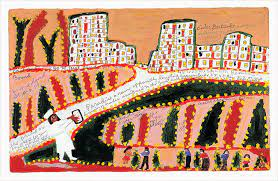
New Jerusalem by Sister Gertrude Morgan (1900-1980)

God’s judgment is but for a moment; but the Lord’s promise, salvation, and peace shall endure forever. God’s wrath is quite real and certain, yet it is a brief extension of the Lord’s steadfast love. Rebellion and judgment are never the last words; forgiveness and grace are:

Many times he [Yahweh] delivered them [the Israelites],
    but they were rebellious in their purposes
    and were brought low through their iniquity.
Nevertheless, he regarded their distress
    when he heard their cry.
For their sake he remembered his covenant
    and showed compassion according to the abundance of his steadfast love.
He caused them to be pitied
    by all who held them captive. (Psalm 106:43-46, NRSV)

All of the Old Testament prophets end their message of impending judgment with the final note of hope. That is, it won’t always be this way. There are better days ahead. The Lord’s coming is not all wrath; it’s mercy and hope. Notice the five brief messages of hope which Zechariah gives the people:

1. Yahweh burns with jealousy for Zion

Throughout the Bible, God likens the relationship to the Israelites much like a lover – as if the Lord were married to them. God’s covenant relationship with people is at the heart of understanding the whole of Scripture. Whenever they stray from divine promises, Yahweh is offended and hurt. 

God is an emotional Being, which is why we have emotions as people created in his image. Early humanity strayed so far from God that it hurt:

The Lord saw that humanity had become thoroughly evil on the earth and that every idea their minds thought up was always completely evil. The Lord regretted making human beings on the earth, and he was heartbroken. (Genesis 6:5-6, CEB)

Yet, God was gracious, sparing Noah and his family. The Lord took a group of Noah’s descendants, Abraham’s family, and set godly covenant affection on them. Through the Israelites, God hoped to lead the entire world to right relations. Yet, they, too, came to fail the gracious covenant made and set their affections on others.

Like a jilted lover, God longed for Israel to remain faithful, and, at the same time, was hurt and angry. Just as the prophet Hosea did not give up on his wife, even though she was brazenly unfaithful, so God looked at Israel as a spouse and could not bear to give her up.

2. Yahweh returns to Zion  

Jerusalem will be known as a faithful city and a holy mountain. The presence of God is what makes that happen. Because even though people can be fickle, inconsistent, complacent, and unfaithful, Yahweh remains true to the divine character of steadfast and immovable love for people.

You will never again be called ‘The People God Left.’
    Your land will never again be called ‘The Land God Destroyed.’
You will be called ‘The People God Loves.’
    Your land will be called ‘God’s Bride,’
because the Lord loves you,
    and your land will be his. (Isaiah 62:4, ERV)

3. The streets of Jerusalem will be full of children playing

The elderly will be sitting there watching the kids play, full of delight at the scene. Much too often we Westerners measure both the significance and success of our cities by its industry, businesses, buildings, wealth, and culture.

Methinks we may be misguided with such measurements. Instead, I suggest, along with the prophet, that we gage our cities by their effect on both the old and the young – because long life and children are signs of blessing from God.

4. Nothing is impossible with Yahweh

Is anything too hard for God? That, my friends, is a rhetorical question. If the Lord can cause old women to bear children (Genesis 18:10-14) and large armies to evaporate (Judges 7:1-25) then there is nothing more preposterous than to always view everything from our puny human perspective. Mary gained such a vantage and believed. We, too, have such an Advent hope within us.

“You will conceive and give birth to a son, and you are to call him Jesus. He will be great and will be called the Son of the Most High. The Lord God will give him the throne of his father David, and he will reign over Jacob’s descendants forever; his kingdom will never end.”

“How will this be,” Mary asked the angel, “since I am a virgin?”

The angel answered, “The Holy Spirit will come on you, and the power of the Most High will overshadow you. So the holy one to be born will be called the Son of God. Even Elizabeth your relative is going to have a child in her old age, and she who was said to be unable to conceive is in her sixth month. For no word from God will ever fail.”

“I am the Lord’s servant,” Mary answered. “May your word to me be fulfilled.” (Luke 1:31-38, NIV)

5. Yahweh renews and restores

Separation, diaspora, and disconnection will become a thing of the past. The Lord sets all things right again, brings people together, and heals, so that everything exists as it is meant to exist.

Deliverance from sin, death, and hell is the means of bringing renewal to the earth and its people. Salvation belongs to God. Righteousness and justice will characterize the future.

For the word of the Lord is upright,
    and all his work is done in faithfulness.
He loves righteousness and justice;
    the earth is full of the steadfast love of the Lord. (Psalm 33:4-5, NRSV)

Hope is fully realized when people put their trust in God and do their part by having strong hands and faithful hearts. We must be truthful and gracious whenever we speak. The Lord expects us to do the right thing by one another, both personally and publicly. We are to never cook up plans to take unfair advantage of others. Instead, we need to keep our lives simple and honest.

The promise of blessing is assured by God. However, the timing of that blessing is conditioned by our response. And there is no better time than the Christian season of Advent to recall what the Lord will do, as well as what God wants us to do.

May we be people of hope and let hope live in our hearts now and always, to the glory of God. Amen.

Future Hope (Isaiah 29:17-24)

Soon the forest of Lebanon
will become a field with crops,
    thick as a forest.
The deaf will be able to hear
    whatever is read to them;
the blind will be freed
    from a life of darkness.
The poor and the needy
    will celebrate and shout
because of the Lord,
    the holy God of Israel.

All who are cruel and arrogant
    will be gone forever.
Those who live by crime
    will disappear,
together with everyone
    who tells lies in court
and keeps innocent people
    from getting a fair trial.

The Lord who rescued Abraham
has this to say
    about Jacob’s descendants:
“They will no longer
    be ashamed and disgraced.
When they see how great
    I have made their nation,
they will praise and honor me,
    the holy God of Israel.
Everyone who is confused
    will understand,
and all who have complained
    will obey my teaching.” (Contemporary English Version)

We, who have the first fruits of the Spirit, groan inwardly as we wait eagerly for our adoption to sonship, the redemption of our bodies. For in this hope we were saved. But hope that is seen is no hope at all. Who hopes for what they already have? But if we hope for what we do not yet have, we wait for it patiently.

Romans 8:23-25, NIV

There are better days ahead. And it is this hope which is to help sustain us in present – because the current reality for many people is hard and unforgiving. Malevolent and heartless people exist, and they wreak physical, mental, emotional, and even spiritual havoc on those around them.

When in the throes of difficulty, it is good to be reminded that basic human kindness will once again be exalted and valued. Yet, meanwhile, we must endure the evil of dehumanizing behavior. Until then, we must do our best to connect heaven and earth by rehumanizing every space and place within our sphere on influence. We are to be agents of hope for ourselves and for others.

Every person (and I do mean every person) on planet earth is created in the image and likeness of God. Each individual human being is worthy of basic human kindness and deserving of respect. 

Unfortunately, people do and say terrible things every day. Yet this never means that God’s image has left or has taken a vacation, or that someone deserves a pejorative label which stigmatizes and ostracizes them from the human family. 

For the Christian, the supreme ethic of life is love. We hold to the Great Commandment: Love God and neighbor; all other commands of Holy Scripture hang on these two bedrock commands, upheld by Jesus himself.

Therefore we must all ask ourselves if we are living our lives and loving others in this world as intended by our Creator and Redeemer. Hate speech, unsafe working conditions, political gerrymandering, apathy toward another’s injustice, a lack of empathy, and vilifying particular people groups are just a few examples of dehumanizing behavior.

If ever we move down the path of claiming to know whom God judges or ought to judge, then we have gone the way of extreme hubris and are germinating the seeds of a future holocaust of killing, not a future hope of peace and goodness. 

There is no biblical precedent or place to dehumanize another person or group of people, period. Instead, we must actively build relationships with a broad spectrum of groups and individuals – especially with the ones we least know and understand.

The injustice of dehumanization will not always be with us. Confusion and complaints will give way to clarity, understanding, humility, and obedience. Darkness and deafness, poverty and petulance shall melt away. In its place, love and grace will forever be ensconced upon a new earth, free from crime and shame. Hope will be realized.

Our future hope is a living hope.

We typically use the term “hope” in the wishful thinking sort of way. That’s because we aren’t quite sure if things will shake-out like we want. Biblical hope is not wishful thinking but a confident expectation that knows what is coming. 

Hope is like anticipating the seasons. In the dead of winter when it’s bitter cold with little sunshine, we hopefor Spring. It’s not wishful thinking. We know it’s coming. It might come in early March, maybe in late April. But it’s coming, and you can bet the farm on it. The trees will bud, the grass will turn green, and the temps will warm.

Hope in the Bible is a sure thing. Because of the person and work of Jesus Christ, there is hope, the confident expectation that deliverance from sin, death, and hell will be fully realized.

Hope, inheritance, and salvation are all words that describe nearly the same thing. They all point to Jesus. We are saved from the slavery of sin through the cross and resurrection of Christ. We are delivered into an inheritance which can never perish, spoil, or fade. But an inheritance isn’t activated until death. Someday, when this present life of earthly brokenness is over, we have the hope, the confident expectation, of a permanent inheritance with Jesus forever. (1 Peter 1:3-9)

Outwardly, we suffer in all kinds of earthly grief from others who don’t understand us. Inwardly, we have the silent pain and terrible wrestling of wanting to forgive but desiring revenge; of seeking to be gracious but seething with anger; of looking to express kind words but having hate speech blurt out instead.

But it won’t always be this way. We have a future living hope. In this season of Advent, we are reminded that God shall break into this fallen world with all of its dehumanizing behaviors and hate speech. The hopes and fears of all the years are met in a humble feeding trough, in a little baby.

Hope is as real as anything you’ll ever know this side of heaven. You might not always find what you’re looking for in this life; but in the next life, you can find the life that is truly life. For Jesus Christ is our hope.

God of hope, we seek you. During this holy season of Advent, help us to see you in all whom we encounter. We seek you in the crude manger, a child born to save the world. May your hope be a comfort to all who long for justice; and may that hope overflow in our hearts and grace our lips so that we might reflect your hope for all the world. Amen.

Spiritual Renewal (Isaiah 30:19-26)

People of Zion, who live in Jerusalem, you will weep no more. How gracious he will be when you cry for help! As soon as he hears, he will answer you. Although the Lord gives you the bread of adversity and the water of affliction, your teachers will be hidden no more; with your own eyes you will see them. Whether you turn to the right or to the left, your ears will hear a voice behind you, saying, “This is the way; walk in it.” Then you will desecrate your idols overlaid with silver and your images covered with gold; you will throw them away like a menstrual cloth and say to them, “Away with you!”

He will also send you rain for the seed you sow in the ground, and the food that comes from the land will be rich and plentiful. In that day your cattle will graze in broad meadows. The oxen and donkeys that work the soil will eat fodder and mash, spread out with fork and shovel. In the day of great slaughter, when the towers fall, streams of water will flow on every high mountain and every lofty hill. The moon will shine like the sun, and the sunlight will be seven times brighter, like the light of seven full days, when the Lord binds up the bruises of his people and heals the wounds he inflicted. (New International Version)

Better days are ahead.

In this time of year, there are many people who simply don’t have to think twice about purchasing and giving gifts for Christmas. They have blessings, both material and spiritual. And they can always identify other persons who are in much more need than them. Some of them may even believe that those in need are in that position because of unwise individual choices. 

But we must maintain a focus on our own lives. We need to recognize the maladies of our hearts. The state of our lives is as important, and is just as real and needy, as someone else’s life who is in more humble circumstances. 

There are specific conditions in our lives that leave us in bondage and in need of restoration, renewal, and revitalization, just like all kinds of other people. 

Being a vital part of a local church does not automatically immune one from having serious needs. And having a good steady income doesn’t inoculate one from need or privation.

We must not suppress those realities and needs, but instead, name the conditions which are packed away in a closet of our heart deep inside us – such things as the love of possessions and money; broken relationships; old grudges; hidden addictions; domestic violence; denial of depression; secret affairs; cutting; fear; anger; greed; hatred; and much more. 

Outward smiles and small talk conversations may hide the truth from others, but they do nothing to hide from a God for whom everything is laid bare.

The good news is not just something for someone else who has “obvious” needs; the gospel must touch our lives and bring us freedom.

Only then can we pass on the good news to the legion of social ills that make our world sick. There are people all around us who need spiritual, emotional, and material help. Yet, we will not have eyes to see them, or have hearts to help, if we are stuffing our own burdens so deep within that we are blind to others.

Far too many Christians, especially the church-going kind, have become expert emotional stuffers and deniers of need. 

We may believe “those other people” need ministries of justice and help. But the truth is: Many of us are one paycheck, one prodigal kid, one mental health diagnosis, one serious illness, one drink, one affair, or one bad decision away from being one of “those people” – the people we typically identify as in need – the ones that bad things happen to – the ones we do not want next door to us.

We may not yet be vulnerable enough to admit our situation; and so, we keep practicing the denial of our spiritual poverty. 

What to do? Turn from the things that have caused us to be in poverty and be prisoners (not just secretly!) and hope in the Lord’s restorative grace. God takes all sorts of seemingly impossible situations of destruction and death, creating fresh new growth in the form of a little green sprout. 

God will rebuild our ruined souls; restore the places of our lives that have been devastated; and renew the places that have not seen renewal for generations. 

It begins with you and me allowing the justice of God to work within us, not just others. 

If we want comfort, we need to mourn. If we desire joy, then there needs to be some lamenting of a dire situation. If we hope for an oak of righteousness, there must be a confession of despair. For there to be a resurrection, there has to be a death.

What is your real situation and the true realities of your life that need to be named? 

Where will you go to address those needs and truths? 

Will you keep stuffing them, or will you become able to voice your inner personal needs? 

How might you be vulnerable enough to allow others to minister grace to your needy soul?

Let us have a vision of Jesus coming into our lives and replacing a tattered hat of grief with a crown of beauty. 

Let us picture the Lord placing on us a garment of praise to replace our stinky clothes of grumbling. 

Let us allow our lives to display the grace of God in Christ because we have been profoundly touched by the justice of God. 

Let us herald the coming of the Christ child as the hope of us all.

Soli Deo Gloria

The Tension of Advent (Hebrews 11:32-40)

What else can I say? There isn’t enough time to tell about Gideon, Barak, Samson, Jephthah, David, Samuel, and the prophets. Their faith helped them conquer kingdoms, and because they did right, God made promises to them. They closed the jaws of lions and put out raging fires and escaped from the swords of their enemies. Although they were weak, they were given the strength and power to chase foreign armies away.

Some women received their loved ones back from death. Many of these people were tortured, but they refused to be released. They were sure they would get a better reward when the dead are raised to life. Others were made fun of and beaten with whips, and some were chained in jail. Still others were stoned to death or sawed in two or killed with swords. Some had nothing but sheep skins or goat skins to wear. They were poor, mistreated, and tortured. The world did not deserve these good people, who had to wander in deserts and on mountains and had to live in caves and holes in the ground.

All of them pleased God because of their faith! But still they died without being given what had been promised. This was because God had something better in store for us. And he did not want them to reach the goal of their faith without us. (Contemporary English Version)

God has entered history through the incarnation of Jesus Christ. In this season of Advent, Christians everywhere enter a time of anticipation, waiting, and hoping. Advent is meant to stir our awareness of God’s actions – past, present, and future.

During this time of year, we need to feel the tension between what is and what is yet to come. Christ has come, in his first advent, to seek and save the lost. And yet, not all things have reached completion. Our deliverance from sin, death, and hell has been accomplished through the cross of Christ; yet this salvation isn’t here in it’s fullness. That will come when Jesus returns in his second advent to judge the living and the dead.

Which is why today’s New Testament lesson is perfect for the Advent season. It captures this awkward tension between already having something but not yet possessing it. It’s the tension of the Christian life. Celebration and hope are practiced together because we rejoice in what is, while confidently expecting what is not yet.

Throughout every era, people of faith have lived with the rubber band existence of feeling the extreme stretch without being broken by the pressure. Our spiritual ancestors didn’t break because of their hope. And the persons mentioned by the author of Hebrews inspire us to join them on this journey of perseverance until the promises of God are fully realized.

Gideon, Barak, Samson, and Jephthah all defeated large armies with just a few people because their robust faith melted circumstantial fear.

David, Samuel, and the prophets proclaimed truth, justice, and righteousness, knowing there would be adverse circumstances to speaking up and out.

People overcome dark times, establish what is just and right, gain what is promised, and do incredible things because they are looking beyond the present here-and-now of their difficulty to see something better. They know that their actions now will connect to better times ahead.

That’s what Shadrach, Meshach, and Abednego did in the face of overwhelming heat in a fiery furnace. It’s what Moses, Elijah, and David did by escaping the edge of the sword. They all refused to be thwarted in their mission and purpose for the world.

There were those who willingly endured torture and death rather than get sidetracked from their purpose. They were able to do it because they truly believed that their suffering and death was not the end of it. Better days were ahead and not even death could stop it.

This tends to make our own proclivities toward giving up when things are hard look really wimpy. Far too many folks have their focus in the wrong place – trying to change circumstances and other people – instead of focusing on simply being faithful to what God calls us to do.

We likely won’t have to undergo joint dislocations, torture racks, crushed bones, catapults, thumbscrews, branding irons, and a hundred other devious devices for trying to make a human’s spirit break.

Yet, we are presently enduring the subtly evil machinations of gaslighting, emotional manipulation, mental torture, spiritual abuse, and a hundred other sinister ways of attempting to break our will and commitment to what is right, just, and true.

The present awful consequences mean little whenever we’re able to connect what we’re doing to our coming heavenly reward. If the faithful people of the past could live and die in faith, no matter the circumstances, so can we.

Someday, everything will be made right by God. And when that day happens, we will experience it together as one people of God – all the believers of the past and us together. Right now, this present moment, the saints who have gone before us are patiently waiting for us….

Almighty God, give us grace to cast away the works of darkness, and put on the armor of light, now in the time of this mortal life in which your Son Jesus Christ came to visit us in great humility; that in the last day, when he shall come again in his glorious majesty to judge both the living and the dead, we may all rise together to eternal life, through him who lives and reigns with you and the Holy Spirit, one God, now and forever. Amen.