Keep the Main Thing the Main Thing (Galatians 2:1-10)

Fourteen years after that first visit, Barnabas and I went up to Jerusalem and took Titus with us. I went to clarify with them what had been revealed to me. At that time I placed before them exactly what I was preaching to the non-Jews. I did this in private with the leaders, those held in esteem by the church, so that our concern would not become a controversial public issue, marred by ethnic tensions, exposing my years of work to denigration and endangering my present ministry.

Significantly, Titus, non-Jewish though he was, was not required to be circumcised. While we were in conference we were infiltrated by spies pretending to be Christians, who slipped in to find out just how free true Christians are. Their ulterior motive was to reduce us to their brand of servitude. We didn’t give them the time of day. We were determined to preserve the truth of the Message for you.

As for those who were considered important in the church, their reputation doesn’t concern me. God isn’t impressed with mere appearances, and neither am I. And of course these leaders were able to add nothing to the message I had been preaching. It was soon evident that God had entrusted me with the same message to the non-Jews as Peter had been preaching to the Jews.

Recognizing that my calling had been given by God, James, Peter, and John—the pillars of the church—shook hands with me and Barnabas, assigning us to a ministry to the non-Jews, while they continued to be responsible for reaching out to the Jews. The only additional thing they asked was that we remember the poor, and I was already eager to do that. (The Message)

The former devout Jew, Saul, had become the Christian apostle and missionary, Paul. His ministry was as radical and dramatic as his conversion to Christianity was.

The Struggle

Keep in mind that the earliest church was predominantly made up of Jewish Christians. They had to struggle with the relationship between their historic Judaism and their newfound Christianity. For many of them, Paul was doing the unthinkable; he not only purposely sought to reach Gentiles (non-Jewish people) with the message of Jesus Christ, but he also did not require them to be circumcised. For Paul, one did not have to first become Jewish before becoming Christian.

Paul doggedly sought to preserve the core essence and spirit of Christ’s message, that is, to proclaim the good news of forgiveness and new life through the person and work of Jesus – and not by means of retaining Jewish customs or laws, including circumcision.

The Main Thing

Christianity is more than set of beliefs and practices; it’s a way of life which can be summed up in three important words: faith, hope, and love. 

Both new believers in Jesus and veterans in the faith know from experience how difficult it can be to live the Christian life. One reason for this difficulty, even when we want to please the Lord, is due to the confusion that occurs between our inner feelings and our outer actions.

The Confusion

The confusion starts with the creation and fall of humanity. In the beginning, God created humans as persons with a divine/human relationship as central to daily life. (Genesis 1:26; 2:16-25) 

What’s more, God created people with the capacity to receive divine revelation through our ability to think and reason. (Ephesians 4:24; Colossians 3:10) 

Before disobedience entered the world, in the original state before humanity’s fall, all human functions were under complete control with an inner experience of unity and harmony with one another and God. (Genesis 1:31; 2:7, 16-25) 

It is imperative for us to recognize the distinction between our personal being and our personal functions. (Romans 1:21-32; 6:16-22; 1 Corinthians 9:27; Ephesians 4:21-32)

If we don’t grasp how cataclysmic the fall of humanity was, we are going to have big struggles with living the Christian life – illustrated in the way that Paul needed to fend off a bunch of professing Christians who still seemed spiritually stuck. 

The Disobedience

In Adam and Eve’s original disobedience to God, the authority for life was transferred from God to us so that our sinful bent is to call our own shots without God. The source of authority also got whacky, transferred from a holistic and synergistic approach of body, mind, emotions, and spirit to a one-dimensional approach of simply how we feel at any given moment.

If we fail to understand this dynamic, we will be continually frustrated with people because they do irrational things. For example, many church pastors are flabbergasted that parishioners do not simply take what they teach them and go and do it. Yet, if it were that simple, there would be no place for the Holy Spirit!

Unfortunately, there’s more. In humanity’s fall, we lost control of our capacity to function well. We are all now vulnerable to manipulation, too easily swayed by the surrounding culture, and, of course, Satan. (Ephesians 2:2-3; Galatians 5:16-21) 

As a result, our inner conscience has become confused. We are not always certain of right and wrong. We misunderstand what life is really supposed to be all about. 

We lose sight of the main thing. And, in that state, there’s no way we can keep the main thing the main thing.

Instead, we become obsessed with feeling comfortable and secure; so, we pursue false gods – leaving usdisappointed and with a lack of fulfillment in life.

The Good News

However, the good news is that through the redeeming work of Jesus Christ, new life emerges; the bondage of sin is broken in our lives, and we are legally reinstated in a relationship with God in which the Lord is central in our daily life and the final authority. 

In this new relationship we can again receive truth through the Holy Spirit and the Holy Scriptures. We regain control of our functions. 

Yet, unless we learn the Scriptures and growin a daily walk with Jesus, the practical experience of this relationship with all its freedom, joy, assurance,  power, and fruitfulness may be greatly limited. (Romans 7:14-25; 1 Corinthians 3:1-4)

Even though we have redemption and faith, it is still possible to regress and give in to our old ways of functioning. This is a big reason why Christians can experience conflict, doubt, fear, anxiety, frustration, disappointment, and confusion.

To live keeping the main thing the main thing means to grow in the experience and application Christ’s centrality and authority in our lives. 

The Awareness

We must, therefore, make daily decisions of faith, hope, and love based in who we are in Christ and recognize his authority in our lives. The following seven recognitions and awareness may be helpful for you in experiencing Christian freedom and unity:

  1. You are a person with the ability to function in faith, hope, and love as God’s beloved child in Christ (2 Corinthians 7:1; Romans 8:14-17)
  2. There is a difference between who you are and what you do (or don’t do).  Evil thoughts and emotions do not make you evil, anymore than fantasizing about being a unicorn makes you a unicorn.
  3. You can take charge of your actions and your life (Galatians 5:22-23)
  4. The key is the use of your will through living in harmony with revealed biblical truth. In other words, you really can make choices of faith, hope, and love, no matter the situation. (Romans 4:17-21; Psalm 56:3; Psalm 43:5-11)  
  5. Reject whatever is contrary to Scripture, reason, and conscience. Listen to your whole self. Unhealthy patterns of acting and speaking must be broken in Jesus’ name. (Ephesians 4:22; Colossians 3:5-9; Titus 2:11-12)
  6. Choose to obey the Holy Spirit and the Holy Scriptures. Learn to think and act on the basis of truth. (Acts 27:25)
  7. Practicing the truth results in freedom, a re-patterning of thinking and functions, as well as the fruit of the Spirit. (John 8:32; Titus 2:11-14; Philippians 2:12-16)

The church is intended to be a supportive community of fellow redeemed people who worship and love Jesus together. 

Without sharing our collective learning of the Scriptures and daily struggles of faith, hope, and love, believers will inevitably be spiritually immature over the long haul. Instead, talk about your shared experiences of worship, Scripture reading, and Christian living. 

In doing so, God is glorified, the church is strengthened, and the cranky circumcisers are seen as the legalistic lunkheads they really are.

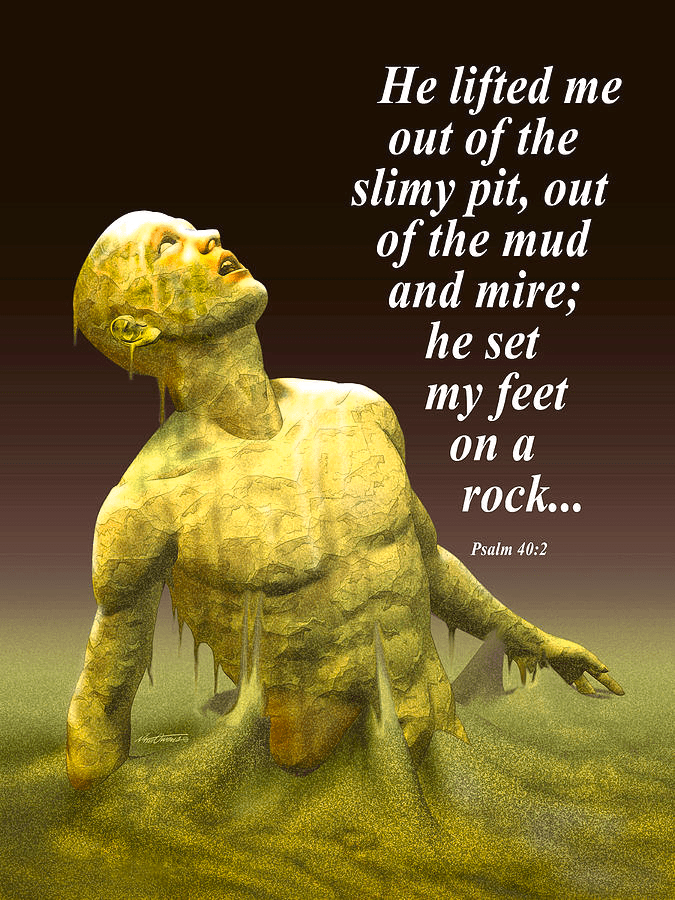
Out of the Slimy Pit (Psalm 40:1-11)

He Lifted Me by Nate Owens

I put all my hope in the Lord.
    He leaned down to me;
    he listened to my cry for help.
He lifted me out of the pit of death,
    out of the mud and filth,
    and set my feet on solid rock.
        He steadied my legs.
He put a new song in my mouth,
    a song of praise for our God.
Many people will learn of this and be amazed;
    they will trust the Lord.
Those who put their trust in the Lord,
    who pay no attention to the proud
    or to those who follow lies,
    are truly happy!

You, Lord my God!
    You’ve done so many things—
    your wonderful deeds and your plans for us—
        no one can compare with you!
    If I were to proclaim and talk about all of them,
        they would be too numerous to count!
You don’t relish sacrifices or offerings;
    you don’t require entirely burned offerings or compensation offerings—
    but you have given me ears!
So I said, “Here I come!
    I’m inscribed in the written scroll.
    I want to do your will, my God.
    Your Instruction is deep within me.”
I’ve told the good news of your righteousness
    in the great assembly.
    I didn’t hold anything back—
        as you well know, Lord!
I didn’t keep your righteousness only to myself.
    I declared your faithfulness and your salvation.
I didn’t hide your loyal love and trustworthiness
    from the great assembly.

So now you, Lord—
    don’t hold back any of your compassion from me.
Let your loyal love and faithfulness always protect me. (Common English Bible)

Every follower of the Lord has a powerful story of God’s grace in lifting them out of a slimy pit experience. 

We live in a profoundly broken world; and no one is exempt from its effects upon us. Whether physical problems, emotional trials, or relational hardships, there is always something going on in our lives – with the added pull toward trusting in things other than God. 

The temptation to say unjust words and do unjust actions is always over-promised and under-delivered. 

It’s easy to get sucked-in to poor decisions and be stuck in an empty hole with seemingly no way out. We often find ourselves slipping into a slimy pit because of our own bad decisions, as well as by no fault of our own. 

Living in a fallen world means that we inevitably experience troubles and hardships.

So, what do we do if we find ourselves in a slimy pit?

Look for Hope

David, the psalmist, waited patiently for the Lord. With great expectation, he fully anticipated God to act on his behalf. The sort of patience he practiced was an intense waiting – a waiting filled with longing and expectant hope, a patience that kept looking and praying and seeking.

The reason believers in Jesus keep hoping beyond hope is that we know that God is ultimately the One who delivers from the pit. 

But what if you have been looking for deliverance from the slimy pit experience and you have not seen it come to pass? 

Expectantly expect God to act. Wait patiently. Do not give up. Keep praying and watching. Like the father in the story of the prodigal son, keep looking out the window, waiting for the son to return, and picture the deliverance coming – because our waiting is not in vain.

flickr.com/photos/joshtinpowers

The psalmist, David, was eventually delivered. The Lord leaned down to him. God listened and lifted him. The Lord God set him on a firm place to stand and put a new song in his mouth. 

This was not only a personal matter for David; it was also an occasion that other people needed to know about.

Look for God

We all must finally come to the end of ourselves and look up. Whenever the deliverance doesn’t come quickly, we may look to other people or things to give us the freedom we long for. It’s easy to become impatient and begin searching for answers in everything else but God. 

Yet, if we will let patient hope have its way, we are blessed when we trust in the Lord.

In all my years of churchgoing as a kid, I had never read my Bible. But God was gracious to me. I remembered all those sermons I heard about Jesus. I gained a newfound sense of my own inner darkness, as well as the desire to read God’s Word. And God saved me. 

My circumstances did not change, but I did. My loneliness turned to joy; my aimlessness turned into purpose; and my selfishness became a deep concern for others. My heart had been black, and what God did to change it was nothing less than miraculous.

Look Within

The person who looks for hope and seeks God is also a person who looks into their own heart and there finds the attitude which God will bless. 

Blessing does not come from great sacrifice, but by syncing one’s heart with the heart of God. 

The Lord cares little about how much money or stuff you have, or how many sacrifices were made for God; that’s because God wants your heart, your mind, your will, and your emotions. In other words, God wants you! 

And God desires you because the Lord made you with a heart that beats for the same things God cares about: justice, mercy, and humility.

If you and I will but look within at the very spirit God has put within us, we shall find resources beyond what we can ask or think.

Look to Bless Others

We possess more than a personal faith which is to benefit ourselves; we also have an equal responsibility to bless the community with our experiences of what God has done in our lives. 

The telling of stories about what God has done for us is a necessary part of building up the church and helping others move forward in faith, hope, and love.

The psalmist proclaimed his testimony in the great assembly, that is, publicly. This isn’t about standing behind a microphone in front of lots of people; it’s about being so touched by God that we cannot keep our mouths shut about the Lord’s deliverance on our behalf.

So, let’s not shelve the idea of giving testimony to others as if it were only for pastors, missionaries, or other very religious people. 

When a person decides to play hockey in -20 degrees below zero weather, we might think that person is a little crazy;  but, hey, we reason, if they love hockey that much, more power to them. 

We must not think about Christianity in the same way, that if a person is passionate about Jesus and desires to tell others about what God has done for them, more power to them; just don’t expect me to go out in the cold and do that because it isn’t my thing. 

Christianity is a life, not a hobby; it’s about humble service, and not a means to look respectable; it cannot be reduced to a few practices, such as church attendance or putting money in an offering plate.

Christianity is a relationship with God through Jesus. Try looking at marriage as simply showing up for supper and paying the bills and see how far that gets you.

Look to Get Lost to Get Found

We may become obsessed with getting out of our slimy pit of illness, infirmity, pain, adversity, hardship, or discord. If that happens, we will likely lose our proper focus.

Instead, get lost in the wonder of God. The Lord does wondrous things when we are immersed in God’s wonders.

“Any of you who try to save the life you have will lose it. But you who give up your life for me will find true life.” Jesus (Matthew 16:25, ERV)

New life comes from a change of heart, not a change of circumstances. Wherever there is a firm reliance on God; a glad obedience to God; and a readiness to give testimony to God’s actions, then we are living into the spirit of today’s psalm.

Lamb of God, who takes away the sins of the world, have mercy on us.
Lamb of God, who takes away the sins of the world, grant us your peace. Amen.

Sensing the Divine (Exodus 3:1-5)

The Burning Bush by Yoram Raanan

Now Moses was tending the flock of Jethro his father-in-law, the priest of Midian, and he led the flock to the far side of the wilderness and came to Horeb, the mountain of God. There the angel of the Lord appeared to him in flames of fire from within a bush. Moses saw that though the bush was on fire it did not burn up. So Moses thought, “I will go over and see this strange sight—why the bush does not burn up.”

When the Lord saw that he had gone over to look, God called to him from within the bush, “Moses! Moses!”

And Moses said, “Here I am.”

“Do not come any closer,” God said. “Take off your sandals, for the place where you are standing is holy ground.” (New International Version)

The burning bush is one of those iconic objects and stories in Holy Scripture. Moses had an experience which changed his life, as well as the lives of all the Israelites then and now.

Having spent the first forty years of his life as a darling in the Egyptian court; and then the next forty years far from that life on the backside of the desert with a bunch of sheep; it’s an understatement to say that Moses did not expect or ever envision encountering God in a burning bush. The impossible has no possibility… Or does it?…

The experience of the burning bush fired the five senses of Moses:

  • See. There was the paradoxical sight of seeing fire in a bush that isn’t burning up.
  • Smell. All around there were the smells of sheep, the outdoors, and perhaps, even the lack of smelling burnt wood.
  • Hear. Listening to the voice and call of God from within the bush.
  • Taste. Spiritually and emotionally savoring God’s attentive justice toward the people.
  • Touch. Removing his sandals to feel the grounding of sacred space.

The story also comments on the senses of God, as well. Even though God is Spirit and is worshiped as such, God is alive with divine sensations:

  • See. Observing the approach of Moses, and the misery of the Israelites.
  • Smell. The stench of injustice wafting into God’s nostrils, bringing a strong divine reaction.
  • Hear. Listening to the cries of suffering and oppression amongst the people.
  • Taste. Anticipating the savor of showing mercy, justice, and righteousness.
  • Touch. A profound and holistic touching of Moses so that both he and the Israelites would never be the same again.

Through it all, the close identification between God and the people is expressed. The Lord feels the humiliation and pain of the Israelites – and vows to uproot them from the Egyptian factory farm of slavery and plant them firmly into rich Promised Land soil.

And what God promises to do, God has the authority and power to make good on.

Although experiencing all of this unbelievable sensory encounter, Moses knew it to be an impossible task in freeing so many Israelites from such a powerful Egyptian juggernaut.

After all, the people had their senses aflame, as well; and not in a good way:

  • See. The sight of family being worked to the bone; and cruelly treated.
  • Smell. The constant smell of bricks baking, mixed with the ever-present smell of death.
  • Hear. Listening day after day to the groans of people, just trying to survive under awful conditions.
  • Taste. Every day tasting the desert dust.
  • Touch. Overstimulated with handling tools to the point of hard callouses and dry, cracked, bloody hands.

Hundreds of years of backbreaking bondage to a national force so mighty that nothing can be done about it be broken…. Ah, but God specializes in systems of oppression and miserable people.

It is the Lord’s abilities which conquer the mightiest of foes and can extend mercy to the lowest and the least powerful. The entire Israelite situation was ripe for divine intervention and supernatural wonders to occur.

God will make a way where there seems to be no way. God works in ways which transcend our senses.

  • See. We are blind, but God gives us the gift of sight.
  • Smell. Our nostrils have become accustomed to the smell of death, but God’s aroma of life awakens us to new hope.
  • Hear. We are deaf, but God opens our ears with the sound of justice.
  • Taste. Our taste buds are shot with the gruel of poverty, but God causes our tongues to dance with the zest of mercy.
  • Touch. Our nerve endings are raw from cruel bondage, but God touches us with freedom.

You already intuitively know deep in your spirit that the impossible is possible with God. It’s never a question of God’s ability, but of God’s timing.

God is able and works the impossible in its proper time so that justice and mercy will have their full effect.

God of the impossible: I believe. Help me in my unbelief.

God of mercy: I receive. Help me in my denial.

God of justice: I accept. Help me in my rejection.

God of all time: I endure. Help me in my impatience.

God of All: I submit. Help me in my rebellion.

God of power and of might: I trust. Help me in my distrust.

God of our Lord Jesus Christ: I follow. Help me in my wandering.

God of the nations: Yes, you know that I love you. Yes, Lord, you know I love you. Lord, you know all things, and you know that I love you. So, yes, I will answer your call to go. Help me in my sending. Amen.

Promise and Pilgrimage (Genesis 12:1-7)

The Lord said to Abram,

“Leave your land,
your relatives,
and your father’s home.
Go to the land that I will show you.
I will make you a great nation,
I will bless you.
I will make your name great,
and you will be a blessing.
I will bless those who bless you,
and whoever curses you, I will curse.
Through you every family on earth will be blessed.”

So Abram left, as the Lord had told him, and Lot went with him. Abram was 75 years old when he left Haran. Abram set out for Canaan. He took along his wife Sarai, his nephew Lot, and all the possessions they had accumulated and the servants they had acquired in Haran.

They arrived in Canaan, and Abram traveled through the land to the oak tree belonging to Moreh at Shechem. At that time the Canaanites were in the land. Then the Lord appeared to Abram and said, “I’m going to give this land to your descendants.” So he built an altar there to the Lord, who had appeared to him. (God’s Word Translation)

Abram (later having a name change to “Abraham”) knew quite a lot about new beginnings.

It isn’t every day that the Lord comes along and completely upends a person’s life. Abram had lived his entire life in the same city, Ur, in Chaldea (present day Iraq). By all accounts, Abram was completely fine living where he was living. He had neither the ambition nor need to leave his home city.

The Lord, however, had other plans for Abram. And they were radical plans. This was no rearranging of the furniture; it was a wholesale life-altering change. Ur was an important cosmopolitan city, a trade center, located at a pivotal point where the Tigris and Euphrates Rivers run into the Persian Gulf. Thus, Ur was a wealthy city, the citizens enjoying a level of comfort unknown in other parts of Mesopotamia.

Actor Eddie Albert as the out of place city lawyer trying to make it in the country on “Green Acres” which aired on CBS from 1965-1971

So, Abram being called to move from the city and go to some unknown place in the west would be something like growing up in Manhattan, New York and being called by God to head for Brewster, Nebraska – which is pretty much in the middle of nothing. It makes “Green Acres” look like a night out at the opera.

The Lord’s First Promise to Abram

It wasn’t all unknown change; there was a promise attached to the call. Having every family on earth blessed through you is a really big promise. There was a lot riding on Abram’s response.

Perhaps there was some pushback on Abram’s end of things. But we don’t have any record of it if it even happened. Instead, we get a simple statement telling us that he left, just as the Lord told him to do.

Lest we think Abram had some incredible relationship with the Lord before this call came, we need to think again:

“This is what the Lord God of Israel says: Long ago your ancestors, Terah and his sons Abraham and Nahor, lived on the other side of the Euphrates River and served other gods. But I took your ancestor Abraham from the other side of the Euphrates River. I led him through all of Canaan and gave him many descendants.” (Joshua 24:2-3, GW)

The One true God wasn’t even on Abram’s radar. He was merrily serving the pagan gods of Sumer, seemingly without a care in the world. It wasn’t as if Abram was bored watching old reruns of “Green Acres” and wishing for a change. And it sure wasn’t because he was attuned to knowing anything about Yahweh.

Whatever went down between Abram and the Lord was likely so compelling that Abram left willingly and without any pushback.

The Lord’s Second Promise to Abram

To travel from Ur of the Chaldees to the land of Canaan is an approximate distance of 800 miles. That’s slow going when you’re traveling in a caravan by donkey and camel. It took a while to get to the land that the Lord had in mind for Abram.

Once there, God gave Abram another promise: The land that he reached will be his home, the new land, the Promised Land. It would be yet another 500+ years before Abram’s descendants took full possession of that land and the promise realized.

Abram had a lot of time to consider and reflect on the Lord’s calling and promises. And that is precisely why pilgrimage is so very important. Yes, the destination is significant; yet it is the journey itself that really matters.

Pilgrimage

Those who put their strength in you are truly happy;
    pilgrimage is in their hearts. (Psalm 84:5, CEB)

Abram journeys into the unknown by Yoram Raanan

The way of pilgrimage is for all, like Abram, who walk in faith and patience, awaiting the fulfillment of God’s promises.

By faith Abraham obeyed when he was called to go out to the place which he would receive as an inheritance. And he went out, not knowing where he was going. 

By faith he dwelt in the land of promise as in a foreign country… for he waited for the city which has foundations, whose builder and maker is God…. Therefore from one man, and him as good as dead, were born as many as the stars of the sky — innumerable as the sand which is by the seashore.

These all died in faith, not having received the promises, but having seen them afar off were assured of them, embraced them and confessed that they were strangers and pilgrims on the earth. 

For those who say such things declare plainly that they seek a homeland. And truly if they had called to mind that country from which they had come out, they would have had opportunity to return. But now they desire a better, that is, a heavenly country. Therefore God is not ashamed to be called their God, for He has prepared a city for them. (Hebrews 11:8-16, NKJV)

Each day, we have the opportunity to be pilgrims, walking by faith, exercising patient hope, persevering in love for one’s fellow humanity.

Just because we live in a microwave society which values speed and customer service above all else, doesn’t mean our religion has to follow suit. The best things in life are slow in coming; they require a great deal of blood, sweat, and tears.

Go ahead and enjoy an episode or two of “Green Acres;” just remember to listen when the Lord calls and go to make disciples of all nations.

All-powerful God, you always show mercy toward those who you love, and you are never far away for those who seek you. Be with your servants on this pilgrimage and guide their way in accord with your will. Amen.