Protest As Faith

But when they opposed Paul and became abusive, he shook out his clothes in protest and said to them, “Your blood be on your own heads!” (Acts 18:6)

“Your name will no longer be Jacob, but Israel, because you have struggled with God and with humans and have overcome.” (Genesis 32:28)

Deliver us from the evil one. (Matthew 6:13, NIV)

If it looks like terrorism, talks like terrorism, and acts like terrorism, it’s probably terrorism.

I have become exasperated in numerous ways in the past few days – not only from the federally-sponsored terrorism which is presently oppressing and abusing the Twin Cities of Minnesota, but also from some “Christians” who say ungracious and unfeeling statements concerning what is happening in where I presently live.

The greater Minneapolis/St. Paul area is now my home, so that my dear wife and I can be near our middle daughter and her family who reside in south Minneapolis.

At the least, it isn’t helpful to make comments, such as the following, which I have heard multiple times from some “Christians:” “Well, if the leaders and people of Minnesota would just give a little cooperation, then everything would be okay,” and “Don’t you think Minnesota leadership is creating this protest scene to hide fraud investigations?”

At worst, those comments are a projection that put the deportations and deaths of Americans squarely on the actual victims, instead of the real perpetrators. I, for one, will not stand for that sort of attitude and rhetoric, and as it turns out, neither will my fellow Minnesota residents.

Because even the “unbeliever” knows right from wrong and the face of evil when they see it up close and personal.

When I hear blatant lies from federal officials which contradict my own eyes, ears, and experience; and see it coming from persons with a cross dangling from their neck, I begin to better understand the biblical stories of defiant faith in the midst of this present darkness (e.g. Luke 18:1-8).

Maybe such “Christians” would like to explain to my grandchildren why they shouldn’t be afraid when I.C.E. helicopters hover over their home…

Perhaps such professing “believers” would like to try and reassure my 36-year-old Christian white daughter of three children that she is safe and has nothing to worry about…

Maybe such church folk would like to try and console the hundreds of grieving families who lament the injustice done to their loved ones…

Just once, I wish these “Christians” would take seriously the Gospel admonitions to love neighbor, welcome the stranger, and provide for the needy who are near them, no matter who they are and without prejudice. (Matthew 22:39; 25:31-46)

The experience of faux faith from others is what creates the conditions for protest. And I strongly argue that there is such a thing as biblical protest. It can take many forms.

I find myself giving protest to God. Yes, the Lord God Almighty, Creator of heaven and earth. And I do so because I believe this is what I am called to do for this time and for this place.

The biblical characters of Job, Abraham, Jacob, and Moses, along with the psalmists and the prophets, all protested God to make things right in the middle of unjust circumstances and victimization.

They all struggled and wrestled with God concerning their respective situations. Yet, they never let go of the Lord and their own faith, holding fast to God’s justice, God’s goodness, and God’s righteousness – trusting God when they don’t understand why and what the heck is going on.

The Lord responded to those struggling believers’ uppity protests in a favorable way (Genesis 18:26-32; Exodus 32:14; Job 42:7). Pleading to God when unjust evil is running amok is to rectify injustice. Keeping silent is to passively accept evil, making one complicit to the injustice.

Believe it or not, God is perfectly fine, and actually likes it, when humans remind God of who God is in God’s very character. Because God is just, right, good, holy, and loving all the time, God’s people fully expect these inherent character qualities of God to work themselves out in practical ways on this earth.

We express the depth of our faith by tenaciously clinging to what we know about God, instead of running from God, or simply relying upon ourselves, doing whatever the heck we want to do, and putting a spiritual veneer over the lies, as if we are really pleasing God.

Furthermore, Christian history is replete with godly protest. For example, Black spirituals, sung by enslaved African-Americans, such as “Wrestle On, Jacob” and “I Will Not Let You Go, My Lord” were forms of pious irreverence against the entire slave system through complaints to God.

For decades I have found the psalms to be my best expression of defiant faith. Along with the psalmist I pray with fervor and flavor:

Rouse yourself! Why do you sleep, O Lord?
    Awake, do not cast us off forever!
Why do you hide your face?
    Why do you forget our affliction and oppression?
For we sink down to the dust;
    our bodies cling to the ground.
Rise up, come to our help.
    Redeem us for the sake of your steadfast love. (Psalm 44:23-26, NRSV)

I looked for pity, but there was none;
    and for comforters, but I found none.
They gave me poison for food,
    and for my thirst they gave me vinegar to drink.

Let their table be a trap for them,
    a snare for their allies.
Let their eyes be darkened so that they cannot see,
    and make their loins tremble continually.
Pour out your indignation upon them,
    and let your burning anger overtake them.
May their camp be a desolation;
    let no one live in their tents.
For they persecute those whom you have struck down,
    and those whom you have wounded they attack still more.
Add guilt to their guilt;
    may they have no acquittal from you.
Let them be blotted out of the book of the living;
    let them not be enrolled among the righteous.
But I am lowly and in pain;
    let your salvation, O God, protect me.

I will praise the name of God with a song;
    I will magnify him with thanksgiving.
This will please the Lord more than an ox
    or a bull with horns and hoofs.
Let the oppressed see it and be glad;
    you who seek God, let your hearts revive.
For the Lord hears the needy
    and does not despise his own who are in bonds. (Psalm 69:20-33, NRSV)

May the Lord take notice of defiant faith, and bring justice to the nations. Amen.

Be Patient – Third Sunday of Advent (James 5:7-10)

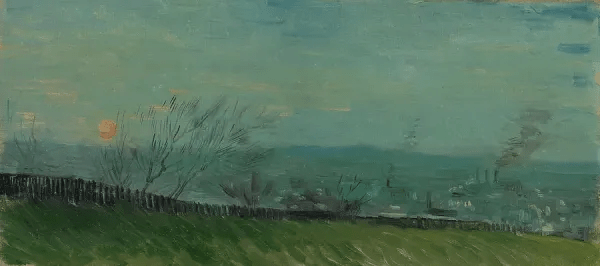
Sunset in Montmartre, by Vincent Van Gogh, 1887

Be patient, therefore, brothers and sisters, until the coming of the Lord.

The farmer waits for the precious crop from the earth, being patient with it until it receives the early and the late rains. You also must be patient.

Strengthen your hearts, for the coming of the Lord is near.

Brothers and sisters, do not grumble against one another, so that you may not be judged. See, the Judge is standing at the doors! 

As an example of suffering and patience, brothers and sisters, take the prophets who spoke in the name of the Lord. (New Revised Standard Version)

Patience is a wonderful virtue… unless you’re smack in the middle of circumstances you neither want nor asked for. Then, patience feels a whole lot more like a vice.

It’s easy to be impatient; it takes little to no effort at all. And praying for patience doesn’t help, because you’re prayer actually gets answered; God puts you in one of those unwanted situations.

The Jewish Christians for whom the Epistle of James was addressed were in that weird life-place of enduring hard circumstances. They were struggling with impatience, so much that the believers began cozying up to the rich and powerful to meet their ever-increasing needs. In their misery, they were looking to the very people who were using them and withholding wages from them. (James 2:1-7; 5:1-6)

It seemed as if God was shuffling his divine feet and not getting around to helping the Christians in their difficulty. They gave everything to Jesus and following him, to the point of being willing to suffer for the Name.

Their suffering led to outright persecution. The believers had to flee Judea for Gentile lands to the West (Acts 8:1-3). In their new homes they got double-trouble. Because they were Jews, they were looked at with suspicion. And because they were Christians, the Jewish community didn’t accept them. The believers were truly alone. All they had was Jesus.

It was enough, at least for a while. But it’s one thing to face difficulty, and quite another thing for the trouble to bleed into next week, next month, next year… When is this ever going to end?

Impatience doesn’t help. In fact, it only exacerbates an already agonizing situation. Grumbling and arguing and verbal fights begin to occur. The community starts to fracture. Blaming and shaming slowly replace the love and encouragement they once had together.

Every good thing in life takes time – lots of time! And the best things in life require a lifetime of endurance, perseverance, and patience. In order to keep going and hold onto our spiritual commitment, we need solid examples of patience, and reasonable ways to think about our situations.

I admit that it has been hard for me to be patient, as of late. I’m weary of American politics and the current administration. I’m tired of seeing my family members struggle with health issues day after day – many of them having to endure debilitating and heart-wrenching trials.

And there are some days when I’ve just had it with my own limitations. I can’t do many of the things I used to do, and it’s frustrating to tears to try and do some things that others do effortlessly.

Yet the Scripture reminds me of my days growing up on the farm. Planting and harvesting never happened in a week; it takes months to realize a return on all the hard work done through the Spring and Summer to get to Fall’s mature crop.

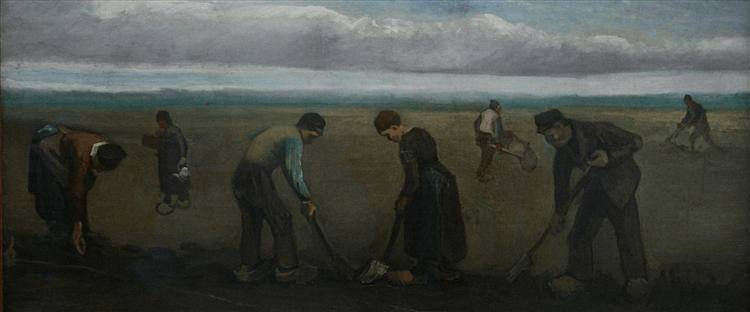
Peasants Planting Potatoes, by Vincent Van Gogh, 1884

I’m also reminded of the biblical prophets who suffered much for their message to the people. Lately, I’ve been reading the prophecy of Ezekiel in the Old Testament. If you have never read Ezekiel, or only read bits of it, you may not realize how incredibly difficult Ezekiel’s life was in serving Yahweh.

The prophet kept up a steady stream of very challenging situations to illustrate the message of judgment he was continually giving. Needless to say, Ezekiel was not always a popular guy. Proclaiming gloom, doom, and death all day every day tends to do that. In one encounter, for month after month, the prophet laid on his side and had to use excrement to light a fire and cook his food every day. God told him to, so that the people would see what was about to happen to them. (Ezekiel 4:1-17)

We have no record of Ezekiel grumbling or talking back to God. He faithfully did all that the Lord commanded him to say and do. He endured all the grumblers around him, and all the grieving people who had been displaced from their homes in Jerusalem.

In every generation, there are people in this world that undergo difficulties and troubles which others could never even imagine. And it’s been going on for millennia. Furthermore, terrible adversity will keep happening… until Christ returns.

Yes, there will be an end to all the suffering. But we may have to persevere to the end of our lives, remaining faithful to our spiritual commitment, and keeping up our love for one another. It won’t be easy to do.

I would be nothing but a hack preacher if I told you that everything will be bunnies and butterflies if you only look to Jesus and have faith. Although there can be joy, even in our mourning, there will always be the need for an agonizing form of patience that continually watches for help, healing, and hope in the return of Christ.

This is why it is so important not to let your own family, church, and faith community break down into fissures of impatience and grumbling.

We must keep our hearts strong. Ironically and paradoxically, that happens through our weakness.

In some ways, I’m weaker than I’ve ever been in my life. Yet, in other ways, I’ve never been stronger. The Trump administration can break me down and mess with my healthcare and my finances… my illness can keep me from ministry that I long to do… and the daily crud of life may redirect me in ways I don’t like… but I can truly say that God is good; God is the strength of my life.

I know that Christmas is coming. I’m looking for the birth of the Savior. I expect to see the angels rejoicing in the sky. I fully look forward to stepping in a few cow pies and horse apples in order to get a glimpse at the baby who changes the world.

Every good thing in life comes with a bit of manure on the shoes. And the best things in life are worth all the hardship one goes through in order to see the glory and majesty of the Divine.

I may not know you, my friend, but please know that I am praying for you. No matter what happens, I can always pray, always watch, always hope, always believe, and always love my neighbor, despite all the hate in this old fallen world.

Be safe. Be strong. Be spiritual. We are all in this life together.

God of joy and exultation, you strengthen what is weak; you enrich the poor and give hope to those who live in fear. Look upon our needs this day. Make us grateful for the good news of salvation and keep us faithful in your service until the coming of our Lord Jesus Christ, who lives forever and ever. Amen.

I Will Yet Again Praise God (Psalms 42 & 43)

Solitude, by Winslow Homer, 1889

As a deer longs for flowing streams,
    so my soul longs for you, O God.
My soul thirsts for God,
    for the living God.
When shall I come and behold
    the face of God?
My tears have been my food
    day and night,
while people say to me continually,
    “Where is your God?”

These things I remember,
    as I pour out my soul:
how I went with the throng
    and led them in procession to the house of God,
with glad shouts and songs of thanksgiving,
    a multitude keeping festival.
Why are you cast down, O my soul,
    and why are you disquieted within me?
Hope in God, for I shall again praise him,
my help and my God.

My soul is cast down within me;
    therefore I remember you
from the land of Jordan and of Hermon,
    from Mount Mizar.
Deep calls to deep
    at the thunder of your torrents;
all your waves and your billows
    have gone over me.
By day the Lord commands his steadfast love,
    and at night his song is with me,
    a prayer to the God of my life.

I say to God, my rock,
    “Why have you forgotten me?
Why must I walk about mournfully
    because the enemy oppresses me?”
As with a deadly wound in my body,
    my adversaries taunt me,
while they say to me continually,
    “Where is your God?”

Why are you cast down, O my soul,
    and why are you disquieted within me?
Hope in God, for I shall again praise him,
    my help and my God.

Vindicate me, O God, and defend my cause
    against an ungodly people;
from those who are deceitful and unjust,
    deliver me!
For you are the God in whom I take refuge;
    why have you cast me off?
Why must I walk about mournfully
    because of the oppression of the enemy?

O send out your light and your truth;
    let them lead me;
let them bring me to your holy hill
    and to your dwelling.
Then I will go to the altar of God,
    to God my exceeding joy,
and I will praise you with the harp,
    O God, my God.

Why are you cast down, O my soul,
    and why are you disquieted within me?
Hope in God, for I shall again praise him,
    my help and my God. (New Revised Standard Version)

I often get asked why God allows such hard things in our lives. There is likely no complete answer to that question; at least not on this side of heaven. Yet, I believe we can respond to the query in part: Facing hard circumstances, difficulty, and  adversity drives us to seek our help in God.

For those committed to knowing God, the desire for help through hardship becomes a deep longing not just to cope with and transcend troubles, but also to experience God like never before.

Every believer is familiar with becoming forlorn, even with crying themselves to sleep at night because of what is happening in their life. And the experience is further exacerbated by calloused others who mock us for our belief in a divine transcendent being.

Much like Christ on the cross, those who care nothing for us stroll by, see our agony, and respond with a “Humph! Let’s see your ‘God’ save you now!” (Matthew 27:42; Mark 15:31; Luke 23:35)

It’s in such times we remember back, when God felt very near to us, and seemed to answer every prayer. Yet now, the silence of God is palpable. This awkward quietness puts one in a position to hope. And when hope reawakens, a new resolve toward perseverance through the trouble comes.

For in hope we were saved. Now hope that is seen is not hope, for who hopes for what one already sees? But if we hope for what we do not see, we wait for it with patience. (Romans 8:24-25, NRSV)

Somehow, deep in our soul, we know that we will yet praise God again for a great deliverance. We remember that we were helped in the past; and now, in the present, that we will be helped again. Praise arises as an organic response to what we know will happen, even though it hasn’t yet happened.

Fresh prayers come to us, smack in the midst of our adverse situations. We pray, not only for our own help and deliverance, but also for the justice of God to have it’s way in the world.

We think of all the other believers who, like us, are facing hardship for no fault of their own. In a wonderful sense of solidarity in spirit, we lift up our sisters and brothers in the faith before the God for whom we are convinced will help them, as well as us.

All we want to do is somehow maintain our integrity of relationship with God and others, to remain in the cradle of truth – keeping our little light shining in the darkness that surrounds us.

It is not a sin to be troubled and to feel alone in the middle of a stressful and difficult circumstance. What we do with ourselves when we are in such a situation is what makes all the difference.

I suggest we flee to the Book of Psalms. In those times when tears become our food and drink, and we don’t know how to pray, let’s let the psalmist pray for us by adopting his prayers as our very own.

O God, our refuge and hope: When despondency and despair haunt and afflict us, comfort us with the stillness of your divine presence, so that we might confess all you have done, through Christ to whom we belong and in whom we are one. Amen.

Spiritually and Emotionally Overwhelmed

Gethsemane – His Will, by Lucy Dickens

I lift up my eyes to the hills—
    from where will my help come?
My help comes from the Lord,
    who made heaven and earth. (Psalm 121:1-2, NRSV)

“You can’t calm the storm, so stop trying. What you can do is calm yourself. The storm will pass.” – Timber Hawkeye

Even Jesus got overwhelmed.

He took Peter and the two sons of Zebedee along with him, and he began to be sorrowful and troubled. Then he said to them, “My soul is overwhelmed with sorrow to the point of death. Stay here and keep watch with me.”

Going a little farther, he fell with his face to the ground and prayed, “My Father, if it is possible, may this cup be taken from me. Yet not as I will, but as you will.” (Matthew 26:37-39, New International Version)

Jesus was so spiritually and emotionally overwhelmed, he felt so bad, that depression and grief were a powerful part of his experience in the garden as he anticipated facing his horrendous death.

Yes, Jesus became grieved and depressed. Not only did he express such emotions in prayer, but he also told his feelings to his disciples. I personally don’t know of any leader – either in the world or in the church – that would ever admit such a thing to his/her parishioners, employees, or constituents.

Christ confessed that his very soul was encircled with grief-stricken depression. The weight of the emotion was so heavy that Jesus felt as though he was being crushed to death.

“It is one thing for Jesus to feel this way; but should a leader tell his followers he feels this way? Isn’t a part of effective leadership keeping fears from followers? But if Jesus having depression has already taught us it is acceptable, at times, to be depressed, then Jesus talking about his depression teaches that it is acceptable, at times, for leaders to tell followers the bad state of their souls.” – Frederick Dale Bruner, The Church Book: Matthew 13-28

If Jesus needed human companionship and the ability to bear his soul, then how much more do his followers need to do so? And especially the clerics who are ordained to his ministry?

Becoming overwhelmed is a universal human experience:

May my prayer come before you;
    turn your ear to my cry.

I am overwhelmed with troubles
    and my life draws near to death.
I am counted among those who go down to the pit;
    I am like one without strength. (Psalm 88:2-4, New International Version)

We may become overwhelmed by being devastated or feeling overpowered by a confluence of circumstances all at once. To be overwhelmed is to experience several big emotions all at once – including an awful feeling of estrangement from God and/or others.

Whenever complicated grief, relational distance, traumatic experiences, and too many responsibilities come together, they create a perfect storm which can leave us stuck, lonely, and chronically tired.

There are times when it seems as if every time we turn around, there’s another big shoe that drops. We might end up dealing with so many large circumstances and important situations happening at the same time, that we become spiritually and emotionally overwhelmed with it all.

Although it’s easy to become overwhelmed, it’s hard to get over those big, troubled feelings. Yet, we can do it. We can initially calm ourselves enough to function.

Yet, we also need to understand that the emotional array surrounding our difficult circumstances will take more than a few minutes and a few breathing exercises to overcome; it could take weeks, months, even longer.

What’s more, going forward, there will always be a need to listen to our bodies, be attentive to our feelings, and remain in touch with our gut instincts.

We could use some helpful habits to serve us well, whenever we sense the tug toward that sinking feeling of becoming spiritually and emotionally overwhelmed:

  • Sit with your emotions, especially the grief. That is, acknowledge your feelings, and actually let yourself feel them, and express them in positive ways that don’t damage others or their property.
  • Identify and list your current stressors. Then, prioritize them as to which you will work on first. Avoid multi-tasking. Breaking down your life into manageable pieces, done over time with patience, is a healthy way of approaching the behemoth in front of you.
  • Write out your experiences. Keep a daily journal. Focus on expressing both your emotions and your gratitude. The act of writing in and of itself is a powerful means of bringing health, wholeness, and some sort of sense to your situations.
  • Create art. Learn a musical instrument, write your own poetry, sculpt, or paint. Let any anger and frustration come out through your art, rather than coming out sideways onto others through verbal violence.
  • Discover new or alternative spiritual practices, i.e. mindfulness, meditation, Reiki, aromatherapy, breath prayers, etc. Crazy new circumstances you’ve never experienced before may require some seemingly new or strange practices you’ve never tried before.
  • Change the story you are telling yourself. Look for parts of your experience within your control. Learn from the past. Consider what you might do differently in the future in similar situations. In other words, let your story not be one big nasty carbuncle on your soul; allow it to be a companion that teaches you.
  • Consider having a comfort animal. Caring for a pet fosters emotional healing. This one addition to your life could change it immeasurably for good.
  • Engage your inner critic. Face the judgment you may be giving yourself and replace it with grace. Work on dropping the ego and becoming your true self. And there is perhaps no better way of this happening than facing your inner critic.
  • Exercise. Pay attention to where you carry stress in your body. Find an enjoyable way of moving your body.
  • Connect with others. Join a group of like-minded people, such as a faith community or a volunteer organization. Tell your story to another trusted person, such as a friend, therapist, or pastor.
  • Find your identity. Most spiritual traditions take a high view of humanity as having intrinsic worth. As for me, I know to whom I belong: God. Having my identity firmly in Christ – and not in my abilities, or the lack of them – makes all the difference.

Our limitations, screw-ups, diseases, disorders, and disasters need not define our lives. There is no shame in admitting when we are full of sorrow, in the throes of grief, experiencing depression, or living in an awful situation.

Taking Jesus as an example, we have the courage to face stressful adversity and become the people we were always meant to become.

May the places of darkness within you be turned towards the light. And may you know divine shelter and healing blessing when you are called to stand in the place of pain. Amen.