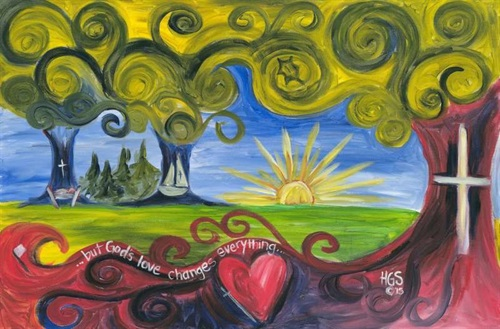
What Is Your View of God? (Psalm 86:1-10)

God’s Love… by Hope G. Smith

Incline your ear, O Lord, and answer me,
    for I am poor and needy.
Preserve my life, for I am devoted to you;
    save your servant who trusts in you.
You are my God; be gracious to me, O Lord,
    for to you do I cry all day long.
Gladden the soul of your servant,
    for to you, O Lord, I lift up my soul.
For you, O Lord, are good and forgiving,
    abounding in steadfast love to all who call on you.
Give ear, O Lord, to my prayer;
    listen to my cry of supplication.
In the day of my trouble I call on you,
    for you will answer me.

There is none like you among the gods, O Lord,
    nor are there any works like yours.
All the nations you have made shall come
    and bow down before you, O Lord,
    and shall glorify your name.
For you are great and do wondrous things;
    you alone are God. (New Revised Standard Version)

What is your view of God? 

For some, God is up there, somewhere, like some white-bearded old guy who is aloof to what is going on down here – there is neither anything personal nor personable about him, at all. If he gets involved, at all, it’s just to get out his divine BB gun and shoot a few sinners in the backside.

For others, God is a force which binds all things together; God is there, but you’re never quite sure how to get in touch with him – it’s like a crap shoot trying to connect with God. So, you might do all sorts of things to get God’s attention, like be especially good – and if that doesn’t work, maybe you’ll go the other way and be especially bad, just to get any sort of attention.

For yet others, God is perpetually perturbed about something; he’s got a bee in his divine bonnet and it’s our job to figure out what he’s sullen and upset about all the time, that we might appease God in some way. So, you might double-down on being self-sacrificial, try not to swear in front of the Pastor, and help others so that God will, in turn, help you.

The psalmist David, however, sees God in a very different way than all the aforementioned. God is not aloof and distant, nor angry. Instead, David understands and views God as personal, knowable, and reachable.

What characterizes God?

Reading today’s psalm tells us a great deal of how David thought and felt about God. Notice what we learn about God from David’s description: good and forgiving; abounding in steadfast love; listens and answers; and, does great and wondrous things.

Now this is a God you can sink your teeth into. This God is attentive, engaged, and is anything but upset all the time – which is why David has no problem asking God to listen and answer his prayer.

David put his trust in God to save him and make his heart glad. With this kind of God, David can willingly affirm his devotion. With a God of steadfast love and support, the worshiping and praying person’s heart forever belongs to the Lord.

If your view of God cannot support and bear the weight of your life’s hardest circumstances, then you need a different view of God!

Rather than God being the problem, it could be that your understanding of God is off. And if your understanding of God is off, then it’s likely that your own understanding of yourself is skewed – which is why many persons who have darker views of God are down on themselves and possess little self-worth.

I invite you to see the God of David. This God has both the ability and the willingness to satisfy your life’s greatest needs.

What will you do with your view of God?

In humility and brokenness, we call out in our misery. God responds in steadfast love and abundant mercy. With God, we can move from trouble to confidence.

And sometimes, we discover that our troubles and our circumstances change very little. But we ourselves have changed a great deal. Our compulsions for solid answers to our questions give way to a settled confidence in divine mystery. And our obsessions with a pain-free and problem-free life are replaced with a curiosity for what the hard situations in our lives will teach us.

The poor and needy cry out to God, knowing that grace and mercy characterizes the Lord. Life on this earth may not treat us well, but God gives us much more than we deserve.

The faithful trust in the Lord, fully confident that their preservation and protection are in God’s hands – and not in political leaders or padded bank accounts.

The miserable pray, constantly persevering in prayer, because their hope is in the name of the Lord who made heaven and earth. They have learned to pray expectantly, understanding that sometimes the greatest miracle of all is being delivered from the need to have a miracle.

Those who lift their faces to heaven, looking for the bright sunshine of grace, will know joy, down deep in their soul – and not simply a fleeting happiness from temporary reprieve of trouble.

The ones calling on the name of the Lord, banking their lives on God’s love, discover forgiveness and a good peaceful life of peace – rather than the anxiety of constantly worrying about tomorrow.

The spiritually devoted are confident that God will answer in their day of trouble – and they are patient, knowing full well that God’s sense of timing is much better than their own. So, they learn to hold all things loosely, knowing that God gives and God takes away. Blessed be the name of the Lord.

All those taking the time and effort to find the God who is truly characterized by kindness and compassion know in their gut, without a shadow of a doubt, that there is no one like the Lord – a God who does wondrous things and is attentive to justice and righteousness.

What is your view of God? Listen closely to the psalmist, and he will tell you what the Lord has done for him because of God’s basic nature of love and goodness.

Great God of David, you are above all things and beside all things and with all things. You are uniquely positioned and powerful to walk with me through all the situations of my life. Thank you for sending the Son of David to make your promises real to me. Amen.

Let Mercy Be Our Guide (Matthew 12:1-8)

At that time Jesus went through the grainfields on the Sabbath. His disciples were hungry and began to pick some heads of grain and eat them. When the Pharisees saw this, they said to him, “Look! Your disciples are doing what is unlawful on the Sabbath.”

He answered, “Haven’t you read what David did when he and his companions were hungry? He entered the house of God, and he and his companions ate the consecrated bread—which was not lawful for them to do, but only for the priests. Or haven’t you read in the Law that the priests on Sabbath duty in the temple desecrate the Sabbath and yet are innocent? I tell you that something greater than the temple is here. If you had known what these words mean, ‘I desire mercy, not sacrifice,’you would not have condemned the innocent. For the Son of Man is Lord of the Sabbath.” (New International Version)

I’ll just say it plainly: We people are quick to judge. All of us have been on the end of someone judging us for something we did or said; and also all of us have played the judge, telling someone they aren’t right, when we really don’t know what’s going on or don’t have the full picture.

In today’s Gospel lesson, the Pharisees take issue with Christ’s disciples doing something unlawful (that is, unbiblical). Since the Pharisees chose to respond to the situation using the ground of Scripture, Jesus responded to them on Scriptural grounds.

Jesus went back to the Bible, with three pointed biblical retorts: “Haven’t you read?” “Haven’t you read in the Law?” and “If you had known what these words mean….”

David and His Companions

The first example of Jesus, in reply to the Pharisees’ issue with the disciples picking heads of grain on the Sabbath, was to lift up David and his men. They had the audacity to waltz into the holy place, take the sacred Bread of the Presence, and proceed to eat it. And it was all done above board.

In a usual circumstance, it would be unlawful for anyone other than a priest to eat the bread. However, under unusual circumstances or extreme situations, it is very much permitted for the priest(s) to give the bread to others. This gets at the spirit and intent of the Law, not just the letter of it.

If we are unable to practice biblical injunctions with both knowledgeable skill and practical art, then we are failing to keep the Law. In other words, meeting the very real needs of people is a high priority – which is a major point of divine commands to begin with.

Priests on Sabbath Duty

The Pharisees had a problem with the disciples “working” on the Sabbath day. Rather than quibble about whether they were working by sowing and reaping, or not, Jesus went to the example and reality that the priests of God “work” on the Sabbath day – an argument which every Christian Pastor knows all too well, since we do a great deal of work on our Sunday of “rest.”

Jesus is merely making a simple observation that priestly work is done on the Sabbath without any guilt, sin, or shame behind it. In fact, it’s expected. Just as the priests are squeaky clean, then so are Christ’s disciples.

Christ brings it closer to his main point – that if the temple and all the ritual laws can validate Sabbath work – then it follows that Jesus has the freedom to “work” on the Sabbath because he is actually Lord of the Sabbath. It’s an argument from the lesser to the greater. If the temple is important, and Christ is greater than the temple, then there ought to be no constraints to Messiah’s work in this world.

If You Only Knew Your Bible

The lynchpin and hinge point of all Christ’s words hangs on the revealed biblical heart of God toward the very situation in which the disciples were in the field getting some heads of wheat. And it is the verse drawn from the prophet Hosea: “I desire mercy, not sacrifice.”

Again, the point of the Law, the aim of the biblical commands, is not self-sacrifice. It isn’t about going without eating because you would need to work in order to prepare food. Rather, it is having a big heart directed toward the needs of humanity. Human willpower, self-discipline, and right theology don’t mean much, at all, next to the weightier matters of empathy, compassion, and relational connection.

Religious duty is just that. But spiritual care which seeks to bring heartfelt compassion, responsible love, and social justice to a community is the sort of divine work that God is looking for in God’s people. Anything less than that is only hollow legalism.

So, instead of ignoring the Law, Jesus was actually upholding and fulfilling God’s Law. Christ was keeping the spirit, heart, and intent of divine instructions – even though it may have looked otherwise to a particular group of people.

Sabbath and the Reformation

In the Protestant Reformation, John Calvin understood this meaning, that the Sabbath is made for humanity, not humanity for the Sabbath, and that Jesus Christ is Lord of the Sabbath. Therefore, we are to observe the Lord’s Day (Sunday) in an intentionally non-legalistic way:

“The Lord’s Day was not established for us to hallow it before all others, that is, to count it more holy. For this is the prerogative of God alone, who has honored all days equally (Romans 14:15). But it was established for the church to gather for prayers and praises of God, for hearing the Word, for the use of the sacraments.”

John Calvin, Institutes of the Christian Religion (Book 1, Chapter 14)

Let mercy, not judgment nor sacrifice, be our interpretive guide through the whole of Holy Scripture and the Christian life, to the glory of God. Amen.

A Prayer of Desperation (Jonah 2:1-10)

From inside the fish, Jonah prayed to the Lord his God:

When I was in trouble, Lord,
I prayed to you,
    and you listened to me.
From deep in the world
    of the dead,
I begged for your help,
    and you answered my prayer.

You threw me down
    to the bottom of the sea.
The water was churning
    all around;
I was completely covered
    by your mighty waves.
I thought I was swept away
    from your sight,
never again to see
    your holy temple.

I was almost drowned
by the swirling waters
    that surrounded me.
Seaweed had wrapped
    around my head.
I had sunk down deep
    below the mountains
    beneath the sea.
I knew that forever,
    I would be a prisoner there.

But you, Lord God,
    rescued me from that pit.
When my life was slipping away,
    I remembered you—
and in your holy temple
    you heard my prayer.

All who worship worthless idols
turn from the God
    who offers them mercy.
But with shouts of praise,
I will offer a sacrifice
    to you, my Lord.
I will keep my promise,
because you are the one
    with power to save.

The Lord commanded the fish to vomit up Jonah on the shore. And it did. (Contemporary English Version)

Desperate (adjective):

  1. reckless or dangerous because of despair, hopelessness, or urgency: a desperate prayer for help
  2. having an urgent need, desire: desperate to stay alive in a watery grave
  3. leaving little or no hope; very serious or dangerous: desperately stuck in the belly of a fish
  4. extremely bad; intolerable or shocking: skin being bleached white inside of a stomach
  5. extreme or excessive: swallowed and puked-out by a fish

Out of all the postures of prayer I have taken in my life, and in every prayer of desperation I’ve ever uttered to God, none of my experiences were ever quite like Jonah’s. Curled up in a fetal position inside the belly of a big fish will tend to bring out a desperate plea for help. And desperate prayers are the sort God wants from us.

I am God Most High!
    The only sacrifice I want
is for you to be thankful
    and to keep your word.
Pray to me in time of trouble.
I will rescue you,
    and you will honor me. (Psalm 50:14-15, CEV)

The Lord says, “If you love me
    and truly know who I am,
I will rescue you
    and keep you safe.
When you are in trouble,
    call out to me.
I will answer and be there
    to protect and honor you.
You will live a long life
    and see my saving power.” (Psalm 91:14-16, CEV)

Anyplace of difficulty, adversity, or overwhelming situation, can be transformed from the acid belly of a fish to a womb of possibility and new life.

In running from God, Jonah chose unwisely, and took the path of separation and death. Being swallowed whole by a great fish, and languishing in such a place of sheer isolation, is also a metaphor mirroring the actual circumstance of Jonah’s great separation from everyone, everything, especially God.

Our own fleeing from what we hate, and searching for safety apart from the Lord, only lands us in a place of horror. Jonah got himself so far from everything that he became entombed in a living death. In truth, God is the only safe and sacred place we have, our only secure refuge. We don’t need to run in order to be protected – not when God has our backs.

The turning point is whenever we come to our senses and make the choice to unmask our actual thoughts, feelings, and intentions before the Lord. The change comes whenever we make an honest cry of desperation in prayer. For prayer is the very breath of life; it is our hope.

What do you do when you are in distress?

Prayer elicits mercy from the heart of God. The value of adopting biblical prayers, like the ones in the psalter and Jonah’s prayer, is that frequent use of praying them fills our minds and hearts with words in times of great distress.

Its when we are in overwhelming need that scriptural prayers and familiar passages reawaken us with fresh hope for deliverance and renewal.

Jonah’s dark watery grave became empty when he decided to voice his desperate prayer to God. It’s one thing to pray because you want something; it’s another thing to pray because your very life is on the line.

Living for God is much more than holding to particular doctrines or making pious statements about God. The spiritual life is one in which we open ourselves to new beginnings and new life – going beyond ourselves and connecting with a transcendent God.

We must abandon ourselves to God. We are in no position to negotiate or make deals with the Lord. There needs to be a radical letting go of hatred and bigotry, injustice and unrighteousness, and especially our bent toward wanting things our way.

It is from the empty places of life that we find possibility. It was from the grave of the fish’s belly that set up Jonah’s experience of being vomited out in a spiritual resurrection.

Jonah was in the stomach of a big fish for three days and nights, just as the Son of Man will be deep in the earth for three days and nights. (Matthew 12:40, CEV)

Abandoning the false self, forsaking the old life, and coming to the end of ourselves, puts us in a position to pray desperate prayers which God delights to answer beyond what we can even ask or think.

Most holy and merciful God, I am in your care. Help me know that I need not face my troubles alone. May you grant me consolation in my sorrow, courage in my fear, and healing in the midst of my suffering. Fill me with the grace to accept whatever lies ahead for me; and strengthen my faith. Thank you that I have a living hope, through Jesus Christ my Lord, who with you and the Holy Spirit are one God, now and forever. Amen.

Guide Me By Your Good Spirit (Psalm 143)

Listen to my prayer, Lord!
    Because of your faithfulness, hear my requests for mercy!
    Because of your righteousness, answer me!
Please don’t bring your servant to judgment,
    because no living thing is righteous before you.

The enemy is chasing me,
    crushing my life in the dirt,
        forcing me to live in the dark
            like those who’ve been dead forever.
My spirit is weak inside me—
    inside, my mind is numb.

I remember the days long past;
    I meditate on all your deeds;
    I contemplate your handiwork.
I stretch out my hands to you;
    my whole being is like dry dirt, thirsting for you.

Answer me, Lord—and quickly! My breath is fading.
    Don’t hide your face from me
        or I’ll be like those going down to the pit!
Tell me all about your faithful love come morning time,
    because I trust you.
Show me the way I should go,
    because I offer my life up to you.
Deliver me from my enemies, Lord!
    I seek protection from you.
Teach me to do what pleases you,
    because you are my God.
Guide me by your good spirit
        into good land.
Make me live again, Lord, for your name’s sake.
    Bring me out of distress because of your righteousness.
Wipe out my enemies because of your faithful love.
    Destroy everyone who attacks me,
        because I am your servant. (Common English Bible)

Many Westerners tend to think about sin as bad individual actions which are quite personal. However, sin is much bigger than that. Primarily, sin is a force, a power in this universe which weighs on every molecule within it. None of us can escape having to deal with it.

For persons like the psalmist, they strive to be good and live a just life, yet they are continually dogged by others who have given into the “dark side.” The wicked discern the force of sin in the world, and then decide to move with it – believing that good guys finish last.

Yet, there is another powerful force in the universe – and it’s a greater power than sin.

Everywhere we look, we see a bad spirit. And that sinful spirit is behind the injustice, oppression, war, conflict, ignorance, and avarice which exists in every nation, community, and even home. Entrenched opinions, yelling at each other, the refusal to consider evidence, and narrow thinking have permeated our societies and pitted people against one another.

This evil spirit of the age is captured in the Apostle Paul’s words as he reflected on this and other psalms:

As it is written:

“There is no one righteous, not even one;
    there is no one who understands;
    there is no one who seeks God.
All have turned away,
    they have together become worthless;
there is no one who does good,
    not even one.”
“Their throats are open graves;
    their tongues practice deceit.”
“The poison of vipers is on their lips.”
    “Their mouths are full of cursing and bitterness.”
“Their feet are swift to shed blood;
    ruin and misery mark their ways,
and the way of peace they do not know.”
    “There is no fear of God before their eyes.”

Now we know that whatever the law says, it says to those who are under the law, so that every mouth may be silenced and the whole world held accountable to God. Therefore no one will be declared righteous in God’s sight by the works of the law; rather, through the law we become conscious of our sin. (Romans 3:10-20, NIV)

The psalmist doesn’t want to be a part of the sinful force and the bad spirit. He, instead, knows that sometimes he’s part of the problem, along with being a victim of sin, and thus, knows he needs deliverance from this awful power.

Promises to do better and personal willpower won’t cut it, when it comes to changing a life and a society. Rather, we must tap into a good spirit, which is ultimately, the Spirit.

Even though all have been both victim and victimizer, and fall short of God’s glory, all are justified freely by God’s grace through the redemption that came by Christ Jesus. (Romans 3:23-24)

Once we were blocked from prayer because of obstacles existing unaware among us and within us. But now we see the world for how it’s been touched by foulness and degradation, so we pray.

The spirit of the age will fail us. Our own spirit will be fickle. God’s Spirit, however, is continually living and active with the force of grace and mercy.

In our fear, it’s okay, even good, to flee from evil. Yet, we must complete the process by not only fleeing from the bad spirit, but also fleeing to God’s Spirit.

Prayer, then, becomes our lifeline. It’s our connection to what is right, just, and good. In Christianity, the Spirit is the one who conforms us to the glory of God and the image of Jesus. The Spirit is our Teacher, Guide, and Advocate, keeping us on God’s good path.

We need to live according to the Spirit – which is a continual journey of removing obstacles to faith and allowing God’s good gifts to awaken within us.

My counsel is this: Live freely, animated and motivated by God’s Spirit. Then you won’t feed the compulsions of selfishness. For there is a root of sinful self-interest in us that is at odds with a free spirit, just as the free spirit is incompatible with selfishness. These two ways of life are contrary to each other, so that you cannot live at times one way and at times another way according to how you feel on any given day. Why don’t you choose to be led by the Spirit and so escape the erratic compulsions of a law-dominated existence? (Galatians 5:16-18, MSG)

Yes, sin is a powerful force, manifesting itself in a host of bad spirits all around us. But grace is greater than all sin, and God’s good Spirit shall overwhelm and overcome all evil.

Visit this place, O Lord, we pray, and drive far from it the snares of the enemy; may your holy angels dwell with us and guard us in peace, and may your blessing be always upon us, through Jesus Christ our Lord. Amen.