Bored To Death (Acts 20:7-12)

On Sunday we met to break bread. Paul was discussing Scripture with the people. Since he intended to leave the next day, he kept talking until midnight. (Many lamps were lit in the upstairs room where we were meeting.)

A young man named Eutychus was sitting in a window. As Paul was talking on and on, Eutychus was gradually falling asleep. Finally, overcome by sleep, he fell from the third story and was dead when they picked him up. Paul went to him, took him into his arms, and said, “Don’t worry! He’s alive!” Then Eutychus went upstairs again, broke the bread, and ate. Paul talked with the people for a long time, until sunrise, and then left.

The people took the boy home. They were greatly relieved that he was alive. (God’s Word Translation)

I’m bored

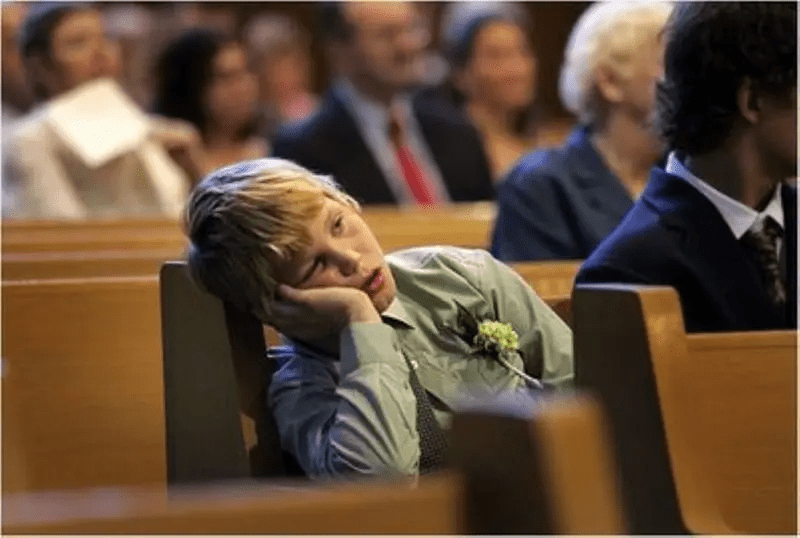
When I was a kid, the church worship service on Sunday was the longest hour of my week. I wanted to play in the pew, but my mom wouldn’t let me. I asked to go the bathroom, but my dad wasn’t having it. I tried to draw in the hymnal, but my sister always took everything around me ought of sight. My only relief was to sleep and drool on whatever I could lay my head on.

I’ve come a long way since then. But my experience taught me something. God isn’t boring, so I’m not going to be boring, either. Maybe I could have taught the Apostle Paul a thing or two.

In our New Testament lesson for today, the lateness of the hour (past midnight) and the ambiance of the room (all those burning oil lamps, presumably to keep people awake without any coffee) clues a church-going person immediately that something bad is about to go down. A long-winded preacher only serves to make for a combustible situation.

Uh-oh

In all fairness to Paul, if the congregants were bored out of their minds, the text doesn’t tell us. My guess is that the author, Luke, doesn’t want to go there. Yet, we have evidence of a bored person in the form of none other than a young person, a kid named Eutychus.  

He’s over by the open window, propped up on the ledge, and can’t keep his eyes open. Heck, for all we know, everyone was starting to doze off. And, as every preacher has experienced, as somebody slips into sleep, we just talk even longer.

The young man’s precipitous position leads to disaster: he falls out the third floor window. And, as one might expect, he fell to his death. Now, instead of some slap-stick comedic set up, we have a genuine tragedy: a young person literally bored to death by preaching.

The Apostle Paul raises Eutychus to life, by Gerard Hoet, 1728

All of a sudden, the story is no laughing matter. So, what might we learn from the preacher who bored Eutychus to death?

He finally stops preaching

The sermon is interrupted (as it turns out, of course, only momentarily) in order to attend to the tragedy. Sometimes, the sermon has to stop. Everything has to stop. We have to take a good, hard look at what’s going on. There are questions to ask, things to notice, conversations to begin. We have to get particular about where we are, and what we’re doing, before we can keep going with anything.

Maybe, just maybe, if Eutychus was part of the communion service, he wouldn’t have been on the margins and at risk of falling. As for many churches today, it could be there’s no young people around because they all fell out the window. Never underestimate the power of participation. Most youth just need to be asked to help out. But most adults don’t ask. And most kids aren’t going to volunteer.

He threw himself on him

Paul went down to Eutychus, and bending over him, took him in his arms in an emotional embrace – similar to what the father did when the prodigal son came home. (Luke 15:11-32)

In both cases – the prodigal son and Eutychus – they each needed a new life. The prodigal fell asleep to who he was, in a living death, and woke to his condition and went home. Eutychus literally fell asleep to an actual death and was woke to a resurrected life – returning back to the congregation (and even more preaching! *sheesh* leave it alone, Paul).

Each was found. Each had someone care about them by throwing their arms around them and giving them new life. That’s what grace is. Grace is giving the gift of seeing another person and embracing them – no matter whether they’re worthy of it, or not.

He’s alive

“He’s alive” is a statement of fact, of reality. It puts all the attention on what is true, right now, in this moment – and deflects attention away from who’s around the living person. In other words, Paul doesn’t take credit for Eutychus coming to life or restoring breath to him.

Implicitly, we know where the power comes from to raise Eutychus to life. It doesn’t come from the preacher. However, there is an important task that every preacher can do: witness a new life and bring the announcement of that life to the community. Preaching can (and ought to) bear witness to the activity of God in raising the dead and granting life.

The preacher can encourage the congregation to celebrate life around the Lord’s Table, notice the people on the margins of the community, and stay awake to the possibilities of what God can do amongst us.

Turns out, neither the length of a sermon nor the level of boredom is the issue. What’s most important is proclaming the gospel of grace in word and sacrament. And that’s something we all can participate in together and celebrate.

God of life, may we learn how to live from the mercy which was brought to us through the mission of your Son – whose saving love extends to every person, whose presence reaches into every place, Jesus Christ, who makes all things new, who lives and reigns with you and the Holy Spirit, one God, now and forever. Amen.


Mercy Will Happen (Isaiah 60:17-22)

I will exchange your bronze for gold,
    your iron for silver,
your wood for bronze,
    and your stones for iron.
I will make peace your leader
    and righteousness your ruler.
Violence will disappear from your land;
    the desolation and destruction of war will end.
Salvation will surround you like city walls,
    and praise will be on the lips of all who enter there.

“No longer will you need the sun to shine by day,
    nor the moon to give its light by night,
for the Lord your God will be your everlasting light,
    and your God will be your glory.
Your sun will never set;
    your moon will not go down.
For the Lord will be your everlasting light.
    Your days of mourning will come to an end.
All your people will be righteous.
    They will possess their land forever,
for I will plant them there with my own hands
    in order to bring myself glory.
The smallest family will become a thousand people,
    and the tiniest group will become a mighty nation.
    At the right time, I, the Lord, will make it happen.” (New Living Translation)

The people of ancient times typically had a love/hate relationship with prophets. After all, the Lord’s messengers gave verbal punches to the gut with bad news of judgment. But they also were bearers of good news, as well. They were able to hold both judgment and grace together.

It is good to always keep in mind that, despite human foibles, grace exists and is the grand operating force in God’s big world. Good news turns to great news when there is a realization that judgment is deserved, yet it won’t have the last word.

God’s grace prevails in the end. God has a tenacious resolve to work out good for people, not ill. Although the Lord dispenses judgment, sometimes with a firm hand, there is an unflagging commitment to divine love which shines through the darkest of times.

God expertly knows how to make a reversal in people’s situations from hopeless despair to incredible fortune (and vice versa). The Lord truly has plans of goodness and well-being for humanity. Humiliation and powerlessness will give way to exaltation and empowerment. Peace will eventually overcome both the human heart and human institutions.

Deliverance from the ills which plague both body and soul comes from the God who specializes in penetrating the blackest darkness with overwhelming light – and it’s more than personal well-being. Isaiah’s prophecy communicates a cosmic vision of peace which thoroughly works its way in all the shadowy places of the world. It’s a vision of a new world and new life.

Because of God’s merciful action in a broken and bruised world, we can make some bold and hopeful theological claims for God’s people:

  • God’s good grace and steadfast love are the superior forces in the church and the world. Because grace and love are pure gifts from the Lord, they are not dependent upon whether we deserve them, or not. The sheer fact that we need them is what prompts God to give generously and unsparingly. A new heaven and new earth are coming. Sin and death are not permanent.

Then I saw a new heaven and a new earth; for the first heaven and the first earth had passed away. (Revelation 21:1, NRSV)

  • God is the center of every good thing that was, is, and is coming. God’s world runs on God’s providence and power, and not on human agency. God is in control. All the Lord’s good promises shall not fail but will be realized. For the Christian, those promises are ultimately fulfilled in the person and work of Jesus Christ. When circumstances are at their worst, faith is at its best.

In everything we have won more than a victory because of Christ who loves us. I am sure that nothing can separate us from God’s love—not life or death, not angels or spirits, not the present or the future, and not powers above or powers below. Nothing in all creation can separate us from God’s love for us in Christ Jesus our Lord! (Romans 8:37-39, CEV)

  • God’s promises extend well beyond the “spiritual” to all of life. God’s peace will work its way into the fabric of the whole world, not only individual hearts. God’s benevolent kingdom and ethical will shall be done on earth as it is always done in heaven. Just as every human institution and all creation have been profoundly touched by sin, so everything will be touched by grace and renewed. Our prayers are to encompass this grand scope of God’s renewing vision for the world.

May your Kingdom come soon. May your will be done on earth, as it is in heaven. (Matthew 6:11, NLT)

God’s plans are more than good and gracious; they are cosmic in their scope and include an expansive realm of peace which is so incredible that the Lord’s glory will overwhelm all darkness and shall shine forever.

Human sin might seem as though it is so pervasive as to win the day, yet it will not always be this way. God’s light will penetrate, overcome, and dispel guilt, shame, and disobedience. And it has already begun…

Almighty God give us a new vision of you, of your love, of your grace and power; and then, give us a new vision of what you would have us do as your people, and an awareness that in the strength of your Spirit we can do it to your glory, through Jesus Christ our Lord. Amen.

Be Merciful (Jonah 4:1-11)

Jonah was really upset and angry. So he prayed:

Our Lord, I knew from the very beginning that you wouldn’t destroy Nineveh. That’s why I left my own country and headed for Spain. You are a kind and merciful God, and you are very patient. You always show love, and you don’t like to punish anyone.

Now let me die! I’d be better off dead.

The Lord replied, “What right do you have to be angry?”

Jonah then left through the east gate of the city and made a shelter to protect himself from the sun. He sat under the shelter, waiting to see what would happen to Nineveh.

The Lord made a vine grow up to shade Jonah’s head and protect him from the sun. Jonah was very happy to have the vine, but early the next morning the Lord sent a worm to chew on the vine, and the vine dried up. During the day the Lord sent a scorching wind, and the sun beat down on Jonah’s head, making him feel faint. Jonah was ready to die, and he shouted, “I wish I were dead!”

But the Lord asked, “Jonah, do you have the right to be angry about the vine?”

“Yes, I do,” he answered, “and I’m angry enough to die.”

But the Lord said:

You are concerned about a vine that you did not plant or take care of, a vine that grew up in one night and died the next. In that city of Nineveh there are more than 120,000 people who cannot tell right from wrong, and many cattle are also there. Don’t you think I should be concerned about that big city? (Contemporary English Version)

Fear and anger go hand in hand. The fear of what sort of evil might happen often leads a person toward angry vitriol, even violence.

I once dealt with a woman who was so upset with her husband that she was literally shaking with anger. There was a time when her husband had been abusive, but thankfully, he gave his life to God, changed, and became a loving person. 

The thing that was so upsetting for the wife is that God saved her husband without punishing him for all the abuse he had dished out. She wanted some divine payback! The woman was actually furious about God showing grace and compassion.

This is not a novel or new experience. In the ancient world, the Assyrians were notorious for their brutality toward conquered peoples. They thought up forms of torture as a creative past-time. It was a violent culture, full of inhumane practices, and soldiers who were the scourge of the Middle East.

The violent ways of the Assyrians caught the notice of God. Divine judgment was hanging over the capital of the Assyrian Empire, Nineveh. So, God told the prophet Jonah to go and give the powerful empire a message of impending doom. (Jonah 1:2)

Jonah did not immediately obey God. However, he eventually went to Nineveh (after the infamous being in the belly of a great fish for three days and nights). The result was a great repentance of sin from the Assyrian people. 

The entire city turned from their evil ways. God saw this mass repentance and relented from sending disaster. Instead of destroying the city, with all its inhabitants and animals, the Lord was merciful and spared them. After all, God delights in seeing humility and the courage to admit evil and turn from it.

But Jonah had a serious problem with God’s grace toward the Assyrians. He was so upset and angry about the whole affair, that he wanted to die. Jonah was actually annoyed and greatly displeased by God’s goodness. Jonah wanted justice; he was looking for judgment. The last thing he wanted was divine mercy toward the very people who were experts at killing Jews. 

Yet, we must come to grips with the reality that God’s grace is so massive that it even extends to some of the most evil people in history. And Jonah wanted no part of that sort of theology.

God asked Jonah twice, “Do you have a right to be angry?” Jonah wanted destruction and pay-back for all the sin of the Assyrians. But God searches our hearts and exposes our expectations. Often, when those expectations do not happen, we are disappointed and become angry, even livid over the lack of retribution from God.

God wanted Jonah to share the same heart of mercy. And God still desires God’s people to have a heart that has grace and compassion, even in the face of terrible evil. Sometimes, God calls us to do what we least want to do in order to reveal what is really in our own hearts.  

Hating people to the point of wanting nothing but destruction upon them does nothing to bring about the righteous life that God desires. In Christian understandings, the blood of Jesus Christ has the power to bring healing and hope, even to the worst of sinners.

Whenever our fears turn to anger and we believe that God should bomb evil people off the face of the earth… or if we think our neighbors might be harboring ill-intent just because they are of a different race, ethnicity, or religion… or if we harbor bitterness because of real evil present in this world and want at least a little payback; then, we are no better than Jonah.

We end up looking just as ridiculous as Jonah, sitting at the edge of the city, pouting like a little kid.

Let’s grow up and rise above the current rancor that exists in so many places. Be concerned for the billions of people on this earth who need a merciful divine intervention and the grace of repentance that leads to new life. 

Pray for your enemies. Do good works for those who oppose you. Gain a bigger for the nations of the world. Remember what is really important in life. 

Any fool can rant and rave with anger against another; but the wise and gracious follower of God patiently and carefully prays and acts in ways that brings mercy and grace to others.

Merciful God, your presence of love in this world is truly amazing. Despite the real existence of evil on this earth, your grace cuts through it all and has the last word. Work in my life in such a way that fear is done away with and sinful anger vanishes, to be replaced with the love of Jesus Christ. Amen.

Obey with Integrity and Love (Psalm 15)

God, who gets invited
    to dinner at your place?
How do we get on your guest list?

 “Walk straight,
    act right,
        tell the truth.

“Don’t hurt your friend,
    don’t blame your neighbor;
        despise the despicable.

“Keep your word even when it costs you,
    make an honest living,
        never take a bribe.

“You’ll never get
blacklisted
if you live like this.” (The Message)

Nearly all of us had to work hard to get good grades in school. Each schoolyear began with a blank slate; then, what we did with learning the lessons determined the grade.

So, it’s unthinkable for many of us to consider that we all begin God’s school with A’s. We’re all 4.0 students. There’s only a lower grade if we neglect to do the things necessary as an A student. And, as it turns out, the most important things are a matter of basic human kindness and respect for others.

At the end-of-the-year banquet, awards are given. If we’ve done what’s expected, then the invitation to come to the front and receive the award is assured.

Yet, if anyone has gone out of their way to be deliberately stupid and ignore what’s right, then they aren’t going to show up at the banquet. They’ll dismiss it as a waste of their time and blabber about how they don’t be around a bunch do-gooder pricks and Abe Lincoln’s, blah-blah-blah.

Integrity, honesty, kindness, accountability, and commitment matter. Virtue shows itself through the practice of obedience.

We might get hung up on obedience for a few reasons:

  1. Many Westerners, especially Americans, have a strong anti-authoritarian strain; obedience smacks them as something negative. For some, they would rather stick-it-to-the-man than obey. Even Christians might sacralize their disobedience by linking obedience to law – as if gospel and obedience are antithetical.
  2. A lot of people have been personally hurt because they tried to do the right thing by obeying their authorities, but it ended badly. Now, they aren’t so sure about the whole obedience thing.
  3. We just plain don’t want anyone else telling us what to do and not do; and that includes not wanting to obey God. So, we focus on the freedom to do what we want, to the exclusion of obedience.

Yet, there’s no way to get around the pervasive reality of obedience to Torah, to Yahweh. Obedience is both the glue which holds a people together, as well as the major means of expressing love to God and others.

Jesus said, “If you love me, obey my commandments.” (John 14:15, NLT)

Love and obedience go together in Holy Scripture like a hand in a glove. Jesus insisted that upholding Torah and loving others is by obedience to divine commands.

When Jesus first began his teaching and healing ministry, he sat all the people down who were following him and gave them a summary of the Old Testament understanding of God’s righteousness. These are the things, Jesus explained, that characterize a person who loves God:

Blessed are the poor in spirit, for theirs is the kingdom of God. 

Blessed are those who mourn, for they shall be comforted. 

Blessed are the meek, for they will inherit the earth. 

Blessed are those who hunger and thirst for righteousness, for they will be filled. 

Blessed are the merciful, for they will be shown mercy. 

Blessed are the pure in heart, for they will see God.  Blessed are the peacemakers, for they will be called sons of God. 

Blessed are they who are persecuted for righteousness, for theirs is the kingdom of God (Matthew 5:12-17, NIV).

Obedient believers are characterized by their:

  • Authentic humility
  • Deep concern over sin, to the point of tears
  • Gentle and meek spirit toward others
  • Intense desire for personal righteousness and corporate justice
  • Daily life of mercy, purity, and peacemaking
  • Willingness to accept adversity as part of the spiritual life

“Love the Lord your God with all your heart and with all your soul and with all your mind. This is the first and greatest commandment. And the second is like it: Love your neighbor as yourself.”

Jesus (Matthew 22:36-40, NIV)

Humanity is meant for wholeness, integration, and alignment of head, heart, and gut – with the glue of obedient love. We are designed to have all of life in parity and balance – work, play, family, and faith – because God is Lord of it all, not just the spiritual parts.

Historic confessional Christianity acknowledges that obedience is both duty and delight – and they go together in perfect harmony.

Believers consider it a both a high charge and a wonderful privilege to love the Lord with a life devoted to obeying divine commands.

It’s just that sometimes we have our lives so planned and pre-determined that when God’s Spirit shows up to take us to a place of obedience, we struggle to realize what’s happening. And we miss what the Lord is doing in this world. 

At other times, we read scriptural commands and feel the gentle nudging of God’s Spirit, yet we either cannot or will not respond out of fear, busyness, or grief. 

Then there are times in which we are attentive to God’s Word and Spirit, seeking to obey – only to mess up and fail at it. It can leave us wondering if God could ever really do anything in or through us.

The truth is this: Love conquers all. Grace overcomes everything. Mercy never fails.

We are here on this earth because of how much the Lord is devoted to us. Even though we often walk the spiritual road in a three-steps-forward-two-steps-backward kind of way, God accommodates to our weakness. 

So, we keep learning the ways of the Lord under the tutelage of God’s Spirit – who patiently and powerfully works within us so that God’s kingdom breaks into this world and God’s will is done on earth as it is in heaven.

Blessed God, I seek not my own will but to fulfill your will in my everyday life. Enable me and strengthen me for this sacred duty and delight, in the power of your Spirit. Amen.