Be Courageous (Joshua 1:1-9)

After the death of Moses the servant of the Lord, the Lord spoke to Joshua son of Nun, Moses’s assistant, saying: 

“My servant Moses is dead. Now proceed to cross the Jordan, you and all this people, into the land that I am giving to them, to the Israelites. Every place that the sole of your foot will tread upon I have given to you, as I promised to Moses. From the wilderness and the Lebanon as far as the great river, the River Euphrates, all the land of the Hittites, to the Great Sea in the west shall be your territory. 

No one shall be able to stand against you all the days of your life. As I was with Moses, so I will be with you; I will not fail you or forsake you. 

Be strong and courageous, for you shall lead this people to possess the land that I swore to their ancestors to give them. Only be strong and very courageous, being careful to act in accordance with all the law that my servant Moses commanded you; do not turn from it to the right hand or to the left, so that you may be successful wherever you go. 

This book of the law shall not depart out of your mouth; you shall meditate on it day and night, so that you may be careful to act in accordance with all that is written in it. For then you shall make your way prosperous, and then you shall be successful. I hereby command you: Be strong and courageous; do not be frightened or dismayed, for the Lord your God is with you wherever you go.” (New Revised Standard Version)

Freedom came to the ancient Israelites; they were delivered from their cruel Egyptian bondage. Then, they wandered through the desert for forty years; and, after the death of their leader Moses, were poised to enter the Promised Land. 

However, it was going to be no cakewalk. There were pagan peoples entrenched in the land. It would be a huge feat to conquer their territory. Joshua, the young aide-de-camp of Moses, now leader of the people, would be the one to go before them in battle. Understandably, Joshua was likely nervous, maybe even downright scared. 

So, the Lord came to Joshua. God told him to be strong and courageous, to not be afraid to claim the divine promise of the land. 

The path to success for Joshua – as well as all God’s people – is not by the physical sword but by the sword of the Lord, the Word of God. 
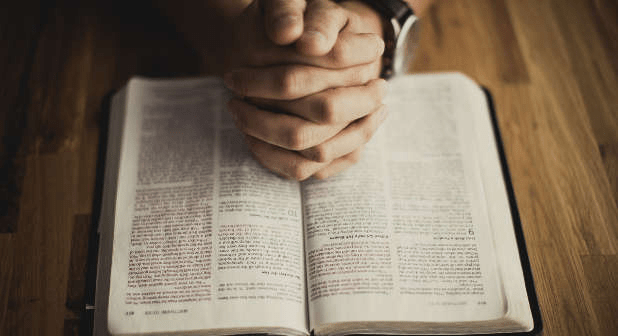
The Lord was plainspoken about the need to intimately know the Law given to the people and to continually meditate upon it. Being careful to do everything written within it, Joshua would find both the courage and the wisdom to lead the people to victory.

It still remains true for all God’s people that faithful knowledge, sage wisdom, and careful adherence to Holy Scripture comes through meditation upon its contents. 

There is a great need amongst believers to continually ruminate on God’s Word. We live on a broken planet, filled with all sorts of adversity, hardship, difficulty, and challenge to living a committed spiritual life. And so,

we may sometimes wonder how to address and deal with it all; our problems might seem as large as taking the Promised Land. 

The place to begin is by going to the Word of God – not so much in an anxious, hasty, or impatient question-and-answer sort of way which looks for a quick response; but instead, in a slow, deliberate, contemplative way. 

Lasting and genuine spirituality, as well as a sense of settled success, comes not only through acknowledging the importance and integrity of Scripture; one must know it’s contents, and allow it’s wisdom to saturate the soul through consistent and continual meditation.

Scripture memorization is a discipline worth pursuing. Having large chunks of the Holy Bible in our minds and hearts helps us in the crucible of challenging situations and adverse circumstances. 

What’s more, when doing the everyday pedantic and tedious work, we can engage our minds in the practice of contemplation on those verses we have committed to memory. Meditation on God’s Word is a necessary practice if we want to have success in living a genuinely well-rounded life.

Courage and meditation are a package deal. Bravery and contemplation are meant to be wed together. One rarely comes without the other – which means the realization of our good dreams, for both us and the world, needs the practice of Scripture meditation.

God Almighty, my delight is in your law, and on it I meditate day and night. (Psalm 1:2)

O how I love your law! It is my meditation, my food and drink, all day, every day. (Psalm 119:97)

I will meditate on your precepts and honor your ways in all I do and say. (Psalm 119:15)

I am determined to lift my hands to your commandments, which I love; and I will meditate on your statutes. (Psalm 119:48)

I look forward to the wee hours of the night because it provides me the space and the quiet to meditate on your word. (Psalm 119:148)

In fact, I meditate on all your doings through both day and night; I ponder and consider the works of your hands. (Psalm 143:5)

Amen.

Take the Path of Peace (Zechariah 1:1-17)

Michelangelo’s depiction of the prophet Zechariah, Sistine Chapel, Rome

In the eighth month of the second year of Darius, the word of the Lord came to the prophet Zechariah son of Berekiah, the son of Iddo:

“The Lord was very angry with your ancestors. Therefore tell the people: This is what the Lord Almighty says: ‘Return to me,’ declares the Lord Almighty, ‘and I will return to you,’ says the Lord Almighty. Do not be like your ancestors, to whom the earlier prophets proclaimed: This is what the Lord Almighty says: ‘Turn from your evil ways and your evil practices.’ But they would not listen or pay attention to me, declares the Lord. Where are your ancestors now? And the prophets, do they live forever? But did not my words and my decrees, which I commanded my servants the prophets, overtake your ancestors?

“Then they repented and said, ‘The Lord Almighty has done to us what our ways and practices deserve, just as he determined to do.’”

On the twenty-fourth day of the eleventh month, the month of Shebat, in the second year of Darius, the word of the Lord came to the prophet Zechariah son of Berekiah, the son of Iddo.

During the night I had a vision, and there before me was a man mounted on a red horse. He was standing among the myrtle trees in a ravine. Behind him were red, brown and white horses.

I asked, “What are these, my lord?”

The angel who was talking with me answered, “I will show you what they are.”

Then the man standing among the myrtle trees explained, “They are the ones the Lord has sent to go throughout the earth.”

And they reported to the angel of the Lord who was standing among the myrtle trees, “We have gone throughout the earth and found the whole world at rest and in peace.”

Then the angel of the Lord said, “Lord Almighty, how long will you withhold mercy from Jerusalem and from the towns of Judah, which you have been angry with these seventy years?” So the Lord spoke kind and comforting words to the angel who talked with me.

Then the angel who was speaking to me said, “Proclaim this word: This is what the Lord Almighty says: ‘I am very jealous for Jerusalem and Zion, and I am very angry with the nations that feel secure. I was only a little angry, but they went too far with the punishment.’

“Therefore this is what the Lord says: ‘I will return to Jerusalem with mercy, and there my house will be rebuilt. And the measuring line will be stretched out over Jerusalem,’ declares the Lord Almighty.

“Proclaim further: This is what the Lord Almighty says: ‘My towns will again overflow with prosperity, and the Lord will again comfort Zion and choose Jerusalem.’” (New International Version)

God hulking-out isn’t something you want to see repeated, insisted the prophet.

Zechariah directed his message to the Jews returning from their exile in Babylon. He reminded them that their parents and forebears had been called to repent and return to the Lord. They didn’t. Hence, the Babylonian exile. Big hint from the prophet to the people: Don’t ever do that again. Things will get angry, large, and green if you do.

Zechariah’s generation was being given a chance: To live into God’s covenant and law; to hold fast onto their identity as God’s people.

The people listened to the prophet. They expressed their repentance and a desire to turn from past evil ways and embrace the ways of the Lord. And the returning exiles also acknowledged and accepted God’s judgment. The returning exiles understood that, as a people, they deserve the consequences to centuries of neglecting justice, mercy, and humility.

Every generation of believers must learn from the past. Not only do they need to receive the teachings and traditions of those who went before them, but each generation must also struggle with how to put that teaching and tradition into practice.

The past needs to be squarely faced and deliberately pulled into the present. That is the way a genuine hope is born, giving direction for the future. In other words, old words and ways from the past need new experiences in the present; only by doing this will there be guidance.

Bring in your kingdom so that your will is done on earth as it’s done in heaven. (Matthew 6:10, CEB)

Today’s Old Testament lesson includes the first of eight night visions from the prophet Zechariah. The gist of the first prophetic oracle is a message of assurance and comfort: God will restore. The Lord will renew.

Divine intervention is about to happen in the rebuilding of the temple – a physical example of the spiritual reality that is happening. Just as the ancient temple was being restored for new generations of worshipers, so the people were being renewed to be an example of piety and fidelity to God for millennia to come.

Peace and prosperity will again be realized.

Throughout Scripture, trees are a symbol of a thriving and flourishing life. The myrtle tree is a sign of God’s promise to bring new life, branching out to spread into the next generations. Like all trees, the myrtle needs plenty of moisture when young. Yet, it is distinctive in that the myrtle tree can tolerate drought, grow despite limited soil, and remain hardy when it becomes mature.

Your anger lasts a little while,
but your kindness lasts
    for a lifetime.
At night we may cry,
but when morning comes
    we will celebrate. (Psalm 30:5, CEV)

“Tolerate,” “grow,” and “remain” are anything but passive words. People are more than mere observers. “Repent” and “return” and “renew” are verbs. There is a great deal of activity to do. A divine/human cooperation needs to occur. On God’s end, even the angels get involved in the action. What’s happening here is both heavenly and earthly business.

Relational dynamics between God and God’s people are to be a dialogue and not a one-sided monologue. The Lord and the present generation are to demonstrate for future peoples how peace is actually realized and enjoyed.

The Vision of Zechariah, by Unknown artist, c.1300 C.E., Sicily

Like all biblical visions, Zechariah’s is not readily understandable. Nobody is sure about what the symbolism is behind the vision’s horses. Yet, I’ll venture to say that it’s the colors which are significant: red is the color of action; brown is a color of stability and fertility; and white represents purity and holiness. Red, brown, and white mixed together creates a beige color.

Beige is an earthy and dependable color. It’s an inherently welcoming and calming color, offering warmth and symbolizing harmony and comfort. Together, with the horses we have a representation of strength, stability, and structure. They are signs of peace and rest, of God’s shalom.

Spiritual wholeness, moral integrity, relational harmony, and settled peace don’t just magically happen. 

For the Christian, peace was bought at a price – the blood of Jesus. (Colossians 1:20)

Peace must be both passively received and actively pursued. (Ephesians 4:3)

Practices of peace need to be engrafted into our lives so that we might daily experience it. (Romans 14:13-15:7)

The name “Zechariah” is a Hebrew word meaning, “God remembered.” God has not forgotten divine promises. 

The time has come to take hold of the vision God had from the very beginning to walk with humanity in continual fellowship and happiness in the garden, a place of abundant growth, beauty, and health – a place of peace and rest.

The happiest, fully rested, and most peaceful people and nations on earth continually find a steady stream of joy in their families, their rituals/traditions, and their religion.

To find joy and happiness in life is to find peace and rest. And peace is something to be shared, to be passed onto others.

“The peace of Christ be with you.”

“And also with you.”

Such ritual words and practices are reminders of continually returning to the Lord and finding simplicity and satisfaction in Jesus.

In observing and celebrating the Lord’s Table, we find our penultimate remembrance of how peace was achieved, as well as our supreme participation in the triune God.

Perhaps, then, peace and prosperity will extend their tree-like branches over the earth and into the next generations.

Grace to you and peace from God our Father and the Lord Jesus Christ.

Peace before us,
Peace behind us,
Peace under our feet.

Peace within us,
Peace over us,
Let all around us be peace.

Christ before us,
Christ behind us,
Christ under our feet.

Christ within us,
Christ over us,
Let all around us be Christ. – a Navajo Prayer

Speaking Truth to Power (Jeremiah 26:1-15)

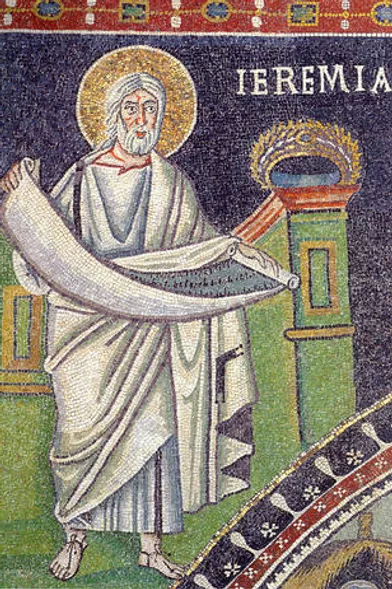
The prophet Jeremiah, 6th century mosaic, Ravenna, Italy

Early in the rule of Judah’s King Jehoiakim, Josiah’s son, this word came from the Lord: The Lord proclaims: Stand in the temple courtyard and speak to all the people of the towns of Judah who have come to the temple to worship. Tell them everything I command you; leave nothing out. Perhaps they will listen, and each will turn from their evil ways. If they do, I will relent and not carry out the harm I have in mind for them because of the wrong they have done. 

So tell them, The Lord proclaims: If you don’t listen to me or follow the Instruction I have set before you—if you don’t listen to the words of the prophets that I have sent to you time and again, though you haven’t listened, then I will make this temple a ruin like Shiloh, and this city I will make a curse before all nations on earth.

The priests, the prophets, and all the people heard Jeremiah declare these words in the Lord’s temple. And when Jeremiah finished saying everything the Lord told him to say, the priests and the prophets and all the people seized him and said, “You must die! Why do you prophesy in the Lord’s name that ‘this temple will become a ruin like Shiloh, and this city will be destroyed and left without inhabitant’?” Then all the people joined ranks against Jeremiah in the Lord’s temple.

When the officials of Judah heard these things, they went up from the royal palace to the Lord’s temple and took their places at the entrance of the New Gate of the Lord’s temple. The priests and the prophets said to the officials and all the people: “This man deserves to die for prophesying against this city as you have all heard firsthand.”

Jeremiah said to all the officials and to all the people, “The Lord sent me to prophesy to this temple and this city everything you have heard. So now transform your ways and actions. Obey the Lord your God, and the Lord may relent and not carry out the harm that he’s pronounced against you. 

But me? I’m in your hands. Do whatever you would like to me. Only know for certain that if you sentence me to death, you and the people of this city will be guilty of killing an innocent man. The Lord has in fact sent me to speak everything I have said to you.” (Common English Bible)

When it comes to the spiritual and religious life, on the one hand, we hold the joy and contentment of divine connection and peace; and, on the other hand, we hold the sadness that many turn their backs on divine realities. In Christian terms, Jesus is both the cornerstone of faith and the stone which causes people to stumble and fall. (1 Peter 2:8)

Frankly, the Lord is not okay with cruel injustice, hollow worship, and inattention to both the divine and human. There is a way to make things right. But not everyone wants that. Systemic evil persists because there are always those who benefit from the current structures of power – and they care little about how it impacts those on the underbelly of their control.

Things may be going well for a large chunk of people. And, conversely, things may not be going well at all, for an even larger group of folks. Therefore, it is necessary to acknowledge that the world is not only good, but also quite broken. We must speak truth to power. I understand that this is no easy task, because rarely are things simply black and white, all good or all bad.

Jeremiah preaches in the temple gate, a woodcut by Unknown artist, 1886

In the prophet Jeremiah’s day, it was not that his opponents were pure evil with no acknowledgment of God. Rather, the problem was that the power brokers in Judah tried to keep a strict separation of religion from everything else; they were perfectly fine with God, that is, if the Lord would stay in the temple where he belonged.

But Jeremiah would have none of this sort of mentality and behavior. Keeping Yahweh out of matters of social justice, geopolitics, and institutional governance led to severe humanitarian problems. Jeremiah became God’s voice to a generation of people who ignored the divine in everything but religious ritual.

Bifurcating worship and work disconnects daily life from divine resources. Without God infused in all of life, a lack of grace fills the empty places. What’s more, the sovereign Lord can neither be silenced nor dismissed; God will find a way to accomplish peace and justice for the common good of everyone, and not just the few.

The heart of Jeremiah’s message was for king and people to be obedient in all of life, to recenter themselves around God’s law – not just the religious bits but the social ones, as well. Jeremiah did not proclaim something new. He was calling those in places of power and authority to a proper Torah observance.

The true needs and interests of our communities can never be addressed and lifted-up in the narrow self-serving interests of persons in power who turn a blind eye to anyone unlike them.

The needs and interests of our world lie in becoming who we were designed to be from the beginning: A people belonging to God, tapping into the deep reservoir of light and spirituality within us. It is to acknowledge the image of God inside us all.

We are to follow in the way of grace and truth. There is to be no division between the sacred and the secular because, for the Christian, Jesus is Lord of all.

We are to continually use our voice for both praise and prophecy, for shouting celebration to God and for speaking truth to power.

Holy God, the gracious Sovereign of all, we give you praise for your steadfast love toward us, your people. Keep us grounded in humility, sensitive to sin, attentive to that which is just and right, merciful in all things, pure in worship, and peace-loving through Christ our Lord in the strength of the Spirit. Amen.

Night Prayer (Psalm 119:49-56)

Remember your promise to me, your servant;
    it has given me hope.
Even in my suffering I was comforted
    because your promise gave me life.
The proud are always scornful of me,
    but I have not departed from your law.
I remember your judgments of long ago,
    and they bring me comfort, O Lord.
When I see the wicked breaking your law,
    I am filled with anger.
During my brief earthly life
    I compose songs about your commands.
In the night I remember you, Lord,
    and I think about your law.
I find my happiness
    in obeying your commands. (Good News Translation)

During a typical day, I keep busy and am engaged with applying an understanding of the spiritual life to my work. At bedtime, sometimes the job goes with me.

Stillness and silence can sometimes, ironically, become an alchemy of restlessness and noise. I toss and turn, the racing thoughts in my head refusing to slow down and rest.

Insomnia happens to everyone, some more than others. We all have experienced the inability to sleep. 

There are some who choose not to sleep. They arise in the middle of the night – not because of insomnia or sleep disorders – but because they intentionally wake for prayer. 

Yes, many monastics routinely pray in the night. Yet, there are many lay people who do so, as well. 

In my own times of trying to sleep, I often think about those persons who are purposefully trying to stay awake and deliberately keeping watch in prayer during the night. I, then, reflexively go to the biblical psalms.

Along with the psalmist, and in solidarity with my Christian brothers and sisters in this hemisphere who are maintaining a prayerful spirit, I reflect at night on the character and nature of the Lord who created both the sun to govern the day and the moon as a faithful witness in the dark.

The psalmist seems to be awake at night because he is frustrated and upset. It irks him that there are people who spurn wise instruction and aim their contempt at those trying to live according to God’s Law.

Although insomnia can certainly be the result of angry or unwanted feelings, maybe it is something else altogether. Perhaps the psalmist simply chose to be awake at night and do some theological reflection on God, others, and himself.

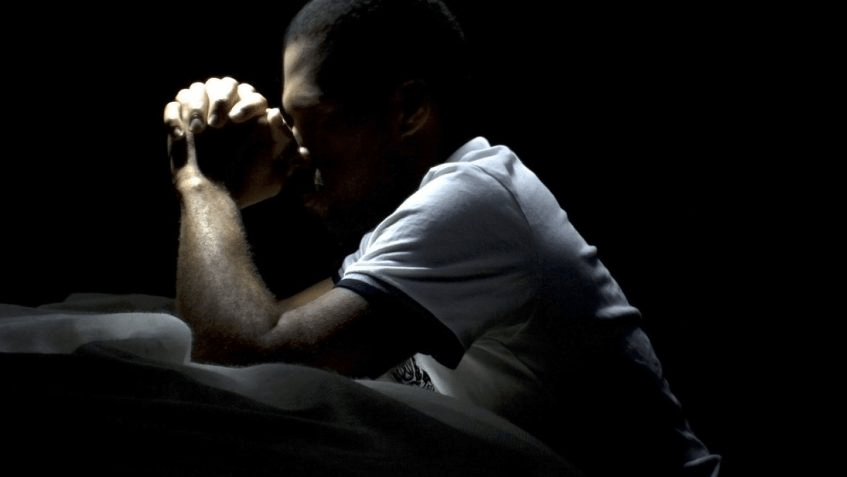
At various times in my life, I have decided to set my alarm for two o’clock in the morning to pray. I know it may sound crazy to some. Yet, this discipline has taught me something valuable: God is Lord over all chronological time and every season. I am a servant. I am neither lord nor master. 

This nightly exercise of weaving my life around a set time of prayer has caused me to learn that I have spent far too much of my life trying to make time bend to my wishes. 

It’s actually delusional for me to believe that I somehow control time – that I can cause the relationship between events to be fast or slow. It is all really an illusion – that I can control the clock. Time marches forward, seasons come and go, and we are a vapor which lasts only a moment.

The only control I possess is self-control. Anything beyond this is nothing but a pathetic attempt at manipulation.

Whether we find ourselves awake in the night because we cannot sleep, or intentionally choose to use the night for connecting with God, the wee hours of darkness afford us a unique opportunity to ponder the Lord’s promises, commands, attributes, and works. 

The next time you find yourself awake at night, try avoiding the television and a zombie-like state of hoping for sleep. Try using the night-time for reflecting on the Lord in ways you might not have considered during the day. Pray. Reflect. Consider. In doing so, you may find a blessing of light within the dark.

Keep watch, dear Lord, with those who work, or watch, or weep this night, and give your angels charge over those who sleep. Tend the sick, Lord Christ; give rest to the weary, bless the dying, soothe the suffering, pity the afflicted, shield the joyous; and all for your love’s sake. Amen.