1 Timothy 1:1-11 – A Plea for Grace and Truth

From Paul, an apostle of Christ Jesus by order of God our Savior and Christ Jesus our hope—

To Timothy, my true son in the faith:

May God the Father and Christ Jesus our Lord give you grace, mercy, and peace.

I want you to stay in Ephesus, just as I urged you when I was on my way to Macedonia. Some people there are teaching false doctrines, and you must order them to stop. Tell them to give up those legends and those long lists of ancestors, which only produce arguments; they do not serve God’s plan, which is known by faith. 

The purpose of this order is to arouse the love that comes from a pure heart, a clear conscience, and a genuine faith. Some people have turned away from these and have lost their way in foolish discussions. They want to be teachers of God’s law, but they do not understand their own words or the matters about which they speak with so much confidence.

We know that the Law is good if it is used as it should be used. It must be remembered, of course, that laws are made, not for good people, but for lawbreakers and criminals, for the godless and sinful, for those who are not religious or spiritual, for those who kill their fathers or mothers, for murderers, for the immoral, for sexual perverts, for kidnappers, for those who lie and give false testimony or who do anything else contrary to sound doctrine. That teaching is found in the gospel that was entrusted to me to announce, the Good News from the glorious and blessed God. (Good News Translation)

We all need to be continually reminded of the supreme, overarching, and divine imperative of love. Love God and love neighbor is the summation of all other commands in Holy Scripture.

Whenever we lose sight of love as the guiding ethic of law, we stray into foolish discussions which are always unhelpful, and oftentimes harmful. As a result, there is today a plethora of shortsighted and small-hearted pundits who don’t even understand their own speech.

The irony is that those who rail against particular sins are themselves the most egregious sinners of all; and the ones calling for observance of Christian ethics are themselves acting unethically.

While there a large chunks of the Christian world who condemn same sex relations because “the Bible says it is sin,” they never question the translation of what they’re reading in Scripture – failing to realize that the original scriptures were not authorized by King James to be written in English.

Translation is no easy task. Believe me, I’ve done my share of it. Unfortunately, many translations simply go with “homosexuality,” even though it’s difficult to translate from the original Greek. It seems to me that the Good News Translation of “sexual perverts” is about as accurate as one can get.

The word has much more to do with pederasty (same sex relations with a minor) and rape than it does with all same sex relations. If we can easily understand the nuances of opposite sex relations, then why not same sex relations?

Frankly, I am genuinely grieved, and I lament over how Christians talk to one another about these matters.

On the one hand, there are the “truth tellers.” They have a passion for holiness and a zeal for righteousness. They point out that Jesus got angry and did not put up with people watering down the gospel. Jesus, for them, is the Divine Warrior who is ready and armed to oppose same sex marriage.  

On the other hand, there are the “lovers.” They are sincerely hurt by chatter about homosexual sinners bound for hell. For them, Jesus loves, period. He would never hurt a fly, drives a Prius, and tries to leave the most loving impact he can on the earth without a harmful spiritual footprint or a rebuke from anyone.

I, of course, have painted two extremes. But therein lies the point: The rhetoric from both hands is extreme, as if, somehow, love and truth cannot co-exist together.

Methinks one of the great problems is that few people want to take the time to listen; few are interested in understanding the other.  

Failing to possess a listening spirit means there isn’t much poverty of spirit, very little mourning over personal sin, and even less meekness.  

Instead, we look down our noses at one another.  

But is listening really that important?  Yes, it is.  

Jesus said, “If your brother sins against you, go to him and show him his fault. But do it privately, just between yourselves. If he listens to you, you have won your brother back.” (Matthew 18:15, GNT)

It’s hard to listen when people are taking pot shots at each other through social media and huddling together in their own small worlds without any diversity or contrary thought. The aforementioned quote from Jesus presupposes relationship; and there seems to be little of it going around.

“Truth teller,” will you take the time and effort to build a relationship with someone, or even a group of people, very different from yourself? Will you seek to ask questions, listen, and understand without judgment or making comments? Are you able to see the image of God in them?  

“Lover,” do you have room to love someone who is at the complete opposite end of your own understanding? Are you willing to take the time and effort to see why this person or group of people are so passionate about the issue – without believing that you already know why they think the way they do? Can you see that God’s love is big enough to extend to the unloving?

Everyone has their hot button issues in which people are at very different ends of the spectrum of thinking.  

What I am pleading for is that we in the church must take the lead by having the maturity to learn how to talk to one another without assuming we already know what the other side is all about. We don’t. And we won’t unless we listen. And we won’t listen unless we are humble; we will never be humble unless we realize our poverty of spirit before God.

Please don’t turn the good news of grace into the bad news of judgment. That, perhaps, is the worst blasphemy of all. Instead, may you embrace the mercy and peace which has been graciously given to you at the cost of great suffering.

Almighty God, from whom all thoughts of truth and peace proceed: kindle, we pray, in the hearts of all, the true love of peace and guide with your pure and peaceable wisdom those who take counsel for the nations of the earth – so that in tranquility your kingdom may go forward, till the earth is filled with the knowledge of your love; through Jesus Christ your Son our Lord, who is alive and reigns with you, in the unity of the Holy Spirit, one God, now and forever. Amen.

Luke 13:10-17 – Healing on the Sabbath

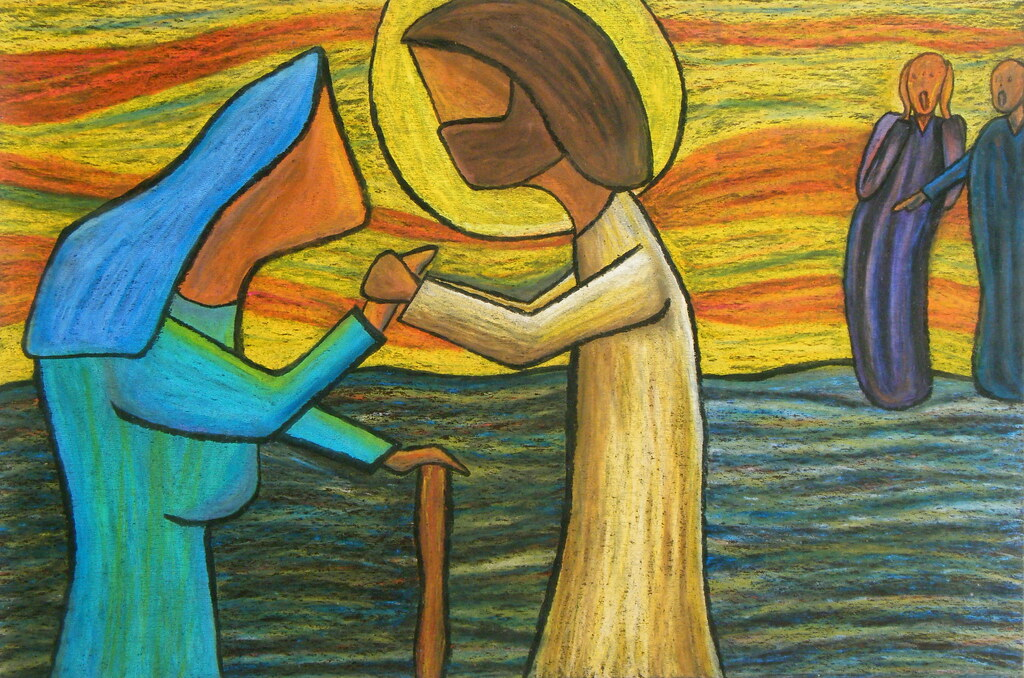
Jesus Healing the Bent-Over Woman by Glenda Skinner-Noble

On a Sabbath Jesus was teaching in one of the synagogues, and a woman was there who had been crippled by a spirit for eighteen years. She was bent over and could not straighten up at all. When Jesus saw her, he called her forward and said to her, “Woman, you are set free from your infirmity.” Then he put his hands on her, and immediately she straightened up and praised God.

Indignant because Jesus had healed on the Sabbath, the synagogue leader said to the people, “There are six days for work. So come and be healed on those days, not on the Sabbath.”

The Lord answered him, “You hypocrites! Doesn’t each of you on the Sabbath untie your ox or donkey from the stall and lead it out to give it water? Then should not this woman, a daughter of Abraham, whom Satan has kept bound for eighteen long years, be set free on the Sabbath day from what bound her?”

When he said this, all his opponents were humiliated, but the people were delighted with all the wonderful things he was doing. (New International Version)

The way in which we interpret events says a lot about who we are and what we need. The story sounds different, depending upon which person(s) are viewing it….

The Crippled Woman

She had gotten used to looking at people out of the corner of her eye, by looking up and sideways.

After eighteen years, she could hardly remember any other way of seeing the world. On this particular Sabbath, there was a special excitement at the synagogue, where she regularly went to worship. A Galilean preacher and prophet, Jesus of Nazareth, had arrived in town and would be teaching there.

She and the others in town had heard reports about Jesus–how he talked about God’s reign arriving soon and how he healed sick people. She was not sure how many of the rumors to believe, but she was trying not to get her hopes up. Her life already had too many disappointments to count.

When she entered the synagogue, the place was abuzz. As Jesus began to teach, however, the room was hushed. Moments later, his words turned from teaching to invitation. He had caught her eye–no mean feat, given that he had to lean over and incline his head to do so. “Come here,” he said to her. She slowly made her way to the front of the assembly.

Jesus and the Bent-Over Woman by Marg Mowczko

What happened next amazed the whole congregation. “Woman, you are set free from your ailment.” When this man, Jesus, spoke those words and put his hands on her broken, bent body, she felt power surge through her. Without hesitation, she straightened her once crooked back. She stood tall and praised her God . . .

The Synagogue Leader

He has come to the synagogue every Saturday. Each Sabbath day the synagogue leader stands and faithfully reads the Torah. On this particular Sabbath, a Galilean preacher is coming. Some say his is a prophet, even Messiah. The leader has seen his share of would-be messiahs come and go, claiming to speak for God. He doubts anything will come of this. Just another man.

But what is this? A synagogue full of people! And just as the leader thought this may just be good for the people, getting them to pay attention to the law and the prophets, this preacher calls a woman forward, and of all things, heals her!? This is not good. This is not how things are to be done!

In the Torah, the seventh day was set aside by God for Israel’s rest. Work is prohibited. Non-life-threatening illnesses and conditions can be treated on the other six days. The synagogue leader is not opposed to healing. In fact, he welcomes it. But at an appropriate time, on the right day. He says to himself, “This all must be done decently and in order. Who does Jesus think he is? We cannot have such insubordination amongst the people, and in the synagogue, of all places!”

And so, the synagogue leader is beside himself with both anger and fear that the Law will not be properly upheld, and that God will be displeased and take away their place of worship.

Coptic Church depiction of Jesus healing the crippled woman, 12th century

Jesus

Jesus comes, looking forward to being with the people in the synagogue on the Sabbath. He understands that since the Sabbath law commemorates and celebrates Israel’s liberation, it ought to be a day for enacting — not inhibiting — the present-day liberation of Israelites. Yes, it is a good day for a healing. Every day is a good day for healing.

As Jesus enters the synagogue, it is full of people, charged with the atmosphere of anticipation. During the service, Jesus sees a woman. Although he rightly discerns that the synagogue leader and some of the congregants will not be happy about this, he calls her forward, intent on freeing her from her satanic bondage. And also knowing that placing his hands upon this woman will appear scandalous, he does it anyway.

Sure enough, the synagogue leader is livid. The leader feels the need to correct Jesus. Yet, Jesus unmoved by this, calmly retorts, without budging an inch, that given the custom of providing water for thirsty livestock on the Sabbath, it is surely appropriate to heal a long-suffering Israelite on the Sabbath.

In none of this does Jesus abolish the Sabbath commandment. Rather he follows it faithfully. Jesus enters an ongoing Jewish debate about how to interpret the Sabbath law, locating himself at the less stringent end of the opinion spectrum.

Jesus is determined to uphold the spirit of the Law, to practice compassion, to do what leads to human betterment. He is doing God’s will. He is allowing the Sabbath to serve this old woman, rather than letting the woman serve the Sabbath as a bent over crippled person.

The People

They come, as they do each Sabbath, to gather and listen to Torah read, to pray to God, and to strengthen one another in their common faith. Yes, the synagogue leader can be a bit tedious. The synagogue service can be a bit boring. But he is a good man doing good work.

Today, however, is different. Jesus, the one they have heard so much about, is there. And what a synagogue service it is! Jesus teaches us, and with authority! But, to our astonishment, he calls one of our women forward. And he touches her! Then heals her! This is the woman who has been tortured with such crippling pain and bent over all the time!

Oh, my, the synagogue leader is upset! We are so full of joy for our healed sister, yet also confused. This is a good thing that Jesus did – God’s kingdom breaking into this world. Yet, here is the synagogue leader and Jesus debating Torah. Does freedom from Satan only come on six days, not seven? Surely, God is especially honored on such a holy day as the Sabbath to do such important work. But work, it is. And Jesus did it. Is this really a good thing, or not?

Syrian Church depiction of Jesus and the crippled woman, 6th century

Conclusion

This is a story about the role and function of our religious traditions, our claims about what could and should be practiced, when and where it ought to take place, and who is allowed within the walls of our faith communities. Special religious practices may become hindrances to including folks. We must be diligent to recognize what theological ideas we hold dear that disallow full participation from others.

Jesus was no Sabbath breaker. He operated well within Jewish tradition of the day. At the same time Christ is also not one to allow the tradition to exclude people from access to the community and the potential for their healing. Even though the synagogue leader and some others disagreed, many in the crowd agreed.

Today’s story is about the community and addresses questions such as, “What kind of community do we want to be?” “Do our religious traditions help us to become that kind of community or do they hinder it?” “If we want to be a healing community, how can we make that happen?”

O God the Father, whose will for us and for all your people is health and salvation, O God the Son, who came that we might have life and have it in abundance, O God the Holy Spirit, whose indwelling makes our bodies the temples of your presence, have mercy on us.

O Triune God, we pray you to hear us, and that you will grant your grace to all who stand in need of healing of both of body and spirit, and lead them to look with confidence in you;

That you will grant patience and perseverance to all who are disabled by injury or illness, and increase their courage;

That you will grant peace to all who are troubled by confusion or pain, and set their minds at rest;

That you will grant relief from suffering to all sick children, and give them a sure sense of your tender love and care;

That you will grant rest to all whose increasing years bring weariness, distress, or loneliness, and give them the abiding comfort of your presence;

That you will grant confidence to all about to undergo surgery or difficult procedures, and keep them free from fear;

That you will grant purpose to the church as it seeks to carry on Christ’s ministry of healing to suffering humanity, and keep it always true to the gospel of Christ;

That you will grant skill and compassion to doctors, nurses, technicians, aides, and all who are called to  practice medical arts, and make strong their dedication to help others;

That you will grant to all people the peace of quiet sleep and the joy of resting in your everlasting arms, that we may rejoice in your care while we are on earth, and in the world to come, have eternal life.

O God, who in Jesus Christ called us out of darkness into your marvelous light; enable us always to declare your wonderful deeds, thank you for your steadfast love, and praise your with heart, soul, mind, and strength, now and forever. Amen.

Luke 6:1-5 – Lord of the Sabbath

One Sabbath Jesus was going through the grainfields, and his disciples began to pick some heads of grain, rub them in their hands and eat the kernels. Some of the Pharisees asked, “Why are you doing what is unlawful on the Sabbath?”

Jesus answered them, “Have you never read what David did when he and his companions were hungry? He entered the house of God, and taking the consecrated bread, he ate what is lawful only for priests to eat. And he also gave some to his companions.” Then Jesus said to them, “The Son of Man is Lord of the Sabbath.” (New International Version)

We Christians tend to be rather hard on the Pharisees. Yet, most of them, much like us, were just trying to uphold their understanding of God’s commands. They wanted to do God’s will. And so did Jesus.

The problem in the New Testament Gospels is that Jesus and some of the Pharisees (not all of them, e.g., Nicodemus) were at loggerheads about how to view and interpret the Law. Jesus wanted them to see the purpose of the law, the heart and spirit of the law, and who was the lord of the law. For Jesus, many of the Pharisees were spiritually blind. They either would not or could not discern who Jesus was and what he was all about.

So, when we refer to spiritual blindness, let’s have a bit of humility about it. Although for the Apostle Paul, a dramatic event happened in which the scales of blindness (both physically and spiritually) fell from his eyes, most folks have a gradual ability to see, an awakening which requires a process of time and growing awareness. This was true of Christ’s original disciples. They believed, yet their faith was an extended process over three years. It wasn’t until after Christ’s resurrection and Pentecost that their faith became complete.

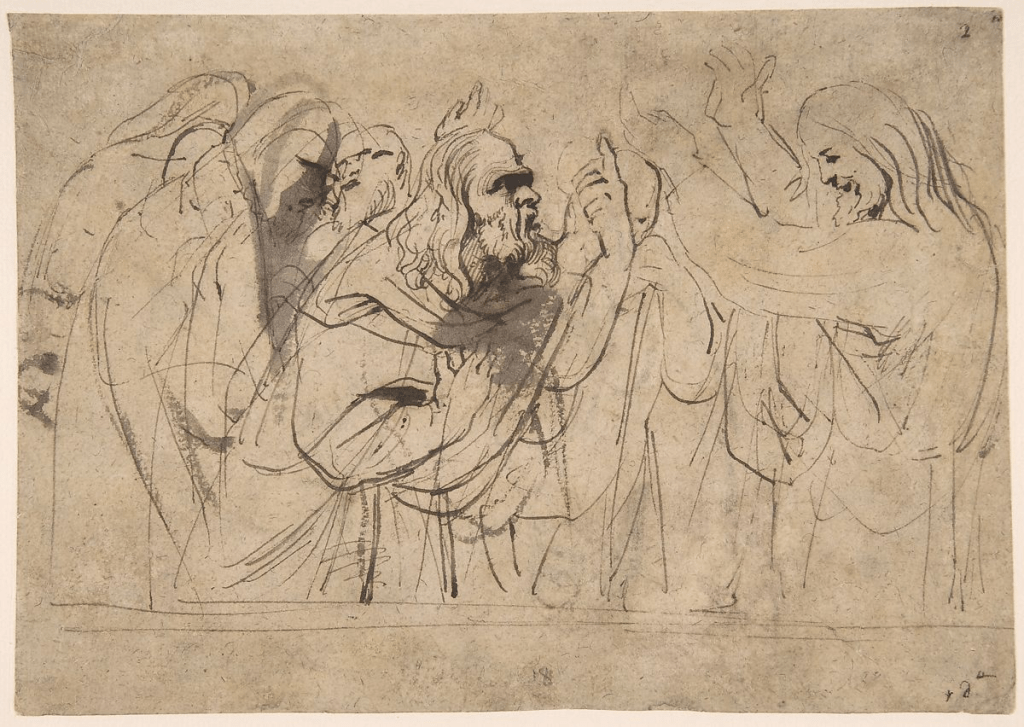
Christ and the Pharisees by Belgian artist Anthony van Dyck (1599-1641)

Jesus didn’t like it that those who should know better, those persons for whom the light of God’s truth ought to be clear and present, were in darkness. When leaders are blind, then we have the blind leading the blind, and nobody finds the door of God’s kingdom.

Many of the Pharisees in the New Testament, most of the heretics in the early church, and some of the spiritual phonies of today are actually not charlatans, that is, they are not deliberately trying to deceive or lead others astray; they are not trying to keep people out of God’s kingdom – they think they are doing the right thing when they are actually leading others astray. 

One of the eye-opening realities I discovered, when I first began studying church history, is that the early heresies condemned at the church councils were doctrines promoted and put forth by men who were not evil bad people – they were just sincerely misguided. They thought they were helping the church better understand the nature of God and Christ, when in fact they were promoting unhealthy doctrine – unintentionally closing the door of God’s kingdom to some people. 

And later when I worked on my master’s thesis in nineteenth century American religious history, I read hundreds of sermons from southern preachers before the American Civil War. I learned that they had a biblical defense for the institution of black chattel slavery. Many of them were pastors of large churches and led many people to Christ, that is, white people. They were slamming the door of God’s kingdom in the faces of African-Americans, and teaching others to do the same.

We can unwittingly slam the door of God’s kingdom in the faces of people when we say God’s grace is for all and then turn around and avoid particular people; or whenever we have explicit written statements or rules that exclude people from serving or being served; or when we bind people to human traditions and practices instead of Holy Scripture. 

The seven deadly words of the Church, believing it is doing the Lord’s will, is, “We’ve-never-done-it-that-way-before… We cannot have somebody out in the field picking heads of grain and rubbing them in their hands. That’s reaping; it’s work; and you can’t do that on the Sabbath.”

Never mind that there are people trying to eat or attempting to enter the kingdom of God. So, we lose sight that the Law was meant to benefit people, to help them thrive and flourish, to lead them into the grace and knowledge of God. The Law gets turned on its head by becoming a heavy burden to carry instead of an easy yolk which brings freedom.

No matter the issue, the last word to everything is grace, God’s grace in Jesus Christ.  

Just as the priest in David’s day was gracious in giving him and his men the consecrated bread meant only for the priests, so Jesus was gracious in giving himself, the Bread of Life, for the benefit of the whole world.

For the Christian, the Law points to Christ, who is the Law’s fulfillment. Now, we carry one another’s burdens, and in doing so, we fulfill the Law of Christ.

O God the Holy Spirit, Sanctifier of the faithful: Make us holy through your abiding divine presence. Enlighten the minds of your people more and more with the light of the everlasting Gospel. Bring erring souls to the knowledge of our Savior Jesus Christ; and those who are walking in the way of life, keep them steadfast in faith to the end.

Give patience to the sick and afflicted and renew them in body and soul. Guard those who are strong and prosperous from forgetting you. Increase in us your many gifts of grace and make us all fruitful in good works. This we ask, O blessed Spirit, whom with the Father and the Son we worship and glorify, one God, world without end. Amen.

Isaiah 24:1-13 – Dehumanization Pollutes the Earth

The Lord is going to turn the earth into a desolate wasteland.
He will mar the face of the earth and scatter the people living on it.
The same will happen to people and priests,
male slaves and masters,
female slaves and masters,
buyers and sellers,
lenders and borrowers,
debtors and creditors.
The earth will be completely laid waste and stripped
because the Lord has spoken.

The earth dries up and withers.
The world wastes away and withers.
The great leaders of the earth waste away.

The earth is polluted by those who live on it
because they’ve disobeyed the Lord’s teachings,
violated his laws,
and rejected the everlasting promise.
That is why a curse devours the earth,
and its people are punished for their guilt.
That is why those who live on the earth are burned up,
and only a few people are left.

New wine dries up, and grapevines waste away.
All happy people groan.
Joyful tambourine music stops.
Noisy celebrations cease.
Joyful harp music stops.
People no longer drink wine when they sing.
Liquor tastes bad to its drinkers.
The ruined city lies desolate.
The entrance to every house is barred shut.
People in the streets call for wine.
All joy passes away,
and the earth’s happiness is banished.
The city is left in ruins.
Its gate is battered to pieces.

That is the way it will be on earth among the nations.
They will be like an olive tree which has been shaken
or like what’s left after the grape harvest. (God’s Word Translation)

A lot of people shy away from biblical passages, like today’s Old Testament lesson from Isaiah. Too negative, not enough positivity.

Like it, or not, Isaiah 24, along with many other texts of a similar vein, exist in Holy Scripture. And I insist we must pay attention to such texts of doom and gloom. For if we only choose to deal with the encouraging and inspirational texts of the Bible, we will have a severely truncated faith which will not stand in the hard times.

The voice I offer, however, isn’t a beat-you-up tone. I seek to have a pastoral voice that upholds the best of biblical ethics and human dignity. 

Because every person (and I do mean every person) on planet earth is created in the image and likeness of God, each individual human being is a person of worth and deserves respect and kindness.

People do and say terrible things every day. Because of that reality, it doesn’t mean God’s image has left or taken a vacation, or that someone deserves a pejorative label which stigmatizes and ostracizes them from the human family. 

For the Christian, the supreme ethic of life is love. We hold to the Great Commandment: Love God and love neighbor. All other commands of Holy Scripture hang on the commands to love, upheld by Jesus himself.

Jesus answered, “‘Love the Lord your God with all your heart, with all your soul, and with all your mind.’ This is the greatest and the most important commandment. The second most important commandment is like it: ‘Love your neighbor as you love yourself.’ The whole Law of Moses and the teachings of the prophets depend on these two commandments.” (Matthew 22:37-40, GNT)

It is because of the presence of God and Love that difficult biblical texts occur in Scripture. When people, in God’s image, defile that image through oppressing fellow image-bearers and turning from commands to live ethically and lovingly in the world, God has something to say about it. And we get texts like today’s from the prophet Isaiah.

Therefore, we must all ask ourselves if we are loving others in this world as intended by our Creator and Redeemer. 

We routinely hear, through social media posts, political pundits, religious prognosticators, and daily interactions around the water cooler, opinions laced with profound hate, disrespect, and misunderstanding.

Whenever disasters occur – whether yet another act of gun violence, a natural calamity, or economic ruin – there are a host of stories which surround them all. Some of those stories are heartwarming tales of people rushing in to bring comfort, solace, and support. And there are far too many stories of abject fear, ignorance, and calloused behavior directed at others, even victims, with selfish and misguided tools of wrath.

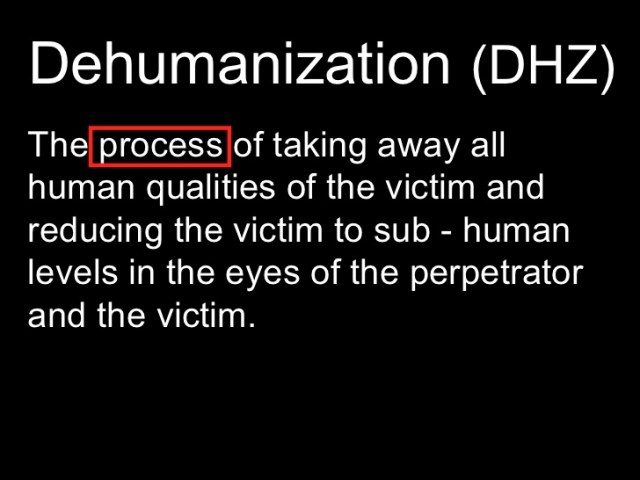
There is such a constellation of issues and problems to unpack and deal with in this world that I do not nor cannot even begin to try to do such a task. I only want to bring a small bit of light to the shadows of the human heart which inevitably tries to dehumanize others who do not agree with his/her opinion and group-think.

For example, there is no lack of people who persist in dehumanizing LGBTQ individuals and gay communities.  One man told me recently, in a matter-of-fact manner, that the Orlando, Florida shooting from 2016 was most likely a judgment from God upon homosexuals because of our government’s straying from godliness. 

Those in LGBTQ circles are quite familiar with this kind of speech. To label it correctly: It is hate speech – dehumanizing speech – the kind of attitude and talk which pollutes the world and raises the hackles of a holy and loving God. 

When people of any particular kind of group, whether gay or straight, Democrat or Republican, Christian or non-Christian, are verbally (and actually) mowed-down like animals, it is because they are being looked at as nothing but animals, or monsters, or anything but a human being.

The apple does not fall far from the tree of the knowledge of good and evil.

We must come to grips with the fact that every person killed on this planet is a destruction of God’s image. And we are not the judges of whether any loss of life is God’s judgment, or not. To make any sort of claim to knowing this is, at best, extreme hubris, and, at worst, germinating the seeds of a future holocaust of killing. 

Whenever any one person or group places a superimposed label upon another person or subculture of people of being monstrous, hateful, and undeserving of justice, then that person or group must come to grips with their own poverty of spirit and embrace the real love which Jesus has demonstrated and offers. And, if they don’t, they ought not be surprised when their tree gets shaken by God, or even cut down and thrown into the fire.

No matter what side one falls on, there is no biblical precedent or place to dehumanize another person or group of people, period. 

Christians and churches, especially, need to stop acting and reacting to the parts of culture and society they don’t like and start living and loving like Jesus by building relationships with a broad spectrum of groups and individuals.

It falls to the faith communities of this land to initiate love and to live above hate speech. And the onus is on Christians to model a supremely loving ethic toward all people.

I admit that many Christians do not have a good track record on this. And I further admit that I have observed an eerie silence from far too many of them in the face of great human tragedy, as if nothing of particular consequence has happened. 

This post is a very small and meager attempt on my part to offer something of the loving Christ to others. For, the church is nothing at all, if it isn’t all about Jesus and his gospel of grace.

Gracious Father, lead us from death to life, from falsehood to truth, from despair to hope, from fear to trust. Let peace fill our hearts and our world. Let us dream together, pray together and work together, to build one world of peace and justice for all, through the One who made peace possible, Jesus Christ, your Son, our Lord, who with you and the Holy Spirit reign as one God, now and forever. Amen.