Covenant Promises (2 Samuel 7:1-17)

Jerusalem. Photo by Anton Petrus

After the king was settled in his palace and the Lord had given him rest from all his enemies around him, he said to Nathan the prophet, “Here I am, living in a house of cedar, while the ark of God remains in a tent.”

Nathan replied to the king, “Whatever you have in mind, go ahead and do it, for the Lord is with you.”

But that night the word of the Lord came to Nathan, saying:

“Go and tell my servant David, ‘This is what the Lord says: Are you the one to build me a house to dwell in? I have not dwelt in a house from the day I brought the Israelites up out of Egypt to this day. I have been moving from place to place with a tent as my dwelling. Wherever I have moved with all the Israelites, did I ever say to any of their rulers whom I commanded to shepherd my people Israel, “Why have you not built me a house of cedar?”’

“Now then, tell my servant David, ‘This is what the Lord Almighty says: I took you from the pasture, from tending the flock, and appointed you ruler over my people Israel. I have been with you wherever you have gone, and I have cut off all your enemies from before you. Now I will make your name great, like the names of the greatest men on earth. And I will provide a place for my people Israel and will plant them so that they can have a home of their own and no longer be disturbed. Wicked people will not oppress them anymore, as they did at the beginning and have done ever since the time I appointed leaders over my people Israel. I will also give you rest from all your enemies.

“‘The Lord declares to you that the Lord himself will establish a house for you: When your days are over and you rest with your ancestors, I will raise up your offspring to succeed you, your own flesh and blood, and I will establish his kingdom. He is the one who will build a house for my Name, and I will establish the throne of his kingdom forever. I will be his father, and he will be my son. When he does wrong, I will punish him with a rod wielded by men, with floggings inflicted by human hands. But my love will never be taken away from him, as I took it away from Saul, whom I removed from before you. Your house and your kingdom will endure forever before me; your throne will be established forever.’”

Nathan reported to David all the words of this entire revelation. (New International Version)

What is a covenant?

A covenant is simply a contract or agreement between two or more parties. The Bible is a covenant document. The Old and New Testaments are really Old and New Covenants. The word “testament” is Latin for “covenant.” When God makes a covenant with people, it means they receive divine promises of what God will do; and, in response, the people have moral expectations or ethical responsibilities to follow. 

The ancient world operated on a covenant system. A nation or empire would conquer a city or territory and set up a covenant in which the conqueror promised protection, certain provisions, and left a military presence among them. In response, the conquered people were required to offer their allegiance and some of the goods and services of the land. 

God made a covenant with Abraham and promised that all the nations of the earth would be blessed through him. The only stipulation that God gave to Abraham was to leave and begin a new life in the land he would show him. (Genesis 12:1-3)

The Lord continued to work through Abraham’s descendants, the Israelites. They would be a kingdom of priests, testifying to the nations through a lifestyle of having God at the center of all they do. The people were expected to embody the Ten Commandments and be holy, thus reflecting the holiness of God.

The difference between earthly covenants and God’s covenant is that God saturates the divine covenant in love and grace – because the Lord cares about the divine/human relationship.

What do we learn about God through a covenant?

First and foremost: God never forgets nor reneges on divine promises. God was faithful to David by establishing a covenant, yet also spoke to him about his descendants. The Lord promised David a dynasty, a kingdom that would never end, a temple, and a father/son relationship with his progeny. 

Furthermore, God promised that divine love would never be taken away. The Lord shows continuous love to people, even when they go astray. Unlike the nations of the earth, the fickle nature of people, and the inconsistent commitment of others, God is a Being whose very nature is love.

In a world of broken families and severed relationships; of selfishness and trying to impose one’s will on another; of taking advantage of others; and in a world that is messed up and depraved because of sin and unfaithfulness, God stands as the consistent, never-changing Sovereign of Love who graciously blesses people. 

What sort of covenant is this?

Short answer: a covenant of grace. It’s demonstrated in how the tables are turned on David with grace. David intended on doing something for God. But the Lord completely turned it around and blessed him abundantly beyond what David could even ask or think. David had it in his heart to build a house for God, but God comes back and says that an enduring house (household and dynasty) will be built for David.

How does this covenant apply to Christians?

All the good and gracious promises given to Abraham, Moses, and David are all fulfilled in the person of Jesus Christ.  

The New Testament Gospels are steeped in the language and explanation that Jesus is the Son of David, the Promised One, Savior, Lord, Teacher, and Healer. He will save the people from their sins and bring them to a spacious kingdom full of the grace and love. 

Through the cross and resurrection of Jesus Christ we are brought into union with God and participate fully in all the promises of the New Covenant of love. Love the Lord your God with all your heart, soul, mind, and strength. Love your neighbor as yourself. All this love is personified in Christ.

Where is the covenant?

The Davidic Covenant is not limited to a specific place or a building. God is present with people wherever they go. 

A common understanding in the ancient world was that there were local gods, not a universal God over all the earth. The Jews were unique in the belief that there is not one square inch of this entire earth where God is not present. The Lord does not need a permanent structure because God is everywhere. 

We, as New Covenant people, are God’s temple. The Lord takes up residence within our lives. We possess covenant loyalty and faithfulness, continually, in the person of the Holy Spirit.

What do we learn about ourselves?

Timing is important. David had a good idea and good motives for wanting to house the Ark of the Covenant in a temple. Yet, God let David know that the timing was off. So, David would need to be patient and let his vision of a temple come to fruition with his son. 

However, that didn’t mean David was idle. By the time he died, his son Solomon had most of the building materials already stockpiled and ready for the temple construction. Waiting does not necessarily mean passivity. 

A vision for life or for ministry rarely is implemented quickly. It needs to grow and mature before it will bear fruit. Two sage questions to ask, therefore, are:

  1. Is the future I am imagining, a future that God desires, or do I have my ladder leaning on the wrong building?
  2. If I am imagining a good and gracious future, is it the right time for it to happen? 

We also learn about ourselves that we must bank on the promises of God – and trust in the person and work of Jesus because all of God’s promises are fulfilled in Christ. In Christ we are taught how to live, and by his wounds we are healed. Jesus is the hope of the world. 

There is grace to be found; forgiveness to be had; and dreams to be realized, if we are attentive to the promises given to us in Holy Scripture. Do not let your sanctified dreams die, because they might not yet have come to full term.

God’s direction for our lives is needed. We have responsibilities as God’s covenant people to be faithful and uphold the ethics of the kingdom, as expressed by Jesus in his Sermon on the Mount. (Matthew 5-7)

Perhaps what we learn most about ourselves is to surrender our plans to God. My life is not all about me. Most of the Christian life is about weaning ourselves away from our own thoughts and ingenuity, learning to submit to God’s plans for our lives. We must pray and not make assumptions, because after a night of prayer, the prophet Nathan withdrew his building permit for David.

Unless the Lord builds the house, those who build it labor in vain.

Psalm 127:1, NIV

The Lord is gracious, loving, and loyal to covenant promises. We are to live into what God is building on this earth: an ethical kingdom with people characterized by mercy, purity, and peace-making. 

Soli Deo Gloria.

Take the Path of Peace (Zechariah 1:1-17)

Michelangelo’s depiction of the prophet Zechariah, Sistine Chapel, Rome

In the eighth month of the second year of Darius, the word of the Lord came to the prophet Zechariah son of Berekiah, the son of Iddo:

“The Lord was very angry with your ancestors. Therefore tell the people: This is what the Lord Almighty says: ‘Return to me,’ declares the Lord Almighty, ‘and I will return to you,’ says the Lord Almighty. Do not be like your ancestors, to whom the earlier prophets proclaimed: This is what the Lord Almighty says: ‘Turn from your evil ways and your evil practices.’ But they would not listen or pay attention to me, declares the Lord. Where are your ancestors now? And the prophets, do they live forever? But did not my words and my decrees, which I commanded my servants the prophets, overtake your ancestors?

“Then they repented and said, ‘The Lord Almighty has done to us what our ways and practices deserve, just as he determined to do.’”

On the twenty-fourth day of the eleventh month, the month of Shebat, in the second year of Darius, the word of the Lord came to the prophet Zechariah son of Berekiah, the son of Iddo.

During the night I had a vision, and there before me was a man mounted on a red horse. He was standing among the myrtle trees in a ravine. Behind him were red, brown and white horses.

I asked, “What are these, my lord?”

The angel who was talking with me answered, “I will show you what they are.”

Then the man standing among the myrtle trees explained, “They are the ones the Lord has sent to go throughout the earth.”

And they reported to the angel of the Lord who was standing among the myrtle trees, “We have gone throughout the earth and found the whole world at rest and in peace.”

Then the angel of the Lord said, “Lord Almighty, how long will you withhold mercy from Jerusalem and from the towns of Judah, which you have been angry with these seventy years?” So the Lord spoke kind and comforting words to the angel who talked with me.

Then the angel who was speaking to me said, “Proclaim this word: This is what the Lord Almighty says: ‘I am very jealous for Jerusalem and Zion, and I am very angry with the nations that feel secure. I was only a little angry, but they went too far with the punishment.’

“Therefore this is what the Lord says: ‘I will return to Jerusalem with mercy, and there my house will be rebuilt. And the measuring line will be stretched out over Jerusalem,’ declares the Lord Almighty.

“Proclaim further: This is what the Lord Almighty says: ‘My towns will again overflow with prosperity, and the Lord will again comfort Zion and choose Jerusalem.’” (New International Version)

God hulking-out isn’t something you want to see repeated, insisted the prophet.

Zechariah directed his message to the Jews returning from their exile in Babylon. He reminded them that their parents and forebears had been called to repent and return to the Lord. They didn’t. Hence, the Babylonian exile. Big hint from the prophet to the people: Don’t ever do that again. Things will get angry, large, and green if you do.

Zechariah’s generation was being given a chance: To live into God’s covenant and law; to hold fast onto their identity as God’s people.

The people listened to the prophet. They expressed their repentance and a desire to turn from past evil ways and embrace the ways of the Lord. And the returning exiles also acknowledged and accepted God’s judgment. The returning exiles understood that, as a people, they deserve the consequences to centuries of neglecting justice, mercy, and humility.

Every generation of believers must learn from the past. Not only do they need to receive the teachings and traditions of those who went before them, but each generation must also struggle with how to put that teaching and tradition into practice.

The past needs to be squarely faced and deliberately pulled into the present. That is the way a genuine hope is born, giving direction for the future. In other words, old words and ways from the past need new experiences in the present; only by doing this will there be guidance.

Bring in your kingdom so that your will is done on earth as it’s done in heaven. (Matthew 6:10, CEB)

Today’s Old Testament lesson includes the first of eight night visions from the prophet Zechariah. The gist of the first prophetic oracle is a message of assurance and comfort: God will restore. The Lord will renew.

Divine intervention is about to happen in the rebuilding of the temple – a physical example of the spiritual reality that is happening. Just as the ancient temple was being restored for new generations of worshipers, so the people were being renewed to be an example of piety and fidelity to God for millennia to come.

Peace and prosperity will again be realized.

Throughout Scripture, trees are a symbol of a thriving and flourishing life. The myrtle tree is a sign of God’s promise to bring new life, branching out to spread into the next generations. Like all trees, the myrtle needs plenty of moisture when young. Yet, it is distinctive in that the myrtle tree can tolerate drought, grow despite limited soil, and remain hardy when it becomes mature.

Your anger lasts a little while,
but your kindness lasts
    for a lifetime.
At night we may cry,
but when morning comes
    we will celebrate. (Psalm 30:5, CEV)

“Tolerate,” “grow,” and “remain” are anything but passive words. People are more than mere observers. “Repent” and “return” and “renew” are verbs. There is a great deal of activity to do. A divine/human cooperation needs to occur. On God’s end, even the angels get involved in the action. What’s happening here is both heavenly and earthly business.

Relational dynamics between God and God’s people are to be a dialogue and not a one-sided monologue. The Lord and the present generation are to demonstrate for future peoples how peace is actually realized and enjoyed.

The Vision of Zechariah, by Unknown artist, c.1300 C.E., Sicily

Like all biblical visions, Zechariah’s is not readily understandable. Nobody is sure about what the symbolism is behind the vision’s horses. Yet, I’ll venture to say that it’s the colors which are significant: red is the color of action; brown is a color of stability and fertility; and white represents purity and holiness. Red, brown, and white mixed together creates a beige color.

Beige is an earthy and dependable color. It’s an inherently welcoming and calming color, offering warmth and symbolizing harmony and comfort. Together, with the horses we have a representation of strength, stability, and structure. They are signs of peace and rest, of God’s shalom.

Spiritual wholeness, moral integrity, relational harmony, and settled peace don’t just magically happen. 

For the Christian, peace was bought at a price – the blood of Jesus. (Colossians 1:20)

Peace must be both passively received and actively pursued. (Ephesians 4:3)

Practices of peace need to be engrafted into our lives so that we might daily experience it. (Romans 14:13-15:7)

The name “Zechariah” is a Hebrew word meaning, “God remembered.” God has not forgotten divine promises. 

The time has come to take hold of the vision God had from the very beginning to walk with humanity in continual fellowship and happiness in the garden, a place of abundant growth, beauty, and health – a place of peace and rest.

The happiest, fully rested, and most peaceful people and nations on earth continually find a steady stream of joy in their families, their rituals/traditions, and their religion.

To find joy and happiness in life is to find peace and rest. And peace is something to be shared, to be passed onto others.

“The peace of Christ be with you.”

“And also with you.”

Such ritual words and practices are reminders of continually returning to the Lord and finding simplicity and satisfaction in Jesus.

In observing and celebrating the Lord’s Table, we find our penultimate remembrance of how peace was achieved, as well as our supreme participation in the triune God.

Perhaps, then, peace and prosperity will extend their tree-like branches over the earth and into the next generations.

Grace to you and peace from God our Father and the Lord Jesus Christ.

Peace before us,
Peace behind us,
Peace under our feet.

Peace within us,
Peace over us,
Let all around us be peace.

Christ before us,
Christ behind us,
Christ under our feet.

Christ within us,
Christ over us,
Let all around us be Christ. – a Navajo Prayer

Isaiah 5:1-7 – A Parable of the Vineyard

Let me sing for my loved one
    a love song for his vineyard.
My loved one had a vineyard on a fertile hillside.
He dug it,
    cleared away its stones,
    planted it with excellent vines,
    built a tower inside it,
    and dug out a wine vat in it.
He expected it to grow good grapes—
    but it grew rotten grapes.
So now, you who live in Jerusalem, you people of Judah,
    judge between me and my vineyard:
What more was there to do for my vineyard
    that I haven’t done for it?
When I expected it to grow good grapes,
    why did it grow rotten grapes?
Now let me tell you what I’m doing to my vineyard.
I’m removing its hedge,
    so it will be destroyed.
I’m breaking down its walls,
    so it will be trampled.
I’ll turn it into a ruin;
    it won’t be pruned or hoed,
    and thorns and thistles will grow up.
I will command the clouds not to
The vineyard of the Lord of heavenly forces is the house of Israel,
    and the people of Judah are the plantings in which God delighted.
God expected justice, but there was bloodshed;
    righteousness, but there was a cry of distress! (Common English Bible)

God is the owner of the vineyard. Israel and Judah are the beloved. The Lord graciously chose them, gave them divine promises, and set his steadfast love upon them. God sang over them with affection and took care of them.

The Lord God put time, effort, and love into the relationship. God anticipated good things, looked forward to a bright future, and expected a flowering of justice and righteousness from the people.

It didn’t happen. The relationship went sour. Nothing but rotten grapes.

God builds. God gives. God sustains…. God destructs. God takes away. God ends it.

The Lord didn’t put all that work into the people to have them perpetuate injustice toward the poor and disadvantaged. God didn’t choose Israel so that they would then neglect God’s law by mistreating others and ignoring the right.

The bloodshed of the people was that they squeezed and bled the poor to death. Their cries and anguished responses were ignored. There was no mercy. So, God was not about to idly stand by and let such rotten grapes abuse and ruin the good, the just, and the right.

The relationship between and God and God’s people was an ancient love song that went off key and struck a minor chord. The Lord has extreme love and patience… until he doesn’t. There’s no way the just and right God is going to put up with abusive, ignorant, and bad folks forever.

Defend the rights of the poor and the orphans; be fair to the needy and the helpless.

Psalm 82:3, GNT

Jesus had this allegorical image of Isaiah in mind when he spoke in parables about the impossibility of good fruit coming from bad vines and trees, and the necessity of removing dead branches. (Luke 6:43-45; John 15:1-17)

If the grapes are bad, the vine is bad. If the words are hateful, sarcastic, passive-aggressive, manipulative, conniving, racist, hurtful, mean, foolish, and either subtly or overtly abusive, then the person has a dark heart and is need of redemption, not excuses.

Learn to do good.
    Seek justice.
Help the oppressed.
    Defend the cause of orphans.
    Fight for the rights of widows.

Isaiah 1:17, NLT

Every tree that does not bear good fruit will be cut down and thrown into the fire. The wicked heart will not be able to speak ill of others and act hatefully with impunity forever. They will be called to account for their abusive words and actions, whether overtly violent, or subtly undermining.

The righteous heart, however, shall experience divine pleasure and reward, as if the careful construction of helpful and building up words with loving deeds wins first-prize at the great heavenly fair for their plump juicy grapes.

The good person loves and does not hate. They are so far from harming anyone that they even pray and wish well for their enemies. They pray for blessings on those who curse them. There is an honest striving to speak good words to everyone, regardless of who they are.

The upright heart thinks the best of everyone and holds nothing over someone else’s head. Such a good heart condemns no one, leaving all judgment to God alone. It is patient with the most exasperating of people, praying they might come to their senses and become spiritually healthy.

The righteous are able to use their speech to admonish their neighbor with care and affection. They freely forgive, happily give, liberally encourage, and use their tongue to speak words of life. Indeed, their speech is wise, humble, full of grace, and above all, loving.

The just and right person uses their hands and feet to build good things for others, especially the most vulnerable and needy among us. They willingly meet needs without bitterness or with a begrudging heart.

If there is a problem with words, it will not do to simply change the speech. That’s because it is a heart issue. And the heart must be willing to change and be transformed by sheer mercy.

If there is an issue with actions, it will not do to merely enforce a change in behavior. That’s because it’s a heart problem. And the heart desperately needs to acknowledge sin and repent from evil.

Fortunately, God is the expert on renovating dilapidated hearts and performing effective heart transplants.

Oftentimes something needs to be destroyed for a building to be erected. There always needs to be a death before there can be a resurrection. New life cannot occur without forsaking an old life.

In this Christian season of Lent, believers in Jesus are mindful that our life of faith, hope, and love comes from a death. So, we journey with Jesus along the road of suffering, up Calvary, and are crucified with him so that we might rise with him.

This is the way.

It is the way of repentance, of genuine change, of new habits, of Christianity. So now, let’s go to him outside the camp, bearing his shame. We don’t have a permanent city here, but rather we are looking for the city that is still to come. (Hebrews 13:13-14)

May justice, righteousness, and peace be yours in abundance through him who gave himself for us and for our salvation.

Exodus 19:16-25 – An Awesome God

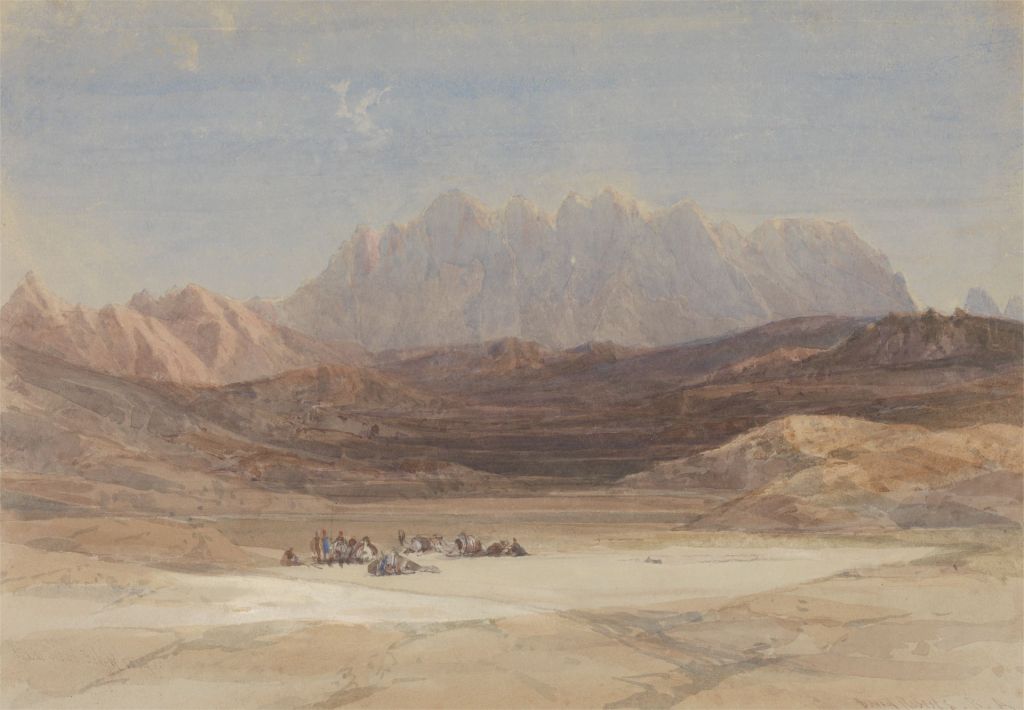
Mount Sinai by Scottish painter David Roberts (1796-1864)

On the morning of the third day, thunder roared, and lightning flashed, and a dense cloud came down on the mountain. There was a long, loud blast from a ram’s horn, and all the people trembled. Moses led them out from the camp to meet with God, and they stood at the foot of the mountain. All of Mount Sinai was covered with smoke because the Lord had descended on it in the form of fire. The smoke billowed into the sky like smoke from a brick kiln, and the whole mountain shook violently. As the blast of the ram’s horn grew louder and louder, Moses spoke, and God thundered his reply. The Lord came down on the top of Mount Sinai and called Moses to the top of the mountain. So, Moses climbed the mountain.

Then the Lord told Moses, “Go back down and warn the people not to break through the boundaries to see the Lord, or they will die. Even the priests who regularly come near to the Lord must purify themselves so that the Lord does not break out and destroy them.”

“But Lord,” Moses protested, “the people cannot come up to Mount Sinai. You already warned us. You told me, ‘Mark off a boundary all around the mountain to set it apart as holy.’”

But the Lord said, “Go down and bring Aaron back up with you. In the meantime, do not let the priests or the people break through to approach the Lord, or he will break out and destroy them.”

So, Moses went down to the people and told them what the Lord had said. (NLT)

As Christians await Easter and the resurrected Christ, the Revised Common Lectionary reminds us of another great anticipation from the Old Testament. The ancient Israelites were amazingly delivered from Egyptian slavery, miraculously walked through the Red Sea, and traveled with wondrous anticipation to Mount Sinai. Now, in today’s reading, they are about to meet with God!

The scene of this meeting is not exactly the romantic highland encounter of the Man from Snowy River (my wife’s all-time favorite movie). The landscape is much more akin to the dark and volcanic Mount Doom from The Lord of the Rings. The picture appears more foreboding than loving. The thing about mountain top experiences is that they are not all monolithic one-size-fits-all encounters with bright rainbows and happy skipping unicorns.

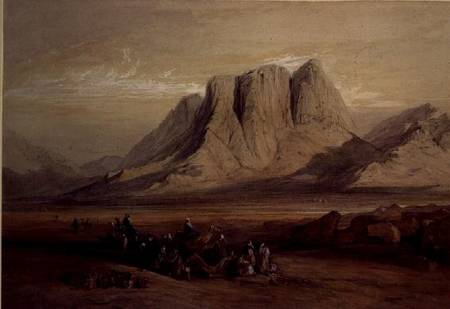
Mount Sinai by English painter Edward Lear (1812-88)

Mountain Top Experiences

Holy Scripture is replete with mountain experiences. Mountains serve as symbols for significant encounters with a mighty God. Whether it is Christ’s transfiguration on a mountain, or the giving of the law on a mountain, the awesome mountain serves as a tangible symbol of divine majesty, strength, and sovereignty. And, I might add, conversely, valleys in Scripture are symbolic of difficulty and suffering. Our God is Lord of both mountain and valley. The God of the Bible is both transcendent and immanent, ruling with power and might high above us on the holy mountain. Yet, the Lord also comes near to us in the valley of the shadow of death.

Leading up to the giving of the Ten Words (Commandments) in Exodus 20, Exodus 19 portrays an awesome scene of God in transcendent holiness and power. In fact, the experience was so otherworldly that the people were afraid to even come near the mountain. The Israelites needed limits placed on themselves because of God’s holy presence. Just like coming too near the immense power of the sun will destroy us, so getting near to God can ruin us if we do not respect divine holiness.

The Lord of the Mountain

Respecting God’s power and transcendence brings the reality of the Lord’s immanence into greater appreciation. God has gone to extreme lengths of self-revelation to people. For the Christian, it all culminates through the incarnation of Christ, the sending of the Son. In Jesus, the transcendence and immanence of God meet perfectly to bridge the chasm between humanity and the divine. Because of Jesus, the awesome sounds of thunder and trumpet do not lead to fear; they announce grace to those who approach God by faith.

You have not come to a mountain that can be touched and that is burning with fire; to darkness, gloom and storm; to a trumpet blast or to such a voice speaking words that those who heard it begged that no further word be spoken to them, because they could not bear what was commanded: “If even an animal touches the mountain, it must be stoned to death.” The sight was so terrifying that Moses said, “I am trembling with fear.” But you have come to Mount Zion, to the city of the living God, the heavenly Jerusalem. You have come to thousands upon thousands of angels in joyful assembly, to the church of the firstborn, whose names are written in heaven. You have come to God, the Judge of all, to the spirits of the righteous made perfect, to Jesus the mediator of a new covenant….

See to it that you do not refuse him who speaks. If they did not escape when they refused him who warned them on earth, how much less will we, if we turn away from him who warns us from heaven? At that time, his voice shook the earth, but now he has promised, “Once more I will shake not only the earth but also the heavens.” The words “once more” indicate the removing of what can be shaken—that is, created things—so that what cannot be shaken may remain. Therefore, since we are receiving a kingdom that cannot be shaken, let us be thankful, and so worship God acceptably with reverence and awe, for our “God is a consuming fire.” (Hebrews 12:18-29, NIV)

Our God is an awesome God. The divine dramas of God’s victory over Egypt and Christ’s victory over sin, death, and hell, have provided God’s people with spiritual power. Both the deliverance of the Israelites from Egyptian slavery by God and the deliverance secured on Mount Zion from spiritual slavery by Jesus are meant to free us to do the will of God. With God’s Word and God’s Spirit given to us, we are emancipated from an empty way of life to experience the fullness of Christ.

May the peace of God which surpasses all understanding, keep your hearts and minds in the knowledge and love of God, and of the Son, Jesus Christ, our Lord, and the blessing of God almighty. May Father, Son, and Spirit be among you and remain with you always. Amen.