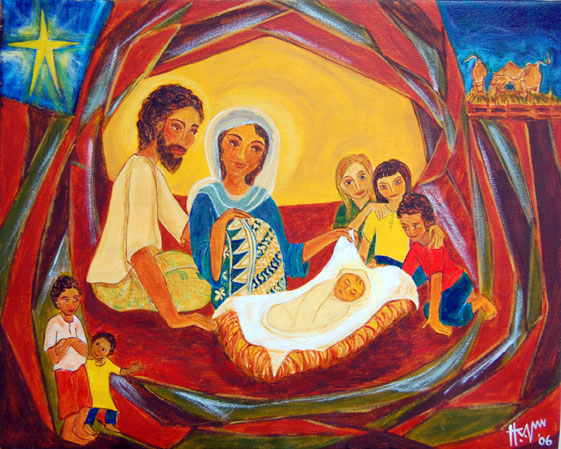
Hebrews 8:1-13 – Deliverance through a Manger

God Is With Us, by Malaysian artist Hanna Varghese, 2006

Now the main point of what we are saying is this: We do have such a high priest, who sat down at the right hand of the throne of the Majesty in heaven, and who serves in the sanctuary, the true tabernacle set up by the Lord, not by a mere human being.

Every high priest is appointed to offer both gifts and sacrifices, and so it was necessary for this one also to have something to offer. If he were on earth, he would not be a priest, for there are already priests who offer the gifts prescribed by the law. They serve at a sanctuary that is a copy and shadow of what is in heaven. Therefore, Moses was warned when he was about to build the tabernacle: “See to it that you make everything according to the pattern shown you on the mountain.” But in fact, the ministry Jesus has received is as superior to theirs as the covenant of which he is mediator is superior to the old one, since the new covenant is established on better promises.

For if there had been nothing wrong with that first covenant, no place would have been sought for another. But God found fault with the people and said:

“The days are coming, declares the Lord,
    when I will make a new covenant
with the people of Israel
    and with the people of Judah.
It will not be like the covenant
    I made with their ancestors
when I took them by the hand
    to lead them out of Egypt,
because they did not remain faithful to my covenant,
    and I turned away from them,
declares the Lord.
This is the covenant I will establish with the people of Israel
    after that time, declares the Lord.
I will put my laws in their minds
    and write them on their hearts.
I will be their God,
    and they will be my people.
No longer will they teach their neighbor,
    or say to one another, ‘Know the Lord,’
because they will all know me,
    from the least of them to the greatest.
For I will forgive their wickedness
    and will remember their sins no more.”

By calling this covenant “new,” he has made the first one obsolete; and what is obsolete and outdated will soon disappear. (NIV)

Our wait is nearly over. Christmas Day is almost here. The Messiah is coming. I genuinely believe that Jesus is the mid-point of history; everything for all time hinges upon Christ’s incarnation. The most cataclysmic event in the history of the world is a birth. The hopes of humanity are focused, of all things, in a stinky old feeding trough for animals – a manger.

Yes, Christians put a lot of focus on the cross and resurrection. Yet, the incarnation was the signature event of God’s breaking into this world. The inconceivable was conceived. God became human. Nothing would ever be the same again….

Nativity by African artist Joseph Mulamba-Mandangi, 2001

Jesus is our great high priest, the nexus between heaven and earth. All else are only mere shadows of the real Savior. Christ is the hinge upon which our own personal lives turn. The old system of law fades and gives way to the person for whom it all pointed. For the law, as important as it was, has never been able to save. In Christ there is a new covenant established by grace, taking care of the sin issue once for all.

Through the Christ child, all other means of deliverance have become obsolete. No matter how much he washed his hands, Pilate could not wash away his guilt. Despite all our efforts to hide or undo our shame, it will not go away. It is through Jesus that all guilt and shame have been banished. Human iniquity is taken away. All that we have done and left undone is forgiven – our sin is purged forever.

A new age has dawned. A new era has been inaugurated. The miracle of the Nativity explodes with continuing effect throughout history. Its continuing effects can still be felt, two-thousand years later. Nothing will ever undo the power of love and grace which was unleashed in the little town of Bethlehem.

Here is a clear and confident declaration to any and all in despondency or despair, no matter the reasons why: We may feel crushed, dejected, confused, or broken because of this past year’s events; but our salvation depends not on our mood or the constant changing of circumstances. Christ has offered himself once for all. The work is finished. Our faithful high priest is even now interceding for you and me in heaven.

Our faith is grounded not in our pedigree, our position, or our ability to produce but forever in what Christ has done in becoming human on our behalf. See the manger where he lies. Know that salvation is before us. Believe the promise of God.

May this eternal truth be always on our hearts:
That the God who breathed this world into being
Placed stars into the heavens
And designed a butterfly’s wing
Is the God who entrusted his life
to the care of ordinary people
became vulnerable that we might know
how strong is the power of Love
A mystery so deep it is impossible to grasp
A mystery so beautiful it is impossible to ignore.


Job 13:13-19 – Contending with God

Mother Teresa suffering quote

“Keep silent and let me speak;
then let come to me what may.
Why do I put myself in jeopardy
and take my life in my hands?
Though he slay me, yet will I hope in him;
I will surely defend my ways to his face.
 Indeed, this will turn out for my deliverance,
for no godless person would dare come before him!
Listen carefully to what I say;
let my words ring in your ears.
Now that I have prepared my case,
I know I will be vindicated.
Can anyone bring charges against me?
If so, I will be silent and die. (NIV)

The story of the biblical character, Job, is both famous and infamous.  It’s famous among most bible readers because we are privy to why Job endured such terrible suffering and how the story ends.  Conversely, the story is infamous because Job’s “friends” and most everyone else in his day believed that the extremely hard circumstances were proof positive of sin.  Job had the misfortune of being misunderstood and misinterpreted with an evil, infamous, reputation.

Job was understandably desperate.  He hadn’t a clue why he lost his every earthly possession and relationship, not to mention his health.  Job was hurt, angry, and lonely.  In today’s Old Testament text, we observe Job getting ready to have-it-out with God.  It is interesting to me that in such grinding physical, emotional, and spiritual pain as Job experienced, he held to both his own integrity and of confidence in God.

If this story strikes a familiar chord, it may be because this was also Christ’s experience.  Jesus did nothing unethical or immoral to deserve being whipped, beaten, and tortured.  Our Lord, like Job, felt the awful sting of silence stating, “My God, my God, why have you forsaken me?” (Matthew 27:46).  As we fast approach Holy Week, the Lectionary reminds us that there must be suffering before glory, crucifixion before resurrection, agony before victory.

Christ on the Cross
Painting by Hans Mertens

I wonder what humanity would be like if we stopped fighting so hard against suffering and instead leaned into it as a teacher and a means of awareness.  For the Christian, I am curious what the Church everywhere would be like if she embraced suffering as the path of solidarity with Jesus. I wonder what human interactions on the personal, corporate, and global level would look like if people throughout the earth would stare this current pandemic through their spiritual eyes and imagine as Old Testament scholar Walter Brueggemann does:

“We may imagine God doing a new thing among us. Perhaps we are arriving at a new neighborly normal:

  • Imagine, we are treating prisoners differently, even releasing some who constitute no threat
  • Imagine, we are mobilizing generous financing for needy neighbors who must have resources in order to survive.
  • Imagine, we are finding generous provisions for students and their debts.

The new thing God is making possible is a world of generous, neighborly compassion.”

When we are stripped of wealth, cut-off from others, and do not know how to make sense of the suffering around us and in our own lives – it is in such a time that we are invited to consider a few observations from the story of Job:

  1. Much, if not most, of life is a mystery – including God. We are neither all-knowing nor all powerful.  Our nation’s perceived power and intellectual savvy expose deep fissures of pride and hubris.  Events like pandemics reveal that there is so much we don’t know and must learn.  We will likely never get all the answers we want when tragedy hits and lives are turned upside-down.
  2. Confronting and contending with God is okay, perhaps even encouraged. Unlike the human creature, the Creator God is big enough to take and absorb whatever anger, rage, disappointment, discouragement, depression, fist-shaking, and expletives we throw at him.
  3. Suffering does not mean that God has forgotten us. We may not understand why or even what we go through.  We will, however, never go through it alone.  God is often silent; yet, never aloof.  God maintains both his transcendence high above us and his immanence close to us at the same time, all the time.  In the Christian tradition, this is why the Holy Spirit was given – to be the continuing presence of Jesus on this earth.

My prayer for you today is that your suffering will not be wasted – that God will bend each adverse situation toward your good and the good of others.

Soli Deo Gloria

Click How Deep the Father’s Love for Us sung and mixed by David Wesley as we anticipate the suffering of Christ on our behalf in this next Holy Week.

Job 1:1-22

            Much of life is a mystery.  We do not know why some things happen.  From our puny human perspective, they just do, and that is all we can say about it.  There are times in Scripture, however, when the veil between heaven and earth is peeled back long enough for us to catch a glimpse of mystery.  Today’s Old Testament lesson is such a story. 
 
            Job was a wealthy man and had everything that this earthly life could offer.  And he was a pious godly person of faith.  It was commonly understood that those two things always went together.  So, when we see behind the curtain and are privy to a conversation between God and Satan, the devil himself points this out – that Job only praises God because of how good he has it.  Even with this understanding of what was behind Job’s misery, we still see the mysterious God allowing Satan to operate with only God-knows reasons why.
 
            When calamity strikes; when bad news causes us to slump in our chairs; when adversity hits unexpectedly; when trouble smacks us upside our life like a sledgehammer, it is only human to begin wondering what we did wrong or what we did to bring on such a terrible set of circumstances.  But the truth is:  we just don’t always know.  But what we do know is Job’s incredible response to the mystery of God.  “The LORD gave, and the LORD has taken away; blessed be the name of the LORD.”  Rather than spending all of our emotional energy trying to figure out an answer to our “why” questions, perhaps the more sage response is to confess our faith in a radical trust of God.  Using these actual words from Job would be a necessary start to navigating the troubled waters of evil which swirl around us, even if we have to say them over and over again to believe them.


            God Almighty, every good thing I have in my life has come from you.  It is your prerogative whether I continue to have those things, or not.  Whatever happens, whether it causes heartbreak or happiness, is completely known to you.  I trust that you know what you are doing, and I completely throw myself upon your mercy through Jesus Christ, my Savior.  Amen.

Ephesians 3:1-12

            On this first day of celebrating Epiphany (which means “manifestation” or “appearing”) it is quite appropriate to drink in the wonderful teaching of the Apostle Paul on the subject of mystery.  The term “mystery” as used by Paul is not so much like reading a Sherlock Holmes novel in the sense that we need to do some detective work to solve a murder.  Mystery for Paul is something that was once hidden or obscure, but is now revealed. 
 
            The great mystery that lurked in the shadows of the Old Testament but is now fully revealed in the New Testament is, in Paul’s words, “that the Gentiles are fellow heirs, members of the same body, and partakers of the promise in Christ Jesus through the gospel.”  Perhaps that truth come to light does not seem very bright or astounding to you and I.  Yet, back in Paul’s day, this was momentous.  Yes, most Jews understood that many Gentiles could and would come to worship God, but none of them saw it coming that those Gentiles would actually be completely grafted into life with them and be formed into a new society, the church, the community of the redeemed.  Jew and Gentile would cease to be separate peoples and would now become fellow heirs as one people in Christ.
 
            As non-Jews, maybe we take for granted that we believe and are full participants in Christ and full-fledged members of Christ’s Body, the Church.  But because of the faithful ministry of people like Paul and Peter and the other original apostles, the vast majority of believers throughout the world are us Gentiles.  This is, then, to be a day of celebration and gratitude that God has included us through the person and work of the Lord Jesus.  No longer are we shrouded in mystery.  We share in Christ and are partakers in all the good promises of God.  Let us, therefore, punctuate this day and season with thanksgiving to God for his gracious outreach to us.
            Revealing God, you have included us in Christ by grace through faith so that your wisdom might now be made known to all.  Thank you for your gracious wooing us to your church, and giving us your very great and precious promises to us in Jesus Christ.  Amen.