Matthew 20:1-16 – The Parable of the Vineyard Workers

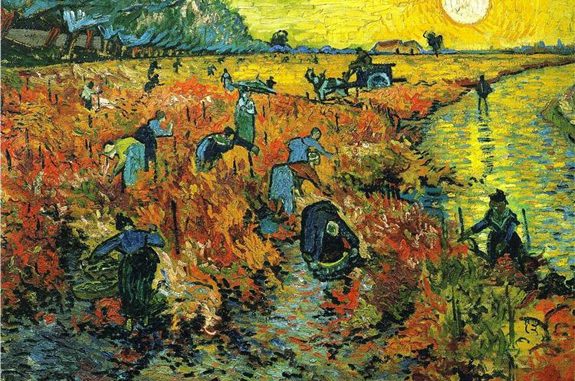
The Red Vineyard by Vincent Van Gogh, 1888

“For the kingdom of heaven is like a landowner who went out early in the morning to hire workers for his vineyard. He agreed to pay them a denarius for the day and sent them into his vineyard.

“About nine in the morning he went out and saw others standing in the marketplace doing nothing. He told them, ‘You also go and work in my vineyard, and I will pay you whatever is right.’ So, they went.

“He went out again about noon and about three in the afternoon and did the same thing. About five in the afternoon he went out and found still others standing around. He asked them, ‘Why have you been standing here all day long doing nothing?’

“‘Because no one has hired us,’ they answered.

“He said to them, ‘You also go and work in my vineyard.’

“When evening came, the owner of the vineyard said to his foreman, ‘Call the workers and pay them their wages, beginning with the last ones hired and going on to the first.’

“The workers who were hired about five in the afternoon came and each received a denarius. So, when those came who were hired first, they expected to receive more. But each one of them also received a denarius. When they received it, they began to grumble against the landowner. ‘These who were hired last worked only one hour,’ they said, ‘and you have made them equal to us who have borne the burden of the work and the heat of the day.’

“But he answered one of them, ‘I am not being unfair to you, friend. Didn’t you agree to work for a denarius? Take your pay and go. I want to give the one who was hired last the same as I gave you. Don’t I have the right to do what I want with my own money? Or are you envious because I am generous?’

“So, the last will be first, and the first will be last.” (NIV)

We as humans have an innate sense of right and wrong, justice and injustice. We want life to be fair. It disturbs us when there is favoritism, discrimination, and preferential treatment. When things seem askew and others seem more privileged, envy can creep in and settle in our bones.

The envy can go even deeper. For example, is it fair that any child should struggle with health issues like cancer, epilepsy, and mental disorders?  Is it fair to have healthcare disparities? Is it fair to have a spouse taken from you before their time?  Is it fair to lose your job because of a pandemic? Is it ever fair to be treated like a second-class citizen?

Pat answers to people’s genuine struggles will not do, such as “Well, you just need to work hard and hope for the best;” “We have to take what is given us and accept these things;” “Think of all those starving children in India;” or the more crass, “Suck it up buttercup; life was never meant to be a rose garden.”  Those statements simply do not help.

At the heart of envy is the belief that others are getting something that I deserve.

Plenty of jerks have healthy grandkids, grow old with their spouses, and retire in comfort with plenty of money. “It isn’t fair!” we cry.

God does not always operate according to our standards of fairness. God’s very nature is to be generous and full of grace. The parable which Jesus told about the vineyard workers is a story not of unfairness, but a story of generosity and grace. It is all in how you look at it.

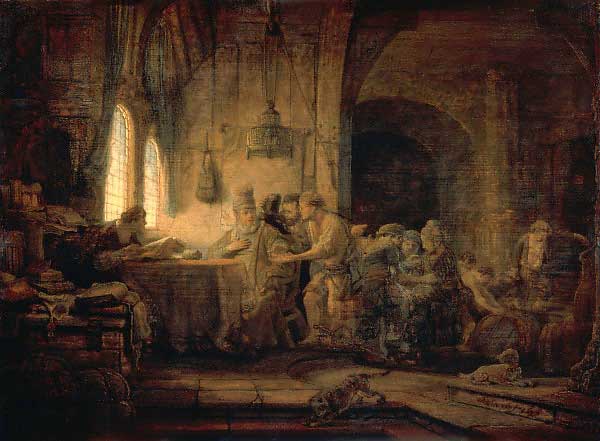
Parable of the Workers in the Vineyard by Rembrandt, 1637

A normal workday in the ancient world was ten hours, not counting breaks. The workday began at 6:00am. A denarius was a typical day’s wage for laborers. The landowner went out at the third hour, 9:00am; the sixth hour, noon, etc. He kept returning to hire more workers even up to the last hour of the workday. Laborers were always paid at the end of the day. In this parable, the last workers were paid first, which prompted the first workers hired to think they would be getting more, even though they had been promised a denarius. So, they grumbled about not getting more. They thought the landowner was not being fair.

Grumbling. Complaining. Murmuring. It is the bane of our existence. Decades ago, when gas station attendants still filled tanks for customers, I was working at a station and had a lady go berserk on me for not checking her oil and cleaning her windshield, because I did it for the car in front of her. Even though there was a sign right in front of her that said checking oil and cleaning windshields is only done upon request, the lady thought she was getting gypped. 

In truth, the landowner did not cheat or defraud the workers in any way. He paid the agreed upon wage, just like he promised. Should he want to pay everyone the same even though the amount of work was different was his own business. The problem was not with the owner, it was with the worker’s envy of the owner’s generosity toward the others. God distributes gifts because he is gracious, not because we have earned anything.

Our standard of fairness is not the rule of the kingdom of God – grace is.

The founder of Methodism, John Wesley, was physically thrown out of a church one Sunday because of a sermon he was preaching on the grace of God. Afterwards, when Wesley wrote about this to a friend, he said, “There is no Christian Doctrine more repugnant than the affirmation that we are saved by the grace of God through faith.”

Deep down many believe we control our destiny, and that we save ourselves by what we do. We discern that if we serve God all our lives, in the end, God will reward us. We believe that our pious activities, our acts of service and our work for the Lord, will bring us salvation, or, at least a leg up in the kingdom of God over others who have not worked as hard or as long as we have. After all, we do the right thing.

So, what about those who have not figured out Christianity… those who do not have the correct or proper beliefs… or those who have not straightened out their lives? According to a worldview of human fairness, they are out of luck. They should be in church. They should work harder, faster, and better. Then, they could get their lives in order. If they would only understand fairness, we reason, then all would be well.

Parable of the Vineyard Workers from unknown artist in the Middle Ages

But there is a problem, because the parable of the workers told by Jesus seems to be saying that is not how it works, at all.  Jesus seems to be saying that grace and grace alone saves, that God’s amazingly naive and irresponsible grace is available to anyone and everybody. And that troubles the workers to no end. 

Whenever we run headlong into God’s unfair grace and see that God’s way of doing things is so far removed from our way, there is bound to be grumbling.  After all, if God is going to run a vineyard like the one in the gospel lesson and give everybody the same pay regardless of their actual work hours, then what’s the use of getting up early in the morning to work? 

What is the good of sitting in church, listening to sermons from a crazy preacher who is no better than us, if these outsiders, these Johnny-and Jane-come-lately’s can waltz in at the last minute and receive the same treatment as the rest of us?  For many church folks who diligently serve, it is not fair to pay so much attention to outsiders and build ministry around people who aren’t even here, who don’t yet know Jesus.

The conclusion and point of the parable: The last will be first, and the first will be last. In Luke’s prodigal story, the elder brother grumbles and gripes: “All these years I’ve been slaving for you and never disobeyed your orders.  But when this son of yours who has squandered your property with prostitutes comes home, you kill the fatted calf!”  It is the firstborn son that complains. (Luke 15:11-32)

In both the parable of the prodigal son and the parable in today’s lesson, “good” people are the ones who fail to see the heart of the Father and of the landowner. The “firsts” got off track because, over time, they forgot the kingdom hinges on grace, not effort, on not simply doing the right things over a long period of time.

God controls the flow of mercy, not us. 

We will likely be surprised in heaven with those already sitting at God’s banquet table, and equally surprised with who is not there. Resentment can move us away from the table of mercy God is preparing. The problem comes whenever we think we are above other people.  We might be sinners, but we are not as bad as some other people are!  We commit ordinary sins, not mass murder!

Here is the unvarnished truth: God does not owe you or I a thing, and God cares about all kinds of people, not just us and people who think and live like we do. Our hearts need to be big enough to center ministry around other people who are different than us.

If our hearts are small, we easily get jealous when God pays attention to prodigals and profligates. Grace becomes too repugnant a doctrine for us.

The gospel of Jesus Christ is about grace. Life is not all about being decent. It is not all about morality, and it is certainly not about our own goodness. The gospel is about being steeped in and surrounded by the grace of God in Christ, so that we, in turn, can show others grace. Grace is the way God deals with us beyond what we deserve or feel we have earned. 

Grace is unfair; we get what we do not deserve. 

May we allow God’s grace to so permeate our hearts and lives so that we will give it to others as freely as we have received.Praise be to you, almighty and everlasting Father of our Lord Jesus Christ. In Christ, you have given us every spiritual blessing in heaven. In Christ, you chose us before the world was made. You chose us in love to be your holy people—people who could stand before you without any fault. And before the world was made, you decided to make us your own children through Jesus Christ. It pleased you to do it. And this brings praise from us because of your wonderful grace, given to us freely, in Christ, the one you love. We have forgiveness of sins because of this lavishly rich grace. Thank you, O my Father, for your grace extending to me in Christ! Amen

1 Thessalonians 4:1-8 – An Embodied Spirituality

divine dance

One final word, friends. We ask you—urge is more like it—that you keep on doing what we told you to do to please God, not in a dogged religious plod, but in a living, spirited dance. You know the guidelines we laid out for you from the Master Jesus. God wants you to live a pure life.

Keep yourselves from sexual promiscuity.

Learn to appreciate and give dignity to your body, not abusing it, as is so common among those who know nothing of God.

Don’t run roughshod over the concerns of your brothers and sisters. Their concerns are God’s concerns, and he will take care of them. We’ve warned you about this before. God hasn’t invited us into a disorderly, unkempt life but into something holy and beautiful—as beautiful on the inside as the outside.

If you disregard this advice, you’re not offending your neighbors; you’re rejecting God, who is making you a gift of his Holy Spirit. (MSG) 

Consider for a moment some of the things you have done today… For me, I arose early, had a workout, ate breakfast, showered, went to work, etc. Yeah, typical stuff we are familiar with. These things I just mentioned all had to do with the body. What is more, all of them are good and holy. Sometimes we may get a misguided notion that purity and holiness only has to do with activities that take place in a church building; or special works like serving at a homeless shelter; or, that the meeting of physical needs is merely a means to reach the soul. Yet, in today’s verses from Thessalonians, as well as the whole of Scripture, there is neither a secular/sacred dichotomy nor a dualism of body and soul.

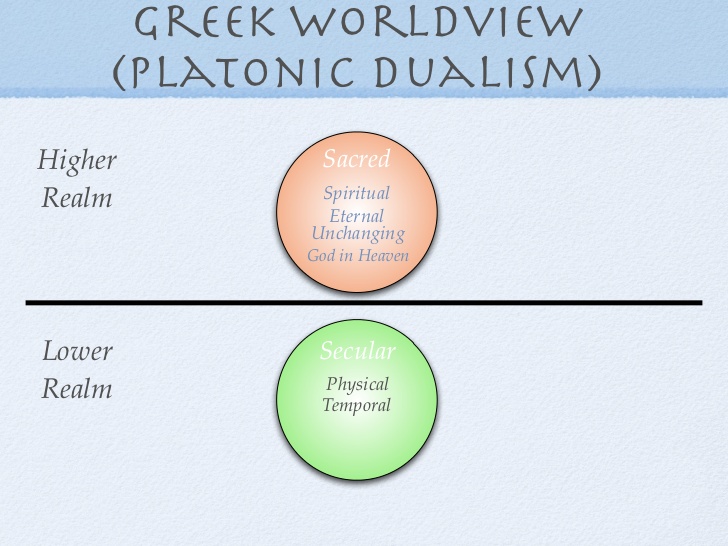
We in the western world have inherited a long tradition of Platonic thinking. It underlies a lot about how we think of the body. Plato (c.427-327 B.C.E.) embraced a dual nature of people – an existence of body and soul in which the spirit is trapped within physical flesh. Plato considered the soul to be the true nature of a person and tended to denigrate the body as an earthen vessel which will eventually be discarded. Our physical existence was nothing more than a necessary evil for Plato.

Greek Dualism

The problem with Plato’s anthropology is that it fails to discern the holistic nature of body and soul and the need for integrity with these human dimensions. Historically, Plato’s view has tended to come out sideways through lack of care for the body and seeing bodily actions as insignificant.

Thus, sexual immorality is common in dualism because our physical selves are less significant, temporary, and disposable. In all fairness to Plato, he did not encourage misuse of the body or sexual immorality, yet, his philosophy opened-up generations of people neglecting their own bodies and inflicting harm on other bodies. In many ways, Greek dualism is the shadow philosophy behind much sexual abuse today.

When we exalt the soul as supreme over the body, we are living out platonic thought, not biblical teaching. All of life is sacramental – the body is sacred, and, so, ought to be treated as holy – with great care and careful attention to breath, movement, exercise, eating, sleeping, playing, and, yes, even sex. The body is to be celebrated as our means of glorifying God on this earth. And, at the end of the age when Christ returns, we will be reunited with our bodies to live forever as embodied creatures. What we do with our bodies now matters to God.

Inattention and/or disregard for the body God has given us will inevitably lead to a lack of boundaries in which others are open to violate us and we are unaware of violating others. We end up running roughshod over each other, spiritually and physically. An embodied and grounded spirituality helps us clarify what holiness and sanctification looks like in relationships and everyday life.

boundaries

God has not called us to impurity but to holiness in all of life, in every physical activity we do. We have not been designed by our Creator to live in any old way we want; we have been set apart and called by God to walk along the road of purity and peace.  The way in which we use our minds, wills, emotions, and bodies – aligned and in agreement with the whole person – are of much interest and great concern to God Almighty.

God cares about food and whether I eat to his glory and give thanks; or, whether I have no interest in those that are hungry but just stuff as many groceries as I can in my distended stomach.  God cares about whether I take time for rest and Sabbath and whether I isolate myself in mindless TV watching for hours.  God cares about the content of my conversations with my family and friends – whether I am using my vocal cords for encouraging and building-up others, or whether they are forming slanderous, gossipy, and unhelpful words.

Everything in all creation belongs to God – including me, you, and everything we do.  God cares about all of life’s activities and leisure time.  Whether tying our shoes or teaching a Sunday School class, it is all to be done with a sense of holiness and connection to the God that makes it all possible. Christian spirituality is embodied spirituality. So, let us engage in all kinds of good works for the benefit of the body, whether little or large, with the time and talents God has graciously given us.

Lord God, I belong to you – set apart and sanctified so that I may always walk in holiness and please you in everything I do.  Help my life today to reflect the purity you have given me through your Son, the Lord Jesus.  May he be glorified through me now and always.  Amen.

Romans 15:14-21 – Paul the Missionary

Apostle Paul by Ivan Filichev

My brothers and sisters, I know without a doubt that you are full of goodness and have all the knowledge you need. So, you are certainly able to counsel each other. But I have written to you very openly about some things that I wanted you to remember. I did this because God gave me this special gift: to be a servant of Christ Jesus for those who are not Jews. I serve like a priest whose duty it is to tell God’s Good News. He gave me this work so that you non-Jewish people could be an offering that he will accept—an offering made holy by the Holy Spirit.

That is why I feel so good about what I have done for God in my service to Christ Jesus. I will not talk about anything I did myself. I will talk only about what Christ has done with me in leading the non-Jewish people to obey God. They have obeyed him because of what I have said and done. And they obeyed him because of the power of the miraculous signs and wonders that happened—all because of the power of God’s Spirit. I have told people the Good News about Christ in every place from Jerusalem to Illyricum. And so, I have finished that part of my work. I always want to tell the Good News in places where people have never heard of Christ. I do this because I don’t want to build on the work that someone else has already started. But as the Scriptures say,

“Those who were not told about him will see,
and those who have not heard about him will understand.” (ERV)

Paul was an Apostle – a person commissioned by God for a specific purpose. His task was to go to the Gentiles – non-Jewish people. Although a Jew himself, Paul was sent as the missionary to places where Gentiles were the dominate culture. Through the Apostle Peter, and then Paul, the good news of Jesus spread to persons that were beforehand considered unreachable. Paul viewed himself as having no limits as to who could hear and respond to the gospel of new life in Jesus Christ.

The Apostle Paul understood himself as standing between heaven and hell, interceding, and pleading on behalf of people in need.

It is quite likely there are persons in our sphere of influence for whom we think would never respond to the message of Christ’s redemption. In these dog days of summer’s ordinary time in which we may be just trying to beat the heat; and, we might see family that we typically don’t throughout the rest of the year; it could be easy to lose sight that attending a virtual meeting, family gathering, and/or interaction with a person outdoors, there are those who need the kind of life which Jesus invites us to – and we will never know if God is wooing them to himself unless we share life with them.

Perhaps we need to see ourselves as Paul did – standing in the gap and always trying to find ways to speak good news to people who need deliverance from empty ways of life. The cousin or uncle, co-worker or friend, neighbor, or new acquaintance, can be forgotten by us as to their very real need to discover faith and the spirituality which resides within.  We, my friends, are the conduit that God has ordained to bring the life-giving message to people all around us – people for whom we might have already written off as unreachable.

Sometimes the Apostle Paul gets a bad rap as moving beyond the bounds of his apostolic authority in dedicating his life to reaching the non-Jewish person, as if Gentiles were not really on the radar of Jesus. Yet, Paul took pains to demonstrate biblically that his mission was really God’s mission. Indeed, Paul did not fabricate including Jew and Gentile together as one people of God. Romans 15 is filled with Old Testament quotes pertaining to God’s agenda that all peoples of the earth would come and worship together.

It has always been God’s vision to restore humanity, Jewish and Gentile alike, to a life-giving place of beauty and joy in the Garden.

So, Paul had a healthy pride in his work as an Apostle sent from God to the task of reaching the vast numbers of non-Jewish people. I sit here today, two millennia later, the spiritual progeny of the Apostle’s great effort. Because Paul kept pioneering new churches, pushing ever farther into places which knew little to none about Jesus, and being concerned for people very different from himself, Christians today enjoy a rich legacy of faith and works to draw upon in our own lives.

Yes, as an historian I am quite aware of the complicated history between the Jewish people and their Gentile neighbors. I perhaps know more than the average bear about how the Church has far too often brought harm and not help to the world. Yet, this in no way mitigates the incredible new life which has occurred for so many people and cultures throughout the past two-thousand years of Christian history. In fact, in the light of today’s New Testament lesson, it behooves us Christians to establish gracious and loving connections with our Jewish brothers and sisters, as well as all of humanity. Their pain of persecution and difficulty through the centuries is our pain, as well.

May the power of God’s Spirit come upon us all. May we all become a community of priests and prophets proclaiming peace, love, and joy – the life we are all meant to experience and share together.

We praise you, O God, for the ministry and success of your servant, the Apostle Paul, through whom we who are Gentiles owe our own faith and calling.  Grant us a vision like his, the conviction and commitment to pursue it, and the grace which confirms and prospers it.  Amen.

1 Corinthians 12:4-13 – For the Common Good

spiritual gifts

Now there are varieties of gifts, but the same Spirit; and there are varieties of services, but the same Lord; and there are varieties of activities, but it is the same God who activates all of them in everyone. To each is given the manifestation of the Spirit for the common good. To one is given through the Spirit the utterance of wisdom, and to another the utterance of knowledge according to the same Spirit, to another faith by the same Spirit, to another gifts of healing by the one Spirit, to another the working of miracles, to another prophecy, to another the discernment of spirits, to another various kinds of tongues, to another the interpretation of tongues. All these are activated by one and the same Spirit, who allots to each one individually just as the Spirit chooses.

For just as the body is one and has many members, and all the members of the body, though many, are one body, so it is with Christ. For in the one Spirit we were all baptized into one body—Jews or Greeks, slaves or free—and we were all made to drink of one Spirit. (NRSV)

A gift is meant to be unpacked. It would be weird if someone was given a gift, then let it sit unopened. Instead, we typically receive the gift, rip it open, and express gratitude for the thoughtfulness. Then, we use and enjoy it.

The Spirit, likewise, has been marvelously given to God’s people. Each individual Christian is specially provided a gift to open, use, and enjoy. Spiritual gifts graciously given to us are meant for the common good of all. And this use for the common good is where the gift is different than Christmas or birthday presents.

Spiritual gifts are designed by God to be acts and words of service, dispersed for the benefit of others. They are not meant solely for personal satisfaction. So, if a person’s spiritual gift is teaching, they do not stand in front of a mirror and talk at themselves. Instead, they jump into the fray of learning and explaining, and do it in such a gracious and loving way that the enabling of the Spirit is evident.

If a person’s gift is faith, they do not merely step out and act with unusual courage for the purpose of personal betterment in a holy belief from God. They also demonstrate faithfulness to God’s people and to God’s world. The gift is for the common good of all persons.

Spiritual gifts are intended by God to be shared freely for the common good of all people so that everyone is supported for the rigors of daily life in the world.

Therefore, we are to take initiative in identifying our gift(s), unpacking them, and indiscriminately using them.  Spiritual health and wholeness can only truly be realized through everyone’s active participation in distributing their God-given abilities. Spiritual gifts are neither to be hoarded, nor miserly dealt to only people I like or my own little world of groupies and friends. Any and every ability comes from God, and is, therefore given for the benefit of all persons. Underprivileged groups need the gifts of others, as well as discovering their own resources so that everyone is built up in a society of redeemed persons.

In addition, mavericks are not helpful here. The Lone Ranger is not to be the model of aspiration. Christians are the Body of Christ, meant to function as one. Just as the Holy Trinity of divine three persons – Father, Son, and Spirit – work together in unity of purpose and harmony of being, so the persons of the Church are to unify and act as one in the mission of God. Diversity of gifts are to be expressed in unity of building up others and extending Christ’s love to the world. When we harmoniously coordinate our joint efforts in utilizing our collective spiritual gifts, the world is turned upside-down with kingdom grace and ethics.

Sometimes we might succumb to “gift envy.” We observe the talented gift of another and secretly wish it for ourselves. The proper remedy to such a malady is gratitude. When we give thanks to God for the gift(s) we truly possess, then envy has nowhere to reside and slithers away. None of God’s gifts are “sexy” in the sense that they come easily without effort and always look appealing. On the contrary, our gifts are meant to be received and developed with lots of daily mundane work so that we live into the special endowment bestowed upon us. This, in fact, takes a lifetime of development because the Spirit’s gifts are so generously large – much bigger than we originally observe at first glance. Like an engagement ring in a tiny box, receiving the gift and putting it on will involve commitments and challenges we cannot at the time perceive.

Whatever it is you do well, do it to the glory of God. Allow God to activate it and energize it for the prevailing needs of a church and a world which is in want of seeing spiritual fruit manifest in kindness, goodness, and love.

O Lord, you have taught me that without love, whatever I do is worth nothing.  Send your Holy Spirit and pour into my heart your greatest gift, which is love, the true bond of peace and of all virtue, without which whoever lives is accounted dead before you. Grant this for the sake of your only Son Jesus Christ, who lives and reigns with you and the Holy Spirit, one God, now and forever. Amen.