All I Want for Christmas Is Joy

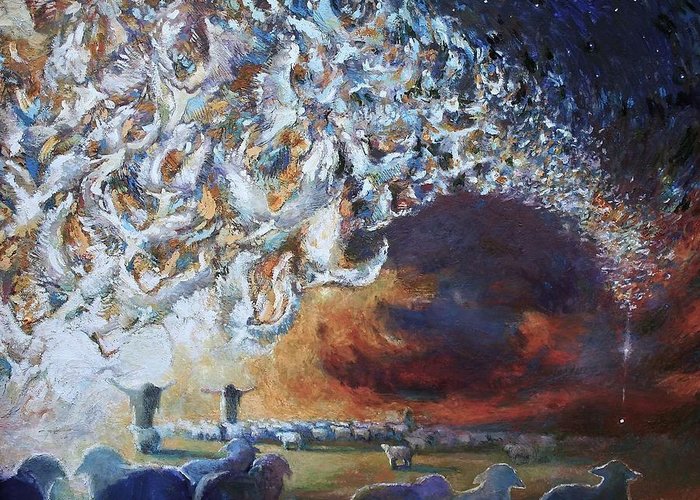
Seeing Shepherds by American painter Daniel Bonnell

There were shepherds living out in the fields nearby, keeping watch over their flocks at night. An angel of the Lord appeared to them, and the glory of the Lord shone around them, and they were terrified. But the angel said to them, “Do not be afraid. I bring you good news that will cause great joy for all the people. Today in the town of David a Savior has been born to you; he is the Messiah, the Lord. This will be a sign to you: You will find a baby wrapped in cloths and lying in a manger.” (Luke 2:8-12, NIV)

When I think of sheer unbounded joy, I think of dogs. My own dog, Max Power, waits every day for me to get home from work. And when I walk through the door, he acts as if he has not seen me in months, wagging his tail so hard that it looks like it will fly off his butt. This is one reason people like dogs so much – their joy brings us joy. It is not a joy that was ever learned in obedience school – it is just built into the relationship. 

Genuine joy does not come from getting all the presents we want for Christmas or having everything go our way.

Joy is not a product we can buy at the store. Authentic, real joy is the fruit of meaningful relationships. My dog cares nothing about how much money I have or even if he has the best dog food to eat and a trendy collar to wear; his joy comes from being with me.

The good news of a Savior coming to this earth means God is coming to be with us.  This is good news of great joy! We are loved because God is good, not because we are good.  And because God is good, and we are a mess of humanity, there is joy that the Lord is coming to save us!

The reason Christ’s birth was good news of great joy to the shepherds is that they were shepherds.  Shepherds in the ancient world were generally looked on with contempt. In fact, Egyptians refused to eat with Jews because they were mostly shepherds (Genesis 46:31-34). 

Shepherds spent most of their time living with their sheep outdoors, to protect the flock.  Shepherds were neither well-dressed nor culturally refined. They mostly smelled like sheep poop. Shepherds also had the notoriety of being drinkers. Because they slept with the sheep, many shepherds passed the time and dealt with the chilly air by taking a nip of alcohol.  We do not really know whether most shepherds were drunkards, or not; but we do know they had a bad reputation.

Becoming a shepherd was not a profession a young person aspired to. Nobody took out a student loan to major in shepherding at the University of Jerusalem. King David started out as a shepherd. He was the youngest in the family and got stuck with the job nobody else wanted.

Out of all the persons and people-groups the heavenly angels could have come to announce the birth of Christ, it was shepherds.

This is truly a gospel of grace. The angelic announcement to a bunch of stinky shepherds is profoundly significant.  It is important because grace is being shown to the lowliest of society. A lowly Savior, born to a lowly family, and placed in a lowly feeding trough, came to reach the lowly, common, ordinary person.

The Shepherds by Malaysian artist Hanna Varghese (1938-2009)

To have this kind of attention from God Almighty is like the master of a dog walking into the house. We, as the common, ordinary mutts of society, are beside ourselves with joy, feeling privileged to be in the same room as Jesus.

It is only the lowly and humble in heart who will see God and enjoy the Lord’s presence. That is because God opposes the proud but gives grace to the humble. It is why the angels came to the shepherds and not to the religious leaders. It is good news of great joy for all the people. 

The gospel is not limited to those who are the most educated, the wealthiest, or from the most prominent of families – it is for everyone.

Yet, even with this good news of grace, many people still live their lives in fear and worry instead of joy. The message seems to only linger on the surface, not getting firmly pressed into minds and hearts. 

Even though a Savior is born, we still experience the harshness of a world under the dominion of darkness.  We worry about constant disease, financial difficulties, and the daily stresses of life.  We fret about dealing with ornery people, hard circumstances, family members who go astray, and the little plastic things on our shoelaces coming off leaving the shoestrings frayed! 

Sometimes, we strain our eyes to try and see some joy.

Jesus is the son of David, born in the town of David – both were anointed as kings but had to go through a lot of hardship before realizing their kingships.  We live in the time between the two advents of Christ in which God’s kingdom is already here but not yet here. It is a topsy-turvy time characterized by a weird mix of sinner and saint, despair and joy, adversity, and comfort.

Real joy is not found in having every circumstance go our way and having everyone like us, all the time. Joy comes from the gospel of grace, from God coming down and being with us.  Being in the presence of the Master makes all the difference. If joy comes from being with God in Christ, then cultivating and practicing the presence of Jesus in our daily lives is important and necessary.

Had the angels come into Bethlehem, a town swelling in numbers of people because of the Roman census, I am not sure anybody would have heard them. The shepherds were away from the noise, out in the quiet solitude of the fields by themselves. So, they were able to hear the message of God when it came.

Noise comes in various forms, both around us and within us. Sometimes we even create noise on the outside so that the boisterous racing thoughts on the inside will get drowned. To be quiet is to be able to listen. To listen is to receive another’s voice.

Receiving the voice of the angels, their message, and their praise to God, is the pathway to joy and the way out of unhappy inner noise.

We need deliverance from our brokenness and unhealthy ways of coping. There is far too much unhappiness in this world. One in every two-hundred teenage American girls cut themselves on a regular basis. More than half of people in the United States with serious depression do not receive or will not get adequate help.  Anxiety disorders affect nearly sixty million adults in the United States. 

The coming of Jesus Christ into this world makes a difference. God has come to be with us to meet the deepest needs of our lives. The deliverance can be realized as we eagerly anticipate the Master, spend time with him, and allow the Lord’s loving presence and compassionate voice to transform our hearts and change us from the inside-out. 

Christianity is not a magic happy pill to swallow; it is a relationship with God which is cultivated and grows over time.

Joy is relational. That means no amount of positive thinking, buying new stuff, or good situations will create joy or sustain it. Christianity offers joy in Jesus – not a cheap sentimental happiness of having every prayer answered or each situation go our way – but the settled joy of God with us through the valleys as well as on the mountain tops.

Neither worry nor fret. Do not be afraid. I bring you good news of great joy that will be for all the people. In the town of David, a Savior is born. He is Christ the Lord.  What can I give him, poor as I am?  If I were a shepherd, I would bring a lamb. If I were a wealthy man, I would give him frankincense or gold. Yet, what can I give him?… 

I can give him my heart.

Micah 5:1-5a – The Shepherd Leader

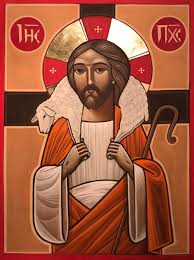
Coptic Church icon of Jesus the Good Shepherd

Jerusalem, enemy troops
    have surrounded you;
they have struck Israel’s ruler
    in the face with a stick.

Bethlehem Ephrath,
you are one of the smallest towns
    in the nation of Judah.
But the Lord will choose
one of your people
    to rule the nation—
someone whose family
    goes back to ancient times.
The Lord will abandon Israel
    only until this ruler is born,
and the rest of his family
    returns to Israel.
Like a shepherd
    taking care of his sheep,
this ruler will lead
    and care for his people
by the power and glorious name
    of the Lord his God.
His people will live securely,
and the whole earth will know
    his true greatness,
because he will bring peace. (CEV)

In Micah’s day there was no peace on earth, goodwill to all. In the eighth century B.C.E. the powerful Assyrian Empire came and conquered the northern kingdom of Israel, deporting many of the people and re-populating the cities with their own.

The Assyrian takeover of Israel not only left the northern kingdom in shambles but had a large impact on the southern kingdom of Judah.  All of Judah and Jerusalem were in extreme duress.  Even though Judah had not been conquered and was intact, they were still forced to pay tribute to the Assyrians to keep them at bay. 

The problem became even more exacerbated because the leadership of Judah sought to maintain their power and lifestyle.  The leaders neither looked to God for help nor looked out for the interests of the people.  Instead, they expected the already burdened poor to shoulder the burden of the tribute to the Assyrians.

What is more, thousands of refugees from Israel flooded into Judah and Jerusalem.  So, the already scant resources in Judah were pushed to the brink. Those in authority, the ones with resources who could make something of a difference, ended up taking advantage of the situation by buying fields and land at a fraction of its worth.  In some cases, they leveraged their power by simply pushing people of their land and taking it over. It was anything but a time of security, peace, and actions of goodwill.

Into this terrible situation of hardship and survival, Micah prophesied judgment upon the leaders who were oppressing the poor and displaced.  Micah’s message of hope was that a new kind of leader will come from humble origins, just like the common oppressed people of Judah.  The refugees, the displaced farmers, and the poor will have a champion.  He will feed and shepherd them, leading them to green pastures.  This leader will serve the people instead of the people serving the leader.

Christians see Jesus in Micah’s prophecy. Just as the ancient Jews needed hope and the promise of a different ruler, so today we, too, need hope and the anticipation of the leader who will come again using his power for security, peace, and goodwill.

Christ’s authority is different than earthly politicians and officials.  Israel and Judah had been so filled with bad kings and self-serving leadership over the centuries that Christ’s disciples could barely conceive of a different kind of rule. So, Jesus called his disciples together and said:

“You know that those who are regarded as rulers of the Gentiles lord it over them, and their high officials exercise authority over them.  Not so with you.  Instead, whoever wants to become great among you must be your servant, and whoever wants to be first must be slave of all.  For even the Son of Man did not come to be served, but to serve, and to give his life as a ransom for many” (Mark 10:42-43, NIV).

The people of Micah’s day needed to see beyond their terrible circumstances to hope of better days with food, peace, and protection.  We, too, feel insecure and anxious. We want leaders to be wise and just toward the vulnerable, the poor, and the displaced.  But while we look to our politicians and election cycles for our hope, the prophet Micah is jumping up and down, pointing us to a different leader – a shepherd leader.

Micah said the shepherd leader will come from Bethlehem.  When Micah proclaimed this, King David, the original shepherd king, had been dead for nearly three-hundred years. The people immediately made the connection between the coming leader and David.  There would be restoration and renewal!  A benevolent kingly reign is coming! 

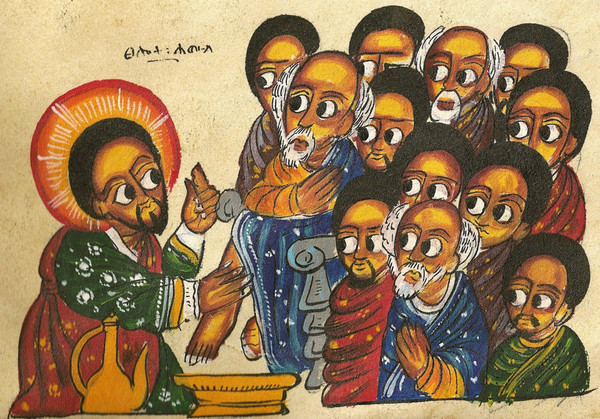
Ethiopian Orthodox Church depiction of Jesus the Bread of Life

“Bethlehem” is two Hebrew words put together: beth (“house”) and lechem (“bread”) thus being “House of Bread.” God was communicating that the coming shepherd leader would provide abundant food and care for them. God wanted, and still wants, a society that does not feed on itself, but is a house of bread for others. Jesus is the Bread of Life. Christ feeds us so that we will become a people who offer bread to others – both physical and spiritual bread.

Jesus is the bread for all the hungers we have in this life. We hunger for security in our world; satisfaction in our daily work; loved ones to be healthy and happy. In short, we hunger for peace. Our spiritual stomachs growl with hunger for spiritual food.  Many are spiritually starving because they are searching for peace and goodwill in places without food.

Satisfaction, contentment, and peace have come from the most unlikely places of Bethlehem and Nazareth. Can anything good come from villages in Judea that do not even show up on most maps of the ancient world?  Peace, hope, and goodwill can and do come from the least expected places and people. 

Christ was not born in the halls of power. Yet, through him there is peace, in the complete sense of the word. Jesus is the One who brings a full-orbed wholeness and wellness to life, no matter the situations around us. Jesus is our peace:

Like a shepherd, God will tend the flock; he will gather lambs in his arms and lift them onto his lap. He will gently guide the nursing ewes. (Isaiah 40:11, CEB)

“Yes, I will feed my flock, and I will lead them to a place of rest. I will search for the lost sheep. I will bring back the sheep that were scattered and put bandages on the sheep that were hurt. I will make the weak sheep strong, but I will destroy the fat and powerful shepherds. I will feed them the punishment they deserve.” (Ezekiel 34:15-16, ERV)

 “I am the Good Shepherd. I know my own sheep and my own sheep know me. In the same way, the Father knows me, and I know the Father. I put the sheep before myself, sacrificing myself if necessary. You need to know that I have other sheep in addition to those in this pen. I need to gather and bring them, too. They’ll also recognize my voice. Then it will be one flock, one Shepherd.” (John 10:14-16, MSG)

“I am the bread of life. He who comes to Me shall never hunger.” (John 6:35, NKJV)

When Jesus originally said those words, it was scandalous, unheard of rhetoric. So, Jesus, the stinker he could be, pressed it even more:

“I am the bread of life. Your ancestors ate the manna in the wilderness, yet they died. But here is the bread that comes down from heaven, which anyone may eat and not die. I am the living bread that came down from heaven. Whoever eats this bread will live forever. This bread is my flesh, which I will give for the life of the world… Very truly I tell you, unless you eat the flesh of the Son of Man… you have no life in you. (John 6:48-51, 53, NIV)

We are to ingest Jesus – to be filled with him. We need Jesus because he is our house of bread, our peace, our shepherd, and our king. Believing in him is to give our lives to him. The greatest Christmas gift we can give this season is the gift of our lives to Jesus Christ, the promised Messiah.

Lord Jesus, I have strayed far from your flock and taken matters into my own hands. I have chosen to feed in pastures that will never take care of my real hunger.  I need Your forgiveness. I believe You died on the cross for all the things I have done and left undone.  You rose from the grave to give me life. So, I want to stop going my own way and start going yours. Amen.

John 5:19-40 – The Centrality of Christ

The Risen Lord by Chinese artist He Qi

Jesus gave them this answer: “Very truly I tell you, the Son can do nothing by himself; he can do only what he sees his Father doing, because whatever the Father does the Son also does. For the Father loves the Son and shows him all he does. Yes, and he will show him even greater works than these, so that you will be amazed. For just as the Father raises the dead and gives them life, even so the Son gives life to whom he is pleased to give it. Moreover, the Father judges no one, but has entrusted all judgment to the Son, that all may honor the Son just as they honor the Father. Whoever does not honor the Son does not honor the Father, who sent him.

“Very truly I tell you, whoever hears my word and believes him who sent me has eternal life and will not be judged but has crossed over from death to life. Very truly I tell you, a time is coming and has now come when the dead will hear the voice of the Son of God and those who hear will live. For as the Father has life in himself, so he has granted the Son also to have life in himself. And he has given him authority to judge because he is the Son of Man.

“Do not be amazed at this, for a time is coming when all who are in their graves will hear his voice and come out—those who have done what is good will rise to live, and those who have done what is evil will rise to be condemned. By myself I can do nothing; I judge only as I hear, and my judgment is just, for I seek not to please myself but him who sent me.

“If I testify about myself, my testimony is not true. There is another who testifies in my favor, and I know that his testimony about me is true.

“You have sent to John and he has testified to the truth. Not that I accept human testimony; but I mention it that you may be saved. John was a lamp that burned and gave light, and you chose for a time to enjoy his light.

“I have testimony weightier than that of John. For the works that the Father has given me to finish—the very works that I am doing—testify that the Father has sent me. And the Father who sent me has himself testified concerning me. You have never heard his voice nor seen his form, nor does his word dwell in you, for you do not believe the one he sent. You study the Scriptures diligently because you think that in them you have eternal life. These are the very Scriptures that testify about me, yet you refuse to come to me to have life. (NIV)

There are many things in this world of great importance: how we govern ourselves as a free people; addressing issues of poverty, disease, education, taxes, healthcare, racism, and international relations; building local community relationships; supporting small business; working to make a decent contributive living; being a responsible citizen; and, loving our families and faith communities. It is my unshakable conviction that all these issues need more than mental and physical attention; they need our spiritual resources. People need the Lord.

Seasons, years, centuries, and even millennia come and go. People are born, live, and die. Generations exist and then are no more. Civilizations rise and fall. Yet, through it all and above it all is Jesus.

Christ is alive, and he continually brings life from dust, beauty from ashes, and everlasting meaning from apparent meaninglessness.

Today, Christ is still on the throne of all creation. 

Human elections and institutions only have authority as given by Jesus, the Ruler of all. Presently, Jesus remains attentive to people, even interceding for us at the right hand of his Father in heaven.  At this very moment, God’s Holy Spirit roams the earth and continues to apply all the redemptive consequences of Christ’s cross mysteriously and graciously to the lives of millions. 

Sometimes we need to do the occasional spiritual fact check, to remember what is really of ultimate significance in this old broken world.  If people need the Lord, then it only makes sense to live in ways that foster connection with Jesus. 

So, this morning I did what I do every morning: I began the day with Scripture reading, prayer, reflection, and gratitude – all done with the realization that Christ’s authority is real and pervasive, and his reign is supreme.

No matter the Christian tradition, Jesus Christ is the exalted and glorified Son of God, the Sovereign authority over every dominion. Jesus is God. God the Father works through God the Son. The works of Jesus bear testimony to the cosmic reality that he is Lord of all. And, if that were not enough, Jesus shares his divine power with us, his people.

In the face of the greatness and majesty of the Lord Jesus, the only valid and appropriate response is sheer submission to Christ’s authority.  Just as Jesus listened to the Father and obeyed the Father’s will, so we need to listen to Jesus and carry out his will.  Just as Jesus enjoyed his relationship with the Father, so we are to bask in our wonderful relationship with Jesus. 

Since Jesus submitted to death on a cross and rose from the dead through God’s power, we now have access to that power by God’s grace through faith in Christ.

We need not bend to any other master other than King Jesus, the rightful ruler of the universe.  Let us put away all other “gods” in which we depend for solace and help.  Jesus is the pioneer of our salvation who guides us with grace into God’s will for us. Thanks be to God!

Almighty God, to you all hearts are open, all desires known, and from you no secrets are hid: Cleanse the thoughts of our hearts by the inspiration of your Holy Spirit, that we may perfectly love you, and worthily magnify your holy Name; through Christ our Lord. Amen.

On Knowing Christ

Pietà by Elisabeth Frink

The ancient Philippian church had lost sight of their purpose, of what is the primary reason for their being in existence. Simply put, they needed to unify around what is the central and most valuable core of Christianity: knowing Jesus Christ. For the Apostle Paul, in his letter to the Church at Philippi, Jesus was so valuable that he literally gave up everything to become a Christian and follow Jesus. (Philippians 3:4-14)

It was no little thing that Paul did, converting in such a completely life-altering way to Christ. Paul had everything going for him. He was the up and coming star in Judaism. Paul had the Jewish pedigree, the intelligence, the personality, and the drive to become one of the greatest Pharisees of all time. And yet he forsook it all to pursue and know Christ. 

It might be hard for us to imagine just how significant Paul’s turn around was. On a much smaller scale, it would be like Green Bay Packer quarterback, Aaron Rodgers, at the height of his career, leaving football altogether to become a missionary to some remote place few people have ever heard of. Most might likely think he lost his marbles and was throwing away (pun intended) something valuable and important. So, it was with Paul.  Everyone thought he was nuts for becoming a Christian.

However, this would be to misunderstand what is really of greatest value. There are plenty of people in our society telling us what we need. With all the noisy rhetoric, from political pundits to commercial marketers, the person and work of Jesus can easily get lost in an ocean of competing voices. On a practical level, it can be far too easy to simply toss Christian discipleship on the smorgasbord of good ideas we get handed each day. Jesus might get misplaced and forgotten on our plate of life because of the mass of other food that is piled alongside him.

World Communion Sunday (always the first Sunday in October each year) reminds Christians that Jesus is our surpassing greatness, the highest and most worthy asset we possess. When we come to the Lord’s Table, there is nothing else to feast upon except Jesus, and Jesus alone. In the act of receiving the common elements of bread and cup, we proclaim that we need no one else and no other thing to make us happy in this life. Jesus is enough for us. What is more, we stand united with our brothers and sisters in Christ throughout the world in a common purpose and value of knowing Jesus Christ, and him crucified.

The Elements of Holy Communion by Jacques Iselin

The core value and heart of Christianity is a faith and love relationship with Jesus, to know him. This was the heartfelt cry of the Apostle Paul, and it was so meaningful to him that he gave up everything to pursue Christ and follow Jesus.  If we ever strip Christianity of this core value and stray from knowing Christ, the vacuum will be quickly filled with all kinds of other stuff, like the sheer duty of perfunctory prayers, clean living, and dispassionate robotic service. 

Paul longed to know Christ better. There are two words in the Greek language for “know.” One word refers to information; the other refers to an experiential knowledge – and that is the word Paul used with the Philippians. He deeply desired an intimate experience of Jesus. And Paul craved this so much that literally everything, when compared to Jesus, was “rubbish” to him. 

In the ancient world there were no landfills and dumps – the street served as the place people threw their garbage. The trash then got trampled into the ground, along with the generous amounts of animal dung. That is how Paul thought of even the best things in life as compared to knowing Jesus. 

There is no comparison between a freshly grilled T-bone steak and microwaved liverwurst. There is no comparison between a billion dollars and a penny. There is no comparison between the Green Bay Packers and the Chicago Bears (sorry Chi-Town). And there is no comparison between Jesus and anyone or anything else, no matter whom or what it is. 

Saint Augustine, Bishop of Hippo, in the fifth century, described life apart from Jesus as “disordered love.” By that he meant we pursue whatever our affections are set upon. One might love family, friends, job, and hobbies, yet if Jesus is absent or must compete for our affections in the middle of those things, then it is a disordered love. The solution, for Augustine, is to rightly order our love by having Jesus as the premier object of our affection. The New Testament frames it this way: Repent and believe the gospel.

To have “disordered love” is a nicer way of saying “spiritual adultery.” Using this metaphor, the appropriate response is to return to our first love. “You have forsaken your first love,” said Jesus to the church in Ephesus.  “Remember the height from which you have fallen!  Repent and do the things you did at first” (Revelation 2:4-5). 

Christianity is not some religion in which we strike a deal with God to go to heaven if we accept Jesus. Rather, Christianity centers all of life in the person and work of Jesus. The Lord is a jealous God, feeling slighted when Christians moonlight with the world at night while acknowledging Jesus during the day.

Specifically, Paul wanted to know the power of Christ’s resurrection. He yearned to experience a supernatural change from the inside-out – to be a new person in Christ. Paul did not simply turn over a new leaf; he did a dramatic 180 degree turn and went hard after Jesus. A desire and/or decision to know Christ is to be more than a milquetoast “I’ll try to do better.” Christianity, at its core, is dying to self and being reborn in Jesus with new life.

Furthermore, Paul wanted to know Christ and the fellowship of sharing in his sufferings. Paul ached to know Jesus so much that he embraced suffering, just as his Lord did. Paul was not some spiritual masochist; he rightly recognized that spiritual growth and intimacy with Jesus largely comes from the harsh realities of life’s trials and difficulties, as faith is stretched.  We would not know Christ the healer if we were not broken; Christ the provider if we were not in want; and, Jesus Christ and him crucified unless we were aware of sin in the world along with our own personal sin.

Each time a Christian approaches the Lord’s Table, they set aside competing voices and forsake rival gods to have Jesus. For us who believe, let the ingesting of the elements be an act of fellowship with God. May we, along with Paul, Augustine, and all past saints desire to have Jesus completely take over our lives because he is so valuable to us. We never need to be perfect to partake of bread and cup. Instead, we only need to strive toward what is ahead and decide that today we will press on toward the higher goal of knowing Christ.