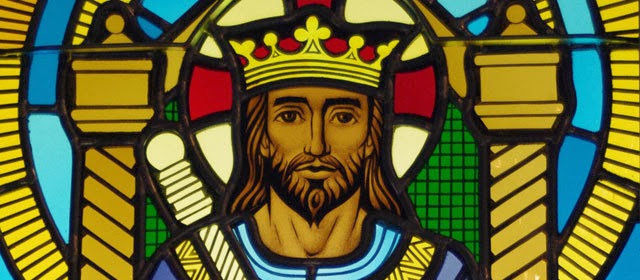
Christ the King Sunday (Luke 23:33-43)

The 118 feet high Christ the King statue in Świebodzin, Poland

When they came to the place that is called The Skull, they crucified Jesus there with the criminals, one on his right and one on his left. Then Jesus said, “Father, forgive them, for they do not know what they are doing.” And they cast lots to divide his clothing. And the people stood by watching, but the leaders scoffed at him, saying, “He saved others; let him save himself if he is the Messiah of God, his chosen one!” The soldiers also mocked him, coming up and offering him sour wine and saying, “If you are the King of the Jews, save yourself!” There was also an inscription over him, “This is the King of the Jews.”

One of the criminals who were hanged there kept deriding him and saying, “Are you not the Messiah? Save yourself and us!” But the other rebuked him, saying, “Do you not fear God, since you are under the same sentence of condemnation? And we indeed have been condemned justly, for we are getting what we deserve for our deeds, but this man has done nothing wrong.” Then he said, “Jesus, remember me when you come in your kingdom.” He replied, “Truly I tell you, today you will be with me in paradise.” (New Revised Standard Version)

I’m glad that the Gospel text on this Christ the King Sunday is the story of Christ on the cross with the two criminals on each side also crucified. Why?

Because our cultural contexts tend to associate power and authority with high level earthly positions. But, in reality, Christianity is a paradoxical religion full of truths which seem antithetical to each other; yet they are not.

Many people (including many Christians) believe that, in order to influence the culture, Christians must have prominent positions in society. This leaves the majority of Christians feeling as if they have nothing to offer the world. After all, they have no important title at their job, in the government, or within the church.

But nothing could be further from the truth. Christ, in the lowest earthly position possible by being nailed to a cross, was a king who had the highest heavenly position in the universe. One will never come to grips with Jesus apart from understanding that Christianity is an inherently paradoxical religion.

The Sanctuary of Christ the King in Almada, Portugal

One of the criminals crucified with Christ discerned this reality well; the other criminal did not understand at all. One demonstrated the reality that humility is the powerful key to all things, whereas the other criminal remained full of himself.

The scene portrayed for us on Golgotha’s hill shows us what the kingly reign of Jesus Christ truly looks like: It is characterized by the power of humility and sacrifice. It highlights Christ’s authority by giving mercy to those hanging on a cross alongside himself.

True power is not found in the halls of earthly political power, but rather in the elevating power of God’s grace and Christ’s self-sacrifice. Therefore, Christians can best demonstrate their own power and authority by extending grace and mercy toward others, even when it’s hard to do.

It can be difficult to wrap both our heads and our hearts around this reality of possessing power without actually having positions and titles of authority in the world and the church.

Many a church pastor bemoans the fact that a number of their parishioners fail to be active servants in the wrongheaded notion that the clergy are supposed to do all the work. The laity may believe that the clergy are the ones with the educational, experiential, and positional power to influence culture and society.

What’s more, it can be even harder for those who once had positions of power to believe they themselves can no longer effectively work for the good, because they are now nobodies. They may ask, “Who would listen to me?”

The answer is: A lot of people. God uses all sorts of persons in all sorts of places and situations. What we all need, whether clergy or laity, is the willingness to be humble and to sacrifice one’s time or talent in showing mercy to another.

Christians must take their cues from the Lord Jesus. In the setting of the interaction between Christ and the other two crucified men in today’s story, Jesus is the innocent one sandwiched between two guilty persons. Christ’s humiliation is on full public display. The crowd of onlookers mock him, along with one of the criminals. Because of the apparent incongruence between being ‘King of the Jews’ yet not freeing himself from his awful situation.

Whereas most of us might avoid being humiliated in public at any cost, Jesus embraced the rejection and the suffering, knowing that he was offering a sacrifice for the benefit of the whole world.

Even though Jesus was extremely vulnerable, and in emotional, spiritual, and physical pain which we can only imagine, he nonetheless chose to use his kingly power and authority on behalf of others – including those who blatantly rejected and mocked him.

Grace and mercy were demonstrated by submitting to an ignominious death, and by willingly acting to be the bridge connecting others to God. Relationship is at the very heart of the divine will; God would do anything to restore broken relations with his fallen people. No one is beyond the reach of grace.

In a contemporary culture of polarized relations and angry vitriol toward one another, the ordinary Christian without earthly title or authority is in the best position to provide basic human kindness by extending mercy to “enemies” and demonstrating humility in all things.

Christ embodied love and forgiveness. He used his power for mercy, not judgment;  and for grace, not revenge.

Jesus demonstrated for us how grace is the greatest operative force in the universe.

To love and forgive another is the best demonstration of power and authority that anyone could ever show.

God’s action in Christ through the cross is what can move us to true acts of love and selflessness. We participate in Christ by giving grace through acts of mercy in comforting, encouraging, and helping others.

The only way we can give grace is to receive grace. It is God’s action in Christ through the Spirit that moves us to true acts of love and selflessness.

Personally, I am encouraged with the image of Christ as King – the One who is both sovereign over all creation, and yet is with me and knows my every need, giving grace and mercy and unconditional love.

For me, the idea of both God’s transcendence and God’s immanence is the perfect lead-in for the Advent season.

Earthly leaders can be capricious, petty, enamored with earthly power, and wield authority only in ways that serve themselves and not the common good of all. No wonder there is so much corruption and injustice in this old fallen world of ours.

Such hateful leadership has no problem leaving us beaten, bruised, and hanging on a cross. In our pain and our suffering, what will we do?

Hopefully, we will let Jesus transform our understanding of power and authority.

Ideally, in our worst situations of suffering and confusion, we will remember Jesus lifted-up on the cross, lifted-up as sovereign over all things. We will find our own true power in self-giving-love to a world which appears it has given itself to hate and selfish judgment of people they don’t like.

A participation in Christ’s rule and reign over all things means that his crucified power has given us grace and forgiveness, so that we might pass it on, pay it forward, and work for that which is just, right, and good.

May it be so, to the glory of God.

Almighty God, you rescue us from our enemies, so that we may serve you without fear. Strengthen us, that we might share in the inheritance of the saints in your kingdom of light. Amen.

Christ the King Sunday (John 18:33-37)

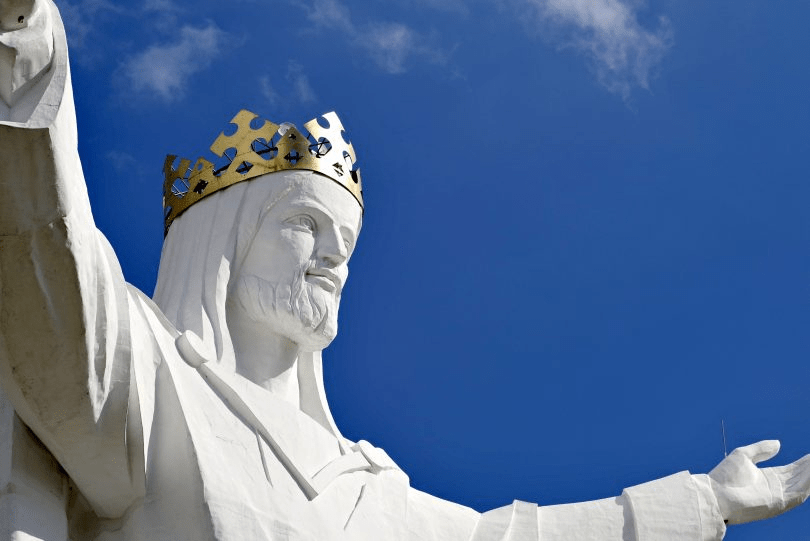
Statue of Christ the King, in Świebodzin, Poland

Then Pilate entered the headquarters again, summoned Jesus, and asked him, “Are you the King of the Jews?” 

Jesus answered, “Do you ask this on your own, or did others tell you about me?” 

Pilate replied, “I am not a Jew, am I? Your own nation and the chief priests have handed you over to me. What have you done?” 

Jesus answered, “My kingdom does not belong to this world. If my kingdom belonged to this world, my followers would be fighting to keep me from being handed over to the Jews. But as it is, my kingdom is not from here.” 

Pilate asked him, “So you are a king?”

Jesus answered, “You say that I am a king. For this I was born, and for this I came into the world, to testify to the truth. Everyone who belongs to the truth listens to my voice.” (New Revised Standard Version)

Each year in the Christian Calendar, Christ the King Sunday is observed as the final Sunday in the liturgical year. It comes at this time, just before the beginning of Advent, in order to consider an important question.

Since Jesus came to this earth in his incarnation to be a king, we must ask, “What kind of a king was Jesus?”

Christ was not, and is not, a king, a ruler (or any other sort of title one wants to use for an authoritative leader) in the same way as was the Roman Emperor, King Herod, or the regional authority of the time, Pontius Pilate.

Jesus was also not like those in authority such as the Jewish High Priest, the Jewish ruling council of the Sanhedrin, or the local synagogue ruler. And Christ is most definitely not like any sort of present day President, Prime Minister, or petty dictator in any of the world’s nations.

Jesus was a king and a ruler who used his power and authority for those on the underbelly of society, that is, people without much, if any, power or authority.

That means Christ the King is concerned to effect a very different set of values from that of any politically dominant governmental system or society that was or is on this earth.

Whether a person or group of people are seeking to win an election, initiate a coup, or effect a change in government, they want their particular system of governing to be in power. They want to call all the shots in a particular place.

That means there will be winners and losers. There will be people in power, and others without it. Some people will benefit from the system, and others will not. Looking at kingship and/or leadership from that perspective, there is a built in failure rate.

The obsession with winning, at a national level, typically involves securing a strong military. Yet, despite military might, soldiers rarely secure any sort of political solution to anything. All it really does is strongarm others into doing what the powerful want done. It does nothing to change the hearts of people.

People in power can be enamored with their authority to do things. And they don’t like it whenever they are not in control of everything. The kings, rulers, and even religious leaders in Christ’s day, were used to controlling public discourse and even the daily lives of common people.

From that sort of worldly understanding of power, Jesus had no real authority. He was this pathetic person standing before a powerful person. Most people would have been begging for their lives. But not Jesus. Christ knew who was really in charge. And it was not Pilate.

Pilate was flummoxed by the presence of Jesus. From Pilate’s perspective, Jesus was not at all acting like a king ought to. Pilate, in his authoritative role, wanted answers about what was going on. But he didn’t realize that his authority was given to him from a power outside the Roman Empire.

Christ’s kingdom is not of this world. Therefore, the power politics and authority positions of that kingdom are nothing what people like Pilate were used to. There was no way that Pilate could use the typical tactics of manipulation, lies, corruption, and leveraging power to come to a satisfactory outcome for himself.

The values of God’s kingdom are quite different from any political government in this world, either past or present.

Jesus had no need to try and be at the top of Pilate’s system, or of the Roman world. So, he wasn’t even going to try and exercise that kind of authority within it. And neither were his disciples. Clubs and swords and pitched battles would not be happening. There was absolutely no need for it whatsoever.

For us today, that means we serve the interests of humility, gentleness, respect, righteousness, mercy, purity, and peace. We are not here on this earth to engage in the routine and typical ways of earthly power politics.

For the Christian, Jesus is King. But this king isn’t riding around in a chariot or a limousine; he comes to us on a jack ass and driving a Subaru.

Jesus is the king with all the power of the universe, and yet is tortured and killed by those with the local society’s authority. That happened not because of weakness or inability, but because of a completely different set of values which have to do with love defeating hate, instead of an army winning a victory.

A God who is crucified is diametrically different than any other deity or authority which has ever existed. The power of love is the ultimate power of doing what is right, just, and good; and letting truth have its way, no matter what.

Christians everywhere must be reminded, on this Christ the King Sunday, that we serve a sovereign king whose power and authority is used to be a humble servant who meets the needs of others.

All Christians, therefore, ought to embrace and engage in becoming gentle folk who bring humble service to others wherever they go. Seeking power, position, prestige, and pedigree is in direct opposition to the values of God’s kingdom, with Christ as King.

Any sort of Christendom, which seeks to control both government and society, or a Christian Nationalism which intends to ensconce personal agendas into society, ought to be rejected.

Christian Nationalism is nothing more than Grape Nuts; just as the cereal is neither grapes nor nuts, so the political movement is neither Christian nor concerned for national interests.

This is a day for the church to reassess what is most important, to affirm its true values, and to evaluate how it really ought to operate in society.

Almighty and everlasting God, whose will it is to restore all things in your well-beloved Son, the King of kings and Lord of lords: Mercifully grant that the peoples of the earth, divided and enslaved by guilt and shame, may be freed and brought together under his most gracious rule; who lives and reigns with you and the Holy Spirit, one God, now and forever. Amen.

The Mediator and Leader (Psalm 110:1-4)

The Lord said to my lord,
    “Sit here at my right side
    until I put your enemies under your feet.”
From Zion the Lord will extend your royal power.
    “Rule over your enemies,” he says.
On the day you fight your enemies,
    your people will volunteer.
Like the dew of early morning
    your young men will come to you on the sacred hills.

The Lord made a solemn promise and will not take it back:
    “You will be a priest forever
    in the priestly order of Melchizedek.” (Good News Translation)

This is the most quoted psalm in the New Testament (twenty-four times) with the reason being that the apostles discerned Jesus as the messianic ruler of Psalm 110. The author of Hebrews purposed to highlight the superiority of Jesus Christ over everyone and everything. So, he went to this psalm, and used it early in his letter for the beginning of his argument:

In the past God spoke to our ancestors through the prophets at many times and in various ways, but in these last days he has spoken to us by his Son, whom he appointed heir of all things, and through whom also he made the universe. The Son is the radiance of God’s glory and the exact representation of his being, sustaining all things by his powerful word. After he had provided purification for sins, he sat down at the right hand of the Majesty in heaven. So, he became as much superior to the angels as the name he has inherited is superior to theirs….

But about the Son he says,

“Your throne, O God, will last for ever and ever;
    a scepter of justice will be the scepter of your kingdom.
You have loved righteousness and hated wickedness;
    therefore God, your God, has set you above your companions
    by anointing you with the oil of joy.”

He also says,

“In the beginning, Lord, you laid the foundations of the earth,
    and the heavens are the work of your hands.
They will perish, but you remain;
    they will all wear out like a garment.
You will roll them up like a robe;
    like a garment they will be changed.
But you remain the same,
    and your years will never end.”

To which of the angels did God ever say,

“Sit at my right hand
    until I make your enemies
    a footstool for your feet”? (Hebrews 1:1-13, NIV)

In Christianity, Jesus is the ultimate Mediator between God and humanity. Neither angel nor any other human can fill such a role. The author of Hebrews wanted to make it clear that Jesus is the rightful Ruler of all creation.

Christ’s authority is far and above all others. So, Christians are never defenseless in this world. Believers have a caring mediator, and a powerful sovereign, knowing that Jesus has the authority to back up his words of love and assurance toward us.

Jesus has the unique combination of being both a king and a priest; he intercedes for us and provides us with compassionate leadership. Again, in the middle of his argument, the author of Hebrews used Psalm 110 to emphasize this:

Every high priest is selected from among the people and is appointed to represent the people in matters related to God, to offer gifts and sacrifices for sins. He can deal gently with those who are ignorant and are going astray, since he himself is subject to weakness. Therefore, he has to offer sacrifices for his own sins, as well as for the sins of the people. And no one takes this honor on himself, but he receives it when called by God, just as Aaron was.

In the same way, Christ did not take on himself the glory of becoming a high priest. But God said to him,

“You are my Son;
    today I have become your Father.”

And he says in another place,

“You are a priest forever,
    in the order of Melchizedek.”

During the days of Jesus’ life on earth, he offered up prayers and petitions with fervent cries and tears to the one who could save him from death, and he was heard because of his reverent submission. Son though he was, he learned obedience from what he suffered and once made perfect, he became the source of eternal salvation for all who obey him and was designated by God to be high priest in the order of Melchizedek. (Hebrews 5:1-10, NIV)

Christ demonstrated and proved that he is qualified to be the rightful priest and king because of his obedient suffering. Therefore, Jesus is perfectly suited and able to help us. He is neither a detached nor an aloof priestly king.

The Lord Jesus knows exactly what it’s like to be a human in this broken and fallen world. Such divine empathy translates into solid emotional and spiritual support because, as the Christian tradition holds, Jesus has taken care of the sin issue once for all through the Cross.

The Messiah’s enemies – whose eventual and final defeat is certain – are not Gentile kingdoms or human institutions. Christ’s ultimate foes are the hostile and evil principalities and powers of this dark world, including death itself. The universal reign of Jesus, the exalted Son of David, brings deliverance from guilt, shame, and injustice as the unique God-Man.

In this unabashed Christian view of Psalm 110, Jesus is our perfected high priest who is able for all time to save those who approach God, since he always lives to make intercession for us (Hebrews 7:25). The appropriate response to such a great king and priest is submissive loyalty and eternal praise.

O Lord our God: Reign in power over us, through your Son, Jesus Christ – for he is exalted over all governments and authorities, all ideologies and creeds, and all human hearts and souls. King Jesus: Be enthroned in our lives, in all people everywhere, as our mediator and atoning sacrifice. Spirit of God: Reign in power over us through Jesus Christ and give us the victory over all the enemies of our souls, within and without, for the glory of your Name. Amen.

Christ the King Sunday (Ephesians 1:15-23)

The 118 feet high Christ the King statue in Świebodzin, Poland

For this reason, ever since I heard about your faith in the Lord Jesus and your love for all God’s people, I have not stopped giving thanks for you, remembering you in my prayers. I keep asking that the God of our Lord Jesus Christ, the glorious Father, may give you the Spirit of wisdom and revelation, so that you may know him better. I pray that the eyes of your heart may be enlightened in order that you may know the hope to which he has called you, the riches of his glorious inheritance in his holy people, and his incomparably great power for us who believe.

That power is the same as the mighty strength he exerted when he raised Christ from the dead and seated him at his right hand in the heavenly realms, far above all rule and authority, power and dominion, and every name that is invoked, not only in the present age but also in the one to come. And God placed all things under his feet and appointed him to be head over everything for the church, which is his body, the fullness of him who fills everything in every way. (New International Version)

Christ the King Sunday is intended to help us see the cosmic reality that Jesus reigns over all creation as the only rightful Sovereign of the universe. This day always comes just before Advent so that we remember to anticipate both a baby and a king.

Christ as Lord of all exposes three problems humanity faces:

  1. Building our own petty kingdoms and setting ourselves up as masters over our own small worlds.  People who have been hurt may attempt to seize power for themselves in order to avoid ever being hurt again; or in the belief that if they had power, the could stop others from being hurt. Instead of submitting to Christ’s rule, they will seek to control their little end of the world, to protect themselves from pain.
  2. Bowing to other kings besides King Jesus. When distressed, some people may rely on another ruler to address their hard circumstances – thereby expecting another to give only what Jesus can provide.  Instead of running to God, they run to politicians or pastors to fix whatever is going on.
  3. Lacking awareness of the power possessed in Christ the King. Christians reign with Jesus Christ, and therefore can exercise authority over every dominion that exists, especially the dominion of darkness.

The Apostle Paul’s letter to the Ephesian believers provides God’s design for the church. It’s a plan for Christians to know their spiritual blessings and exercise the power they have being united to Christ. God wants us to understand this power and authority, and to actively use it.

We have a clear understanding in Ephesians of how to pray: To know Jesus better.  There is probably no higher prayer, according to the Apostle Paul, than to pray to know Jesus better – so that we will know the hope to which we have been called, and the incomparably great power for us who believe.

The word for “power” is where we get the English word “dynamite.” When I was a kid we had a neighbor who had a fondness for playing with dynamite (especially when he drank too much!). Even though he lived a mile down the road, when he blew up a tree stump or anything else on his property, it shook our house and felt like the windows were going to break. Yet, one stick of dynamite is nothing compared to God’s power.

This divine power is for us who believe in Christ the King. It’s the same power used to raise Jesus from death, and which exalted Christ as Lord of the universe. The rule and reign of Jesus is far above any other existing authority – including powers of the dark domain.

Concerning dealing with the powers of darkness, we possess the authority of Jesus Christ. Because of Christ’s resurrection, ascension, and glorification, Christians therefore have a vital and inseparable union with Jesus.  Jesus redeemed us; we belong to God as adopted children. 

Since all earthly and spiritual powers are subject to Christ, they are also subject to us. The imagery of Jesus as Head, and Christians as the Body, means that we have an inseparable union together. Since we are united with Christ, we share his authority over all spiritual powers.

It’s one thing to know this information; it’s another to use it. We are to experience Christ’s power through exercising our authority as believers. We can link faith and knowledge together in a confident use of spiritual authority because we have rights as blood-bought children of God.

All the pronouns used by Paul in Ephesians are plural. This means that tackling the forces of darkness needs to be a communal activity; going it alone is dangerous. The following is a prayer we can pray together, that boldly exercises our authority in Christ:

Almighty God, we bow in worship and praise before you, and thank you that the Lord Jesus Christ is King over all creation, and the rightful Sovereign of the universe. We are grateful that we have power together with Jesus.  We therefore surrender ourselves completely in every area of our lives to You. 

Since Christ’s authority extends over every dominion, including the dominion of darkness, we take a stand against all the work of Satan that would hinder us in prayer. We address ourselves only to the True and Living God, and refuse any involvement of Satan in our prayers.

Therefore, Satan, we command you, in the Name of the Lord Jesus Christ, to leave our presence with all your demons. We bring the blood of Jesus Christ between us.

Sovereign God, we recognize you are worthy to receive all glory, honor, and praise. We renew our allegiance to you and ask the Holy Spirit to help us pray. You have loved us from eternity past; and you sent the Christ into the world to die for us. So, we are thankful for complete forgiven; for adoption into your family; for eternal life; and for your daily help and strength.

Glorious God, open our eyes so that we will see how great you are, and how complete your provision is for today. The victory of Christ’s cross and resurrection has given us a seat in heaven. We take our place with Jesus, and recognize by faith, that all wicked spirits and Satan himself are under our feet.

Thank you, gracious God, for the spiritual armor you have provided. Therefore, we put on the belt of truth, the breastplate of righteousness, the sandals of peace, and the helmet of salvation. We lift up the shield of faith against all the fiery arrows of the enemy; and we take in our hands the sword of the Spirit, the Word of God. We use your powerful Word against all the forces of evil, living and praying in complete dependence upon you, Holy Spirit.

Lord Jesus, we are thankful that you disarmed all power and authorities, triumphing over them by the cross. So, we claim victory for our lives today by rejecting all the insinuations, accusations, and temptations of Satan; affirming that the Word of God is true; living in the light of God’s Word; and choosing to obey you. 

Open our eyes, blessed God, and show us the areas of our lives that do not please you. Cleanse us from anything that would give Satan a foothold against us. We stand into all that it means to be your adopted children; we welcome all the ministry of the Holy Spirit in our lives today.

By faith, and in complete dependence upon you, we put off the old sinful person and stand into all the victory of the crucifixion where the Lord Jesus Christ provided cleansing from the sinful nature. We put on the new person and stand into the victory of the resurrection and the provision Christ has made for us to live above sin. We put off the old sinful nature with its selfishness and put on the new nature with its love.  We put off the old nature with its fear and deceit; and instead put on the new nature with its courage and righteousness.

We are thankful, mighty God, that you have blessed us with every spiritual blessing in Christ; and with new life into a living hope by the resurrection of Jesus from the dead, so that today we can live filled in the Holy Spirit with love, joy, peace, patience, kindness, goodness, gentleness, and self-control. Since we recognize and affirm that this is your will for us, we therefore reject and resist all the attempts of Satan and his demons to rob us of God’s will.   

We are thankful, blessed Holy Trinity, that our spiritual weapons have divine power to demolish demonic strongholds, arguments, and every pretention that sets itself up against the knowledge of God. We therefore take captive every thought to make it obedient to Christ; we tear down the strongholds and smash the plans of Satan that have been formed against us; we affirm that you have not given us a spirit of fear but a spirit of power, love, and self-discipline; and we choose to make right decisions of faith. 

Powerful God, show us the ways Satan is hindering, tempting, lying, and distorting the truth in our lives. Help us to be aggressive in prayer and faith; and to think rightly, and actively practice Your Word. We cover ourselves with the blood of the Lord Jesus Christ and pray that you, Holy Spirit, would bring all the work of Christ’s crucifixion, resurrection, ascension, and all your work of Pentecost into our lives today.

In the name of Christ the King, we surrender ourselves to you, O God; and we refuse to be discouraged because you are the God of all hope. You have proven your power by resurrecting Jesus from the dead. Therefore, we claim this victory over all satanic forces in our lives, our families, our neighborhoods, our workplaces, and our faith communities; through the blood of the Lord Jesus Christ with thanksgiving, we pray. Amen.