Matthew 23:29-36 – “Woe Is Me!”

Ethiopian Jesus
Jesus, from an Ethiopian Orthodox Church, c.1750 C.E.

“Woe to you, teachers of the law and Pharisees, you hypocrites! You build tombs for the prophets and decorate the graves of the righteous. And you say, ‘If we had lived in the days of our ancestors, we would not have taken part with them in shedding the blood of the prophets.’ So, you testify against yourselves that you are the descendants of those who murdered the prophets. Go ahead, then, and complete what your ancestors started! 

“You snakes! You brood of vipers! How will you escape being condemned to hell? Therefore, I am sending you prophets and sages and teachers. Some of them you will kill and crucify; others you will flog in your synagogues and pursue from town to town. And so upon you will come all the righteous blood that has been shed on earth, from the blood of righteous Abel to the blood of Zechariah son of Berekiah, whom you murdered between the temple and the altar. Truly I tell you; all this will come on this generation. (NIV) 

I almost feel the need to place a warning label on this blog post: “The writer has determined that a careful reading of this Scripture is dangerous to those who think their current state of Christianity is just fine.”  Jesus stands in a long line of Old Testament prophets as the ultimate prophesier calling the people to see things as they really are and come back to the God of all, not the God of their own making. 

I feel yet another warning is warranted, knowing from years of experience that there is an Enemy of our souls: The dark forces of this world will try every which way to get us to believe these words of Jesus are for other people, not me or you – that you and I are okay and that this is for “those” people [probably ones we don’t like] who are clearly deluded. We, however, are simply fine.   

We all need these words from Jesus and to let them speak to us. Christ’s scathing and damning critique was leveled against a distorted spirituality, a false Christianity, a controlling leadership that stifled and snuffed-out the true worship of God. Jesus pronounced seven woes on the religiously pious spiritual brokers of his day. Today’s Gospel lectionary contains only the seventh woe. This woe, along with the rest, are not directed toward the irreligious or the spiritually lackadaisical folks among us – the woes are aimed squarely at the religiously committed. 
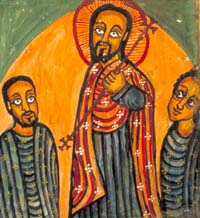
Ethiopian Orthodox Jesus
Ethiopian Orthodox Church depiction of Jesus

The word “woe” literally means “disaster” “calamity” and “misery.” Jesus pronounced a woe against ultra-religious persons who were obsessed with respecting the tombs and the graves of the ancient prophets. It was considered a terrible travesty to walk on such a grave, even accidentally. The concern about it would be something like today’s respect given to the American flag by many people. 

Here is what Jesus is getting at with his woe on those being so concerned with the tombs of the prophets: Honoring dead people and inanimate objects like graves while ignoring live people is not good. Respecting dead people of the past means nothing if we simultaneously ignore the live people right in front of us. For Jesus, one of the surest ways to hell is to give credence to Christian leaders long dead while flippantly disregarding the prophet or pastor presently in our lives who is taking pains to communicate God’s will and care for God’s people right now. 

Jesus knew quite well the telltale signs of hypocrisy: 1) hypocrites don’t practice what they preach; 2) hypocrites keep other people out of God’s kingdom; 3) hypocrites focus on externals; and, 4) hypocrites major on the minors. Hypocrisy, however, never has the last word – grace does. The final word to everything is God’s grace.  

For all of Christ’s severe words, his heart was filled with a love and a longing for his wayward people. Jesus died for the ungodly with deep concern, intention, and hope that everyone would come to know the true worship of God – filled with an abundance of mercy for the penitent sinner. 

When the prophet Isaiah experienced a vision of God his response was “woe is me!” (Isaiah 6:1-5). The appropriate response to today’s Gospel lesson is repentance – to see and turn from our own propensity toward spiritual and/or religious pride and the tendency to view the “other” as needing to repent, but not me.  

Let us, then, come to the cross of Jesus Christ and there find the grace which absolves us from such sin. Let us approach the empty tomb and find Christ’s resurrecting power of transformation. Let us approach the ascended Christ on the throne with both humility and confidence. Let us intercede for a world which desperately needs the peace of Christ. 

Lord Jesus Christ, you prayed that we would be one as you and your Father are one. We confess our resistance to your prayer. We have failed to maintain the unity of the Spirit. We have broken the bond of peace. For the times we have not listened to each other, when we have spoken in anger, haste, or fear, we are sorry. For the times we have not loved each other, when we have competed, or insulted or judged each other, we are sorry. For the harm that our disunity has done to our witness to the Gospel, we are sorry. Have mercy on us, we pray. Restore us to friendship with you and with one another, through the power of your Spirit. Lord, grant your grace for repentance to spiritual charlatans and victimizers; and, give your power to those distressed and victimized for forgiveness of their abusers, so that all of us together may strive to break the chains of oppression and show the peace of Christ in the world. Amen. 

Exodus 10:21-29 – From Darkness to Light

Darkness

Then the Lord said to Moses, “Stretch out your hand toward the sky so that darkness spreads over Egypt—darkness that can be felt.” So, Moses stretched out his hand toward the sky, and total darkness covered all Egypt for three days. No one could see anyone else or move about for three days. Yet all the Israelites had light in the places where they lived.

Then Pharaoh summoned Moses and said, “Go, worship the Lord. Even your women and children may go with you; only leave your flocks and herds behind.”

But Moses said, “You must allow us to have sacrifices and burnt offerings to present to the Lord our God. Our livestock too must go with us; not a hoof is to be left behind. We have to use some of them in worshiping the Lord our God, and until we get there, we will not know what we are to use to worship the Lord.”

But the Lord hardened Pharaoh’s heart, and he was not willing to let them go. Pharaoh said to Moses, “Get out of my sight! Make sure you do not appear before me again! The day you see my face you will die.”

“Just as you say,” Moses replied. “I will never appear before you again.” (NIV)

The ancient Israelites were in bondage to the mighty Egyptian empire. After four-hundred years of bondage, God called Moses to lead them out from Egypt to the Promised Land. The only kink was the Egyptian Pharaoh’s outright reluctance. As the most powerful human on the planet at the time, Pharaoh was used to getting his way on everything. God knew it would be a process of deliverance, and not just a sudden event.

So, a series of ten wonders or miracles occurred that struck at the heart of Egyptian power and religion. A discernible pattern quickly developed in which Pharaoh refused cooperation; God sent an incredible devastation on the land; Pharaoh relented with a half-repentance; God lifted the devastation; and, with things “back to normal” Pharaoh’s heart was hardened and he would not let God’s people go. Rinse and repeat a lot more times.

Today’s Old Testament lesson recounts the ninth wonder done by God, using Moses. Although the miracle of complete and total darkness lasted a full three twenty-four-hour long days without harming any human or animal, the sheer fear and terror it brought to the Egyptians left them in a three-day state of suspense. Living on the edge in anxious apprehension is psychologically overwhelming. At least with the other plagues, you could see what you were up against.

Fear in the dark

In the land known as the “eternally rising sun,” the uncertainty of the perpetual darkness was meant to humble Egypt and put it in its place. Yet, with nine strong and full wonders from God, Pharaoh remained intransigent and stubborn. He was not going to let all that slave labor walk away while he was in charge.

I “wonder” what it takes for most of us to make a major change in our lifestyle – what we need to go through before we cry “uncle” and let go. The more power and control we have, the harder it is to do so. Humans are creatures of habit, and wherever there are long standing routines there you will find great difficulty in changing those practices.

No one simply wakes up in the morning and decides to be a jerk. Instead, it is likely that one day a person will arise, look in the mirror, and not recognize who is looking back at them. A series of choices and habits over a long stretch of time eventually formed the undistinguished blockhead. The Apostle James once described the pathology behind the person in the mirror:

You are tempted by the evil things you want. Your own desire leads you away and traps you. Your desire grows inside you until it results in sin. Then the sin grows bigger and bigger and finally ends in death. (James 1:14-15, ERV)

By reading today’s story Christologically we have a clue as to the remedy and reformation needed to form newer and better habits. Just as all Egypt was in three days of darkness due to sin, so Jesus was three days in the dark grave because of the world’s sin. And just as the ancient Israelites were delivered from their cruel bondage from Egypt and entered the Promised Land, so in Jesus Christ humanity is liberated from their power-hungry, money-grubbing, control-obsessing ways of being insensitive dolts to forming new habits of humility, justice, and love. The Apostle Peter said:

You are a chosen race, a royal priesthood, a holy nation, God’s own people, in order that you may proclaim the mighty acts of him who called you out of darkness into his marvelous light. (1 Peter 2:9, NRSV)

It is the aim of the Christian to look out at the world and bring love where love is not; to discover it is more blessed to give than to receive; and, to have a deep sense of justice which works for egalitarian ways and the equity of all people, not just people of privilege.

So, may we gain a proper perspective of ourselves, others, and the world. And, may we resist the Pharaoh’s among us, while championing the needs of the downtrodden of this old fallen world. May we be like Christ and see Jesus in each person we encounter.

God, you have given all peoples one common origin. It is your will that they be gathered as one family in yourself. Fill the hearts of humanity with the fire of your love and with the desire to ensure justice for all. By sharing the good you give us, may we secure an equality for all our brothers and sisters throughout the world. May there be an end to division, strife, and war. May there be a dawning of a truly human society built on love and peace. We ask this in the name of Jesus, our Lord, through the might of the Holy Spirit. Amen.

Psalm 149 – Praise and Punishment

Church stained glass windows sword dividing

Praise the Lord!
Sing to the Lord a new song,
his praise in the assembly of the faithful.
Let Israel be glad in its Maker;
let the children of Zion rejoice in their King.
Let them praise his name with dancing,
making melody to him with tambourine and lyre.
For the Lord takes pleasure in his people;
he adorns the humble with victory.
Let the faithful exult in glory;
let them sing for joy on their couches.
Let the high praises of God be in their throats
and two-edged swords in their hands,
to execute vengeance on the nations
and punishment on the peoples,
to bind their kings with fetters
and their nobles with chains of iron,
to execute on them the judgment decreed.
This is glory for all his faithful ones.
Praise the Lord! (NRSV)

The initial question that arises with me is this: Is this a psalm of praise to the Lord, or an imprecatory psalm encouraging the punishment of the wicked? Well, perhaps the obvious answer is “yes.” I suppose what I am really struggling with is that out of all the one-hundred fifty psalms in the psalter, only this one has this unique combination of vocal praise and punishing action.

The psalm begins much like many psalms of praise but takes the unexpected turn of a call to a war-like operation to execute vengeance on enemies. I freely admit that I do not know quite what to make of this strange amalgam. I wonder along with the venerable Old Testament scholar Walter Brueggemann who said, “One cannot tell whether this is a responsibility to fend off oppressors or a temptation to gather imperial power.”

Perhaps my wrestling with this psalm is really the struggle with history itself. The Holy Scriptures do not shy away from the realism of its times and often offers historical events and human attitudes with unvarnished narratives. The Bible, and especially the psalmist, will not let us sanitize the past as some idyllic bygone era of divine drama to be envied. Instead, we receive the liberation of God’s people with all its harsh truth.

So, it could be that is why I also loathe seeing some mass market crosses which look ornately beautiful, as if Christ’s death was some pleasant affair. Deliverance from sin, death, and hell came at an awful price. Jesus absorbed all the foulness and degradation of a tortuous ignoble death. In other words, he was a bloody mess, publicly displayed for all to jeer at and be repulsed by.

What is more, for the Christian, perhaps the sagest approach to today’s psalm is unabashedly choosing to view it through Christocentric lenses. Christ is the strong man who has bound the ruler of this dark world with iron chains and secured our liberation from a hellish existence. And the Lord will return, the nations of the earth will be judged, and the faithful will reign with Christ forever.

Even if I read a bit too much into the psalm by interpreting it Christologically, it still leaves the intention of the imprecation open as to its true nature. In other words, the psalm simply does not tell us the trajectory of the curse which comes out of the praise. We are left to wonder in what kind of direction it goes. The Christian tradition of reading psalms and seeing Jesus in them might be our best guide.

Whichever way we choose to examine this unique psalm, the thing which we do know is that it unequivocally stands as a defiance of the nations and peoples of the earth who oppose the living God. Resistance to injustice, unrighteousness, and evil is encouraged by this psalm. The only ruler of this earth who has absolute power is God; and, anyone or any group which attempts to gain and grab such power for themselves is to be resisted. For the harsh reality of living on this created yet fallen earth is that violent and insolent people still desire total control and will do just about anything to get it and keep it.

Almighty and sovereign God, we, your people, ask in the Name of your most precious Son, Jesus Christ, our risen and ascended Lord, to look upon the good desires of your humble servants, and stretch forth the right hand of your power to be our defense against evil in all its insidious forms. And do not lead us into temptation, but deliver us from the evil one. For yours is the kingdom and the power and the glory forever. Amen.

Psalm 83:1-4, 13-18 – Against Evil

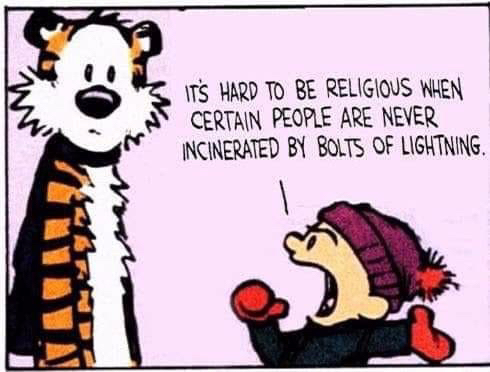
Calvin and Hobbes - imprecation

O God, do not be silent!
Do not be deaf.
Do not be quiet, O God.
Don’t you hear the uproar of your enemies?
Don’t you see that your arrogant enemies are rising up?
They devise crafty schemes against your people;
they conspire against your precious ones.
“Come,” they say, “let us wipe out Israel as a nation.
We will destroy the very memory of its existence….”

O my God, scatter them like tumbleweed,
like chaff before the wind!
As a fire burns a forest
and as a flame sets mountains ablaze,
chase them with your fierce storm;
terrify them with your tempest.
Utterly disgrace them
until they submit to your name, O Lord.
Let them be ashamed and terrified forever.
Let them die in disgrace.
Then they will learn that you alone are called the Lord,
that you alone are the Most High,
supreme over all the earth. (NLT)

The psalms are the church’s prayer book.  Many of the psalms are laments and many of them are worshipful songs of praise. Then there are the “imprecatory” (pronounced im-PRECK-a-tory) psalms.  To “imprecate” means to invoke evil upon someone; it is to pronounce a curse.  The reason for the imprecatory psalm is that it is not any person’s place to engage in revenge or retaliation.  Instead, for people who are genuinely caught in the cross-hairs of evil and have sinful persons dogging them, prayer is their most effective recourse.

Sometimes you must tell it like it is.  There is a time to do your best in putting up a good face and dealing with people who do not ever stop gossiping, slandering, and trying to get their way.

There is also a time to call such behavior “evil” and cry out to God for help.

There are many folks who consider imprecatory psalms a problem because of their detailed expressions of imprecation. Yet, such psalms refuse to put a positive spin on malevolent motives, wicked words, and destructive actions. Desperate people utter desperate prayers. Their unflinching sense of injustice will not allow them to sugarcoat the villainous plans of corrupt people. Evil is never toppled with tepid prayers from wimpy worshipers. Rather, nefarious agendas are thwarted in the teeth of specific, focused, and intense prayers directed with spiritual precision to the very core of diabolical forces.

We need not be shy about being real with God, even with praying imprecatory prayers.  There really are people in this world, maybe even in your own life, that have malicious intent against you or others.  Our job is not personal revenge, but to entrust ourselves to the God who fights for the poor, the oppressed, and the needy against the arrogant and the powerful.

Let your prayers reflect your life.

Along with psalms of praise lifted during times of celebration, so imprecatory psalms are not to be ignored but need to be uttered equally loud as prayers to almighty God in seasons of desperate evil. If you have a gut feeling deep down that wicked people are running amok, then use this psalm as a prayer against the darkness which seeks to envelop the earth.

Jesus Christ will build his church and the gates of hell shall not overcome it (Matthew 16:18). The picture Jesus portrayed is one of faithful believers equipped with righteousness and justice storming the gates of hell, not shying away from it. Baked within the Lord’s words were the promise that evil atrocities will not have the day – that God’s people will not be destroyed or overwhelmed because of demonic and satanic power.

There is a time to flee and then there is a time to engage. I am suggesting that the chief way of mitigating evil is to punch it in the mouth with imprecatory psalms prayed with righteous flavor and focused directly against the powers of this present darkness. Why prayer of all things in dealing with evil?…

For we do not wrestle against flesh and blood, but against principalities, against powers, against the rulers of the darkness of this age, against spiritual hosts of wickedness in the heavenly places. (Ephesians 6:12, NKJV)

Spiritual problems require spiritual implements to solve. And the tool of imprecatory psalms is a major way of not only pushing back the dark forces of this world but is the means of spiritual assertiveness against all forms of heinous acts and acerbic words from depraved people and evil systems.

God’s wrath is an expression of God’s love.

God is not okay with evil taking root in the lives and institutions of humanity. Prayer is our privilege of coming to the God who upholds justice and righteousness. For if God is for us, who can be against us?

God Almighty, may you hear me in the day of my trouble and send help from your holy sanctuary and strengthen my faith. Breathe your Holy Spirit into me and inspire me with a passion for goodness and truth, justice, and righteousness. Lord Jesus be present with me in your risen power and protect me from harm and from all that would hinder your healing presence in this world. You overcame the forces of Satan, redeemed the world, then ascended to the Father. May you be with me and within me; before me and behind me; on my right and on my left; above me and beneath me; and around me always. Amen.