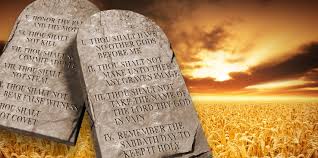
Isaiah 43:8-15 – The Supremacy of God Matters

Bring out the people who have eyes but are blind,
    who have ears but are deaf.
Gather the nations together!
    Assemble the peoples of the world!
Which of their idols has ever foretold such things?
    Which can predict what will happen tomorrow?
Where are the witnesses of such predictions?
    Who can verify that they spoke the truth?

“But you are my witnesses, O Israel!” says the Lord.
    “You are my servant.
You have been chosen to know me, believe in me,
    and understand that I alone am God.
There is no other God—
    there never has been, and there never will be.
I, yes I, am the Lord,
    and there is no other Savior.
First I predicted your rescue,
    then I saved you and proclaimed it to the world.
No foreign god has ever done this.
    You are witnesses that I am the only God,”
    says the Lord.
“From eternity to eternity I am God.
    No one can snatch anyone out of my hand.
    No one can undo what I have done.”

This is what the Lord says—your Redeemer, the Holy One of Israel:

“For your sakes I will send an army against Babylon,
    forcing the Babylonians to flee in those ships they are so proud of.
I am the Lord, your Holy One,
    Israel’s Creator and King. (New Living Translation)

I am an ordained Minister in a smallish denomination, the Reformed Church in America. This particular Christian tradition has its roots in the magisterial reformer, John Calvin (1509-1564). Calvin placed a strong emphasis on the sovereignty of God. In other words, all things hinge on God as the supreme Being of the universe. As Creator of all things, God’s actions and inactions are in no way dependent upon us creatures.

I believe in God’s unconditional election of persons to salvation and new life. Maybe that means nothing to you, and to others it means everything. For many folks, it’s just some churchy mumbo-jumbo which is rather irrelevant to the real stuff of the Christian life. 

I do not agree. It seems to me to be quite important. The heart of Reformation faith is a focus on God’s sovereignty, majesty, power, and grace. It is God who justifies, and not any human. That means there are no conditions to which God is beholden to act. That is, God works in the world according to divine free will and is not reliant upon anyone or anything to accomplish good purposes and fulfill good promises.

“We should therefore learn that the only good we have is what the Lord has given us gratuitously; that the only good we do is what He does in us; that it is not that we do nothing ourselves, but that we act only when we have been acted upon, in other words under the direction and influence of the Holy Spirit.”

John Calvin

Today’s Old Testament lesson is a soaring view of God’s grace and powerful control. Throughout all eternity God is God. There is none who can thwart the Lord’s plans. God acts freely and mercifully and nothing can cancel out those actions. Nothing can separate us from the love of God. We might jump from finger to finger in our puny attempts at autonomy, but we are not getting out of God’s hand! 

For me, this is a balm and a comfort to my soul. Not everything is up to me, as if my action or inaction has cosmic repercussions. As a guy who easily tends toward carrying the world on his shoulders, it is good for me to know that the earth spinning on it’s axis isn’t my job.

It seems to me, the assurance of God’s sovereignty in the world really ought to be a comfort to every believer. God’s decrees will be fulfilled, and there is not one thing any wicked person can do to subvert divine initiatives.

Furthermore, there is absolutely no way we can screw-up God’s purposes. We simply do not have such power. Our great task as believers is to rest secure in God’s will and to therefore place our trust in the One who knows exactly what he is doing in the world.

So, take a few minutes, draw in a few deep breaths, and think on the wonderful truth that God is sovereign. To help you, here is the great opening to the Reformed confession, The Heidelberg Catechism, giving us a glimpse into the majesty of God:

Q: What is your only comfort in life and in death?

A: That I am not my own,

but belong with body and soul,

both in life and in death,

to my faithful Savior Jesus Christ.

He has fully paid for all my sins

with his precious blood,

and has set me free

from all the power of the devil.

He also preserves me in such a way

that without the will of my heavenly Father

not a hair can fall from my head;

indeed, all things must work together

for my salvation.

Therefore, by his Holy Spirit

he also assures me

of eternal life

and makes me wholeheartedly willing and ready

from now on to live for him. Amen.

Psalm 126 – Planting in Tears and Harvesting with Joy

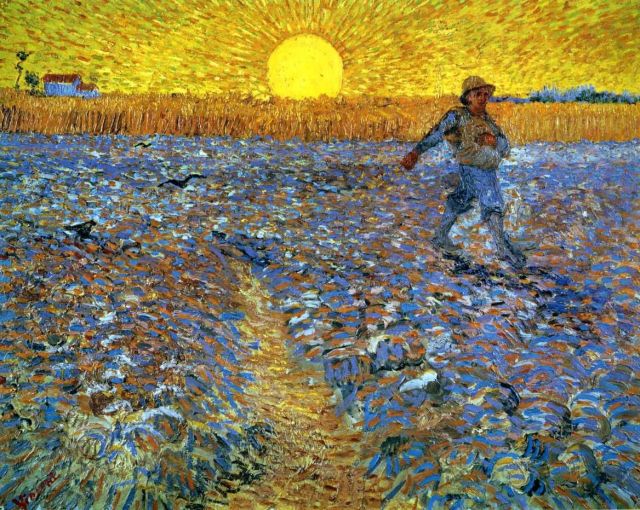
The Sower, by Vincent Van Gogh, 1881

When the Lord brought back his exiles to Jerusalem,
    it was like a dream!
We were filled with laughter,
    and we sang for joy.
And the other nations said,
    “What amazing things the Lord has done for them.”
Yes, the Lord has done amazing things for us!
    What joy!

Restore our fortunes, Lord,
    as streams renew the desert.
Those who plant in tears
    will harvest with shouts of joy.
They weep as they go to plant their seed,
    but they sing as they return with the harvest. (New Living Translation)

Many people are familiar with the phrase, “You reap what you sow.” Although the saying is typically referred to in the context of avoiding poor decisions (Galatians 6:7) the principle is woven throughout Holy Scripture in other scenarios, as well, as it is in today’s psalm.  

Sowing and reaping are, of course, agricultural terms. Farmers and gardeners tend to the soil through tilling, planting, cultivating, weeding, and eventually harvesting. The images of farming and the growth of plants serve as fitting metaphors for the spiritual life. Growth does not occur quickly. Instead, constant and vigilant attention to one’s spirit eventually brings a harvest of good works and godly attitudes. 

Jesus said, “My food is to do what the one who sent me wants me to do. My food is to finish the work that he gave me to do.” (John 4:34, ERV)

In a culture which values immediacy and having things now, the slow growth of the spiritual life can be a difficult principle to grasp. We may think that whenever we sin – with no immediate lightning to zap us – that therefore what we did must not have been so bad. 

Eventually, however, our implanted seeds will sprout and become visible to all. Conversely, we might believe whenever we dedicate ourselves to altruistic service, and then see no immediate results, that we must be doing something wrong. So, we may easily become discouraged and give up.

Sow for yourselves righteousness; reap steadfast love. Break up your fallow ground; for it is time to seek the Lord, that he may come and rain righteousness upon you. (Hosea 10:12, NRSV)

The psalmist reminds us of the need for patience. Just as it takes continual watering to reap a harvest in the field, so the Christian’s life of weeping and tears, of tilling deeply into the things of God, is the necessary work to eventually spot a sprout, see growth, and finally bear fruit. 

The tedious cultivating and weeding of our souls is the task before us. If we are patient and consistent, we will realize a harvest of righteousness. 

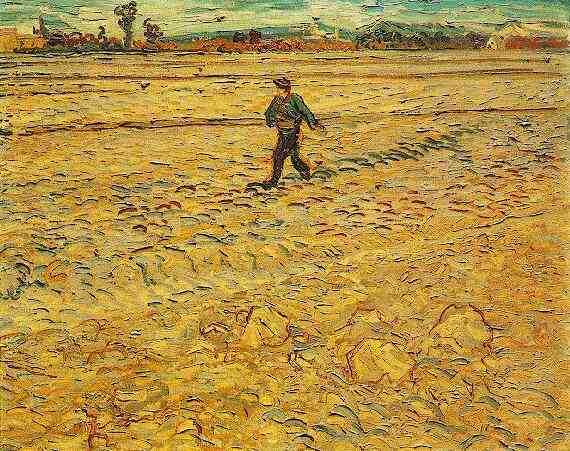
The Sower, by Vincent Van Gogh, 1888

Jesus taught his Beatitudes to help us understand that righteousness, peace, and joy come through connecting with our poverty of spirit; mourning over personal and corporate sin; embracing humility and meekness; hungering and thirsting after righteousness.

Only through the blood, sweat, and tears of spiritual agony will we come through to the deep happiness of seeing the Lord accomplish great things in our lives. In other words, joy is neither cheap nor easy. It is the fruit of many tears.

Spiritual farming involves sound practices of sowing and reaping. There is suffering before glory, tears before joy, lament before healing.

Just as a farmer cannot take short-cuts in the planting and cultivating process if he wants to have a bounteous and delicious harvest, so there is no getting around the painful work of grieving our changes and losses.

Avoiding the hard work of spiritual farming leads to a bogus harvest where we bite into a fresh ear of sweet corn only to discover a mouthful of worms.

Remember this: The person who plants a little will have a small harvest, but the person who plants a lot will have a big harvest.

2 Corinthians 9:6, NCV

The bulk of our lives are played out in the liminal space between sowing and reaping. The farmer plants and waits, attentive to the land and the weather until the time of harvest. We, too, exist in a time of patience. So, we pray, recalling past harvests and anticipate that with God’s good help, we will enjoy abundance.

This in-between time is often characterized by tears.

As she stood behind him at his feet weeping, she began to wet his feet with her tears. Then she wiped them with her hair, kissed them and poured perfume on them. (Luke 7:38, NIV)

I grew up on an Iowa farm. I only saw my father cry twice in my life. The first time, I was just a boy, two days after my eighth birthday – a devastating hailstorm destroyed the crops that had been planted just six weeks before. Despite farm equipment and technological savvy, the farmer is still at the mercy of the weather.

And we will always be at the mercy of God. Because God is good, just, and fair, the Lord does great and benevolent things. To be blessed, we need to embrace the dog days of summer in all its banality and its tears until we reach the time of reaping. There is joy, and it is coming, if we do the work of spiritual farming and wait patiently.

Likely, none of us awake in the morning, sit up on the edge of the bed, and say to ourselves, “Well, let’s see, I think I’ll cry and be sorrowful today.” We might do that with joy, but not with sadness. It can be easier to gravitate toward the fulfillment of dreams, laughter, and happiness than tears and weeping.

Yet, if we want to experience authentic joy, the path to it is through crying because it is our tears which find a better way.

“Normality is a paved road: It’s comfortable to walk, but no flowers grow on it.”

Vincent Van Gogh

Whether it comes from a certain denominational tradition, ethnic background, or family of origin dynamics, there are many Christians who love to emphasize Jesus as Victor and camp in resurrection power – while eschewing Christ as the man of sorrows, acquainted with grief and sadness.

By viewing only one dimension of Christ’s redemptive work, pastoral care often falls far short of true help. Trying to engineer cheerfulness and create solutions to a person’s genuine grief is, at best, not helpful, and at worst, damaging to their soul. It only leads to cheap inauthentic joy.

Sincerely singing spontaneous songs of joy, with a sense of abundant satisfaction, comes through suffering and sorrow. There must be a crucifixion before there is a resurrection. In the agrarian culture of ancient Israel, the metaphor of sowing a reaping connected well to the importance of planting tears and allowing them to flower later into an abundant harvest of joy.

Perhaps in contemporary American culture, a more apt metaphor would be financial investing and cashing out. The investment we put into attending to our grief with expressions of lament through tears, will eventually get a return, and we shall be able to cash out with a rich bounty of joy.

Easter is coming. Resurrection and new life will occur. The journey of Lent, with seeds repentance carefully planted, watered with tears, shall bring an abundant harvest of joy.

Gratias Deo. Thanks be to God.

Luke 9:10-17 – Jesus Feeds Five-Thousand

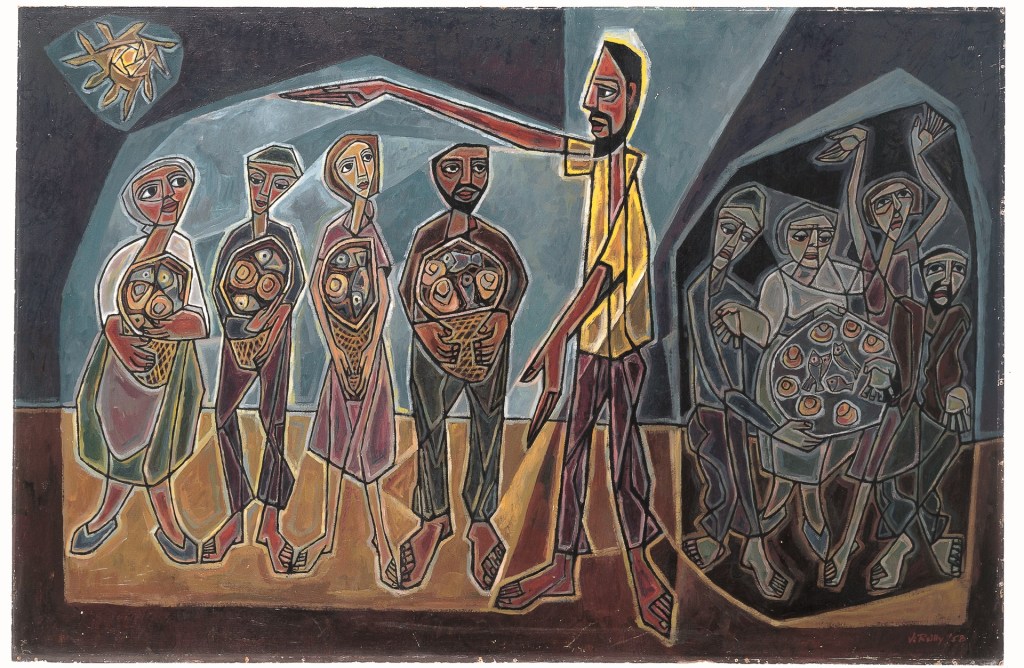
The Feeding of the Five Thousand by John Reilly, 1958

When the apostles returned, they reported to Jesus what they had done. Then he took them with him, and they withdrew by themselves to a town called Bethsaida, but the crowds learned about it and followed him. He welcomed them and spoke to them about the kingdom of God and healed those who needed healing.

Late in the afternoon the Twelve came to him and said, “Send the crowd away so they can go to the surrounding villages and countryside and find food and lodging, because we are in a remote place here.”

He replied, “You give them something to eat.”

They answered, “We have only five loaves of bread and two fish—unless we go and buy food for all this crowd.” (About five thousand men were there.)

But he said to his disciples, “Have them sit down in groups of about fifty each.” The disciples did so, and everyone sat down. Taking the five loaves and the two fish and looking up to heaven, he gave thanks and broke them. Then he gave them to the disciples to distribute to the people. They all ate and were satisfied, and the disciples picked up twelve basketfuls of broken pieces that were left over. (New International Version)

Jesus feeding five thousand people is not just an incredible story that happened a long time ago. Today, Jesus is still in the miracle business because he is still in the kingdom business. Christ still takes our meager resources and turns them into something that has a large impact on a lot of people. 

For that to happen, all we need do, is follow the Lord’s simple instructions: “You give them something to eat,” and, “Bring them [five loaves and two fish] here to me.” Jesus, using a simple act of obedience by his disciples, did one of the most famous miracles in history.

Jesus can multiply whatever little we possess to accomplish his kingdom work through us. 

It is true that Jesus most certainly can do miracles without us. And yet, Christ chooses to use us simple folk to participate in his work. God uses our simple prayers for the miracle of a transformed life. The Lord uses our imperfect speech to bring new life to others. Jesus takes our miniscule bank account to bring a river of financial resources to many through a small act of giving. 

Faith is our true work – to believe God can do the extraordinary through our ordinary loaf of bread and piece of fish.

The Compassion of Jesus Motivates Him To Do Miracles

Jesus withdrew to a solitary place. The crowd, however, did not leave him alone. But rather than being annoyed by the situation because this interruption was not on his divine day planner, Jesus looked at the large group of people and had compassion on them. 

Christ’s heart went out to thousands of people, so he set about the work of healing the sick. Please know that God does not begrudgingly deal with you, as if you were an interruption to his day; the Lord has compassion for you.

The Desire of Jesus is For Us to Participate in the Miracles He Does

After a full day of healing, Christ’s disciples came to him as if he was unaware of the people’s need for food.  They had a very rational and realistic answer to the problem of hunger in front of them; dismiss the crowd so they can go out to eat. 

Jesus calmly responded, “They don’t need to go away; you give them something to eat.” 

I detect perhaps a hint of sarcasm and a slight eye roll in the reply of the disciples, “We have only five loaves of bread and two fish.” But their math was way off because they did not count Jesus. 

The Five Thousand by Eularia Clarke, 1962

Jesus simply said, “Bring them here to me.” My friends, if we have ears to hear, Jesus is still saying this today to us – bring them here to me. Through simple prayer and active obedience, we must give Jesus what we have, no matter how little or insignificant.

Most of what happens in Western Christianity, much like the ancient disciples, is a reasonable doing of rational ministry. Many ministries have little to nothing to do with the impossibility of faith and seeing God work in ways that are incomprehensible to our modern sensibilities.

The earthly miracles of Christ were not an isolated instance. God has always been taking the impossible and making it possible.

Now there was a woman who had been married to a member of a group of prophets. She appealed to Elisha, saying, “My husband, your servant, is dead. You know how he feared the Lord. But now someone he owed money to has come to take my two children away as slaves.”

Elisha said to her, “What can I do for you? Tell me what you still have left in the house.”

She said, “Your servant has nothing at all in the house except a small jar of oil.”

He said, “Go out and borrow containers from all your neighbors. Get as many empty containers as possible. Then go in and close the door behind you and your sons. Pour oil into all those containers. Set each one aside when it’s full.”

She left Elisha and closed the door behind her and her sons. They brought her containers as she kept on pouring. When she had filled the containers, she said to her son, “Bring me another container.”

He said to her, “There aren’t any more.” Then the oil stopped flowing, and she reported this to the man of God.

He said, “Go! Sell the oil and pay your debts. You and your sons can live on what remains.” (2 Kings 4:1-7, CEB)

What if we were to live as if God was interested in doing the miraculous? Would it change the way we pray, and the way we act? 

What if we understood just enough of Jesus, of what he can and wants to do, that we are bold to say:

  • “This might sound crazy, but what if we found out the names of everyone in our community who needs food and go love on them and feed them?” (instead of only the rational means of a food pantry)
  • “This might sound crazy, but what if we used our property to create a community garden and help people grow their own food?” (instead of only the rational means of government aid) 
  • “This might sound crazy, but what if we prayed for one-hundred people, by name, to be healed?” (instead of only the rational means of relying on the pastor to pray)

Most of our plans are humanly possible and doable. Maybe we ought, instead, to seek the impossible.

We may often do nothing out of a sense that God either cannot or does not want to use me or what I have. However, it just won’t do to stand afar off and expect God to work without us giving what we have, whether that something is time, money, conversation, food, hospitality, or whatever. 

Our excuses won’t do for Jesus – my home is too small, I don’t have enough money, I am not smart enough, my schedule won’t allow it, I don’t have enough resources…. In God’s economy you don’t need much, at all. Just a mustard seed worth of faith will do. Jesus wants us to be a part of the miracles he is doing.

Conclusion

I can visualize the disciples befuddled by Christ’s words. I can imagine hearing their excuses. “You want me to do what?  Feed thousands?  Lead someone to Jesus?  Pray in front of others?….” 

The miracle for many a believer is to be open, real, and transparent enough to believe that Christ can do the impossible through confessing sin, participating in ministry, having a spiritual conversation with an unbeliever, or just naming out loud what one actually thinks and feels.  

The question is never, “Can God use me?” The real question is, “What miracle does God want to do through me, and through us as a community of faith?”

It is no accident that when Jesus distributed the bread, it sounds a lot like communion. The Lord’s Supper may seem to be irrelevant – only something we do to remember Jesus, or a mere ritual. But God’s design is much bigger. The Lord wants to do a miracle. 

God wants our observance of Christian communion to bring a healing which the world cannot give. It appears irrational that Jesus can use a small Table to feed and reach thousands. Yet, we don’t serve a God who is limited to work through rational means. 

O God, our heavenly Father, you have blessed us and given us dominion over all the earth. Increase our faith and our reverence for the mystery of life. Give us new insight into your purposes for the human race, and new wisdom and determination in making provision for its future, no matter whether it makes sense, or not, in accordance with your goodwill, through Jesus Christ our Lord. Amen.

Leviticus 25:1-19 – Your Well-Being Is a Priority to God

And the Lord spoke to Moses on Mount Sinai, saying, “Speak to the children of Israel, and say to them: ‘When you come into the land which I give you, then the land shall keep a sabbath to the Lord. Six years you shall sow your field, and six years you shall prune your vineyard, and gather its fruit; but in the seventh year there shall be a sabbath of solemn rest for the land, a sabbath to the Lord. You shall neither sow your field nor prune your vineyard. What grows of its own accord of your harvest you shall not reap, nor gather the grapes of your untended vine, for it is a year of rest for the land. And the sabbath produce of the land shall be food for you: for you, your male and female servants, your hired man, and the stranger who dwells with you, for your livestock and the beasts that are in your land—all its produce shall be for food.

‘And you shall count seven sabbaths of years for yourself, seven times seven years; and the time of the seven sabbaths of years shall be to you forty-nine years. Then you shall cause the trumpet of the Jubilee to sound on the tenth day of the seventh month; on the Day of Atonement, you shall make the trumpet to sound throughout all your land. And you shall consecrate the fiftieth year and proclaim liberty throughout all the land to all its inhabitants. It shall be a Jubilee for you; and each of you shall return to his possession, and each of you shall return to his family. That fiftieth year shall be a Jubilee to you; in it you shall neither sow nor reap what grows of its own accord, nor gather the grapes of your untended vine. For it is the Jubilee; it shall be holy to you; you shall eat its produce from the field.

‘In this Year of Jubilee, each of you shall return to his possession. And if you sell anything to your neighbor or buy from your neighbor’s hand, you shall not oppress one another. According to the number of years after the Jubilee you shall buy from your neighbor, and according to the number of years of crops he shall sell to you. According to the multitude of years you shall increase its price, and according to the fewer number of years you shall diminish its price; for he sells to you according to the number of the years of the crops. Therefore, you shall not oppress one another, but you shall fear your God; for I am the Lord your God.

‘So, you shall observe My statutes, keep My judgments, and perform them; and you will dwell in the land in safety. Then the land will yield its fruit, and you will eat your fill, and dwell there in safety. (New King James Version)

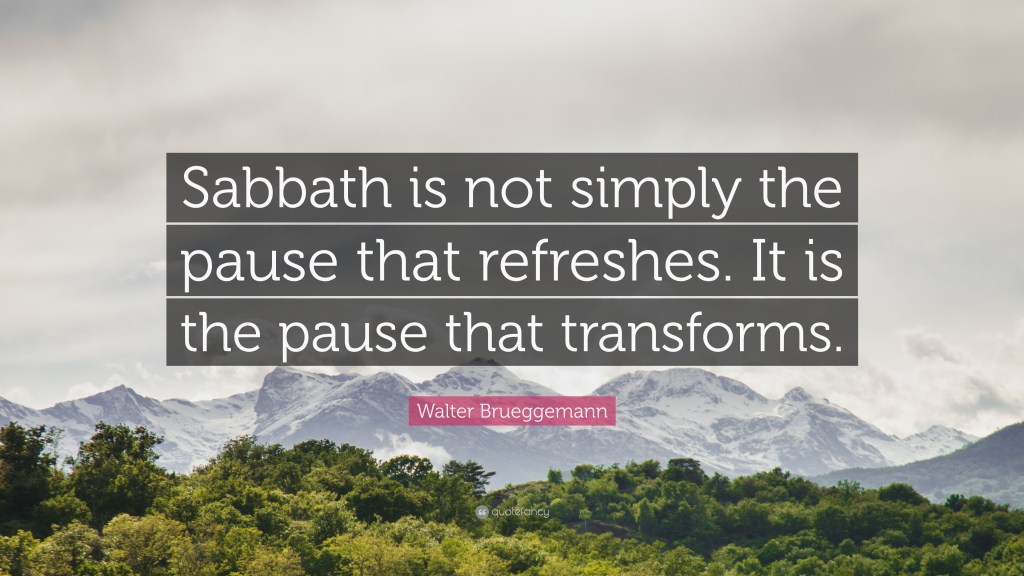
Our continual well-being and rest are not optional; it is absolutely essential.

If a car is driven day-after-day and never gets an oil change, the engine will eventually seize and die. And if a person insists on driving their life every day with continual work, and never practices a Sabbath rest, that person will inevitably burn-out and die an early death. 

In this busy world, far too many persons are putting the pedal-to-the-metal with no thought to the consequences, and no plan for any kind of Sabbath rest. Many people throughout the modern world are slowly draining their souls, causing themselves physical harm, and are on the precipice of emotional and spiritual death.

Perhaps you raise a Mr. Spock eyebrow and wonder if I am being too dramatic. Yet, if we are to take today’s Old Testament lesson seriously, we will see that all of life is to be governed by a healthy rhythm of life which benefits both the individual and the community.

Yes, I fully understand that neither the contemporary person nor the Christian is currently living under ancient Israelite law. However, every single law in the Old Testament is grounded in the character of God. 

This means that, although we may not be obliged to hold the detailed specifics of the seven years system and a year of Jubilee, we are still beholden to observe a Sabbath rhythm of rest because God rested. And we ignore this built-in rhythm to our own peril.

Sometimes I watch the news, see all the upset people at one another and think, “Dude, you really need to sit down, relax, and have a sandwich. Just take a breath, man!” I sometimes wonder if God looks down from heaven at all the world’s conflicts and sees the people involved as a bunch of toddlers who simply need a snack and a nap.

Just as God loves, we are to love. As God is holy, so we are to be holy. And the same holds true for a Sabbath rest. Just as God rested from all the work of creating the world, so we, too, are to rest from our work. Laboring 24/7 will only give us regrets, not results.

If I haven’t been explicit enough, I will say it plainly: We are commanded by God to rest.

It is high time we begin building into our weekly planners, smartphone calendars, and long-range goals, a deliberate and purposeful inclusion of Sabbath rest. 

That means not just doing this biblical rest thing once-in-a-while, that is, if I can fit it in somewhere. A complete Sabbath rest entails making it a real actual event on a regular basis in our life, on our calendars. No excuses, no fudging of appointments, and no lame *sigh* about how busy we are. 

Set aside time today to build a Sabbath into your schedule for the rest of the year, and maybe beyond. I’m not saying this is at all easy; in fact, it is terribly hard for me to get this practice into my own life. 

Because I am a church pastor, hospital chaplain, husband, father, and grandfather, my times of scheduling meetings, events, and visits looks more like a Sudoku puzzle than a calendar. Engrafting some serious biblical rest into my life sometimes feels like hacking through a jungle, looking frenetically for some time.

But, without that rest, I am much less the person I need to be for all the people and responsibilities I care for. The people in my life deserve better than that. They don’t need my leftovers. And I suspect the people in your life want you to rest, too, because you matter to them.

Creator God, you formed the earth in six days and then rested on the seventh. Help me not to put Sabbath on some wish list of things to do someday but enable me to practice it with courage and without apology, through the name of Jesus, I live and pray. Amen.