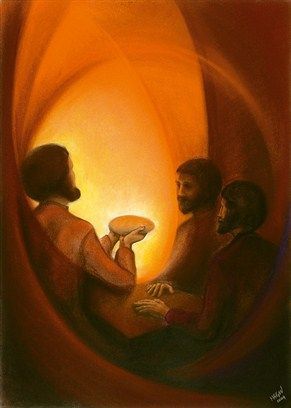
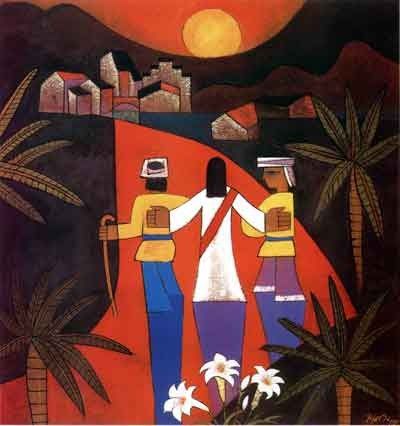
If we want to know what worship truly looks like, the story of the two men talking with Jesus along the Emmaus road shows us (Luke 24:13-35). Worship is not just us talking, praying, and singing to God. Worship is meant to be a conversation between us and God – a dialogue in which we hear from God and reply to him. Worship, then, is both God’s revelation and the people of God’s response.
The term “liturgy” describes what we do in worship. Liturgy is a Greek term that means “the work of the people.” Every church has a liturgy. All gatherings of believers have some sort of prescribed ways of moving through their worship. Liturgy is not only a reference to more traditional forms of worship. Contemporary styled worship may have less liturgical elements to it, but it still has a liturgy of several praise and worship choruses (in which the people know when to stand and sit), and an extended time of preaching.
After Christ’s resurrection, it was Jesus who approached the men. In this divine movement of liturgy, God is always the initiator of salvation and worship. If it were not for God approaching us, most fully expressed in Christ’s incarnation of coming to this earth, then we have no hope. Humanity in the vice grip of sin needs someone to help. So, when we begin worship, it is God himself who starts the conversation.
As the two men continued with their conversation, Jesus engaged them in the Scriptures. He went to the Old Testament and explained to them what it had to say about the Christ. They heard from God. To understand Holy Scripture, we too, need to walk with Jesus and converse with him. Liturgy exists to encourage a relationship between us and God. It is designed to create space whereby God and God’s people can be in a meaningful dialogue with each other.
Maybe it goes without saying, this means we must listen well. We cannot listen well if we our minds are wandering, and our hearts are somewhere else. Sometimes we intentionally make our lives overwhelmingly busy so that we either cannot or do not have time to listen to God. We might create noise and keep moving because we are much too uncomfortable with silence. We may not want to hear what is in our hearts. Getting to the place of relaxing enough to listen can seem, for some, like a daunting task. This is not a plea for you to do more (i.e. “hear more, listen better!”). It is really giving you permission to do less so that you can enjoy a conversation with Jesus. A good place to begin is to practice the Sabbath, and use the day, not just the morning, to connect with God.
Jesus became known to the two Emmaus friends through table fellowship. It was at the table that the two men’s eyes were opened to who Jesus really was. This would not have happened unless they were in meaningful conversation with Jesus. Then, after Jesus left them, the two men were inspired in their going. They went out as witnesses telling others of what they had seen and heard from their conversation with Jesus.
“Road to Emmaus” by He Qi
In this liturgical rhythm, this conversation between us and God, the good news of Jesus is presented. God first acts by seeking and desiring fellowship with us; God sent his Son, the living Word, to restore the fractured relationship – Jesus is the divine Word who has accomplished the restoration between us and God. This revelation, this realization of what God has done for us in Christ begs a response from us. We praise him for wanting fellowship with us. Having glimpsed how holy God is, we realize how sinful we are, and, so we confess our sins to him. God, in his grace, forgives us our sin and assures us of our pardon. In our gratitude for that grace, we joyfully listen and live according to his Word. And, so, back-and-forth we go, with the liturgy proclaiming the gospel to us in a divine dialogue that blesses both us and God.
Now, if you think about it, all of life is liturgical. We each have routines, habits, and life patterns that shape how we get things done. For example, in the first year of marriage, my wife and I experienced a clash of liturgies. Her family had their ways of doing things, and my family had theirs. I quickly learned what a proper liturgy was for folding towels.
A worship liturgy is neither only for Sunday morning nor to be always within a church building. We can deliberately build spiritual rhythms and spiritual conversation throughout each day in our homes, at our jobs, and throughout our daily lives. For example, our daily call to worship is when we wake up, realizing that we have been called into wakefulness to enter praise for a new day. My own personal daily prayer when I get out of bed is:
“Almighty God, thank you for bringing me in safety to this new day. Preserve me with your mighty power that I may not fall into sin, nor be overcome by adversity. In all I do today direct me to the fulfilling of your purposes through Jesus Christ my Lord.”
As we go through our day, we can recognize sin when it happens, and be quick to confess it and accept God’s forgiveness. We can be intentional about hearing from God, by creating space and setting aside time for reading Scripture. When our heads hit the pillow at night, we receive the blessing of God in sleep, until a new day begins.
Whatever way we go about it, we have the privilege of developing spiritual rhythms and habits of approaching God, listening to God, and responding to God. And, we need to acknowledge that something can trip us up in this attempt to live a godly life. There are other secular liturgies that vie for our attention and our hearts. We just might be influenced as much or more by a different competing liturgy. For example, the shopping mall’s version of liturgy is to gather shoppers and develop practices of buying in us. If we shop because we feel that we would have a better life with new clothes, or more stuff, we might have a competing liturgy working in our lives. If we feel we need to shop because there is something we lack in our personhood, as if we are not enough, then we just might have another liturgy that wants our loyalty over God.
The point is not to avoid shopping malls (you have to anyway!); the point is to realize that there are competing loyalties to God’s kingdom, and that we are to be shaped as followers of Jesus as our primary commitment in life. Our lives are to revolve around the person and work of Jesus, and so we must intentionally cultivate liturgical practices in our daily lives and train ourselves to be godly.
Christianity is not merely a system of beliefs; it is a way of life. The kind of habits that we develop in that life will determine what kind of disciples we will be. So, we must choose well the kinds of routines that we need in order to walk well with Jesus and carry on a delightful conversation with him.
On this mountain the Lord Almighty will prepare a feast of rich food for all peoples, a banquet of aged wine— the best of meats and the finest of wines. On this mountain he will destroy the shroud that enfolds all peoples, the sheet that covers all nations; he will swallow up death forever. The Sovereign Lord will wipe away the tears from all faces; he will remove his people’s disgrace from all the earth. The Lord has spoken.
In that day they will say,
“Surely this is our God; we trusted in him, and he saved us. This is the Lord, we trusted in him; let us rejoice and be glad in his salvation.” (NIV)
Mountains are a prominent and symbolic part of Holy Scripture. Abraham sojourned to a mountain where the pinnacle of faith was exhibited. The Law was given on a mountain. Elijah met God on a mountain. Jesus preached the most famous sermon ever on a mountain. From such references, and more, we routinely refer to extraordinary events as “mountaintop experiences.”
The mountain is a great contrast and antithesis to the valley of death below. It signifies God’s power and reign over all earthly rulers. On the mountain we enjoy a great feast of the soul, not to mention an actual meal full of celebration. After all, food and celebration always go together in God’s kingdom.
Whenever healing and/or emancipation happen, it is time for celebration. To celebrate significant events, and even to ritualize them so we remember them, is not only wise – it is much needed and vital to how we are wired as humans. The lack of celebration creates spiritual amnesia. When we need support in the future, we don’t recall the mighty acts of God. Yet, if we consistently practice celebration, the redemption experienced in the past is constantly fresh, like a sumptuous meal which is always before us. We can eat of it anytime we want.
Banquets are rightly associated with hospitality, generosity, and fellowship. Meals in the ancient Near East culture were much more than utilitarian; eating together was (and, frankly, still is in most parts of the world) a deeply spiritual event which communicates acceptance, encouragement, and love to one another.
God is the ultimate host. He throws the best parties. God ensures that there is plenty of food, fellowship, and fun. God’s joy knows no bounds. In the middle of a world beset with sadness, loss, and grief, God’s boundless generosity swallows up people’s disgrace and mourning. At God’s Table, no one cries alone; everyone is comforted; nobody walks away hungry; and, every person is waited upon, no matter who they are or where they have come from. Indeed, there is always room at the Table.
Through Christ’s resurrection, “death has been swallowed up in victory” (1 Corinthians 15:54). Death no longer has any power to control, humiliate, or shame us into submission. Death’s threats are empty. The Grim Reaper’s teeth have been pulled and his scythe has been broken. He is the party-pooper who is barred from entry. Conversely, there is life and abundance for all who ascend the mountain and feast with God at his Table. The invitation has gone out. The Table is spread. We need only to come.
In the joy of your Son, Jesus Christ, through his mighty resurrection and in expectation of his coming again, we offer ourselves to you, Almighty God, as holy and living sacrifices. Together with all your people everywhere and in every age, we proclaim the mystery of the faith:
Christ has died!
Christ is risen!
Christ will come again!
Send your Holy Spirit upon us, we pray, that the bread which we break and the cup which we bless may be to us a sacred communion, a holy celebration of Christ’s body, blood, and victory over death.We declare:
God has spoken!
God has acted!
God has provided!
May you gather all into your hospitable and abundant kingdom; through Jesus Christ, your Son, our Lord, who lives and reigns with you and the Holy Spirit, One benevolent God, now and forever. Amen.
Click Celebrate Jesus to keep the Easter songs coming in this season of celebrating new life.
Therefore, your minds must be clear and ready for action. Place your confidence completely in what God’s kindness will bring you when Jesus Christ appears again. Because you are children who obey God, don’t live the kind of lives you once lived. Once you lived to satisfy your desires because you didn’t know any better. But because the God who called you is holy, you must be holy in every aspect of your life. Scripture says, “Be holy, because I am holy.” (GW)
This is the Christian season of Eastertide. It is a time with a focus on new life in Jesus Christ. God did not save us only for a future life; believers are delivered from sin, death, and hell to also be holy in all we say and do in the here-and-now. The life of the Christian is to be characterized by holiness.
Everything comes down to God. As God’s image bearers we are to reflect God’s character in all things. Unity, harmony, love, and peace always exists within the triune God. Therefore, we, too, are to be characterized with these same qualities. We are to be holy because God is holy. Just as God separates himself from evil, wickedness, impurity, and all that is wrong in the world – so, we are to live a holy life separate from everything that creates and fosters division, hate, abuse, oppression, violence, pride, greed, theft, gluttony, avarice, adultery, and the host of human sins which bedevil the world. God is not at all okay with racism, favoritism, gaslighting, bullying, selfishness, hubris, and all kinds of crimes against humanity which destroy both creature and creation.
Thus, holiness of life involves both a separation from immoral and unethical thoughts, words, and practices; and, a connection with integrity and righteousness which becomes thoroughly grafted into daily life.
The Israelites of the Old Testament had a clear understanding of holiness. In fact, an entire book is devoted to holiness of life: Leviticus. The Apostle Peter drew from Levitical law when addressing the expectation of a holy life:
“I am the Lord your God; sanctify yourselves therefore, and be holy, for I am holy.” (Leviticus 11:44, NRSV)
“Speak to all the congregation of the people of Israel and say to them: You shall be holy, for I the Lord your God am holy.” (Leviticus 19:2, NRSV)
“Set yourselves apart for a holy life. Live a holy life, because I am God, your God. Do what I tell you; live the way I tell you. I am the God who makes you holy.” (Leviticus 20:7-8, MSG)
The ancient Israelites, through a series of regulations about what to wear and not wear, what to eat and not eat, how to relate to one another, etc. were continually reminded of God’s holiness. The importance of a pure life free from the drag of unholy living is the Levitical aim. Rather than following the crowd into mob action that damages people and property, holy living goes against the grain of popularity to seek purity of life.
Jesus said, “Blessed are the pure in heart, for they will see God.” (Matthew 5:8, NIV)
We are not to slide away from our new life in Christ when the going gets hard. That means holiness involves Stay at Home orders, to be separate, even though it is a rough economic hit. It means maintaining social distancing, to have separation between each other, even though it goes against how we have always operated. Holiness means finding creative ways of connecting to one another, making a living, and promoting the common good of all persons. Holiness doesn’t involve impatience, tunnel vision, and allowing our shadow selves to call the shots. Holiness does involve expressions of love, peace, and unity – the very qualities that characterize God himself.
Confidence is born of trust in God’s kindness. Clarity of thought comes from immersing ourselves in God’s non-anxious presence. A holy life arises with the awareness and acknowledgment that God is with us.
Breathe in me, O Holy Spirit, that all my thoughts may be holy, as yours are holy.
Act in me, heavenly Father, that my actions, too, may be holy, as yours is holy.
Draw my heart to you, Lord Jesus, so that I love only what is holy, as you love what is holy.
Strengthen me, Mighty God, to defend all that is holy, as you are just and holy.
Guard me, triune God, that I may always be holy, as you are always holy.
Amen.
Click Take My Life by Scott Underwood as we express our desire to be holy.