Isaiah 25:1-5 – Against Violence

“Violence brings only temporary victories; violence, by creating many more social problems than it solves, never brings permanent peace”. —Martin Luther King, Jr.

AgainstViolence

Lord, you are my God.
I honor you and praise you,
because you have done amazing things.
You have always done what you said you would do;
you have done what you planned long ago.
You have made the city a pile of rocks
and have destroyed her walls.
The city our enemies built with strong walls is gone;
it will never be built again.
People from powerful nations will honor you;
cruel people from strong cities will fear you.
You protect the poor;
you protect the helpless when they are in danger.
You are like a shelter from storms,
like shade that protects them from the heat.
The cruel people attack
like a rainstorm beating against the wall,
like the heat in the desert.
But you, God, stop their violent attack.
As a cloud cools a hot day,
you silence the songs of those who have no mercy. (NCV)

These wonderful words of celebration were uttered not in a time of peace and plenty but in an era of hardship and loss. It seems the Jewish people have always faced a plethora of others who would rather see them wiped off the face of the map than existing with their own customs and religion. It was in one of those times of experiencing problems from Gentiles that this poem was crafted. It is precisely in the adverse times that we need to flee to the open arms of God and enjoy the divine embrace of security. In the sixteenth century, John Calvin reflected on these verses:

“When our minds are perplexed by a variety of uneasy thoughts on account of numerous distresses and afflictions which happen daily, we ought immediately to resort to God, and rely on his providence; for even the smallest calamities will overwhelm us, if we do not betake ourselves to him.”

God Almighty is the One who intervenes on behalf of the poor and helpless. The Lord God is the divine Protector who hears the voice of those overwhelmed with a crushing load of hard circumstances. The great “I AM” is the ultimate refuge and shelter for the vulnerable who possess no resources of their own. There is no bully, whether in the form of a person, an institution, or a government which can stand against the God who bends his ear to listen on behalf of the forgotten and the faint-hearted. Brutality and arrogance might touch our lives, yet it is the Lord to whom all those who exploit others must give an account. The violent, using cruelty and ruthlessness, shall not survive under the shadow of the Almighty God.

The poor and the needy may have no apparent chance against abusive persons and systems of the world. However, no power on earth can take on the Ruler and Sustainer of all creation and expect to have their way. God is the defender of the powerless. He specializes in tearing down the walls of oppression and lifting-up those in need of mercy.

So, then, I shall be explicit about the ancient and almighty God and our present circumstances:

  • Pandemic is a ruthless enemy which knows no pity from both rich and poor, the healthy and unhealthy; and, God is a merciful Deliverer who transcends all disease.
  • Poverty is a cruel master which is never satisfied; and, God is benevolent, bringing both spiritual and material satisfaction to life.
  • Patience is a virtue exemplified and amplified through the divine who desires to see all persons realize new life; and, impatience is a vice of the arrogant who demand their needs be met immediately without any regard to the common good of all.
  • Peace is a harmonious and wholehearted life gifted by God, even despite the surrounding storms of hardship; and, pride is the stance of the privileged who either cannot or will not see those who are underprivileged, and, so, they live in a constant state of unrest and disunity.

Wherever you find people speaking of their individual rights without emphasizing their communal responsibilities, there you will find a situation ripe for God to destroy the walls built by the selfish in order to create a safe place for the afflicted.

The Lord will silence the songs of the unmerciful; and, shall allow the shouts of the ones crying out for mercy to be heard. And he will do it in his own good time and grace.

Lord Jesus Christ, we thank you that through your death on the cross you disarmed the powers of evil. Help us, we pray you, to enter your resurrection victory and to stand in your authority against all evil. Send forth your light and your truth. Bring to light the deeds of darkness and let plans of violence be revealed. Through the power of Holy Spirit, almighty God, disarm every evil power and influence in your good world; and, bring loving connection where there is hatred and cruelty. Amen.

Matthew 12:38-42 – A Changed Life

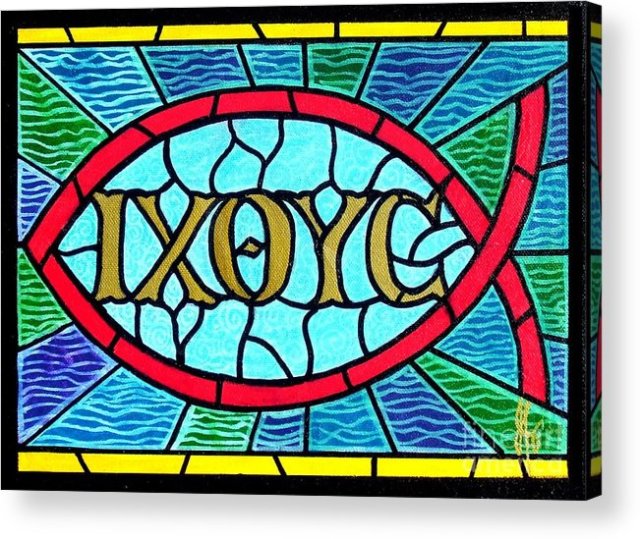
Ichthys
The ichthys (pronounced ick-thoos) is an early Christian symbol of new life in Jesus Christ.

Then some of the Pharisees and teachers of the law said to him, “Teacher, we want to see a sign from you.”

He answered, “A wicked and adulterous generation asks for a sign! But none will be given it except the sign of the prophet Jonah. For as Jonah was three days and three nights in the belly of a huge fish, so the Son of Man will be three days and three nights in the heart of the earth. The men of Nineveh will stand up at the judgment with this generation and condemn it; for they repented at the preaching of Jonah, and now something greater than Jonah is here. The Queen of the South will rise at the judgment with this generation and condemn it; for she came from the ends of the earth to listen to Solomon’s wisdom, and now something greater than Solomon is here. (NIV)

I say at the outset:

The greatest miracle, the best evidence of God’s work in the world, is a changed life.

Yes, both personal and corporate transformation – not a rearranging or a tweeking of habits – but a wholesale change of heart. New life is new life, and not a reconstituted life.

For many folks, when it comes to any discussion of change and transformation, it is a focus on others changing. Other people need to see things rightly; others who must bend their lives and organizations to how I believe things need to be. As you can tell, putting it in writing and laying it bear sounds an awful lot like pride and hubris. And, it is.

The need for repentance is for everyone, not just a select few or others for whom we believe need to change.

Jesus made waves with many people by hob-nobbing with the least, the lost, and the lowly. Christ actively sought such people out, and healed many of them from sickness, disease, and sin so that they would be united with God and no longer remain on the fringes of society.

Some within the religious establishment of the day did not take the healing ministry of Jesus into consideration because they were not in the transformation business. So, healing miracles which created new life did nothing for them. Jesus was not flexing any real Messiah muscle for them and improving their designs to see Gentiles get beat up and kicked out of Palestine. They even went so far as to ascribe Jesus’ healings as the work of the devil. They wanted a sign from heaven that would authenticate proper Messiah credentials.

Jesus responded by essentially saying there is already a sign that exists, the sign of Jonah. As Jonah was three days and three nights in the belly of a whale, so Jesus would be in the earth for three days and nights. The death and resurrection of Jesus is needed, and when faced with this information, the only appropriate response is repentance, a complete U-turn, to a changed life. Jesus brought up the Queen of the South to make the same point: When the ancient Ninevites, who were a sinful people, encountered the person of Jonah, they repented; when the Queen encountered the person of Solomon, she changed.

Therefore, how much more should we change when encountering the person of Christ?

Jesus himself is the sign. Jonah was in the belly of a whale. He was all but dead. But God caused the whale to belch up Jonah, and he went out as a changed man. The experience of having stomach fluids work on a person for three days and nights, some scholars point out that Jonah would have been both spiritually and physically different – bleached completely white and an incredible sight to see!

The whole point of bringing up this sign of Jonah was to communicate the great need for repentance when faced with Jesus, his life, his teaching, his ministry. The appropriate response to Jesus is a changed life.

Jesus was looking for status quo malcontents, and a desire for transformation and new life.

The process of change is hardwired into all creation – from seasons of the year to the seasons of people’s lives – all are designed for a sustained process of time to revolutionize us.

Jesus modeled this for us. He switched his address of heaven and moved into our neighborhood in order to bring us new life. As the Master of conversion, Jesus always extends the invitation to change. All he asks is to let God do the work of change within us, be patient with the construction of the soul he is doing and persist with daily routines of faith individually and with one another.

It pleases Jesus and it is the heart of God to realize new life. Change for change’s sake is not the point. Change that reflects the values of God is the point. And in order to know that, we must hear the Scriptures, and we must pray to seek the mind and heart of God.

God Almighty, we desire to be transformed by you and allow the life of Jesus to be expressed through us. We desire to walk in the light of your spirit. Reveal to us those things in our life that need to be made anew. Allow us to discern between flesh and spirit so that we can choose a healthy holy path. Continue to give us spiritual awareness. Transform us into something new altogether. May our old life and way disappear, and our new life emerge for the blessing of the world, through Jesus Christ our Lord in the power of the Holy Spirit. Amen.

Click I Will Rise by Chris Tomlin as we continue in this season of Eastertide with its focus on new life.

Jonah 1:1-17 – Against Hatred

JonahWhale

The Lord’s word came to Jonah, the son of Amittai: “Get up and go to Nineveh, that great city, and cry out against it, for their evil has come to my attention.”

So, Jonah got up—to flee to Tarshish from the Lord! He went down to Joppa and found a ship headed for Tarshish. He paid the fare and went aboard to go with them to Tarshish, away from the Lord. But the Lord hurled a great wind upon the sea, so that there was a great storm on the sea; the ship looked like it might be broken to pieces. The sailors were terrified, and each one cried out to his god. They hurled the cargo that was in the ship into the sea to make it lighter.

Now Jonah had gone down into the hold of the vessel to lie down and was deep in sleep. The ship’s officer came and said to him, “How can you possibly be sleeping so deeply? Get up! Call on your god! Perhaps the god will give some thought to us so that we won’t perish.”

Meanwhile, the sailors said to each other, “Come on, let’s cast lots so that we might learn who is to blame for this evil that’s happening to us.” They cast lots, and the lot fell on Jonah. So, they said to him, “Tell us, since you’re the cause of this evil happening to us: What do you do and where are you from? What’s your country and of what people are you?”

He said to them, “I’m a Hebrew. I worship the Lord, the God of heaven—who made the sea and the dry land.”

Then the men were terrified and said to him, “What have you done?” (The men knew that Jonah was fleeing from the Lord because he had told them.)

They said to him, “What will we do about you so that the sea will become calm around us?” (The sea was continuing to rage.)

He said to them, “Pick me up and hurl me into the sea! Then the sea will become calm around you. I know it’s my fault that this great storm has come upon you.”

The men rowed to reach dry land, but they couldn’t manage it because the sea continued to rage against them. So, they called on the Lord, saying, “Please, Lord, don’t let us perish on account of this man’s life, and don’t blame us for innocent blood! You are the Lord: whatever you want, you can do.” Then they picked up Jonah and hurled him into the sea, and the sea ceased its raging. The men worshipped the Lord with a profound reverence; they offered a sacrifice to the Lord and made solemn promises.

No escape for the prophet

Meanwhile, the Lord provided a great fish to swallow Jonah. Jonah was in the belly of the fish for three days and three nights. (CEB)

One way of outlining today’s Old Testament reading from Jonah is:

God said, “Go!” Jonah said, “No!” And, God said, “Oh!?”

Jonah did a full out run from God’s clear instructions to go to the city of Nineveh. This does not sound like a wise thing to do with God. So, why did Jonah run? Let’s get some perspective….

Who were the Assyrians?

Nineveh was a large city in the ancient world, and the capital of Assyria. The Assyrians had a reputation as fierce soldiers and conquered all the Middle East. They are mentioned many times in the Old Testament. It was Assyria that God used to judge the northern kingdom of Israel. The typical military practice of the Assyrians was to attack a city and completely subjugate it by deporting most of the people and repopulating it with some of their own people. They did this so that the conquered people could not mount a revolt or resistance to their rule.

What is important to know about the Assyrians and the Ninevites is that they were notorious in the ancient world for their brutality toward conquered peoples. Many forms of torture that we are aware of today were invented by the Assyrians. Their methods were so inhumane that it would be inappropriate for me to even discuss them here. I will just leave it at the fact that the Assyrians were experts at thinking-up and executing extreme forms of torture on everyone who resisted their power. It was a very violent culture.

Who is God?

Now, contrast that knowledge of the Assyrians with God. The ways of the Assyrians caught the notice of God, who was ready to pronounce judgment on the heart of the Assyrian Empire, Nineveh. So, as God typically did in the Old Testament, he told one of his prophets to go and give a message. And the message was simple: “Go to the great city of Nineveh and preach against it, because its wickedness has come up before me.” Lest we think God was determined to wipe Nineveh off the map, think again. Jonah confesses later in the book, “I knew that you are a gracious and compassionate God, slow to anger and abounding in love, a God who relents from sending calamity” (Jonah 4:2).

Who was Jonah?

Jonah was a prophet of God, which means he set apart to speak for God. So, here we have the rub as to Jonah’s lickety-split in the opposite direction from where God wanted him. Jonah did not like Assyrians. More than that, he loathed them. The last thing Jonah wanted was to have effective preaching and see Nineveh repent of their violent ways. Jonah wanted judgment, not grace.

In this little four-chapter prophetic book of the Old Testament, it is Jonah who needs divine deliverance as much as the Ninevites do. In fact, Jonah’s need for rescue gets more attention than the evil Assyrians. The message of Jonah comes down to this: Racism and hatred, however much perceived to be legitimate, have no part whatsoever in the kingdom of God.

Who are we?

Christians are the community of the redeemed. New life in Jesus Christ involves a wholesale jettison of bigotry and a complete chuck to the manure pile of hatred directed toward any ethnic and/or religious group of people, period. New life means adopting the love of God. It involves becoming a dispenser of grace and mercy with all people, not just the ones we feel deserve it.

What does God want us to learn?

To share the same heart as he has – a heart that beats for people to know and live by a better way – a heart that has grace and compassion even in the face of flat-out evil. We are meant to think twice about pointing the finger at others; to take the plank out of our own eye before we address the splinter in another’s eye.

O God, you created all people in your image. We thank you for the astonishing variety of races and cultures in this world. Enrich our lives by ever-widening circles of friendship, and show us your presence in those who differ most from us, until our knowledge of your love is made perfect in our love for all your children; through your Son, Jesus Christ our Lord. Amen.

Click Turn My Heart a beautiful song written by Marty Haugen as we seek to have our lives bend to God’s heart.

1 Corinthians 15:12-20 – Why Is Resurrection Important?

bd2f0-christiancemetery

So, if the message that is preached says that Christ has been raised from the dead, then how can some of you say, “There’s no resurrection of the dead”? If there’s no resurrection of the dead, then Christ hasn’t been raised either.  If Christ hasn’t been raised, then our preaching is useless, and your faith is useless. We are found to be false witnesses about God because we testified against God that he raised Christ, when he didn’t raise him if it’s the case that the dead aren’t raised. If the dead aren’t raised, then Christ hasn’t been raised either.  If Christ hasn’t been raised, then your faith is worthless; you are still in your sins, and what’s more, those who have died in Christ are gone forever. If we have a hope in Christ only in this life, then we deserve to be pitied more than anyone else. But in fact, Christ has been raised from the dead. He’s the first crop of the harvest of those who have died. (CEB)

Christ’s resurrection is at the very heart and soul of what it means to be Christian. For followers of Jesus, the risen Christ is at the center of life. New life means freedom from sin, death, and hell. It means experiencing life without the shackles of our past indiscretions, present failures, and future anxieties. Christianity is grounded and dependent upon a very real physical rising from death. To put it another way, the new spiritual life which Christians experience in the here and now as a result of Christ’s crucifixion and resurrection is a foretaste of our own bodily resurrection.

If you are asking yourself, “Does this guy believe we are going to walk out of our graves like Jesus did?” the answer is a rollicking, “Yes!”  Although Christians have been granted deliverance, our salvation is not yet here in its fullness. We still need to deal with systemic evil in the world, our old habits of sin which occasionally rear their ugly heads, and an Adversary who seeks to exploit it all to undermine God’s redemptive work in us. There is a time coming when Christ will return and the dead will be raised; and, this will not be merely an ethereal going into the clouds to strum on a harp. It will be a bona fide physical resurrection with a new body. Thus, just as we have been given a new spirit within us, a new body will follow at the end of the age.

The Apostle Paul insisted that if there was no bodily resurrection, then our faith is a sham and its worthless. One of the simple observations to make about today’s New Testament reading is that our faith and life are inextricably linked to the life of Jesus. Christ has purposefully joined himself to us. That link is so strong and vital that, in other places, Paul uses the metaphor of a head and a body – Christ is the head and we the body. Just as one cannot separate head from body and expect to have life, so nobody can separate Christ’s resurrection and our resurrection. We will have a new body to go with our new life because of Jesus Christ’s redemptive events. That new body will be as much real as the one you have right now – just without the residual effects of the curse which so stubbornly cling to it.

So, what does this mean for us? Glad you asked. Christian spirituality is also very much sacramental, that is, we inhabit a bodily faith which is firmly grounded in material reality. God’s grace is communicated to us both spiritually through the unseen world and sacramentally by means of the physical creation. We are to be reminded of that sacramental nature of our faith each time we approach the Lord’s Table and ingest the very real bread and imbibe from the tangible cup. Touch and taste help us to know our faith is meant for the creation of our five senses, as well as to impel us to labor in this world for real causes of alleviating poverty, disease, social injustice, and a myriad of ailments that bog this old fallen earth. In short, both body and soul are of great value to our God, and so, ought to be for us, as well.

What’s more, we have both a spiritual and a sacramental inheritance which awaits us at the end of the age when Christ returns to judge both the living and the dead. For the Christian, this is the basis of our hope – a confident expectation that God will make good on his promises.

Almighty God, through your Son, Jesus, death has been conquered and new life unlocked for us. We pray that all who hold to his bodily resurrection may, through the renewal brought by your Spirit, rise up both spiritually and sacramentally; through our Lord Jesus Christ, who lives and reigns with you in the unity of the Holy Spirit, one God, now and forever. Amen.

In this season of Eastertide, click Christ Arose and we’ll keep the celebration of Christ’s Resurrection coming.