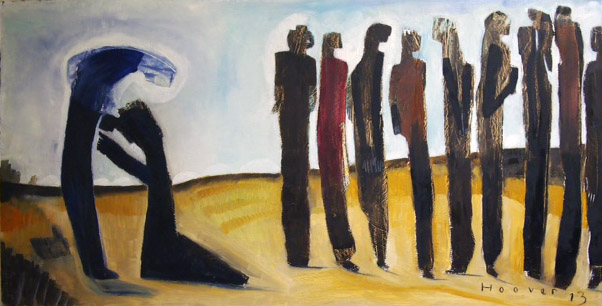
Romans 6:1-11


            It is perhaps ironic that this New Testament lesson falls on Cyber-Monday.  After all, the impulse to shop runs high in a great many Americans.  But shopping can quite easily move from necessity to compulsion.  Before you know it, we can be consuming without much restraint.  On-line shopping, especially, is just so darn easy and can trigger the brain just as much as any addiction.  There is often a very thin line between justified shopping and sinful rationalization of consumption.  So, how do we say “no” in the face of competing choices?  Whatever besetting sin is in our lives, how do we put it aside and rid ourselves of it? 
 
            One of the practical ways of approaching this answer is to read Romans 6 not from a generic standpoint, but make it very personal.  In other words, it could be quite helpful to make all of the pronouns personal and name the specific sin when sin is mentioned.  For example, it would look something like this:
 
“What shall I say, then?  Shall I go on shopping so that grace may increase?  By no means!  I died to shopping; how can I live in it any longer?  Or don’t I know that I am baptized into Christ Jesus and, so, am baptized into his death?  I am therefore buried with him through baptism into death in order that, just as Christ was raised from the dead through the glory of the Father, I, too, may live a new life.”
 
            You can put your own besetting sin and struggling addiction into the text:  “If I have been united with him like this in his death, I will certainly also be united with him in his resurrection.  For I know that my old self was crucified with him so that shopping/gossiping/lying/overeating/alcoholism/legalism, etc. might be done away with, that I should no longer be a slave to shopping – because I have died and have been freed from the compulsive and obsessive need to shop.”
 
            I think you get the idea.  We are to count ourselves dead to all the addictions, compulsions, and activities that we use to replace the finished work of Christ.  Instead, we are to reckon ourselves alive to God in Christ.  The struggle against sin comes down to each and every day making an affirmation of faith that we belong to God through Jesus – and not to some other master.  Yes, the daily work of spiritually affirming our identity might seem mundane, but it is quite necessary to achieving practical victory.


            Holy God, you have made it possible for us to be forgiven and free in Jesus Christ.  I choose today to serve you and you alone in my quest avail myself of the provision you have given me to live above sin.  Amen.

Thanksgiving


            Food, football, and family have become the annual trifecta of the American Thanksgiving Day.  I liberally indulge in all three, and look forward to doing so.  I’m not here to bash on the fact that Thanksgiving has become almost a day of secular worship around an unholy trinity.  And that’s because I really believe that underneath all the gravy, naps at halftime, and obnoxious relatives that we actually know why we are celebrating the day:  to give thanks for our abundant blessings.  And I think even those who do not readily acknowledge a God in the world intuitively know that there is a power and source of blessing well beyond themselves that makes all good things occur.
 
            Celebrations are a spiritual activity.  Parties were not invented by secularists.  God created them.  When Israel was preparing for a new national life in the Promised Land, God told them to celebrate the Feast of Harvest with the first-fruits of the crops (Exodus 23:16).  The Levitical law prescribed how to go about giving thanksgiving offerings; they were commanded and expected.  Gratitude was an important dimension of Old Testament worship.  Even before America as we know it was in existence, the people of God were used to setting aside certain days as events of special thanksgiving to God.  The church has always acknowledged that God as our Creator is also the Provider of all the bounty we receive.
 
            Consider some biblical verses that encourage us toward giving thanks.  “Come to worship the LORD with thankful hearts and songs of praise” (Psalm 95:2).  “Be thankful and praise the LORD as you enter his temple.  The LORD is good!  His love and faithfulness will last forever” (Psalm 100:4-5).  Our mouths need to speak our thanks out loud to God.  “Tell the LORD how thankful you are, because he is kind and always merciful” (Psalm 118:1). 
 
            In the New Testament, Luke tells the story of ten men with leprosy who were miraculously healed by Jesus.  A Samaritan, the lowliest of the low, was the lone person who came and fell at Christ’s feet with intense gratitude.  While the other nine went about their lives free from disease and glad for it, only one guy took the time to thank Jesus (Luke 17:11-19).  Indeed, sometimes we must be reminded to give thanks and to show gratitude for the ways in which God has provided for us.  And it is often the homeless, the sick, the lowly, the marginal of society that are the ones who lead the way and teach us what genuine thanksgiving looks like.


            The people of God are to never forget what they possess in Christ.  Paul told the Colossian church, “You have accepted Christ Jesus as your Lord.  Now keep on following him.  Plant your roots in Christ and let him be the foundation for your life.  Be strong in your faith, just as you were taught.  And be grateful” (Colossians 2:6-7).  Prayer and thanksgiving are to go together like mashed potatoes and gravy:  “Never give up praying.  And when you pray, keep alert and be thankful”(Colossians 4:2).  Since God created everything –  each bite of juicy turkey, every homemade roll, and that piece of pumpkin pie – it is all good (maybe not good for you – but good!).  Every meal is to be eaten with the cognizance that God is really behind it all (1 Timothy 4:4).
 
            If church ministry is not perpetually punctuated with times of celebration, praise, giving thanks, and even blowout parties, then that particular local church will become dull, boring, lifeless, and will not have the lifeblood of Jesus coursing through their corporate veins.  But a joyous church which takes advantage of giving thanks to God at every excuse to do so will be attractive, winsome, and peculiar (in the good way, and not in the weird way of your strange uncle).  Christians really ought to be at the forefront of having maximum fun because they have been forgiven; know the presence of God; are provided for; are confident in the fact they are protected; and, know the power of the Spirit and the shepherding ministry of Jesus.


            Yes, eat to your heart’s content and have a belly full of cornbread stuffing.  But remember to give thanks – out loud and with others – for the God who stands behind every good gift of creation.  Let thanksgiving and not constant complaint shape you and your church.  Be that one person who comes back to Jesus and offers praise, worship, and gratitude – and see how God can change your life and your church.

Luke 1:1-4

            The season of Advent is almost upon us.  Advent is simply another word for “coming.”  During this liturgical season on the Christian Calendar, we rehearse the incarnation of Jesus, his coming to this earth as a baby.  Through this focus we anticipate Christ’s coming again in his Second Advent, at the end of the age.  As the secular world encroaches more and more into the sacred through a mere cultural assent to Christmas with its anticipation of gifts, food, and time off, the spiritual grounding of Advent is quite necessary for the Christian.
 
            It is appropriate, then, that today’s lectionary brings us to the beginning verses of Luke’s Gospel.  We are told that Luke set about the task of an historian, providing a first-hand account of Jesus Christ as well as researching primary sources to give a reliable and faithful narrative of the major redemptive events of Christ’s life and ministry.  The purpose of it all is to ground the believer in truth, and to orient the unbeliever into the vital components of God’s rescue mission of humanity.
 
            Let’s make it our goal to journey with Jesus in this next month by carefully and devotionally reading the daily lectionary so that we might be the recipients of God’s incredible story to us.  It would be helpful if you kept a journal of daily observations and thoughtful applications.  Yes, this takes the time of thought and reflection, but, then again, we are seeking to reverse the trend of the secular invading the sacred.  Who knows?  A fresh movement of the Spirit might stir up amongst us.


            Gracious God, thank you for neither abandoning nor obliterating humanity because of our terrible estrangement from you.  In this Advent season, lead us to Christ and save us from ourselves so that we might know the life that is truly life.  Amen.

Psalm 117

            God’s faithfulness never ends.  Let that statement from the psalmist sink in and ruminate on it for a bit.  What does it mean?  How does it work itself out?  Is God faithful to me?  As a pastor, I can tell you that one of the most difficult things that I see people encounter is wondering if God can really do things in their lives like he does in other people’s lives.  Sometimes we have all the faith in the world for other people – that God will forgive, heal, help, and show up in their lives – but when it comes to me personally, it becomes an entirely different thing.  We wonder if anything can really change.
 
            God is good for his promises.  He will accomplish all that he has said he will do.  It certainly might seem like he is taking his time and is terribly slow in moving on our behalf.  Yet, it shall be done on earth as it is in heaven.  God does not just work in other countries with mass conversions; he does not only grow his church in other geographical locales; and, he does not limit himself to establishing his kingdom in receptive areas.  God can and does work everywhere and will show up in your life and your church, just like he has been doing for ages in all places in all times.
 
            Perhaps the most appropriate response is to praise God for what he is going to do.  That is, don’t just wait for him to do something astounding.  Look for it and give thanks ahead of time for the incredible work of saving, healing, teaching, growing, and transforming that God will do in Christ through the power of his Holy Spirit.  It isn’t just for others; it is for you, my friend.  How will you trust him today?


            Faithful God, I praise you for what you will do in my life this season.  Thanks for the answers to prayer that will come.  I give you gratitude for the people you will deliver from sin, darkness, addiction, disease, and suffering and the new spirit you will give to me and many others in Jesus’ name.  Amen.