1 Corinthians 15:1-11 – Good News

Stained Glass victory

Brothers and sisters, I want to call your attention to the good news that I preached to you, which you also received and in which you stand. You are being saved through it, if you hold on to the message which I preached to you, unless somehow you believed it for nothing. I passed on to you as most important what I also received: Christ died for our sins in line with the scriptures, he was buried, and he rose on the third day in line with the scriptures. He appeared to Cephas, then to the Twelve, and then he appeared to more than five hundred brothers and sisters at once—most of them are still alive to this day, though some have died. Then he appeared to James, then to all the apostles, and last of all he appeared to me, as if I were born at the wrong time.  I’m the least important of the apostles. I don’t deserve to be called an apostle, because I harassed God’s church. I am what I am by God’s grace, and God’s grace hasn’t been for nothing. In fact, I have worked harder than all the others—that is, it wasn’t me but the grace of God that is with me. So then, whether you heard the message from me or them, this is what we preach, and this is what you have believed. (CEB)

The Resurrection of Jesus Christ from death isn’t just a doctrine for Christians to believe; it is a powerful reality to live into. 

Christianity is not a checklist of right beliefs to hold; it is a spirituality deeply concerned with the integration of Christ’s crucifixion and resurrection into the believer’s daily life – affecting everything she says and does.

Belief and action are to be a seamless whole.  Christianity “works” when faith in the redemptive events of Jesus are woven into the daily fabric of our lives.  Where there is a disparity between verbal confession and daily actions, there is need for integration.

To hold to the message of Christianity is to allow and actively practice applying and integrating Christ’s redemption into all of life.

The greatest tool in this work of integrity is grace.  In Christianity, God graciously delivers people of all kinds from sin, death, and hell through the life, death, and resurrection of Christ.  God graciously gives us the gift of faith, to believe.  And God works throughout the duration of the Christian’s earthly life to graciously and patiently sew together a solid spirituality within the believer that effects holiness of life.

The Apostle Paul stated that “you are being saved through [the good news of Christ’s crucifixion and resurrection] if you hold on to the message.”  That’s Paul’s way of expressing the need for this integrating work of belief throughout a person’s life.

Far too often, in many places of evangelical Christianity, salvation is looked upon as something static – a mere belief to possess.  Again, I will say: The Resurrection of Jesus Christ from death involves belief and much more; it is a powerful reality to live into.  Salvation is more expansive than a first glance can perceive.  Three statements of salvation are true:

  • We have been saved (past historical redemptive events of Jesus).
  • We are being saved (present integration of Christ’s redemption into daily life).
  • We will be saved (future event of Christ coming again to bring salvation in its complete fullness).

In other words, faith is dynamic.  It can be strengthened or weakened, has ability to grow or wither, and rarely sits idle.

Faith needs attention and exercise to develop a strong spiritual life.

Christianity is a practical boots-on-the-ground divine/human cooperative.  When we put ourselves in a position to receive, then grace has no obstacles to generously give.  And that’s not a one-time thing – it is to be a constant and healthy dynamic of receiving from God and giving to others.  The bedrock belief for this to happen, according to Christianity, is that Jesus is alive.  Because he lives, we live.  He has ability to graciously and lovingly help those coming to God.  That is some incredibly good news!

Lord God Almighty, the resurrection of your Son has given us new life and renewed hope.  Help us to live as new people in pursuit of the Christian ideal.  Grant us wisdom to know what we must do, the will to want to do it, the courage to undertake it, the perseverance to continue to do it, and the strength to complete it; through Jesus Christ in the power of the Holy Spirit.  Amen.

Colossians 4:2-5 – Devoted to Prayer

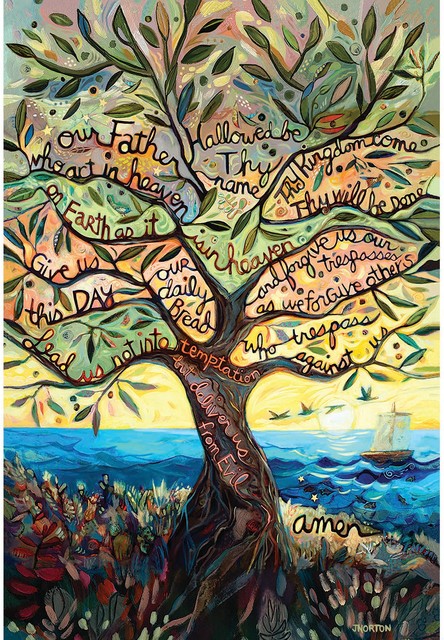
Lord's Prayer

Devote yourselves to prayer, being watchful and thankful. And pray for us, too, that God may open a door for our message, so that we may proclaim the mystery of Christ, for which I am in chains. Pray that I may proclaim it clearly, as I should. Be wise in the way you act toward outsiders; make the most of every opportunity. (NIV)

I’ve always been fascinated with circular breathing ever since I first picked up a musical instrument.  It’s a technique used by the instrumentalist or singer to produce a continuous tone without interruption. In other words, you can keep blowing or singing without doing the traditional stopping to inhale.  By breathing in through the nose while simultaneously pushing air out through the mouth using air stored in the cheeks, the person can maintain the sound.  Circular breathing is not so much difficult; it just takes lots of practice.  The hard part is unlearning how you typically breathe.  I have done it a few times in my life.  I’ve made the personal observation that it doesn’t happen unless you can be very relaxed while feeling very connected to your body and grounded in what you’re doing.

I imagine that we all sometimes feel like admonitions to devote ourselves to prayer, pray continually, and never give up praying are something like circular breathing.  Maybe best left to the experts and the professionals, we think.  Yet, the Apostle Paul encouraged the entire Colossian church to keep up the praying, both leaders and laity.

“Never give up praying,” (Colossians 4:2, CEV) might sound unattainable.  It isn’t.  However, the catch is that you’ll need to unlearn a few things before devotion to prayer is realized.  The ancient Colossians had fallen into the wrongheaded belief that Christianity could be reduced to a nice neat packaged formula of do’s and don’ts.  Do the right things.  Say the right things.  Don’t do the list of the terrible ten or the nasty nine, or whatever checklist you are using to live by your form of “Christianity.”  Paul was telling the Colossians to completely jettison such an approach to the Christian life.  Instead, persevere in prayer without knowing the outcome.  Pray relying on God and the mystery of Christ.  Pray with uncertainty instead of continually believing you need sure answers to everything for everyone.

The Christian life cannot be made into some geeky algorithm so that we can avoid suffering, know all the right things to say in a conversation, and always keep God happy.  God is not some algebra equation to figure out.  He is not a gumball machine to put a quarter in and get what you want.  He is not Santa God.  Christianity requires living in the tension of not knowing everything and yet having cogent answers for others who inquire about our faith.  It is a dynamic relationship in which we continually interact in prayer to God as we largely improvise our lives, spontaneously applying what understanding we have for each situation we face.  Breathing in and breathing out at the same time.

Paul wanted to keep the church vigilant in prayer with an ongoing dialogue with the God who answers in his own good time, according to his own good will.  He wanted a kind of circular praying whereby Christians make good use of the time God has given through choosing our words wisely as we simultaneously carry on a silent prayer conversation with God.  This is Christianity that’s far above rules and laws and checklists.  It is Christianity as it’s meant to be lived, depending on Jesus, and relaxed in the Spirit.

This takes practice, practice, practice.  Failure is both inevitable and expected.  And that’s okay.  We’re not living by lists and human contrived rules.  We’re living a new life in the power of Christ’s resurrection.

God of Mystery, the One who conceals and reveals, forgive me for my attempts at reducing faith to a few spiritual rules to keep.  Help me to speak in ways which are gracious, loving, and redemptive.  May the person and work of Jesus come tumbling out of my mouth while I inhale the breath of your Holy Spirit.  Amen.

The Lord’s Prayer is perhaps the best prayer you could be praying.  It is sung here by Andrea Bocelli.

And if you have not heard Bocelli’s gift of singing to the world on Easter Sunday, here is a link to it: Amazing Grace

Matthew 28:1-10 – Fear Not

Death Swallowed Up in Victory

After the Sabbath, at dawn on the first day of the week, Mary Magdalene and the other Mary came to look at the tomb. Look, there was a great earthquake, for an angel from the Lord came down from heaven. Coming to the stone, he rolled it away and sat on it. Now his face was like lightning and his clothes as white as snow. The guards were so terrified of him that they shook with fear and became like dead men. But the angel said to the women, “Don’t be afraid. I know that you are looking for Jesus who was crucified. He isn’t here, because he’s been raised from the dead, just as he said. Come, see the place where they laid him. Now hurry, go and tell his disciples, ‘He’s been raised from the dead. He’s going on ahead of you to Galilee. You will see him there.’ I’ve given the message to you.”

With great fear and excitement, they hurried away from the tomb and ran to tell his disciples. But Jesus met them and greeted them. They came and grabbed his feet and worshipped him. Then Jesus said to them, “Don’t be afraid. Go and tell my brothers that I am going into Galilee. They will see me there.” (CEB)

The Resurrection of Christ from death has changed everything – especially when it comes to fear.  In this season of Eastertide, we discover and explore the vast implications of what it means to possess a new life.  Because Christians serve a risen Savior, this newfound awareness brings courage and confidence.  Fear isn’t something we can simply exercise willpower over.  Rather, fear begins to give way to the presence of God among us.  Consider just a few of the many references to this in Holy Scripture:

“Be strong and courageous. Do not be afraid; do not be discouraged, for the Lord your God will be with you wherever you go.” (Joshua 1:9, NIV)

“Be strong and courageous. Do not be afraid or terrified because of them, for the Lord your God goes with you; he will never leave you nor forsake you.” (Deuteronomy 31:6, NIV)

“So do not fear, for I am with you;
do not be dismayed, for I am your God.
I will strengthen you and help you;
I will uphold you with my righteous right hand.” (Isaiah 41:10, NIV)

“God has said, ‘Never will I leave you;
never will I forsake you.” So, we say with confidence, ‘The Lord is my helper; I will not be afraid.
What can mere mortals do to me?’” (Hebrews 13:5-6, NIV)

Believe it, or not, the Bible tells us 365 times to not be afraid.  Maybe that’s not a coincidence that we can quote a verse every day of the year about our own fearfulness in the face of so much of the world’s cruel circumstances.

When it comes to fear and bravery, God does not so much command us to be courageous, as he wants us to draw from the great reservoir of bravery within.  That is, God has already created us strong, as creatures in his image.  We just need to get in touch with what is already there.  And the reality of Easter awakens and calls forth that life.

We can act with boldness and overcome fear because Jesus is the pioneer of our salvation.  He is the One which enables us to draw from the deep well of courage….

“So then, since we have a great High Priest who has entered heaven, Jesus the Son of God, let us hold firmly to what we believe. This High Priest of ours understands our weaknesses, for he faced all the same testing we do, yet he did not sin. So, let us come boldly to the throne of our gracious God. There we will receive his mercy, and we will find grace to help us when we need it most.” (Hebrews 4:14-16, NLT).

You and I really can face the fears in front of us.  You can surmount the adversity you are in the middle of – not because of some words I say, but because Christ has risen from death.  He’s alive, and his presence makes all the difference.

St John Chrysostom
“Let all therefore enter into the joy of our Lord. Let rich and poor dance with one another.” –St John Chrysostom

The following is an Easter homily from the fourth-century preacher St. John Chrysostom to the Church of Constantinople:

“Let no one grieve at his poverty,
for the universal kingdom has been revealed.
Let no one mourn that he has fallen again and again;
for forgiveness has risen from the grave.
Let no one fear death, for the Death of our Savior has set us free.
He has destroyed it by enduring it.

He destroyed Hades when He descended into it.
He put it into an uproar even as it tasted of His flesh.
Isaiah foretold this when he said,
“You, O Hell, have been troubled by encountering Him below.”

Hell was in an uproar because it was done away with.
It was in an uproar because it is mocked.
It was in an uproar, for it is destroyed.
It is in an uproar, for it is annihilated.
It is in an uproar, for it is now made captive.
Hell took a body, and discovered God.
It took earth, and encountered Heaven.
It took what it saw, and was overcome by what it did not see.
O death, where is thy sting?
O Hades, where is thy victory?

Christ is Risen, and you, o death, are annihilated!
Christ is Risen, and the evil ones are cast down!
Christ is Risen, and the angels rejoice!
Christ is Risen, and life is liberated!
Christ is Risen, and the tomb is emptied of its dead;
for Christ having risen from the dead,
is become the first-fruits of those who have fallen asleep.

To Him be Glory and Power forever and ever. Amen!”

Click Because He Lives sung by Guy Penrod as we are reminded that the living Christ makes all the difference today.

Colossians 3:12-17 – A New Set of Clothes

White Shirts

Therefore, as God’s chosen people, holy and dearly loved, clothe yourselves with compassion, kindness, humility, gentleness and patience. Bear with each other and forgive one another if any of you has a grievance against someone. Forgive as the Lord forgave you. And over all these virtues put on love, which binds them all together in perfect unity.

Let the peace of Christ rule in your hearts, since as members of one body you were called to peace. And be thankful.  Let the message of Christ dwell among you richly as you teach and admonish one another with all wisdom through psalms, hymns, and songs from the Spirit, singing to God with gratitude in your hearts. And whatever you do, whether in word or deed, do it all in the name of the Lord Jesus, giving thanks to God the Father through him. (NIV)

Easter is to live forever in our hearts.  The great message of the Resurrection is: We now have opportunity to experience new life, free from sin, death, and hell.  Oh, it isn’t that we never need to deal with evil; we very much do.  The difference is that we now have a new awareness of our spirituality.  And with awareness comes choices.  If we aren’t aware of our feelings, our spirit, and/or old nature, well, then, it’s as if we operate on auto-pilot – losing altitude in an immanent descent into tragedy.  When we are aware of our inner selves, then we mindfully ascend through the clouds to join Christ.

We can make choices about what to wear.  With awareness, we look in the mirror and see that the grave clothes need to come off.  The old raggedy garments of pride and hubris, greed and immorality, selfish lust, jealous envy, spiritual gluttony, unholy anger, and complacency get taken off and tossed in the garbage.  We then go to God’s expansive walk-in closet and choose the bright raiment of compassion, kindness, humility, gentleness, patience, forgiveness, and grab the beautiful coat of love which covers it all with such dignity and honor.

It would be super weird to try and put the new clothes over the old raggedy grave clothes.  That’s not only gross, it’s downright wrongheaded.  Practical Christianity always involves two actions: taking-off and putting-on.  Human willpower and/or ingenuity tries to live a virtuous life while ignoring the vices.  This will not do for the Christian.  The endearing qualities we so desire to possess cannot be obtained without first dealing with the crud of sin which clings to us like so many stinky dirty clothes.  To put this in theological terms: the cross and resurrection go together.  Sin must be put to death before a victorious life is put on.

Once we have acknowledged sin, let Christ take it all off, and put on the new clothes.  Then we’re ready to hit the town in style.  We walk out the door with a tremendous sense of peace, knowing God in Christ has cleaned us up.  We stroll into the world with lips whistling and a song in our hearts – singing with gratitude for what the risen Christ has accomplished on our behalf.  After all, we just put on very expensive clothes and it didn’t cost us a dime.  In fact, we’re so darned thankful that we don’t just talk to others, we sing our words to them – even though we can’t carry a tune.  It doesn’t matter.  Our coat of love compels us.  Easter is bursting forth from the tomb.

Almighty and everlasting God, you willed that our Savior should take upon him our clothing of death upon the cross so that all humanity would have the privilege of wearing humility, gratitude, and love.  Mercifully grant that we may both follow the example of Christ’s life, and, also be made aware of our participation in his glorious resurrection, in the power of your Holy Spirit.  Amen.

Click Easter Song which was written by Annie Herring in 1974 and made famous by Keith Green a few years later.  The California Baptist University choir and orchestra perform this version.  May your Easter blessings multiply.