

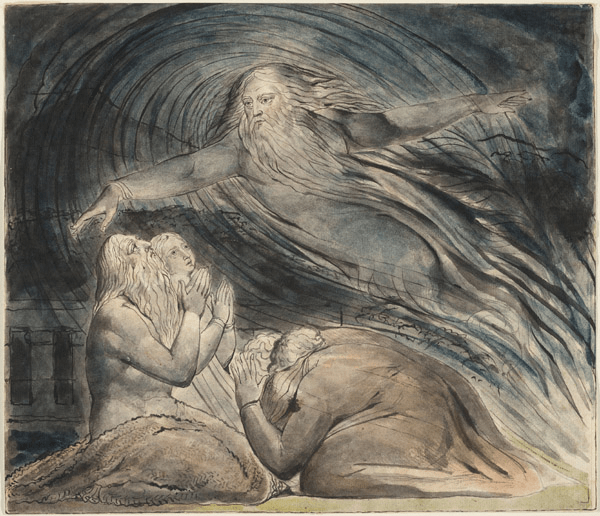
Then the Lord answered Job out of the whirlwind:
“Who is this that darkens counsel by words without knowledge?
Gird up your loins like a man;
I will question you, and you shall declare to me.
“Where were you when I laid the foundation of the earth?
Tell me, if you have understanding.
Who determined its measurements—surely you know!
Or who stretched the line upon it?
On what were its bases sunk,
or who laid its cornerstone
when the morning stars sang together
and all the heavenly beings shouted for joy?…
“Can you lift up your voice to the clouds,
so that a flood of waters may cover you?
Can you send forth lightnings, so that they may go
and say to you, ‘Here we are’?
Who has put wisdom in the inward parts
or given understanding to the mind?
Who has the wisdom to number the clouds?
Or who can tilt the waterskins of the heavens
when the dust runs into a mass
and the clods cling together?
“Can you hunt the prey for the lion
or satisfy the appetite of the young lions,
when they crouch in their dens
or lie in wait in their covert?
Who provides for the raven its prey,
when its young ones cry to God
and wander about for lack of food? (New Revised Standard Version)
The Book of Job is rather long. After the initial two chapters which set the scene for Job’s awful suffering, we then get an extended and agonizing thirty-five chapters of speeches between Job and his companions. It’s a lot of words which generally go nowhere.
So, by the time we get to this point in chapter 38 of Job, we may likely say, “Finally, God speaks!” Indeed, this is the moment Job has anticipated.
Perhaps we are looking for something in Job’s story which may help us in our own story of suffering. Like Job, maybe we’re looking for vindication of our situation, a restoration to some semblance of life before the grief, or to have our reputation upheld.
But that is not what we get from God. For the next nearly four chapters, God only speaks in questions, and does not answer a single one of them.
If it’s answers to questions we’re searching for, it is unlikely you will get them, at least on this side of heaven. You are more likely to get even more questions than you started with. And then, imagine being questioned by God, and having no answers for God whatsoever.
Yet, that is the point. We humans know jack squat – absolutely nothing, in comparison to an omnipresent and omniscient God.
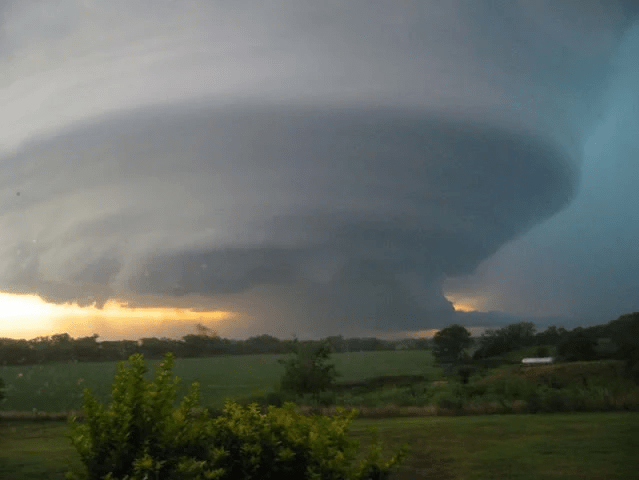
If it’s God’s voice you really want to hear, you may not know what you’re actually asking for. That was certainly true for Job and his friends. God’s questions are really rather rhetorical; there is no way any of us could really answer them with any sort of knowledge or understanding. It would be a bit like a parent asking their toddler to describe his own birth and how it happened.
God’s unanswerable questions revolve mostly around the workings of the universe. God is the Creator, and none of us were around when it all came into existence. So, of course, we have no answers.
Yet, with all of the questions, we quickly get the impression that humans have very little control over much of anything. And I think that perhaps God wants us to be aware of that reality.
It seems to me that with every question of God, we are led to believe that God is God, and is really big; and that we are not God, and are pretty dang small.
I don’t think any of this is meant to make us feel irrelevant or disposable. Rather, it gives us some needed perspective, that is, that our perspective on world issues, events, and problems is very narrow. But God sees the whole big picture and has a stellar full perspective of all things and all people.
The God in the Book of Job is no vending machine deity, in which we can pick-and-choose what we like and don’t like. There is no grand certainty that if we press the right buttons in prayer that we get what we want.
Therefore, God is not some automaton who predictably rewards the righteous, and punishes the wicked (according to our definitions of those terms). Yet this is the God that Job’s friends believed in – which is why they reflexively interpreted Job’s situation as Job himself being a sinful man.
Even Job believed in this sort of God, at least to some degree. Up to the point of his terrible trouble, he was good and righteous, and received due reward for his faithfulness. The divine system was serving Job well.
But then the system seems to have broken down. Job interpreted God as not doing the expected divine job of operating within the predictable divine structure.
Believers in every generation and era must come to grips with the reality that – although personal virtue and devotion are important – one’s piety does not necessarily lead to personal health nor wealth.
In other words, good guys don’t always win in this life, because having faith typically means we will actually suffer, rather than not.
This is, to me, good news. Why? Because it means, conversely, that persons victimized by violence, poverty, and loss are not necessarily to blame for their troubles. Frankly, there are times when bad things happen to us that are not our fault, and we don’t see any good reason for it happening.
Whenever God is silent, we might start to think that God is also absent. We may begin to entertain nihilist thoughts that nothing matters, that everything in this universe is just random chaos.
Yet, God’s response with all the questions lets us know that there is a solid structural foundation to this universe that we aren’t always aware of. In other words, there is meaning, purpose, and order to it all. We are not forgotten. God sees and remembers us.
I do believe there is a reason for everything. However, I do not believe that we are always privy to know what that purpose may be. Which means that oftentimes, like Job, we don’t have any answers to our existential questions of human tragedy and trouble. This line of thinking isn’t meant to be a cop out; it’s meant to help us accept that we are human.
Sometimes all we can do is affirm what we know to be true, and accept the limits of our own human understanding of things such as:
- God is God. I am not.
- God created the world. I didn’t.
- God established order in the universe. I sometimes see order, and oftentimes see what looks like random chaos.
- God is Love all the time. I love, but not always.
- God is with us, even though I may not always sense or feel that divine presence.
Maybe what is most important is that we humans keep up our dialogue with God – our questions, musings, emotions, and expressions of faith and devotion. Because it is in the relationship that we discover the key to the universe.
O God, by whom the meek are guided in judgment, and light rises up in darkness: Grant us, in all our doubts and uncertainties, the grace to ask what you would have us to do, so that the Spirit of wisdom may save us from all false choices, and that in your light we may see light, and in your straight path may not stumble. Amen.

 Rev. Tim Ehrhardt