

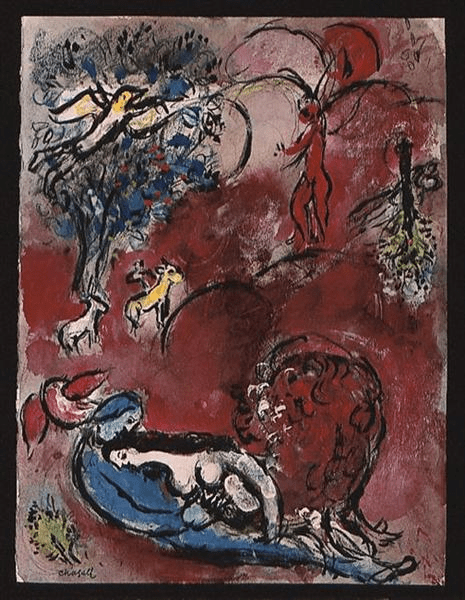
The Song of Songs, which is for Solomon.
[Woman]
If only he would give me some of his kisses . . .
Oh, your loving is sweeter than wine!
Your fragrance is sweet;
your very name is perfume.
That’s why the young women love you.
Take me along with you; let’s run!
My king has brought me into his chambers, saying,
“Let’s exult and rejoice in you.
Let’s savor your loving more than wine.
No wonder they all love you!”
Dark am I, and lovely, daughters of Jerusalem—
like the black tents of the Kedar nomads,
like the curtains of Solomon’s palace.
Don’t stare at me because I’m darkened
by the sun’s gaze.
My own brothers were angry with me.
They made me a caretaker of the vineyards—
but I couldn’t care for my own vineyard.
Tell me, you whom I love with all my heart—
where do you pasture your flock,
where do you rest them at noon?—
so I don’t wander around with the flocks of your companions.
[Man]
If you don’t know your way,
most beautiful of women,
then follow the tracks of the herds
and graze your little goats
by the tents of the shepherds.
I picture you, my dearest,
as a mare among Pharaoh’s chariots!
Lovely are your cheeks, adorned with ear hoops;
your neck, with beads.
Let’s make hoops of gold beaded with silver for you!
[Woman]
With my king close by,
my perfume filled the air.
A sachet of myrrh is my love to me,
lying all night between my breasts.
A cluster of henna flowers is my love to me
in the desert gardens of En-gedi.
[Man]
Look at you—so beautiful, my dearest!
Look at you—so beautiful! Your eyes are doves!
[Woman]
Look at you—so beautiful, my love!
Yes, delightful! Yes, our bed is lush and green!
The ceilings of our chambers are cedars;
our rafters, cypresses. (Common English Bible)
The Song of Songs is an unabashedly sensuous biblical book. It is, throughout its contents, an erotic paean to love. In eight chapters, a man and a woman pursue each other through verdant fields and lush valleys. The excitement they have, being together, is palpable.
Literal and Allegorical
For most of church history, the Song of Songs has been viewed as an allegory, a love poem between Christ and the Church. And in the case of Hebrew Scripture, the covenant love which exists between God and Israel, has been the predominant interpretive lens.
Seen from this perspective, the Song of Songs reflects that we ought to love the Lord with overpowering commitment, as if we were love-sick for our Beloved. Our thoughts are constantly on the object of our love – how we can please our beloved one.
And yet, there still seems to be room to read the Song in the very down-to-earth realness of physical love between two lovers. Since we are embodied people, such love ought to be celebrated, and is anything but base or to be refused. Sex is a gift from the Creator, and encouraged by God.
I think that the Song of Songs is not an either/or; it is a both/and; it’s both literal and allegorical. That’s not a weird thing. On the allegorical level, the Song is a beautiful poem describing the Divine Eros for God’s people, and the faithful’s heartfelt love for the God whose very name is Love.
Concerning a literal view, the Song celebrates the sanctity of human love, seeing within it the symbol of God’s love for us. Our very real bodies are themselves sacred, just as much as our souls.
Yet, however one chooses to look at the Song of Songs, it remains a statement of mutual admiration, of committed love and affection. It is indeed a poetic lifting of love above all else.
Indeed, if love isn’t the answer, we are not asking the right question.
Christ and the Church
Believe it or not, the Song of Songs was once viewed as an important key, capable of unlocking the entirety of Holy Scripture.
In fact, C.H. Spurgeon, the Prince of Preachers, in the nineteenth century, preached 59 sermons from this book; in Victorian England, no less. Spurgeon discerned the Song as central to the whole of the Bible. Reflecting on Song of Songs 1:7, he said:
“These words express the desire of the believer after Christ, and his longing for present communion with Him…. Tell me where Thou feeds, for wherever Thou stands as the Shepherd, there will I lie down as a sheep; for none but Thyself can supply my need. I cannot be satisfied to be apart from Thee. My soul hungers and thirsts for the refreshment of Thy presence….
“Satan tells me I am unworthy; but I always was unworthy, and yet Thou hast long loved me; and wherefore my unworthiness cannot be a bar to my having fellowship with Thee now. It is true I am weak in faith, and prone to fall, but my very feebleness is the reason why I should always be where Thou feeds Thy flock, that I may be strengthened, and preserved in safety beside the still waters.
“Why should I turn aside? There is no reason why I should, but there are a thousand reasons why I should not, for Jesus beckons me to come. If He withdraw Himself a little, it is but to make me prize His presence more. Now that I am grieved and distressed at being away from Him, He will lead me yet again to that sheltered nook where the lambs of His fold are sheltered from the burning sun.” Charles Haddon Spurgeon
The Song, in history past, once functioned as a beautiful path to deep intimacy with God. Methinks it behooves us to recover this.
Beauty Everywhere
The two lovers in the Song see beauty everywhere. They see it in each other, in the fields where the sheep are pastured, in the orchards where love is consummated, in the seasons, in the animals, trees, and hills. Beauty is all around them, and it is they themselves.
All things which God has created are lovely. Nothing is too small or too insignificant when the eyes of love look upon them. Beauty is designed to be noticed, celebrated, and praised. Love is meant to be expressed out loud, with flavor.
Each time love is stated, every exhalation of adoration, and all of the instances when beauty is acknowledged and affirmed, the ones who speak bind themselves more deeply to God and God’s big world. Together, they call all of it good.
Love Will Have Its Way
Today’s Old Testament lesson is a wondrous reminder that beauty and love will have its way. Regardless of class, race, family, or societal norms, lovers will continue to seek and find one another and claim their relationship.
While the daughters may stare, and the brothers may be angry, the lovers will yet affirm the beauty of their love. And they will find contentment with each other.
You and I are no accident on this earth; we were created by a loving Creator who has an eye for beauty. And no matter how separated we may get from our divine source, God will seek us out; and if we seek the Lord, he will be found.
O God, you have prepared for those who love you such good things as surpass our understanding: Pour into our hearts such love towards you, so that we, loving you in all things and above all things, may obtain your promises, which exceed all that we can desire. Amen.

 Rev. Tim Ehrhardt