Christ’s Parable of the Sower (Matthew 13:1-9, 18-23)

“The Sower” by Vincent Van Gogh, 1881

…Jesus left the house and sat on the beach. In no time at all a crowd gathered along the shoreline, forcing him to get into a boat. Using the boat as a pulpit, he addressed his congregation, telling stories.

“What do you make of this? A farmer planted seed. As he scattered the seed, some of it fell on the road, and birds ate it. Some fell in the gravel; it sprouted quickly but didn’t put down roots, so when the sun came up it withered just as quickly. Some fell in the weeds; as it came up, it was strangled by the weeds. Some fell on good earth, and produced a harvest beyond his wildest dreams.

“Are you listening to this? Really listening?”…

“Study this story of the farmer planting seed. When anyone hears news of the kingdom and doesn’t take it in, it just remains on the surface, and so the Evil One comes along and plucks it right out of that person’s heart. This is the seed the farmer scatters on the road.

“The seed cast in the gravel—this is the person who hears and instantly responds with enthusiasm. But there is no soil of character, and so when the emotions wear off and some difficulty arrives, there is nothing to show for it.

“The seed cast in the weeds is the person who hears the kingdom news, but weeds of worry and illusions about getting more and wanting everything under the sun strangle what was heard, and nothing comes of it.

“The seed cast on good earth is the person who hears and takes in the News, and then produces a harvest beyond his wildest dreams.” (The Message)

It takes focused attention to listen well. Allowing the understanding of Christ’s words to awash over us – drinking-in the life-giving good news – is required for the act of listening to achieve its intended purpose.

It is most necessary that we all develop the skill of effective listening, so as to understand what is being said. And yet, understanding, as important as it is – all by itself – is inadequate. If hearing isn’t accompanied by obedient follow-through, then all the listening comes to nothing.

Christian discipleship (following the words and the ways of Jesus) demands that the believer takes Christ’s words and walks faithfully in the way of the good news, which has been absorbed into the mind and heart through effective listening.

Failing to both listen and put the words into practice is like the person who looks into the mirror and then walks away forgetting what he looks like.

Don’t fool yourself into thinking that you are a listener when you are anything but, letting the Word go in one ear and out the other. Act on what you hear! Those who hear and don’t act are like those who glance in the mirror, walk away, and two minutes later have no idea who they are, what they look like.

But whoever catches a glimpse of the revealed counsel of God—the free life!—even out of the corner of his eye, and sticks with it, is no distracted scatterbrain but a man or woman of action. That person will find delight and affirmation in the action. (James 1:22-25, MSG)

Appropriate and fruitful action begins with, and is dependent upon, attentive and effective listening – which is why the ability to hear the words of Jesus are so very vital to our lives.

“The Sower” by Vincent Van Gogh, 1888

The Parable

Our ears are the soil of our lives. Ears that are attentive and devoted to listening to Jesus are good soil; ears that are distracted, inattentive, and/or stopped up with ear wax are the bad soil. 

Receptive listening to the Word of God brings a fruitful harvest of righteousness, peace, and joy in the Holy Spirit (Romans 14:17). Christ’s parable lets us know that planting the Word is important. It is sown on four different soils:

  1. The seed on the road. A path is for walking; and for us, a road is for driving – which is why the seed never takes root. Here there is no real listening. When we act without listening, our actions will inevitably be misguided. 
  2. The seed on gravel. Here there is no deep listening. A lack of attentive hearing results in a shallow person who perhaps relies more on Christian clichés or on one’s personality or abilities, instead of the planted Word.
  3. The seed in the weeds. Here there is some significant listening. However, there are too many voices being heard, and not enough singular listening to the sown Word. Listening to the wrong voices will cause an unfruitful life, so we must be careful to whom we choose to give our listening ears to!
  4. The seed on good earth. A devoted listening to the Word without distraction leads to a productive, fruitful believer.

The Parable Interpreted

The interpretation of the parable which Jesus provided to his disciples focuses on the experience of the seed in a variety of soils, as well as the outside powers which act on the message. It all demonstrates that the words of Jesus – the good news of Christ – is central to our lives, and needs to be received well.

  1. The road is the person who hears the message yet is unable to hear Christ’s words because their heart is hard. The forces of evil snatch up the message before any real understanding, and therefore action, can take place. We must observe that the forces of evil are real; they have the ability to influence people with listening issues.
  2. The gravel is the person who hears just enough to respond with joy but drops out when hard circumstances come around. “I didn’t sign up for this!” is their cry. What they needed was to count the cost of discipleship before responding to the message. This is the mere professing Christian, nothing more. Rather than listening well, and internalizing Christ’s words, there is only positive affirmation without any action or practice. Therefore tomorrow, the message is gone.  When difficulty comes, there are no supporting words to draw from. The person then fades away, unable to navigate life successfully.
  3. The weedy soil hears and responds to the message; and is also a professing Christian, nothing more. The issue with such persons is that they also listen to the voices of worry and wealth. Like some sort of spiritual A.D.D., there is no ability to filter all the voices calling out; and so, there is no growth. The words of Jesus for us must reign supreme; there cannot be two thrones of Wealth and Word, nor two Masters of both God and Money.
  4. The good earth listens with the full intention of understanding, and then puts into practice the message heard. This is what brings about the fruit of righteousness and peace in both the individual and the community. Receiving the implanted word through careful listening brings about spiritual growth.  The first priority must be to listening well to this word. And when an entire group listens well and acts accordingly, then it creates a greenhouse effect in which people cannot help but grow in the Lord.

Conclusion

Jesus was not saying anything new, or what wasn’t already in the First Testament:

How well God must like you—
    you don’t walk in the ruts of those blind-as-bats,
    you don’t stand with the good-for-nothings,
    you don’t take your seat among the know-it-alls.

Instead you thrill to God’s Word,
    you chew on Scripture day and night.
You’re a tree replanted in Eden,
    bearing fresh fruit every month,
Never dropping a leaf,
    always in blossom. (Psalm 1:1-3, MSG)

We live in a time of great conflict – largely due to the refusal to listen well to one another, and to Holy Scripture, especially the New Testament Gospels.

Esoteric and harmful interpretations of the Bible result from failing to hear what Scripture itself is saying to us, especially the words of Jesus. Ignoring the Gospels and myopically focusing on particular parts of the Bible is a sure prescription for poor hearing, and thus, misguided decisions and actions.

This is just one reason why reading Scripture aloud with others in a communal setting is important. Robust discussion around the spoken word is what helps us to move in the sort of directions which the Spirit is leading us.

It is what Jesus and his original disciples did. We must do no less.

O Ancient and Wise Gardener, your holy word is planted in our hearts as good seed in fertile soil. So, nurture us, so that we may bear fruit abundantly, through your Son, Jesus Christ our Lord. Amen.

What Is It You Are Trying To Do? (Mark 10:2-16)

Jesus blesses the children

Some, testing him, asked, “Is it lawful for a man to divorce his wife?” He answered them, “What did Moses command you?” They said, “Moses allowed a man to write a certificate of dismissal and to divorce her.” But Jesus said to them, “Because of your hardness of heart he wrote this commandment for you. But from the beginning of creation, ‘God made them male and female.’ ‘For this reason a man shall leave his father and mother and be joined to his wife, and the two shall become one flesh.’ So they are no longer two but one flesh. Therefore what God has joined together, let no one separate.”

Then in the house the disciples asked him again about this matter. He said to them, “Whoever divorces his wife and marries another commits adultery against her, and if she divorces her husband and marries another, she commits adultery.”

People were bringing children to him in order that he might touch them, and the disciples spoke sternly to them. But when Jesus saw this, he was indignant and said to them, “Let the children come to me; do not stop them, for it is to such as these that the kingdom of God belongs. Truly I tell you, whoever does not receive the kingdom of God as a little child will never enter it.” And he took them up in his arms, laid his hands on them, and blessed them. (New Revised Standard Version)

Trying To Parse the Law?

The topic of divorce has always been a hot button issue throughout human history. And there have continually been diverse views and opinions about it. This is also true of Holy Scripture. A variety of interpretations are offered by many about the Bible’s view of divorce, and Christ’s words concerning it.

Much like today, divorce in the first century was accepted as part of what happens in society, even among Jews, although it was more proliferate in other cultures. Most of the discussions about divorce centered in legal details, with some speaking against it as bad for society.

Among the Jewish religious leaders and experts in the law, it was generally recognized that divorce occurs, with Mosaic legislation proscribing how to carry out divorce (Deuteronomy 24:1-4). Yet, other scripture texts frame the existence of divorce as questionable for God’s people. (e.g. Genesis 2:24; Malachi 2:13-16)

Trying to Test Jesus?

Anyone who doesn’t like another, will often confront them on a hot button issue that has plenty of diverse opinion to it. This is why the Pharisees sought to get Christ’s take on the topic of divorce.

Essentially, Jesus reframed divorce so that it was no longer simply a legal topic, but involves real people. Christ talked about divorce in a way that upheld the dignity of persons, especially women; and lifted up the true sanctity of marriage.

In turning the discussion from a legalities to God’s design for humanity and marriage, Jesus cut to the heart of the matter, to God’s intent, and to human frailty. He focused on relationships, because they were inherent from the beginning.

Yes, divorce is a reality, and it is has its place in society. But no, it’s not supposed to be this way. The very word “divorce” means there is a separation, a breech, a disconnection of relationship. This is why Christ went to another topic: adultery.

Trying To Divorce Women?

Jesus said that a person initiating a divorce in order to marry another person commits adultery. In saying this, he was not offering a legal conversation of details. Rather, Christ was focusing on people; he was concerned for wives and women.

The conversation between Jesus and the Pharisees was a discussion between men, and presupposed a man’s point of view on divorce. Women did not have the ability to initiate divorce in the ancient society.

And Christ seems to have had no stomach for being drawn into abstract legal debates between a bunch of men. Instead, he cared about the people involved in an actual divorce, especially the women.

For all intents and purposes, women (and their sexuality) were the property of men – the father, and then later, the husband. In this social milieu, whenever a husband initiated a break in the relationship, it was important for a woman to have a certified document of divorce. Without that certification, a woman divorcee would be landlocked, unable to do much of anything, as well as be the brunt of societal gossip, slander, or worse.

Since Jesus was talking to the men, the Pharisees, he pointedly looked at them and let them know that, although they might initiate a divorce, it in no way justified their sneaking and creeping around. It didn’t cover their adulterous relationship(s) nor their adulterous hearts.

All this is to say that Christ very much opposed divorce on the grounds of putting a wife away out of a desire for a different spouse. He intended on empowering women. In a divorce situation, because a man was in control of the process, it was then the man who commits adultery against the woman.

Both logically and legally, a woman could never commit adultery because of divorce – only the man. What’s more, adultery is not primarily a violation of the law, but of the woman. Jesus believed it was high time for some accountability with the men.

Even though contemporary Western society is much different than the ancient social structure, Christ’s teaching is still relevant. The need to uphold not just the law, but the rights of women is a must for today, as well.

Unless we can observe Christ’s concern for women’s justice and rights, there will be men who continue to leverage their own gender over and against females and wives. And there will continue to be both husbands and wives who initiate divorce for their own adulterous motives, thus putting their spouse in moral, legal, emotional, and spiritual jeopardy.

Trying To Keep Children Away?

The overarching ethics of Jesus, and the law of God, is to provide justice and righteousness for the most vulnerable among us. And this is why the teaching about divorce is coupled with instruction about children.

In our contemporary society, children have rights and are accorded significant status. That was not true in the ancient world. Children were mostly viewed as potential adults. Until then, kids were to stay quiet unless spoken to, and to obey their parents with absolutely no talk-back.

Christ’s disciples did what any student following their teacher would do; they kept the kids at bay so that Jesus could do his important ministry work. But what the disciples discovered is that the kids were actually part of that important ministry work. As children, they were vulnerable, at the low end of the social scale, and had no personal rights other than being part of a family.

To become like a little child in order to enter the kingdom of God did not mean becoming innocent; it meant becoming humble and dependent, and embracing meekness, gentleness, and lowliness. It meant to become the last and the least among us. Because the last will be first, and the least will become great.

Trying To Get It Right?

It’s important for us to uphold the sanctity of human life, and the spirit of the law. The law is intended to preserve and protect life – and is not to be used to find loopholes or ways to get what you want.

Meeting the needs of all people – whether they be men, women, children, and whether they be rich or poor – is to be everyone’s concern. Why? Because justice and righteousness are at the heart of God’s concern for humanity.

Merciful God, who discerns each heart: We confess our family is most often like strangers to us. So, give to all parents and children the grace to see one another as they truly are, and as you have called them to be. In the name of Jesus Christ, our mediator and advocate, we pray. Amen.

The Evil Within (Mark 7:1-8, 14-15, 21-23)

Now when the Pharisees and some of the scribes who had come from Jerusalem gathered around him, they noticed that some of his disciples were eating with defiled hands, that is, without washing them. (For the Pharisees, and all the Jews, do not eat unless they wash their hands, thus observing the tradition of the elders, and they do not eat anything from the market unless they wash, and there are also many other traditions that they observe: the washing of cups and pots and bronze kettles and beds.)So the Pharisees and the scribes asked him, “Why do your disciples not walk according to the tradition of the elders but eat with defiled hands?” He said to them, “Isaiah prophesied rightly about you hypocrites, as it is written,

‘This people honors me with their lips,
    but their hearts are far from me;
in vain do they worship me,
    teaching human precepts as doctrines.’

“You abandon the commandment of God and hold to human tradition…”

Then he called the crowd again and said to them, “Listen to me, all of you, and understand: there is nothing outside a person that by going in can defile, but the things that come out are what defile…”

For it is from within, from the human heart, that evil intentions come: sexual immorality, theft, murder, adultery, avarice, wickedness, deceit, debauchery, envy, slander, pride, folly. All these evil things come from within, and they defile a person.” (New Revised Standard Version)

There are many people who believe that evil resides out there, but not in here.

“Out there” is usually in places where people don’t live like me, think like me, and act like me. Rarely does anyone, when asked where evil is, points to their own heart.

The religious establishment of Christ’s day saw evil as something which existed “out there” where the sinners are; but not “in here” where I am.

Jesus had something to say on that subject. The exchange between the religious leaders and Christ began with a query toward Jesus about Jewish traditions and interpretations of the Mosaic law.

The leaders observed that Christ’s disciples were not holding to traditional purity practices. They were not washing their hands in a certain way prior to eating. This was less of a criticism on the followers of Jesus, and much more an indictment on Jesus as their rabbi.

It was believed that there are customs which properly trained disciples ought to know and follow. And Christ’s followers were not, it was assumed, trained well.

The religious establishment understood the words and ways of Jesus as an affront to the teaching of the elders, and of proper scriptural and legal interpretation.

Jesus, however, made a distinction between traditions of the elders and God’s commands. The former are human precepts, whereas the latter are to be obeyed. In no way did Christ demean Mosaic law, or any commandments of God.

Instead, Jesus rejected how particular interpretations – along with practices which arose from those interpretations – end up obscuring the spirit and intent of the law. In other words, purity does not come from hand washing, because neither purity nor impurity originates from the hands.

Christ reached back into the prophecy of Isaiah to show that there is a contrast between what the mouth utters and what is within the heart. The incongruence between the words spoken and the heart’s true state puts the issue of where impurity and evil really come from: The heart, not the mouth.

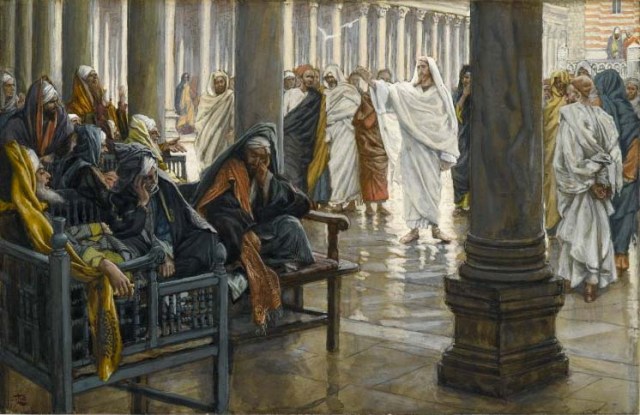
Jesus and the Pharisees, by French painter James Tissot (1836-1902)

Evil intentions originate within. Evil actions are animated by the heart. Evil attitudes are born in the heart. The human heart is the place which needs attention because, for ancient people, this is where a person’s rational will is located. It is where moral pollution dwells, deep within.

Let’s keep in mind that, in the verbal kerfuffle between Christ and the religious leaders, there is no evidence that Jesus disregarded Jewish dietary laws. He instead took the religious establishment to task on elevating outward human traditions, while simultaneously ignoring the inward human heart.

Food and hand-washing are not the chief concern, when it comes to purity and impurity. At issue is the source of defilement, that is, where the pollution is sourced. Jesus insisted that it’s more about who you are, and what is in your heart, than it is about the food you eat or avoid.

In truth, the problem of defilement is important. And keeping the Mosaic law is significant. Yet, Jesus was looking at these issues from a different angle. He affirmed the law’s purpose in restraining evil and avoiding impurity, along with the religious leaders. However, Christ disagreed with them on how the law is practically observed and obeyed.

Jesus did not come up with something new or strange in talking about evil emanating from the heart. Judaism is a religion of the heart, just as much as Christianity or any other religion.

The heart is devious above all else;
    it is perverse—
    who can understand it?
I the Lord test the mind
    and search the heart,
to give to all according to their ways,
    according to the fruit of their doings. (Jeremiah 17:9-10, NRSV)

So, what’s up with the conflict between Jesus and the religious leaders? Over time, many located evil outside, out there, with evildoers and law-breakers, with those disobedient to the law. Christ came along and reaffirmed where the problem originates, scripturally.

One isn’t defiled by improper handling of ritual; one is defiled because being unaware of, or not acknowledging, the dark shadows which reside within every human heart.

Therefore, the discussion of evil and impurity is useless, if we only talk about influences from outside. Deal, instead, with the influences from within.

The heart is not all bad; there’s a lot of good there. But there are spaces within the heart which are camouflaged in darkness. Those places need attention, before we launch into evil which exists elsewhere.

Everyone must come to the point of understanding that they are capable of both great good and great evil. A Pharisee is not all good. And a lawbreaker is not all bad. Until we can see the commonality between ourselves and those we separate ourselves from, we will continually miss the heart of true religion.

Whether a Jew, Christian, Muslim, or any other religious tradition, we must deal with our own collective house, and our own personal heart. Hate speech toward another group has no warrant from Jesus. Injustice has no place in Christianity or anywhere else.

Furthermore, not a one of us can rationalize any unjust words and/or inactions. If that happens, a terrible blindness has occurred in which someone or some group of people refuse to see their own culpability in evil, and project it outward onto another person or group.

If we keep the light of the gospel in our own hearts, then it is much less likely that we will demean or attack others, either verbally, physically, or both.

Using a self-constructed and janky flashlight to shine on another’s heart does nothing but keep the attention off of our own heart. That sort of dubious searching of splinters helps no one, especially ourselves, who already have nasty logs in our own eyes.

Evil is deeper than mere selfishness, bigger than a personal error in judgment, and greater than some individual bad decisions. That’s because there is also a collective heart in every organization, institution, corporation, and faith community. Injustice and unrighteousness resides in those hearts, as well. This makes all of us – personally and communally – both victims of evil, as well as perpetrators of wickedness.

This is why grace and mercy are the real answers to the evil in this world’s systems, and in the human heart. Jesus is trying to pave the way toward a solution of the problem of evil.

Let’s give him an honest look and hearing.

Most merciful God, we confess that we have sinned against you in thought, word, and deed, by what we have done, and by what we have left undone. We have not loved you with our whole heart; we have not loved our neighbors as ourselves. We are truly sorry and we humbly repent. For the sake of your Son Jesus Christ, have mercy on us and forgive us; that we may delight in your will, and walk in your ways, to the glory of your Name. Amen.

A Spiritual Wedding (Psalm 45:1-2, 6-9)

My thoughts are filled
with beautiful words
    for the king,
and I will use my voice
as a writer would use
    pen and ink.

No one is as handsome as you!
    Your words are always kind.
That is why God
    will always bless you…

You are God, and you will rule
    forever as king.
Your royal power
    brings about justice.
You love justice and hate evil.
    And so, your God chose you
and made you happier
    than any of your friends.
The sweet aroma of the spices
myrrh, aloes, and cassia
    covers your royal robes.
You enjoy the music of harps
in palaces decorated
    with ivory.
Daughters of kings are here,
and your bride stands
    at your right side,
wearing a wedding gown
    trimmed with pure gold. (Contemporary English Version)

A Royal Wedding?

Today’s psalm is a love song meant to be used for a wedding. Whether it was designed only for royal weddings, or for ordinary couples to be a king and queen for a day, the psalm’s overall challenge is for the groom to exercise a right use of power.

Back in biblical times, within a patriarchal society, men held the power and authority within every aspect of the culture, especially in the family.

If the psalm is meant for only royal weddings, it communicates that, in effect, the king has been placed on the throne by God, and acts as God’s extension of justice and righteousness to the people.

And if the psalm is intended for any leader, or anyone who possesses power and authority, then being in such a position requires great responsibility. Power is to be wielded for good, with an eye toward doing what is just and right for all of the people in which the leader exercises authority over.

So, whether one is in a hierarchical or an egalitarian structure, all persons in authority are to give themselves to being faithful.

Symbolism and Allegory

There is a symbolic and allegorical aspect to the psalm. Just as the royal robe or wedding clothes of the groom emit sweet aromatic spices, so the leader who loves justice and acts with integrity is pleasing to all those under their authority.

But thanks be to God, who always leads us as captives in Christ’s triumphal procession and uses us to spread the aroma of the knowledge of him everywhere. For we are to God the pleasing aroma of Christ among those who are being saved and those who are perishing. To the one we are an aroma that brings death; to the other, an aroma that brings life. And who is equal to such a task? (2 Corinthians 2:14-16, NIV)

Those in responsible positions – and those sharing authority with one another – are to do what is life-giving for people; and not do things which are death-dealing. Promoting connection and being encouraging are vital. Causing division and being critical are destroyers of people’s welfare.

The psalmist praises a king who loves righteousness and hates wickedness. Such a ruler defends the cause of truth and upholds justice. These are ideals which have a pertinent message for public servants in every age.

Christ the Bridegroom, and the Church as Bride

For most of church history, Christian interpreters took a committed Christ-centered approach to the psalm. They saw Jesus as the beautiful king who reigns in justice and righteousness, faithfully ruling the people.

Through this view, every psalm, in some way, points to Jesus. In Psalm 45, the wedding poem directs believers to the coming wedding of Christ and the Church. The king is Jesus, who is worthy of praise and adoration. The bride is Christ’s Church.

Whether one discerns the psalm as literal or allegorical, the Christian understands that Jesus Christ is the ultimate fulfillment of all God’s promises. So, in that sense, everything in Holy Scripture – including the Old Testament and all of the Psalms – have to do with Christ.

All good earthly kings, rulers, and leaders hold an office which points forward to Christ, who rules over a kingdom to end all kingdoms. In looking at Psalm 45, the author of the New Testament Book of Hebrews takes such a view, since he looks back to this very psalm in speaking about Jesus:

But about the Son he [God] says,

“Your throne, O God, will last for ever and ever;
    a scepter of justice will be the scepter of your kingdom.
You have loved righteousness and hated wickedness;
    therefore God, your God, has set you above your companions
    by anointing you with the oil of joy.” (Hebrews 1:8-9, NIV)

The Reformer John Calvin (1509-1564) stated the reason we know the Psalm is about Jesus, because neither Jew nor Gentile talks this way about any human king – therefore, it is a reference to Messiah.

From St. Augustine to Martin Luther, scholars and interpreters saw in Psalm 45 a praise to Christ, who is the betrothed king.

The psalm’s celebration exalts the union of Christ and the Church. The song of love anticipates the great wedding feast at the end of the age, sung in honor of Jesus the bridegroom and the Church as the bride of Christ.

Weddings Are About Love

The psalmist unabashedly loves the king, and wants everyone to know it. Indeed, it is love which makes life worth living. It’s love that animates our words and actions. Apart from love, we are lost and lonely – languishing without an object of love to orient life around.

An affectionate love for Jesus Christ drives the Christian to live into goodness, justice, and righteousness. And we become what we love – which is why Christianity has the power to change the world for the better (and not in the weird sense of trying to conquer the world through politics and Christendom).

Such love elicits praise and adoration. Love brings about God’s good purposes. And God is determined to bring a spouse for his Son.

“God created the world to provide a spouse and a kingdom for His Son: and the setting up of the kingdom of Christ, and the spiritual marriage of the spouse to Him, is what the whole creation labors and travails in pain to bring to pass.” Jonathan Edwards (1703-1758)

It is far too easy for one’s love to fade in the Christian life. Living an ethical life, and maintaining doctrinal purity, may be kept up; and yet, it all can be done without love behind it.

Jesus said to the Church at Ephesus:

I know your deeds, your hard work and your perseverance. I know that you cannot tolerate wicked people, that you have tested those who claim to be apostles but are not, and have found them false. You have persevered and have endured hardships for my name, and have not grown weary. Yet I hold this against you: You have forsaken the love you had at first. (Revelation 2:2-4, NIV)

Let’s allow today’s Psalm to evoke and stir up our love for God by reminding us of God’s great love for us in Christ, and the love we have, or once had, for Jesus.

Let us see what great lengths God went to love us through Christ. And let us retain and maintain the joyous passion of life with God in Christ, by means of the Spirit.

Amen.