
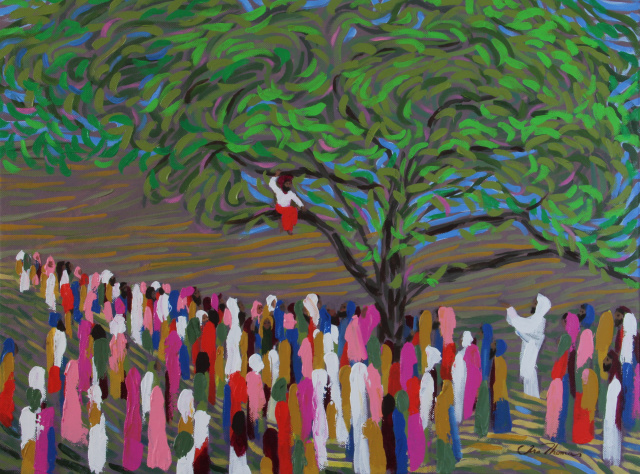
“I Want to See Jesus!” (Luke 19:1-10)

Zacchaeus, by Ira Thomas

Jesus entered Jericho and was passing through. A man was there by the name of Zacchaeus; he was a chief tax collector and was wealthy. He wanted to see who Jesus was, but because he was short he could not see over the crowd. So he ran ahead and climbed a sycamore-fig tree to see him, since Jesus was coming that way.

When Jesus reached the spot, he looked up and said to him, “Zacchaeus, come down immediately. I must stay at your house today.” So he came down at once and welcomed him gladly.

All the people saw this and began to mutter, “He has gone to be the guest of a sinner.”

But Zacchaeus stood up and said to the Lord, “Look, Lord! Here and now I give half of my possessions to the poor, and if I have cheated anybody out of anything, I will pay back four times the amount.”

Jesus said to him, “Today salvation has come to this house, because this man, too, is a son of Abraham. For the Son of Man came to seek and to save the lost.” (New International Version)

Every time I read this story about Zacchaeus climbing up the sycamore tree to see Jesus because he was a short man, I think of the old ‘70s song Short People by Randy Newman. The song was (and still is) criticized by some as being prejudiced against short people. 

Indeed, the criticism seems justified with lyrics such as “short people got no reason to live.” Yet, the song’s intended purpose was really the opposite – to be an attack on the pervasive prejudice of the day, and an attempt to “heighten” (pun intended) awareness of other people’s importance. 

“Short people are the same as you and I. All men are brothers until the day they die” are the lyrics containing the real message within the song.

At first glance, the story of the short Zacchaeus seems to be about his inability to see. Yet the real heart of the story is that:

Zacchaeus is unable to see because the other people are obstacles to his sight. 

In turns out that Jesus is the only person who truly sees Zacchaeus. No one else sees him. No one else seems to care. While everyone else is busy with their own line of sight, Jesus is concerned to see the one person who is unseen: Zacchaeus. 

And here’s the reason why Jesus had his radar attuned to picking up Zacchaeus: Because Jesus came to see people like Zacchaeus; Christ came to seek and to save the lost.

One of the most pertinent applications of this story for us, is that we must not be an obstacle for others coming to Jesus – and instead be a conduit for others to meet Jesus. For that to happen, we need a reformation of both attitude and our action.

Our chief obstacle to realizing a reformation is the sort of hindrance that Zacchaeus overcame in order to see Jesus and experience him:

Zacchaeus did not take himself so seriously.

A very serious Zacchaeus would not have been playful enough and much too respectable to climb a tree. Maybe he was used to living with short jokes all his life; I don’t know. I just see a rich businessman who was lighthearted enough to climb a tree; and who lightened up enough to give a big pile of money away.

As a tax collector, metrics and measurements and figures were his world. All of that accounting can create a serious and sterile environment – concerned with doing more, being more, and getting more.

Reformation – reforming oneself, one’s culture, and one’s institutions – comes through the disposition and willingness of not being so doggone serious all the time.

“Jesus and Zacchaeus” by Soichi Watanabe

Hanging one’s happiness and well-being on other people adopting my opinions, my plans, and my way is a surefire prescription for getting knocked down several pegs by both others and God.

A reformation comes through collegiality, cooperation, and collaboration with others. To acknowledge that God is God, and I am not, and that all people (even the ones I don’t like) are just as important as me, is to see with new eyes. This is the way of seeing Jesus because it’s the willingness to climb trees and to not care how it makes me look to do it.

People short on faith, short on hope, and short on love desperately need the love of God in the gracious person of Jesus Christ. 

Let us then, help, and not hinder, people’s ability to see Jesus.

Jesus said, “You are the light of the world. A town built on a hill cannot be hidden. Neither do people light a lamp and put it under a bowl. Instead they put it on its stand, and it gives light to everyone in the house. In the same way, let your light shine before others, that they may see your good deeds and glorify your Father in heaven.” (Matthew 5:14-16, NIV)

Let us not become discouraged when our expectations obscure our sight.

When John, who was in prison, heard about the deeds of the Messiah, he sent his disciples to ask him, “Are you the one who is to come, or should we expect someone else?”

Jesus replied, “Go back and report to John what you hear and see: The blind receive sight, the lame walk, those who have leprosy are cleansed, the deaf hear, the dead are raised, and the good news is proclaimed to the poor. (Matthew 11:2-5, NIV)

Let us have eyes to see and not be blinded by our own seriousness.

Jesus said, “For judgment I have come into this world, so that the blind will see and those who see will become blind.” (John 9:39, NIV)

Anyone who has seen me has seen the Father. (John 14:9, NIV)

Let us humble ourselves and stoop to see the incredible reality in front of us.

As they entered the tomb, they saw a young man dressed in a white robe sitting on the right side, and they were alarmed.

“Don’t be alarmed,” he said. “You are looking for Jesus the Nazarene, who was crucified. He has risen! He is not here. See the place where they laid him. But go, tell his disciples and Peter, ‘He is going ahead of you into Galilee. There you will see him, just as he told you.’” (Mark 16:5-7, NIV)

Let us see and believe.

“What is mankind that you are mindful of them,
    a son of man that you care for him?
You made them a little lower than the angels;
    you crowned them with glory and honor
    and put everything under their feet.”

In putting everything under them, God left nothing that is not subject to them. Yet at present we do not see everything subject to them. But we do see Jesus, who was made lower than the angels for a little while, now crowned with glory and honor because he suffered death, so that by the grace of God he might taste death for everyone. (Hebrews 2:6-9, NIV)

In God’s kingdom, the tall are short, and the short are tall. And there are plenty of trees to climb so that everyone can see Jesus.

Loving Lord Jesus, give me the grace to see you in all things throughout my days on this earth. Help me to see your benevolent kingdom come and see your ethical will be done, here on earth, as it is always done in heaven. Amen.

Luke 19:1-10 – I Want to See Jesus

Zacchaeus by Joel Whitehead

Jesus entered Jericho and was passing through. A man was there by the name of Zacchaeus; he was a chief tax collector and was wealthy. He wanted to see who Jesus was, but because he was short he could not see over the crowd. So, he ran ahead and climbed a sycamore-fig tree to see him, since Jesus was coming that way.

When Jesus reached the spot, he looked up and said to him, “Zacchaeus, come down immediately. I must stay at your house today.” So, he came down at once and welcomed him gladly.

All the people saw this and began to mutter, “He has gone to be the guest of a sinner.”

But Zacchaeus stood up and said to the Lord, “Look, Lord! Here and now, I give half of my possessions to the poor, and if I have cheated anybody out of anything, I will pay back four times the amount.”

Jesus said to him, “Today salvation has come to this house, because this man, too, is a son of Abraham. For the Son of Man came to seek and to save the lost.” (New International Version)

Every time I read this story about Zacchaeus climbing up the sycamore tree to see Jesus because he was a short man, I think of the old ‘70s song Short People by Randy Newman. The song was (and still is) criticized by some as being prejudiced against short people. 

Indeed, the criticism seems justified with lyrics such as “short people got no reason to live.” Yet, the song’s intended purpose was really the opposite – to be an attack on the pervasive prejudice of the day, and an attempt to heighten the awareness of the inability to recognize others different from ourselves. “Short people are the same as you and I. All men are brothers until the day they die” are the lyrics containing the real message within the song.

At first glance of the story of the short Zacchaeus, it seems to be about his inability to see. Yet the real heart of the story is that Zacchaeus is unable to see because the other people are obstacles to his sight. 

In turns out that Jesus is the only person who truly sees Zacchaeus. No one else sees him. No one else seems to care. While everyone else is busy with their own line of sight, Jesus is concerned to see the one person who is unseen – Zacchaeus. 

And here is the reason why Jesus had his radar attuned to picking up Zacchaeus: Because Jesus came to seek, see, and save those who are lost.

The most pertinent application of this story for us, it seems to me, is that we need to repent of being obstacles to others coming to Jesus – and turn to becoming the conduits to others meeting with Jesus. 

People who are short on faith, short on hope, and short on love desperately need the love of God in the gracious person of Jesus Christ. 

So, what will you and I do today to help another see Jesus?

You are the light of the world. A city on top of a hill can’t be hidden. Neither do people light a lamp and put it under a basket. Instead, they put it on top of a lampstand, and it shines on all who are in the house. In the same way, let your light shine before people, so they can see the good things you do and praise your Father who is in heaven. (Matthew 5:14-16, CEB)

Do we become discouraged when we cannot see what we expect to see?

When John was in prison, he heard about the things Christ had done. So, he sent his disciples to ask Jesus, “Are you the one who is coming, or should we look for someone else?”

Jesus answered John’s disciples, “Go back, and tell John what you hear and see: Blind people see again, lame people are walking, those with skin diseases are made clean, deaf people hear again, dead people are brought back to life, and poor people hear the Good News. (Matthew 11:2-5, GW)

Do we have eyes to see?

Jesus said, “I came into this world for judgment so that those who do not see may see, and those who do see may become blind.” (John 9:39, NRSV)

Anyone who has seen me has seen the Father! (John 14:9, NLT)

Will you and I humble ourselves, and stoop to see?

As they entered the tomb, they saw a young man dressed in a white robe sitting on the right side, and they were alarmed.

“Don’t be alarmed,” he said. “You are looking for Jesus the Nazarene, who was crucified. He has risen! He is not here. See the place where they laid him. But go, tell his disciples and Peter, ‘He is going ahead of you into Galilee. There you will see him, just as he told you.’” (Mark 16:5-7, NIV)

Can you see now?

God has put everything under our power and has not left anything out of our power. But we still don’t see it all under our control. What we do see is Jesus, who for a little while was made lower than the angels. Because of God’s gift of undeserved grace, Jesus died for everyone. And now that Jesus has suffered and died, he is crowned with glory and honor! (Hebrews 2:8-9, CEV)

Loving Lord Jesus, give me the grace to see you in all things throughout my days on this earth. Help me to see your benevolent kingdom come and see your ethical will be done, here on earth, as it is always done in heaven. Amen.

Genesis 12:1-3 – The Blessing

a5487-wisdom2bfrom2babove

The Lord had said to Abram, “Go from your country, your people and your father’s household to the land I will show you.

“I will make you into a great nation,
and I will bless you;
I will make your name great,
and you will be a blessing.
I will bless those who bless you,
and whoever curses you I will curse;
and all peoples on earth
will be blessed through you.” (NIV)

Words are powerful.  They have the power of life and of death, of blessing and cursing. Furthermore, withholding words of blessing and keeping silent is to withhold goodness and love from another.

Speaking words of blessing and backing up those words with an active commitment, is vital to humanity’s spiritual and emotional health.

The question for Abraham, and for us, is not only how we will respond to God’s commands but how we will react to his promise of blessing, and to be a blessing. Abraham left the city of Ur because he believed in the promise God was holding out to him of blessing.  It is the promises of God, not just the commands, which change our lives.  It is the promise, not only the command, which requires a decision and a change.  The world needs promise.  And promise is powered by blessing.

The term “blessing” in Scripture is a powerful communication of God’s presence and approval.  Notice some of the elements of God’s blessing to Abraham. God said that he would show Abraham the Promised Land, that is, he would be with Abraham. Abraham was neither alone nor on his own.  God provided Abraham with a peek into a special future – he would make Abraham into a great nation. What’s more, God would bless everyone else through Abraham. God’s approval was with Abraham – “I will bless you.”  Notice, also, God’s active commitment to Abraham: He would bless those who bless him and curse those who curse him.

This blessing was passed from generation to generation, from Abraham to Isaac, Isaac to Jacob, Jacob to his twelve sons; a blessing of God’s presence, approval; a blessing of a special future, and an active commitment.  The promise of the blessing found its ultimate fulfillment in the person of Jesus, who extended the original promise to the nations. I, as a Gentile believer, have come to faith because of this blessing.

Fathers and mothers everywhere across the world stand in a unique and special position as those who have the power of bestowing a blessing on their children – a blessing of being with them, approving of them, affirming their gifts and abilities, envisioning for them a special future of how God can use them. Those words of blessing have the power to help children navigate the world with assurance and confidence. Armed with blessing, they can filter-out the choices in front of them and walk in the way of God.

Notice in the New Testament Gospels how the God the Father blessed the Son:

As soon as Jesus was baptized, he went up out of the water.  At that moment heaven was opened, and he saw the Spirit of God descending like a dove and lighting on him.  And a voice from heaven said, “This is my Son, whom I love; with him I am well pleased.” (Matthew 3:16-17).

God communicated his constant presence and an active commitment through the Spirit; God spoke words of approval and affirmation; God the Father had a special future for Jesus the Son, which helped Jesus to repel the words of Satan. Since Jesus needed and received a blessing from his Father, how much more do we?

Notice how Jesus passed on the blessing to his disciples with promise and commitment (giving them much more than only the command):

“All authority in heaven and on earth has been given to me. Therefore, go and make disciples of all nations, baptizing them in the name of the Father and of the Son and of the Holy Spirit, and teaching them to obey everything I have commanded you. And surely, I am with you always, to the very end of the age.” (Matthew 28:18-20).

Jesus let his disciples know that his presence would be with them; he communicated an active commitment to give them authority to do the job of disciple-making; he pictured for them a special future of reaching the nations; he affirmed them and approved them. “The Great Commission” is really a re-statement of God’s original blessing to Abraham.

Once we begin to view Holy Scripture through the lens of promise and blessing, we begin to see it everywhere. Perhaps one more illustration of receiving and giving blessing will assist us:

Jesus entered Jericho and was passing through.  A man was there by the name of Zacchaeus; he was a chief tax collector and was wealthy.  He wanted to see who Jesus was, but being a short man, he could not, because of the crowd. So, he ran ahead and climbed a sycamore-fig tree to see him, since Jesus was coming that way.  When Jesus reached the spot, he looked up and said to him, “Zacchaeus, come down immediately.  I must stay at your house today.” So, he came down at once and welcomed him gladly.  All the people saw this and began to mutter, “He has gone to be the guest of a ‘sinner.’” But Zacchaeus stood up and said to the Lord, “Look, Lord!  Here and now I give half of my possessions to the poor, and if I have cheated anybody out of anything, I will pay back four times the amount.”  Jesus said to him, “Today salvation has come to this house, because this man, too, is a son of Abraham.  For the Son of Man came to seek and save what was lost.” (Luke 19:1-10).

Zacchaeus was transformed.  His life changed from one of cursing others through extortion to blessing others through giving. Jesus not once commanded him to do it. Instead, Jesus simply blessed him, and Zacchaeus, in turn, became a blessing. Being invited into someone’s house in the ancient world was in and of itself an act that communicated acceptance, approval, and encouragement.  The presence of Jesus changes people.

God is with us.  He has given us his very great and precious promises in Christ.  He has demonstrated his active commitment to us by giving us the Holy Spirit.  The Holy Spirit has gifted each believer for service so that every individual may be a blessing to both the church and the world.

You and I already possess God’s blessing; there is no need to try and earn it.

We have the privilege and the ability to reverse the world’s curse and turn it into a blessing. Those blessed with money can be a blessing by giving it away. Those blessed by growing up in a loving family can provide love to others who are unloved and need a special blessing. Those blessed with wisdom can mentor and instruct those who need wisdom. Those blessed with the mercy of God can be merciful to others. Those blessed with a wonderful relationship with God can pray people into the kingdom of God.

Parents, it is never too late to bless your children, even if they are adults. Children, it is never too late to bless your parents and your siblings, even if they are prickly and hard. To not bless is to curse. Bless through words that build up, and do not tear down. Use those words to picture a special future of what God can do. Follow through with those words by demonstrating an active commitment to embodying blessing.

I leave you with a blessing, my dear readers:

May God answer you when you are in distress; and, may the name of Jesus protect you. 

May God send you help when you need it and give you support when you cry out to him. 

May the God of heaven remember all your good deeds done in faith and accept you just as you are. 

May God give you the desire of your heart and make all your plans succeed.

When the Almighty answers your prayers and goes out of the way to use you for his glory; then, I will be the first to shout with the loudest shout of joy that there ever was on the earth! 

I know that the Lord is God, and that he has a special future for you beyond what you can even ask or think.  And I will be there on the sidelines, encouraging you all the way. 

Some people trust in the political process, others trust in the strength of the economy; but we trust in the name of the Lord our God. 

May God answer when you call.

May God bless you with an everlasting love. 

May you know Christ, and him crucified, risen, and coming again. 

May God’s presence and power be with you now and forever.  Amen.

Click Blessings by Laura Story to remember that even in difficulty we are blessed.

Luke 19:1-10

            Every time I read this story about Zacchaeus climbing up the sycamore tree to see Jesus because he was a short man, I think of the old ‘70s song Short People by Randy Newman.  The song was (and still is) controversial, mostly because it often gets misinterpreted as being prejudiced against short people.  Indeed, it might seem easy to think this since there are lyrics such as “short people got no reason to live.”  But the song was really the converse; it was an attack on the pervasive prejudice of the day, and an attempt to heighten the awareness of the inability to recognize others different from ourselves.  “Short people are the same as you and I.  All men are brothers until the day they die” is the real message within the song.
 
            At first glance of the story of the short Zacchaeus, it seems to be about his inability to see.  But the real heart of the story is that Zacchaeus is unable to see because the other people are obstacles to his sight.  In turns out that Jesus is the only person who truly sees Zacchaeus.  No one else sees.  No one else seems to care.  While everyone else is busy with their own line of sight, Jesus is concerned to see the one who is unseen – Zacchaeus.  And here is the reason why:  “The Son of Man came to look for and to save people who are lost,” said the Lord Jesus.
 
            The most pertinent application of this story for us is that we need to repent of being obstacles to others coming to Jesus, and instead become the conduits to others meeting with Jesus.  People who are short on faith, short on hope, and short on love desperately need the love of God in the gracious person of Jesus Christ.  What will you do today to help another see Jesus?


            All-seeing God, you are attentive to those most in need of your Son, the Lord Jesus.  Open my eyes to see those around me for whom you see and invite to be with Jesus.  I want to participate with you in your great saving mission of those who are lost.  Amen.