Rituals Are Important (Exodus 13:1-10)

The Passover Meal (Last Supper) by Jess Santos

The Lord spoke to Moses, “Set apart every firstborn male for me. Every firstborn male offspring among the Israelites is mine, whether human or animal.”

Then Moses said to the people, “Remember this day—the day when you left Egypt, the land of slavery. The Lord used his mighty hand to bring you out of there. Don’t eat anything made with yeast. Today, in the month of Abib, you are leaving Egypt. The Lord swore to your ancestors that he would give you the land of the Canaanites, Hittites, Amorites, Hivites, and Jebusites. When he brings you into that land flowing with milk and honey, you must observe this ceremony in this month.

“For seven days you must eat unleavened bread. The seventh day will be a pilgrimage festival in the Lord’s honor. Only unleavened bread should be eaten during these seven days. No sourdough or yeast should be seen anywhere in your territory. On that day tell your children, ‘We do this because of what the Lord did for us when we left Egypt.’ This festival will be like a mark on your hand or a reminder on your forehead that the teachings of the Lord are always to be a part of your conversation. Because the Lord used his mighty hand to bring you out of Egypt, you must follow these rules every year at this time. (God’s Word Translation)

Rituals are an important part of being human. They help us to observe significant events, specials seasons, and daily routines. Ritual activities are meaningful re-telling of stories for us and others. In other words, rituals activate memory, enabling us to remember what is of value.

Religious traditions are typically filled with rituals, in order to remind the faithful of what is significant about their faith. Unfortunately, there are some Christian traditions which have a negative view of ritual, believing it to be “vain repetition.”

The problem, however, is not with rituals themselves; the issue is with the one performing the ritual. If it is done with a disconnect between head and heart, then the ritual does not accomplish it’s intended goal of helping the community to remember and giving meaning in the present time.

“Ritual is not simply an attitude or intention, just as love is not simply a feeling. At its most basic, ritual is something that you do. A man can’t plow a field just by thinking about it; he must go out to the field and get to work. If he is fully present to the work and acts with mindfulness and loving attention – if he brings his whole self along – then even as he turns over the rich soil beneath the plow, he turns it over in his mind and heart, as well. The act of tilling the soil becomes an act of tilling the soul.”

Alison Leigh Lilly

No matter whether folks are religious, or not, all people engage in rituals. For example, here are some rituals many people do in order to remember, celebrate, and renew an old story:

  • Birthdays (remembering and re-telling the birth story)
  • Graduations (remembering and re-telling the story of school)
  • Marriages & Anniversaries (remembering and re-telling the courtship story)
  • National Holidays (remembering and re-telling the patriotic story)
  • Dinner and/or Bedtime (remembering and re-telling stories from the day)
  • Morning (remembering and re-telling my story of purpose and meaning)
  • Earth (remembering and re-telling the seasons of Spring, Summer, Fall, and Winter)
  • Annual sojourns to special places such as vacations, sports stadiums, or reunions (remembering and re-telling the story of friendship and family).

The reasons people do such rituals are to

  • Re-enforce values
  • Have a sense of belonging
  • Mark time in a meaningful way
  • Form personal and healthy habits
  • Remind of us of who we are and what our purpose in this world is

Avoiding rituals can cause a lack of identity and purpose. Failing to observe rituals can also create loneliness, confusion, and emptiness.

“Rituals are those repeated actions done again and again in the interest of things like focus, grounding, tradition, cultural symbolism, predictable life rhythms, and feeling a part of something bigger than ourselves.”

Craig Kelley

The Lord gave divine instructions to the newly freed Israelites. And those commands involved instituting some ritual behavior, to be done year after year. God told them to observe a Passover ritual each year so that the story of Israel’s deliverance from Egyptian slavery would remain alive for the generations to come; and so that the event itself would have meaning for people in the present time.

Because Yahweh spared the firstborn of Israel’s children and livestock – and not the firstborn of Egypt – those same firstborn are to be given to God, in some sort of vicarious ransom. All the symbols of Passover are meant to be reminders of what the Lord had done for Israel.

The exodus event is to be actualized, made real for the generations today. By means of ritual, the relationship between God and the people is remembered and renewed for each new generation. Engaging in the ritual repeatedly helps press the story and it’s reality into both the mind and the heart.

And this is precisely what worship is supposed to do for the Christian. Ideally, a worship service is a re-enactment of Christ’s redemption for believers. Even more, it’s a dialogue between God and the people in which the Lord speaks and the worshipers respond.

One ritual which unites all Christians together is the Lord’s Table (communion, or the Lord’s Supper, or the Eucharist). Each Christian tradition has their particular views and theology surrounding it – yet it’s common to all. Observing the Table is a ritual which has been going on for two-thousand years; and which has it’s roots in the Passover and the original meal at the time of the exodus.

The Table is a time of remembrance, communion, and hope. We retell the story of Christ’s redemption and remember the Lord’s once for all sacrifice on the cross for the whole world. It is a unifying ritual, where believers commune together. And the Table expresses hope – that just as we eat and drink now, we will do so all together at the end of the age at the great supper of the Lamb.

Yes, rituals have meaning and it’s symbols are significant. They help us to express our shared humanity together.

May the love of Christ be active in your heart, be heard in your words, be seen in your actions and inform your choices today and every day. Amen.


Grace Changes Everything (Isaiah 12:1-6)

In that day [to come] you will say:

“I will praise you, Lord.
    Although you were angry with me,
your anger has turned away
    and you have comforted me.
Surely God is my salvation;
    I will trust and not be afraid.
The Lord, the Lord himself, is my strength and my defense;
    he has become my salvation.”
With joy you will draw water
    from the wells of salvation.

In that day you will say:

“Give praise to the Lord, proclaim his name;
    make known among the nations what he has done,
    and proclaim that his name is exalted.
Sing to the Lord, for he has done glorious things;
    let this be known to all the world.
Shout aloud and sing for joy, people of Zion,
    for great is the Holy One of Israel among you.” (New International Version)

The Bad News

The reason prophecies are made about better times ahead is because the times now are not so good. That was true of Isaiah’s day, and still remains true today.

It’s easy to identify what’s wrong in this world, especially during a political election cycle! It’s not so easy to recognize the ways we keep ourselves as Christians in bad times. A big reason why, and I unabashedly state it, even though I say it much to my chagrin:

Christianity in our day has mostly failed at spiritual transformation because we have not identified and named the real evils we face, thus leaving us largely irrelevant to a world desperately in need of Jesus Christ.

Jesus, speaking to religious folk who should have known better, said:

“You have neglected the more important matters of the law—justice, mercy and faithfulness… You blind guides! You strain out a gnat but swallow a camel.” (Matthew 23:23-24, NIV)

The tragedy of our age, which was the same tragedy of Isaiah’s age, is that there are so many godless followers of God. They fuss about trifles while ignoring more serious matters. Many Christians’ faith is not much more than conforming to cultural Christian norms while mostly ignoring the realities in front of their faces.

We say we need God but then turn to Google for answers and solutions.

We bemoan the lack of righteousness in the nation, then obnoxiously argue with others and create unnecessary relational wedges.

We decry the injustice of our cities and our world, then do nothing to address the problems and change it.

We talk about the need for others to change rather than first looking in the mirror. Yet, even when we do that, we walk away and forget what we look like.

“For it is time for judgment to begin with God’s household; and if it begins with us, what will the outcome be for those who do not obey the gospel of God?” (1 Peter 4:17, NIV)

The Good News

However, judgment is not the last word. Even though the prophecy of Isaiah is thick with it, and I started out with less than uplifting words, there is one word that transcends every word: grace.

The grace of God is remarkable! The Lord made promises to Israel in Isaiah’s day not based upon what they would or would not do; God made promises to the people by God’s own radical and scandalous grace. It wasn’t a matter of playing Let’s Make a Deal, with God saying, “If you get your act together, then I will be good to you.” No, before Israel even had a chance to return to the Lord, God was already choosing to be merciful.

I am absolutely convinced with the firmest conviction possible that the Scriptures of the Old and New Testaments are all about God and God’s own unbounded, unfettered, free, crazy, illogical, and wildly wonderful grace.

Because God is Love, the Lord constantly goes out of the way to be gracious so that we can live up to being the sort of people our dogs think we are already.

If we miss the message of God’s grace in the Holy Scriptures, we have missed salvation – because only grace can save us. Without grace, we are lost. Today’s Old Testament lesson is full of praise because it’s a response to the undeserved grace which God freely gives. 

If grace isn’t the answer, we aren’t asking the right question. Grace is love that seeks you out when you have nothing to give in return. Grace is wildly generous. Grace does not use carrot sticks, scorecards, or power politics. Grace never demands – it only gives. 

Grace is unconditional acceptance given to an undeserving person by an unobligated giver. 

That is what God did for Israel… and for us. And when we get a hold of this truth, even a little bit, our hearts become bubblers of praise.

The Bible is an extended drama of redemption; and Isaiah’s prophecy is an adventure of God’s steadfast love toward unlovable people – which is why Isaiah is one of the most quoted books of the Old Testament by Jesus. Jesus came because of grace. 

Jesus came to release us from our obsessive need to be right, our compulsion to be rewarded, and our demands to be respected. 

Because Jesus came to set sinful captives free, life does not have to be a joyless effort of justifying and validating ourselves before others. The grace of God in Christ is a game-changer. And with but a glimpse of grace, we are forever undone by God’s mercy.

Grace leads us to praise God

“Praise be to the God and Father of our Lord Jesus Christ, who has blessed us in the heavenly realms with every spiritual blessing in Christ. For he chose us… In love he predestined us… to the praise of his glorious grace, which he has freely given us in the One he loves.” (Ephesians 1:3-6, NIV)

Grace causes us to trust God

If God is for us, who can be against us? (Romans 8:31, NIV)

Grace results in our comfort and satisfaction in God

Never again will they hunger;
    never again will they thirst.
The sun will not beat down on them,
    nor any scorching heat.
For the Lamb at the center of the throne
    will be their shepherd;
he will lead them to springs of living water.
    And God will wipe away every tear from their eyes. (Revelation 7:16-17, NIV)

Grace creates in us thanksgiving to God

“We know that the one who raised the Lord Jesus from the dead will also raise us with Jesus and present us with you to himself. All this is for your benefit, so that the grace that is reaching more and more people may cause thanksgiving to overflow to the glory of God.” (2 Corinthians 4:14-15, NIV)

The Lord has seen you at your worst, and still loves you. And if that isn’t something that gets you expressing gratitude to God, then you have failed to see God in your dog. We make known among the nations what God has done because God has really done something in our lives worth babbling our thanksgiving over to everyone. And grace helps us to do it.

Grace causes us to sing together to God

When grace takes hold of a congregation, there is no mumbling of songs – there are loud shouts and singing for joy because God is good! We need times of both silence and contemplative worship and times of becoming unhinged with some noisy worship to the God who has saved us and given us something to sing about. 

Oh, sing to the Lord a new song!
For He has done marvelous things;
His right hand and His holy arm have gained Him the victory. (Psalm 98:1, NKJV)

Conclusion

The world mostly ignores God. Some Christians take God’s grace for granted. The greatest sin of all is the sheer absence of grace – because where there is no grace, there is no God. God is the expert in transforming apathetic people into caring, compassionate, and concerned citizens of the kingdom who raise their voices and declare the works of the Lord.

Isaiah’s entire prophecy is about returning to the Lord. And the upcoming season of Advent is all about God’s relentless pursuit of wayward people – the anticipation of grace coming in the form of an infant – and the bringing of grace to a people living in darkness.

Let us, then, return to the Lord… be captivated by grace… renew our love for Jesus… lose ourselves in praise and adoration of the One who gave everything for us.

Let us worship Christ the King and proclaim the name of Jesus as exalted over everything and everyone.

Gracious God, we come with nothing but ourselves and our baggage of sin. Forgive, cleanse, renew, revive, refresh, and reform us according to the ways of Jesus Christ. Thank you for your undeserved grace. We give you praise for the lengths you went to secure our forgiveness. With a joy too deep for words, we humbly offer to you our lives so that the name of Jesus will be exalted through us, to your glory and honor. Amen.

Psalm 97 – Celebrate the Lord

The Lord rules! Let the earth rejoice!
    Let all the islands celebrate!
Clouds and thick darkness surround God.
    His throne is built on righteousness and justice.
Fire proceeds before him,
    burning up his enemies on every side.
His lightning lights up the world;
    the earth sees it and trembles!
The mountains melt like wax before the Lord,
    before the Lord of the whole world!

Heaven has proclaimed God’s righteousness,
    and all nations have seen his glory.
All those who worship images,
    those who are proud of idols,
    are put to shame.
    All gods bow down to the Lord!
Zion has heard and celebrates,
    the towns of Judah rejoice,
    because of your acts of justice, Lord,
    because you, Lord, are the Most High
        over all the earth,
    because you are so superior to all other gods.

Those of you who love the Lord, hate evil!
    God guards the lives of his faithful ones,
    delivering them from the power of the wicked.
Light is planted like seed for the righteous person;
    joy too for those whose heart is right.
Rejoice in the Lord, righteous ones!
    Give thanks to his holy name! (Common English Bible)

Being overwhelmed with a tremendous sense of majesty for King Jesus is an appropriate response, especially in the wake of Ascension Day – the Christian holiday celebrating Christ’s return to heaven.

Today’s psalm portrays the Lord as a huge God whose presence impacts the world in cataclysmic glory. God is truly large and in charge. 

Nothing moves God; but God moves mountains. 

This is no wimpy deity who needs creatures to sustain him and his memory. Conversely, all of creation is dependent upon God for life, sustenance, and flourishing.

Our view of God deeply impacts how we think, feel, and live. Whenever people catch a mere glimpse of God’s glory, it causes them to renounce useless idol worship, and brings forth humble celebration from the penitent. 

The sheer dearth of penitence and praise to God in today’s world ought to clue us to the reality that we are not seeing God for how God truly is. And what is the God of Holy Scripture? The Lord is the great and glorious king who is so immense and so concerned for justice that just a snort of his nostrils could thoroughly lay waste to the earth.

Confronted with such a majestic and awesome Being, the ultimate conclusion in how to order our lives is this: Love the Lord. Hate evil. Why? Because we are God’s people. 

Therefore, celebration and praise to God are in order. So, let us collectively make a simple choice to celebrate and praise God in some simple ways:  

  • Acknowledge God in both the big and the small things of life
  • Talk about God’s grace in your everyday conversations– we don’t have to be preachy, just real, genuine, and authentic
  • Praise God in public as well as in private
  • Pray to God with simple heartfelt prayers – they don’t need to be eloquent, because God simply wants to hear the voice we have been given
  • Be generous toward others through forgiveness and tangible help because the Lord is a generous God
  • Read God’s Word because it honors the Lord
  • Give thanks to God and have a predetermined mindset to find gratitude in all things God has put in your life
  • Count your blessings today, and then again, tomorrow, so that it eventually becomes a spiritual habit
  • Sing to God with the joyful noise you are able to make

The power of God is more than enough to bring effective and lasting transformation of body, mind, emotions, and spirit. The might of God is unlimited, able to establish social change, economic uplift, physical healing, relational peace, spiritual hope, mental rest, and so much more.

Celebrating the sovereignty of God is downright good for us. It releases our stress, energizes us, provides a positive way of reflection, challenges evil, and acknowledges realities which we might have forgotten – especially that God is with us, loves us, and has only good plans for us.

Praise and celebration are both organic acts on our part and need to be intentionally planned. That is, celebrating the Lord ought to be both spontaneous and prepared. Liturgical rhythms of worship to God need to be both formulaic and free.

The shape of our worship can remind us that we are in continuity with believers throughout history and in all places on earth. We are not alone. We are joined by the entire community of worshipers, offering our celebration – both old and new.

Having both fixed forms of worship and free expressions of worship enable us to tap into the full dimension of faith. Practicing both personal prayers in our secluded closet and corporate prayers together with others strengthens our faith, makes more sure our hope, and connects us with the God who is Love.

A big God ought to be worshiped with all the means available to us.

Mighty God, you are worthy of all the praise, honor, and glory I can give you. May my life be a simple offering to you, so that your kingdom comes not only in my own life but impacts the lives of others; through Jesus, my King. Amen.

Revelation 11:16-19 – Be Encouraged

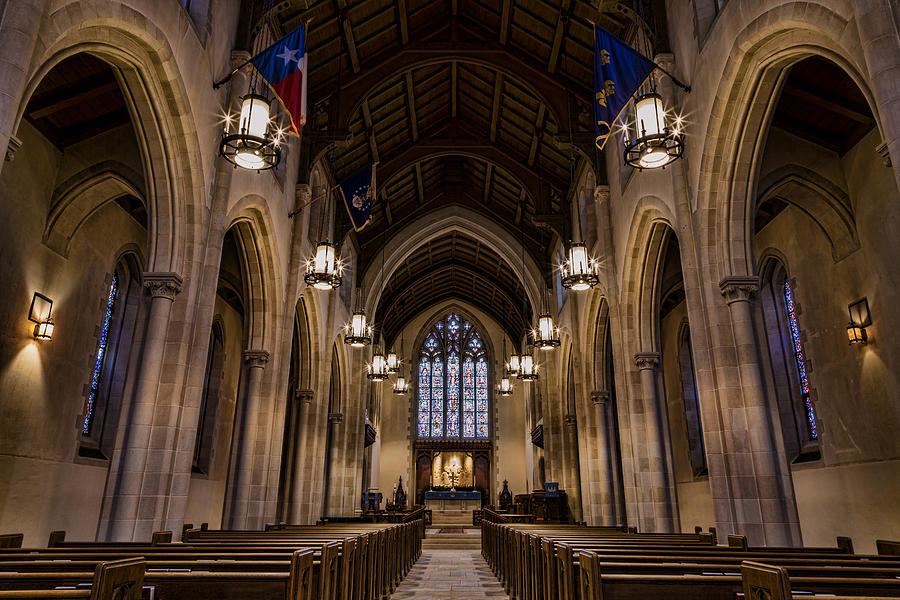
The Episcopal Church of the Heavenly Rest in Abilene, Texas

Then the twenty-four elders who sit on their thrones before God fell on their faces and worshiped God, singing,

“We give you thanks, Lord God Almighty,
    who are and who were,
for you have taken your great power
    and begun to reign.
The nations raged,
    but your wrath has come,
    and the time for judging the dead,
for rewarding your servants, the prophets
    and saints and all who fear your name,
    both small and great,
and for destroying those who destroy the earth.”

Then God’s temple in heaven was opened, and the ark of his covenant was seen within his temple; and there were flashes of lightning, rumblings, peals of thunder, an earthquake, and heavy hail. (New Revised Standard Version)

Late in his life, as the old Apostle John lived in exile, he experienced a grand vision. It is what we today refer to as The Book of Revelation, or The Apocalypse of John. 

At the turn of the first century, Christ’s Church was facing a great deal of difficulty and hardship. Christians were the minority. Believers in Jesus were looked at with suspicion. Followers of Christ were often misunderstood and persecuted because of false information. 

In short, all of the myriad sufferings and persecutions that Jewish people currently face and have faced for millennia were true of the early believers in Jesus.

Therefore, the purpose of John’s vision was not to give slick preachers a reason to craft elaborate prophecy charts about what’s going to happen in the future. Instead, God was concerned for the current welfare of his people. The vision was meant to bring encouragement.

The message to John, passed onto the suffering church, was that this present hard situation will not always be this way. Danger, adversity, and hardship will not last forever. There is a day coming when God’s judgment and benevolent reign will truly rule in all of its glorious fullness.

Our prayers will be answered, the ones we have lifted to God for centuries: “Your kingdom come, your will be done, on earth as it is in heaven.”

Gergeti Trinity Church, Georgia

The Lord did not want his beloved children to succumb to discouragement and lose heart. So, the vision from John assured them that all will be made right. Jesus is Lord, and his good rule will have the day. 

Yes, we currently live in a world profoundly touched by the presence and power of sin. And because of that sad reality, we feel all kinds of various pain. We have no choice but to endure the hardships of national wars, bodily diseases, lack of resources, economic woes, mental disorders, emotional distress, and spiritual warfare.

It is possible to observe, as well as experience, all the crud of this sinful world and fall into despair. If or when that happens, we give-in to unhealthy ways of coping with the adverse circumstances around us.

Graciously, we have been given a glimpse into how all of history will shake-out in the end. That brief pulling back of the curtain is meant to bring us needed encouragement, steadfast hope, and patient endurance. 

There is coming a day when expressions of grief and lament will give way to praise and gratitude to God. And that incredible praise will explode with all believers, past and present, along with all creation, proclaiming together that the Lord God is all-powerful. 

The kingdom of this world belongs to our Lord and to his Chosen One. And he will rule forever and ever.

Some might protest that Christians have been harping on this return of Jesus for two millennia and he still isn’t here. We must not misinterpret God’s inaction as uncaring or that God is non-existent. Because it is really patient grace.

But do not forget this one thing, dear friends: With the Lord a day is like a thousand years, and a thousand years are like a day. The Lord is not slow in keeping his promise, as some understand slowness. Instead, he is patient with you, not wanting anyone to perish, but everyone to come to repentance. (2 Peter 3:8-9, NIV)

Our present sufferings must also not be misinterpreted, as if God hates us or is just plain mean. For the Christian, suffering is transformed into solidarity with Jesus Christ.

My dear friends, do not be surprised at the painful test you are suffering, as though something unusual were happening to you. Rather be glad that you are sharing Christ’s sufferings, so that you may be full of joy when his glory is revealed. (1 Peter 4:12-13, GNT)

All of our collective experiences are meant not for harm, but for good so that we might realize spiritual growth and maturity.

Grow in the grace and knowledge of our Lord and Savior Jesus Christ. To him be glory both now and forever! Amen. (2 Peter 3:18, NIV)

Lord Jesus Christ, by your patience in suffering you caused our earthly pain to be sacred and have meaning. Through your example of humble obedience, you opened the way for us to walk through our own hard circumstances with grace and submission.

Be near me in my time of weakness and pain. Sustain me by your grace, so that my strength and courage may not fail. Heal me according to you will. Help me always to believe that what happens to me in this present life is of little account if you hold me in eternal life, my Lord and my God.

As Jesus cried out on the cross, I cry out to you in pain, O God my Creator. Do not forsake me. Grant me relief from this suffering and preserve me in peace; through Jesus Christ my Savior, in the power of the Holy Spirit. Amen.