Jesus Prays For Us (John 17:6-19)

Word of Life, by Millard Sheets

“I have made your name known to those whom you gave me from the world. They were yours, and you gave them to me, and they have kept your word. Now they know that everything you have given me is from you, for the words that you gave to me I have given to them, and they have received them and know in truth that I came from you, and they have believed that you sent me.

I am asking on their behalf; I am not asking on behalf of the world but on behalf of those whom you gave me, because they are yours. All mine are yours, and yours are mine, and I have been glorified in them. And now I am no longer in the world, but they are in the world, and I am coming to you.

“Holy Father, protect them in your name that you have given me, so that they may be one, as we are one. While I was with them, I protected them in your name that you have given me. I guarded them, and not one of them was lost except the one destined to be lost, so that the scripture might be fulfilled. 

But now I am coming to you, and I speak these things in the world so that they may have my joy made complete in themselves. I have given them your word, and the world has hated them because they do not belong to the world, just as I do not belong to the world. 

“I am not asking you to take them out of the world, but I ask you to protect them from the evil one. They do not belong to the world, just as I do not belong to the world. Sanctify them in the truth; your word is truth. As you have sent me into the world, so I have sent them into the world. And for their sakes I sanctify myself, so that they also may be sanctified in truth. (New Revised Standard Version)

It seems to me only fitting that Jesus concluded his time with the disciples in the Upper Room before his betrayal, crucifixion, and death with prayer. It also seems to me that if you really want to know the heart of a person, listen to them pray.

The prayer of Jesus was thoroughly oriented toward the spiritual needs of his followers – even potential believers who will follow him in the future. And it was a prayer completely devoted toward honoring the heavenly Father through praying consistent with God’s will for this world.

Without the physical presence of Jesus – which would soon be gone – his followers would have to rely on prayer. And Christ was intent on instilling within his disciples the confidence and hope they needed for a solid life of prayer.

For post-resurrection Christians living in an ever-expanding world of oppression, greed, and indifference, we can be encouraged not to settle into despair or loneliness. Why? Because believers can have a solid hope and an abiding trust in the continuing presence of Jesus by means of the Holy Spirit.

God Gives

God gives. Jesus gives. Both the Father and the Son are givers. This is a major reason and motivation for prayer because God is not a reluctant giver. In the act of giving, the Father and the Son are fully on the same page; God is ready and willing to give. The Holy Trinity – Father, Son, and Spirit – are in complete unity, and act as One, in giving to us what we need.

“Those who drink of the water that I will give them will never be thirsty. The water that I will give will become in them a spring of water gushing up to eternal life.” (John 4:14, NRSV)

“Do not work for the food that perishes but for the food that endures for eternal life, which the Son of Man will give you.” (John 6:27, NRSV)

“I give them eternal life, and they will never perish. No one will snatch them out of my hand.” (John 10:28, NRSV)

We Belong

Through giving we are included. Believers and followers of Jesus – having been given the grace of faith – know that they belong to God. Christians are in union with Christ. The redemption which Jesus has secured is a million billion times stronger, and bonds us closer, than any sort of Gorilla glue. And, what’s more, once we belong, we are never forgotten, but always remembered by God.

“The Father knows me, and I know the Father. And I lay down my life for the sheep. I have other sheep that do not belong to this fold. I must bring them also, and they will listen to my voice. So there will be one flock, one shepherd.” (John 10:15-16, NRSV)

Christ the King, statue in Swiebodzin, Poland

The Name of Jesus

Because we belong, we know God’s name. The divine name stands for all that God is and all that God has done. It’s all focused in Christ. In the name of Jesus, through the person and work of Jesus Christ, we have everlasting life, spiritual power, and eternal security.

Now Jesus did many other signs in the presence of his disciples that are not written in this book. But these are written so that you may continue to believe that Jesus is the Messiah, the Son of God, and that through believing you may have life in his name. (John 20:30-31, NRSV)

We Have the Word

The Word became flesh and dwelt among us (John 1:14). Jesus has given to his disciples only those words which he first received from the Father. Those who accept the enfleshed Word and his words have been given power to become God’s children (John 1:12). Because believers belong to God, they know the truth and that truth has set them free.

It is the Christian’s mission to live into the words and ways of Jesus, to follow Christ in thought, word, and deed. The very glory of Jesus in his cross and resurrection is focused within the believing community, who is in union with Christ and belongs to God.

In his prayer, Jesus claimed an intimate oneness in the sharing of concern for people who are the objects of the Father’s gracious giving of love through the Son. All who belong to Christ belong to God, and vice versa. All the love that went into the cross was poured out upon us.

Those who believe in the name of Jesus Christ are the very glory of Jesus, and thus, the glory of God.

Sent Into the World

Because of the Father’s name—because of who the Father is and what the Father has given in love to the Son—we are set apart for truth; the words of God are truth.

Since we belong to God and bear the name of Christ, we don’t belong to the world’s systems of guilt, shame, injustice, and evil. And yet, we are separated from the world for precisely the reason of immersing ourselves in the world. In other words, Christianity is meant for the life of the world, and not as a religion that’s only concerned for itself.

To reach the world, we must be different from it. To reach the world, we need to have boots-on-the-ground in it. To reach the world, Christians are to be both far from the world, and near to the world.

As the Father sent the Son, so the Son sends us into the world – not to be like the world, but to embody the words and ways of Jesus to and for the world.

Just as the world rejected Jesus in his suffering and death, so the world, too, will reject his followers. Which means we will need to pray, a lot! And there is no better scriptural prayer to emulate than the very words of the Lord Jesus, who loved us and gave himself for us.

Holy Father, guard our hearts and minds in Jesus, as we pursue this Christian life which you gave as a gift through Christ, so that we can be united, just as the Father and the Son are one. Although we long for heaven, don’t take us out of the world until we have fulfilled our sacred mission to carry the words and ways of our Lord to the world. Make us holy, and give us everything we need for life in this present evil age; through Jesus Christ your Son, our Lord, who with you and the Holy Spirit are one God, now and forever. Amen.

1 John 2:12-17 – Where Is Your Love Aimed?

I am writing to you, dear children,
    because your sins have been forgiven on account of his name.
I am writing to you, fathers,
    because you know him who is from the beginning.
I am writing to you, young men,
    because you have overcome the evil one.

I write to you, dear children,
    because you know the Father.
I write to you, fathers,
    because you know him who is from the beginning.
I write to you, young men,
    because you are strong,
    and the word of God lives in you,
    and you have overcome the evil one.

Do not love the world or anything in the world. If anyone loves the world, love for the Father is not in them. For everything in the world—the lust of the flesh, the lust of the eyes, and the pride of life—comes not from the Father but from the world. The world and its desires pass away, but whoever does the will of God lives forever. (New International Version)

The true measure of one’s Christian belief and commitment is the direction of their love.

We all love. Its part of being a human. Where our love is oriented is the real issue. The trajectory of love is the best measurement of faith and belief.

To love our fellow humanity, our brothers and sisters in Christ, and the neighbors around us, is to live in the light. It is the distinguishing mark of following Jesus. To hate humanity, to downplay love and dismiss it amongst believers, and to ignore the neighbors God placed us around, is to live in darkness.

A Christian is one who has received the love of God in Christ. Because of Divine Love, they know they are forgiven and have eternal life. They know, experience, and feel the permanence of godly love flowing powerfully in and through them to the glory of God.

Christians trust their gut, informed by the conscience testifying to the importance of love, and the Spirit sanctifying them with the primary tool of love.

So, when some folks come along and place a heavy emphasis on cognitive belief, eschewing the heart and the gut, it ought to raise some saved and sanctified eyebrows. To merely affirm a doctrinal statement, then turn around and aim love in the wrong direction, is to affirm a wrong belief. To hate people and love the world is just plain heretical.

The term “world” in the New Testament has differing meanings according to the context. Jesus stated that God so loved the “world” that he gave his only Son. That’s a reference to people, the entire mass of humanity on this planet. John, however, typically uses “world” as the antonym to the church, as if it were an evil opposite.

In our New Testament lesson for today, the term “world” are the patterns, systems, and operations of the world which are in direct contrast to how God operates and how the church ought to function. To love humanity is to hate the world and do God’s will. To love the world is to hate others and adopt a devilish agenda. For example:

  • The world engages in revenge and payback when wronged, whereas the Christian learns to believe God as the Judge, loves the person who has offended them through prayer for their enemy, and obeys God through good works that seeks the welfare of the other. 
  • The world uses other people as either objects of their pleasure or to get ahead in life, whereas the Christian believes God will take care of their needs, will seek to love the other person instead of use them, and would rather obey God than be selfish. 
  • The world thinks nothing of lying, cheating, and stealing, if they can get away with it, whereas the Christian believes Jesus is the way, the truth, and the life, loves being a person of integrity, and obeys God even when it hurts.

Love in the Bible always begins with God’s love for people. This is the fundamental starting point for love because without God’s love, our love doesn’t get very far.

The world hates. God loves. Many people in this cruel and calloused world are unloving and unkind because they lack knowing that God loves them. If we do not believe or know that God infinitely loves us, then our words and our actions will reflect more hate than love.

The Lord your God is with you, he is mighty to save. He will take great delight in you, he will quiet you with his love, he will rejoice over you with singing.”  (Zephaniah 3:17, NIV)

Christianity does not come into existence by knowing some belief statements about Jesus. Rather, Christianity exists when individuals experience the white-hot burning love of God in Jesus Christ. Jesus came not only for those who skip church and only occasionally read their Bibles, but also came for the hard-hearted prick, the immoral adulterer, the strung-out addict, the terrorist, the murderer, and for all those caught up in bad choices and failed relationships. 

God’s love is not based on our performance, how good we look to others, nor conditioned by our moods. The love of God only looks longingly at you and me with the potential of what we can become in Christ and cares for us as we are.

God demonstrates his own love for us in this: While we were still sinners, Christ died for us. (Romans 5:8, NIV)

Christianity never begins with what we do for God to make ourselves lovely for him. Instead, Christianity always starts with what God has done for us, the great and wonderful love that exists for us in Christ Jesus.

But when the kindness and love of God our Savior appeared, he saved us, not because of righteous things we had done, but because of his mercy. (Titus 3:4, NIV)

All the wrong turns in the past, the mistakes and the moral lapses, everything that is ugly or painful all melts in the light of God’s acceptance and love for us. It makes loving the world seem distasteful, like trying to eat sand. Love for God and neighbor is the true source of doing God’s will and the true measure of Christian belief.

In what direction is your love aimed today?

O Lord, you have taught us that without love, whatever we do is worth nothing. Send your Holy Spirit and pour into my heart your greatest gift, which is love, the true bond of peace and of all virtue, without which whoever lives is accounted dead before you. Grant this for the sake of your only Son Jesus Christ, who lives and reigns with you and the Holy Spirit, one God, now and forever. Amen.
Genesis 46:2-47:12 – How to Live in the World

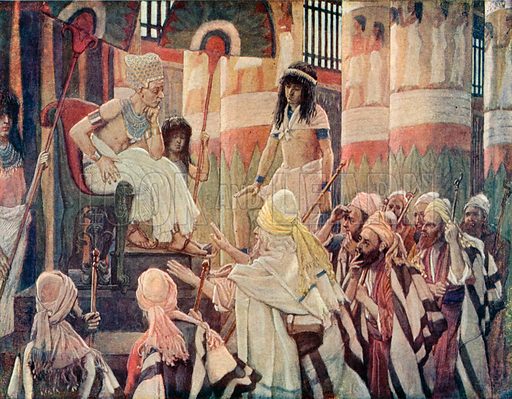
Joseph presents Jacob, his Father, to Pharaoh, Gen xlvii 7 and 8
Joseph presents Jacob and his brothers to Pharaoh by French artist James Jacques Joseph Tissot (1836-1902)

And God spoke to Israel in a vision at night and said, “Jacob! Jacob!”

“Here I am,” he replied.

“I am God, the God of your father,” he said. “Do not be afraid to go down to Egypt, for I will make you into a great nation there. I will go down to Egypt with you, and I will surely bring you back again. And Joseph’s own hand will close your eyes.”

Then Jacob left Beersheba, and Israel’s sons took their father Jacob and their children and their wives in the carts that Pharaoh had sent to transport him. So, Jacob and all his offspring went to Egypt, taking with them their livestock and the possessions they had acquired in Canaan. Jacob brought with him to Egypt his sons and grandsons and his daughters and granddaughters—all his offspring.

These are the names of the sons of Israel (Jacob and his descendants) who went to Egypt:

Reuben the firstborn of Jacob.  The sons of Reuben: Hanok, Pallu, Hezron and Karmi.

The sons of Simeon: Jemuel, Jamin, Ohad, Jakin, Zohar and Shaul the son of a Canaanite woman.

The sons of Levi: Gershon, Kohath and Merari.

The sons of Judah: Er, Onan, Shelah, Perez and Zerah (but Er and Onan had died in the land of Canaan).

The sons of Perez: Hezron and Hamul.

The sons of Issachar: Tola, Puah, Jashub and Shimron.

The sons of Zebulun: Sered, Elon and Jahleel.

These were the sons Leah bore to Jacob in Paddan Aram, besides his daughter Dinah. These sons and daughters of his were thirty-three in all.

The sons of Gad: Zephon, Haggi, Shuni, Ezbon, Eri, Arodi and Areli.

The sons of Asher: Imnah, Ishvah, Ishvi and Beriah.  Their sister was Serah.  The sons of Beriah: Heber and Malkiel.

These were the children born to Jacob by Zilpah, whom Laban had given to his daughter Leah—sixteen in all.

The sons of Jacob’s wife Rachel:

Joseph and Benjamin. In Egypt, Manasseh and Ephraim were born to Joseph by Asenath daughter of Potiphera, priest of On.

The sons of Benjamin: Bela, Beker, Ashbel, Gera, Naaman, Ehi, Rosh, Muppim, Huppim and Ard.

These were the sons of Rachel who were born to Jacob—fourteen in all.

The son of Dan: Hushim.

The sons of Naphtali: Jahziel, Guni, Jezer and Shillem.

These were the sons born to Jacob by Bilhah, whom Laban had given to his daughter Rachel—seven in all.

All those who went to Egypt with Jacob—those who were his direct descendants, not counting his sons’ wives—numbered sixty-six persons. With the two sons who had been born to Joseph in Egypt, the members of Jacob’s family, which went to Egypt, were seventy in all.

Now Jacob sent Judah ahead of him to Joseph to get directions to Goshen. When they arrived in the region of Goshen, Joseph had his chariot made ready and went to Goshen to meet his father Israel. As soon as Joseph appeared before him, he threw his arms around his father and wept for a long time.

Israel said to Joseph, “Now I am ready to die, since I have seen for myself that you are still alive.”

Then Joseph said to his brothers and to his father’s household, “I will go up and speak to Pharaoh and will say to him, ‘My brothers and my father’s household, who were living in the land of Canaan, have come to me. The men are shepherds; they tend livestock, and they have brought along their flocks and herds and everything they own.’ When Pharaoh calls you in and asks, ‘What is your occupation?’ you should answer, ‘Your servants have tended livestock from our boyhood on, just as our fathers did.’ Then you will be allowed to settle in the region of Goshen, for all shepherds are detestable to the Egyptians.”

Joseph went and told Pharaoh, “My father and brothers, with their flocks and herds and everything they own, have come from the land of Canaan and are now in Goshen.” He chose five of his brothers and presented them before Pharaoh.

Pharaoh asked the brothers, “What is your occupation?”

“Your servants are shepherds,” they replied to Pharaoh, “just as our fathers were.” They also said to him, “We have come to live here for a while, because the famine is severe in Canaan and your servants’ flocks have no pasture. So now, please let your servants settle in Goshen.”

Pharaoh said to Joseph, “Your father and your brothers have come to you, and the land of Egypt is before you; settle your father and your brothers in the best part of the land. Let them live in Goshen. And if you know of any among them with special ability, put them in charge of my own livestock.”

Then Joseph brought his father Jacob in and presented him before Pharaoh. After Jacob blessed Pharaoh, Pharaoh asked him, “How old are you?”

And Jacob said to Pharaoh, “The years of my pilgrimage are a hundred and thirty. My years have been few and difficult, and they do not equal the years of the pilgrimage of my fathers.” Then Jacob blessed Pharaoh and went out from his presence.

So, Joseph settled his father and his brothers in Egypt and gave them property in the best part of the land, the district of Rameses, as Pharaoh directed. Joseph also provided his father and his brothers and all his father’s household with food, according to the number of their children. (NIV)

Jacob Blesses Pharaoh
Jacob Blesses Pharaoh by Welsh artist Owen Jones, 1869

God likes fulfilling his promises to us – even and especially when we are in Egypt – in the world. Sometimes we work too hard at avoiding the world and creating heaven on earth right now.  God knew what the Israelites would face: four-hundred years of slavery in Egypt. Yet, God sent them anyway. Often, the people of God grow more in times of trial and hardship, than in times of plenty and peace.

The trip to Egypt included everyone in Israel. There is a genealogical list of those who made the journey because God fulfills his promises through people.  These are the folks who would carry on accomplishing the will of God.  Joseph and Jacob, the son, and the father, are reunited. Joseph diplomatically planned where the gang would live and work because Egyptians looked down on shepherds. Much like the ancient Israelites, we must navigate a world that is okay with us being in it yet not okay with us in the middle of things.

In the Old Testament, Egypt represents the world.  It is interesting God sent his people to live there. God seeks to create a people for his Name who are distinct from Egypt, yet, live among the people of the world.  There is a continual tension for God’s people to be holy and unique, not assimilating into the world’s mold; and, yet, at the same time, God wants them to have a constant engagement and interaction with the world. Therefore, two extremes are to be avoided: to focus solely on being a holy people through complete severance from the world as much as possible; and, to seek relevance in the culture through wholesale jettison of distinctiveness so that the sacred and the secular are connected.

God safeguards a distinct people so that they will be a preservative in the world. Godly people are neither to live in a vacuum, cut off from the world altogether, nor to be wed to the world so that the two are indistinguishable.  We live in a fundamentally broken world in need of the peace and grace of spiritual people within it. The Church has had to struggle with how to live in the world for two-thousand years.  We have the advantage of drawing from a rich Christian history. For there is nothing we face now which has not been faced by the church before.

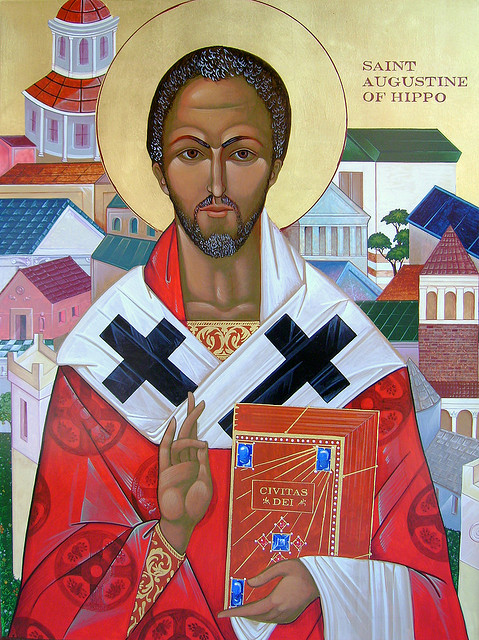
St Augustine

Saint Augustine wrote his seminal work, City of God, in about 413 C.E. The Roman empire had fallen, and pagans were blaming the Church because Christianity had become wed to the state. The people of God were unsure how to proceed.  So, Augustine sought to help Christians think about how to live in a post-Christian society.

Augustine’s work is lengthy and quite in-depth, so, the following is a brief distilling of his main arguments.  For Augustine, there are four essential institutions: two visible institutions; and, two invisible institutions:

  1. The Church – is a divinely established institution, designed to lead people to God.
  2. The State – is a political institution, adhering to political virtues to establish the peace.
  3. The City of Heaven – is made up of those predestined for salvation.
  4. The City of the World – is made up of those destined for eternal damnation.

We must pursue the City of Heaven, which for Augustine, is the pursuit of justice and righteousness. Augustine gave a clarion call for people to choose which city they will pursue, especially because many tended to blur the distinctions between the visible institutions of church and state.

Augustine’s conclusion is that the purpose of history is to show the unfolding of God’s plan. This involves fostering the City of Heaven and filling it with worthy citizens.  Therefore, the fall of Rome, a visible city so important to the people of Augustine’s day, was not near as important to the invisible God.

Maintaining an eternal perspective can help us today. The collapse of jobs, the scourge of a racialized society, the loss of life due to COVID-19, and injustice are significant events and circumstances – important enough to consider deeply how those issues will be handled. Augustine called out the people of his day for ignoring invisible spiritual solutions for the great problems among them.

Returning to the book of Genesis, a question arises: Will the Israelites become a nation through assimilation with Egypt and its institutions, or will they maintain their distinction as God’s people by relying on God’s covenant promises?  There are no easy answers to living in the world. However, it is important we struggle with how to get along in it.

God is the principal actor in the created world. God chooses to use his people as instruments of blessing to it.  Joseph’s wisdom and diplomacy, given by God, turned potentially catastrophic situations into times of prosperity. God, too, will use us as dispensers of wisdom – applying truth to concrete situations for the betterment of all involved.

Joseph handled the delicate situation of his brothers being shepherds while all shepherds were detestable to Egyptians.  Joseph brought the two worlds together through artful negotiation between the interests of both Pharaoh and the Israelites. He created a win/win scenario by setting up his brothers to help Pharaoh with his own needs in caring for livestock. In the end, all parties were satisfied because Joseph maintained a focus on needs instead of only advocating one side.

Rather than getting bogged down in promotion of methods and means, a sage approach is to maintain a focus on needs – which requires careful listening and a stance of empathy. Then, we can work toward prosperity for all instead of hardening into reified positions. A lot of problems in the church, work, society, and family can be turned to blessing if we seek the wisdom that comes from God.

May the Lord bless you and keep you; and, make his face shine on you and be gracious to you. May the Lord turn his face toward you and give you peace. Amen.