What Is It You Are Trying To Do? (Mark 10:2-16)

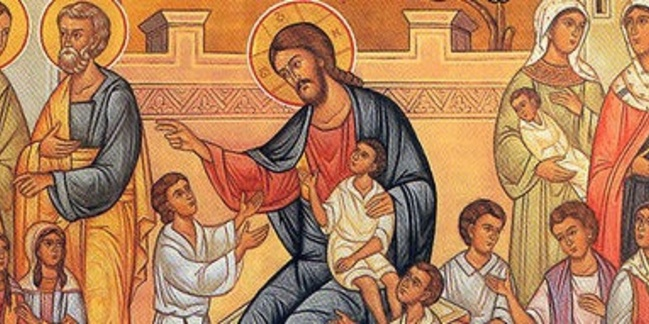
Jesus blesses the children

Some, testing him, asked, “Is it lawful for a man to divorce his wife?” He answered them, “What did Moses command you?” They said, “Moses allowed a man to write a certificate of dismissal and to divorce her.” But Jesus said to them, “Because of your hardness of heart he wrote this commandment for you. But from the beginning of creation, ‘God made them male and female.’ ‘For this reason a man shall leave his father and mother and be joined to his wife, and the two shall become one flesh.’ So they are no longer two but one flesh. Therefore what God has joined together, let no one separate.”

Then in the house the disciples asked him again about this matter. He said to them, “Whoever divorces his wife and marries another commits adultery against her, and if she divorces her husband and marries another, she commits adultery.”

People were bringing children to him in order that he might touch them, and the disciples spoke sternly to them. But when Jesus saw this, he was indignant and said to them, “Let the children come to me; do not stop them, for it is to such as these that the kingdom of God belongs. Truly I tell you, whoever does not receive the kingdom of God as a little child will never enter it.” And he took them up in his arms, laid his hands on them, and blessed them. (New Revised Standard Version)

Trying To Parse the Law?

The topic of divorce has always been a hot button issue throughout human history. And there have continually been diverse views and opinions about it. This is also true of Holy Scripture. A variety of interpretations are offered by many about the Bible’s view of divorce, and Christ’s words concerning it.

Much like today, divorce in the first century was accepted as part of what happens in society, even among Jews, although it was more proliferate in other cultures. Most of the discussions about divorce centered in legal details, with some speaking against it as bad for society.

Among the Jewish religious leaders and experts in the law, it was generally recognized that divorce occurs, with Mosaic legislation proscribing how to carry out divorce (Deuteronomy 24:1-4). Yet, other scripture texts frame the existence of divorce as questionable for God’s people. (e.g. Genesis 2:24; Malachi 2:13-16)

Trying to Test Jesus?

Anyone who doesn’t like another, will often confront them on a hot button issue that has plenty of diverse opinion to it. This is why the Pharisees sought to get Christ’s take on the topic of divorce.

Essentially, Jesus reframed divorce so that it was no longer simply a legal topic, but involves real people. Christ talked about divorce in a way that upheld the dignity of persons, especially women; and lifted up the true sanctity of marriage.

In turning the discussion from a legalities to God’s design for humanity and marriage, Jesus cut to the heart of the matter, to God’s intent, and to human frailty. He focused on relationships, because they were inherent from the beginning.

Yes, divorce is a reality, and it is has its place in society. But no, it’s not supposed to be this way. The very word “divorce” means there is a separation, a breech, a disconnection of relationship. This is why Christ went to another topic: adultery.

Trying To Divorce Women?

Jesus said that a person initiating a divorce in order to marry another person commits adultery. In saying this, he was not offering a legal conversation of details. Rather, Christ was focusing on people; he was concerned for wives and women.

The conversation between Jesus and the Pharisees was a discussion between men, and presupposed a man’s point of view on divorce. Women did not have the ability to initiate divorce in the ancient society.

And Christ seems to have had no stomach for being drawn into abstract legal debates between a bunch of men. Instead, he cared about the people involved in an actual divorce, especially the women.

For all intents and purposes, women (and their sexuality) were the property of men – the father, and then later, the husband. In this social milieu, whenever a husband initiated a break in the relationship, it was important for a woman to have a certified document of divorce. Without that certification, a woman divorcee would be landlocked, unable to do much of anything, as well as be the brunt of societal gossip, slander, or worse.

Since Jesus was talking to the men, the Pharisees, he pointedly looked at them and let them know that, although they might initiate a divorce, it in no way justified their sneaking and creeping around. It didn’t cover their adulterous relationship(s) nor their adulterous hearts.

All this is to say that Christ very much opposed divorce on the grounds of putting a wife away out of a desire for a different spouse. He intended on empowering women. In a divorce situation, because a man was in control of the process, it was then the man who commits adultery against the woman.

Both logically and legally, a woman could never commit adultery because of divorce – only the man. What’s more, adultery is not primarily a violation of the law, but of the woman. Jesus believed it was high time for some accountability with the men.

Even though contemporary Western society is much different than the ancient social structure, Christ’s teaching is still relevant. The need to uphold not just the law, but the rights of women is a must for today, as well.

Unless we can observe Christ’s concern for women’s justice and rights, there will be men who continue to leverage their own gender over and against females and wives. And there will continue to be both husbands and wives who initiate divorce for their own adulterous motives, thus putting their spouse in moral, legal, emotional, and spiritual jeopardy.

Trying To Keep Children Away?

The overarching ethics of Jesus, and the law of God, is to provide justice and righteousness for the most vulnerable among us. And this is why the teaching about divorce is coupled with instruction about children.

In our contemporary society, children have rights and are accorded significant status. That was not true in the ancient world. Children were mostly viewed as potential adults. Until then, kids were to stay quiet unless spoken to, and to obey their parents with absolutely no talk-back.

Christ’s disciples did what any student following their teacher would do; they kept the kids at bay so that Jesus could do his important ministry work. But what the disciples discovered is that the kids were actually part of that important ministry work. As children, they were vulnerable, at the low end of the social scale, and had no personal rights other than being part of a family.

To become like a little child in order to enter the kingdom of God did not mean becoming innocent; it meant becoming humble and dependent, and embracing meekness, gentleness, and lowliness. It meant to become the last and the least among us. Because the last will be first, and the least will become great.

Trying To Get It Right?

It’s important for us to uphold the sanctity of human life, and the spirit of the law. The law is intended to preserve and protect life – and is not to be used to find loopholes or ways to get what you want.

Meeting the needs of all people – whether they be men, women, children, and whether they be rich or poor – is to be everyone’s concern. Why? Because justice and righteousness are at the heart of God’s concern for humanity.

Merciful God, who discerns each heart: We confess our family is most often like strangers to us. So, give to all parents and children the grace to see one another as they truly are, and as you have called them to be. In the name of Jesus Christ, our mediator and advocate, we pray. Amen.


Why Not Women? (Romans 16:1-16)

I commend to you our sister Phoebe, a deacon of the church in Cenchreae. I ask you to receive her in the Lord in a way worthy of his people and to give her any help she may need from you, for she has been the benefactor of many people, including me.

Greet Priscilla and Aquila, my co-workers in Christ Jesus. They risked their lives for me. Not only I but all the churches of the Gentiles are grateful to them.

Greet, also, the church that meets at their house.

Greet my dear friend Epenetus, who was the first convert to Christ in the province of Asia.

Greet Mary, who worked very hard for you.

Greet Andronicus and Junia, my fellow Jews who have been in prison with me. They are outstanding among the apostles, and they were in Christ before I was.

Greet Ampliatus, my dear friend in the Lord.

Greet Urbanus, our co-worker in Christ, and my dear friend Stachys.

Greet Apelles, whose fidelity to Christ has stood the test.

Greet those who belong to the household of Aristobulus.

Greet Herodion, my fellow Jew.

Greet those in the household of Narcissus who are in the Lord.

Greet Tryphena and Tryphosa, those women who work hard in the Lord.

Greet my dear friend Persis, another woman who has worked very hard in the Lord.

Greet Rufus, chosen in the Lord, and his mother, who has been a mother to me, too.

Greet Asyncritus, Phlegon, Hermes, Patrobas, Hermas and the other brothers and sisters with them.

Greet Philologus, Julia, Nereus and his sister, and Olympas and all the Lord’s people who are with them.

Greet one another with a holy kiss.

All the churches of Christ send greetings. (Romans 16:1-16, NIV)

The reason we have the “Captain Obvious” people in our lives, is that they simply point out something that is right under our noses we might miss. I’m playing the role of Captain Obvious. In today’s New Testament lesson are a group of women. Paul names, greets, thanks, and encourages several church leaders, and they are not all men:

  1. Phoebe is a deacon. She’s actually the representative who was sent to take Paul’s letter to the church at Rome and read it to the congregation.
  2. Priscilla is co-equal with her husband Aquila. Together they co-pastored a house church. She helped teach and mentor Apollos in Corinth.
  3. Mary
  4. Junia is an apostle. Paul states that she’s outstanding amongst them, of which also he is one.
  5. Tryphena and Tryphosa
  6. Persis is a dear friend of Paul.
  7. Julia

In the earliest church, within the New Testament Scriptures, women are mentioned as serving in every sort of capacity. And yet, women are the greatest and largest untapped resource in the church today.  

You might wonder why I would say such a thing, being that more women attend church than men. However, still in this day and age – removed 2,000 years from the biblical text – the reality for many churches around the world is that only men can hold positions of authority.  

The reasoning goes something like this: “The Bible says women can’t serve over men, so women can’t hold those positions.” Really?

So, a woman can serve as a CEO of a Fortune 500 company, can be elected as governor of a state, and can manage men on a factory floor, but that same woman cannot serve as an elder in many churches? I once asked a pastor that very question, and he answered with “Yes, because the Bible says so.”

I guess he never read Romans 16.

If you are of the belief that a church office is based on gender instead of the calling and gifting of the Spirit, then, methinks, it behooves us to ask these questions of the biblical text:

  • If women are not to exercise authority over men in the church, how do we account for actual women leaders in the Bible, such as Deborah, Huldah, Philip’s daughters, Priscilla’s role in Apollos’ life, not to mention the list of women leaders in Romans 16?  If our impulse is to say that these are exceptions because there were no men to “step up,” then what does that say about our theology? Is God not big enough to find a man to put into a position of leadership?
  • If we insist that women ought not to teach and be silent based on Paul’s letter to Timothy (1 Timothy 3:11-15) then why do we ignore Paul’s instruction that women are to publicly prophecy and pray? (1 Corinthians 11:5; Acts 21:9)
  • Doesn’t the prominence of women in the ministry of Jesus and Paul suggest something different than just having women tag along to teach children?
  • Just when does a boy become too old for a woman to legitimately teach him?  If women can’t teach men, why in the world would we ever think that they are the best teachers for boys?
  • How can we apply Galatians 3:26-28 (there is no male or female in Christ)? Are women the exception?
  • Does the Reformation doctrine of the priesthood of all believers only apply to men?  Doesn’t the absence of women in church leadership go against this?
  • Isn’t it weird and confusing that women have an equal vote in congregational decisions, even when a male leader is being elected and/or disciplined, when they aren’t supposed to exercise authority?

I could go on, but I think you get the picture; the absence of women in leadership is problematic, at best. It’s a problem because there are actually women leaders in the Bible. So, here is my unabashed, dogmatic, and biblical belief:  

All individuals are equally created in God’s image, and, therefore, have equal worth, privilege, and opportunity in Christ’s Church without any limitation, including gender.

In some churches and Christian denominations today, there are far too many wonderful Christian women who are exhausted and depressed because they are trying to live up to a certain expectation of being someone they are not. They suppress their gifts and calling because they believe they must prop-up the fragile male egos around them.  

They aren’t free to serve in leadership positions; and it’s eating them from the inside-out. These women think there is something wrong with them, but the reality is that there is something wrong with the whole system of male-only authority. And, what’s more, we are missing out on the blessing of God. It is high time we value all women, even those with gifts of leadership, by allowing them to serve without limitation.

I have a wife and three daughters. All of them are more intelligent, more gifted, and better leaders than me, the lone family male. To have them using their superior talents in the church by leading and serving is the least threatening thing to me on this earth. I love it that they can outdo me; it is my joy!  

Even more than that, I believe it is Christ’s joy, as well. We must be proactive in cultivating and nurturing the gifts and calling we see in women. They don’t need to be put in their place; instead, the good-old-boy system of the church needs to be put in its place so that men are practicing a leadership that sacrifices on behalf of making women’s leadership a priority.

Lord God, bless all women who daily strive to bring peace to their communities, their homes and their hearts. Give them strength to continue to turn swords into ploughshares. We pray for all women who face prejudice, inequality and gender disparities. Help us to see and to face the discrimination against women in all the many forms it may take.

Forgive all women and men who let differences breed hate and discrimination. Let your example of valuing all of creation help us to see that we are equal partners in the stewardship of your world. Help us to see the strength and goodness in all women and men. Amen.

The Wonder of Christ’s Resurrection

Welcome, friends! In the New Testament Gospel of Luke 24:1-12, we find an account of women approaching the grave of Jesus, only to find an empty tomb. Today, people search for reality in all kinds of empty places. There is, however, hope, because Christ is risen! He is risen, indeed! Click the videos below and let us enjoy and be in awe that Jesus is alive!

Pastor Tim Ehrhardt, Luke 24:1-12

May the glory and the promise of this joyous time of year bring peace and happiness to you and those you hold most dear.

And may Christ, Our Risen Savior, always be there by your side to bless you most abundantly and be your loving guide. Amen.

Judges 5:1-11 – A Woman in the Middle

Illustration of Deborah in “Woman in Sacred History” by Harriet Beecher Stowe, 1888

On that day Deborah and Barak son of Abinoam sang this song:

Praise the Lord!
    The Israelites were determined to fight;
    the people gladly volunteered.
Listen, you kings!
    Pay attention, you rulers!
I will sing and play music
    to Israel’s God, the Lord.
Lord, when you left the mountains of Seir,
    when you came out of the region of Edom,
    the earth shook, and rain fell from the sky.
    Yes, water poured down from the clouds.
The mountains quaked before the Lord of Sinai,
    before the Lord, the God of Israel.

In the days of Shamgar son of Anath,
    in the days of Jael,
caravans no longer went through the land,
    and travelers used the back roads.
The towns of Israel stood abandoned, Deborah;
    they stood empty until you came,
    came like a mother for Israel.
Then there was war in the land
    when the Israelites chose new gods.
Of the forty thousand men in Israel,
    did anyone carry shield or spear?
My heart is with the commanders of Israel,
    with the people who gladly volunteered.
    Praise the Lord!
Tell of it, you that ride on white donkeys,
    sitting on saddles,
    and you that must walk wherever you go.
Listen! The noisy crowds around the wells
    are telling of the Lord’s victories,
    the victories of Israel’s people!

Then the Lord’s people marched down from their cities. (Good News Translation)

In the Middle

At the center of the celebration – of Israel’s victory over their oppressors – was a woman.

Today’s Old Testament lesson is a classic Hebrew poem and song of celebration. Yet, there is something a bit different with this poem. The structure of Hebrew poetry points to the middle of the poem as the central idea and focus, with verses before pointing forward to it, and the verses after pointing back to it.

In many poems, God is at the center. The poet’s aim is typically to highlight the Lord as the ballast or resolution to some situation. But today’s poem has Deborah, a woman, smack in the middle. Israel was in a bad way, that is, until Deborah became the leader and judge in Israel. And this was no weird aberration.

Women in the Middle

Women are central to Holy Scripture. God called the people of Israel and labored to shape them into a community built on love, mercy, and justice, reflecting God’s image. Through the Israelites, God continued the work begun in creation, commanding them to love God and serve their neighbors–the orphan, the widow, the stranger, and the alien. Women and men, together, served God in Israel.

The women filled their primary roles in Israel as wives, mothers, and grandmothers. In bearing and caring for children, they patterned their lives on the life of the One who in the beginning labored to bring forth the world, and who later brought forth the nation of Israel and patiently taught it to walk.

Whenever freedom and liberation were needed, women played a central role. The Hebrew midwives Shiphrah and Puah trusted God and refused to obey Pharaoh’s orders. When instructed by Pharaoh to kill the male children, but to let the daughters live, these daughters of Israel preserved the lives of all the newborn. They risked their own lives in order to serve God’s purpose in setting the Israelites free from their slavery in Egypt. (Exodus 1:6-22)

Women were at the heart of hospitality, loving the stranger, as God instructed all the people to do. God empowered the widow of Zarephath to offer lodging and food to the prophet Elijah. Her ministry came at a critical time for Elijah, and this poor widow placed herself and her child at risk by offering her only morsel of food to the prophet. Through her acts of service, the widow advanced God’s work in the world and was sustained by God because of her ministry. (1 Kings 17:7-16)

Miriam and Huldah were prophets, revealing God’s will to the people. (Exodus 15:1-21; 2 Kings 22:11-20). And, along with them, Deborah was both a prophet and a judge, the leader of all the people. She gave wisdom, discernment, and justice to Israel. Deborah even had her hand in the military affairs of the nation. She directed Barak, the general, in a battle against the Canaanites. Although men usually filled such roles, God uses whomever God wants to use in accomplishing the divine will here on this earth, as it is always done in heaven.

God in the Middle

God is the Lord of the past, present, and future. God reigns over both the old and the new, utilizing each for good purposes in the world. In other words, God is not boxed-in. The Lord didn’t start wringing his hands in heaven saying, “Oh, my, I can’t find a man for the job. I guess I’ll have to use a woman!” No, instead, a woman was the Lord’s first and only choice for each situation in which females were used to accomplish God’s will. The Lord is not a victim of circumstances. Rather, God is sovereign and reigns supreme over all situations.

Let’s keep in mind that God is not limited to using men. In fact, God is always doing a new thing in the world. Women and men, equally created in the image and likeness of God, are equally able to be partners with God in the never-ending work of bringing life and redemption to all. Women fulfilling roles of ministry and leadership are not exceptions to God’s order and purpose in creation. Instead, they illustrate God’s true intent for women and men in the world.

We need to hear the stories of women’s leadership and service in Israel as testimony to God’s intent that women and men should be co-laborers with God in God’s work. The Lord isn’t laboring in this world with one hand tied between his back. He is using both hands, both men and women, to establish a benevolent rule and ethical reign.

So, loose the bonds and let the women serve!

Soli Deo Gloria