The Light of the World (John 8:12-19)

The Light of the World, by the Jyoti Art Ashram

Again Jesus spoke to them, saying, “I am the light of the world. Whoever follows me will never walk in darkness but will have the light of life.” 

Then the Pharisees said to him, “You are testifying on your own behalf; your testimony is not valid.” 

Jesus answered, “Even if I testify on my own behalf, my testimony is valid because I know where I have come from and where I am going, but you do not know where I come from or where I am going. You judge by human standards; I judge no one. Yet even if I do judge, my judgment is valid, for it is not I alone who judge but I and the Father who sent me. In your law it is written that the testimony of two witnesses is valid. I testify on my own behalf, and the Father who sent me testifies on my behalf.” 

Then they said to him, “Where is your Father?”

Jesus answered, “You know neither me nor my Father. If you knew me, you would know my Father also.” (New Revised Standard Version)

In this season of Christmastide, I am reminded that my own joy over the birth of Jesus as the incarnation of God upon this earth, is not shared by everyone. Where I see good news, there are others who feel threatened. As I bask in glorious light, some prefer to remain in the shadows.

Not everyone, of course, buys into this distinctively Christian way of seeing things – which is why it’s important for all Christians and Churches everywhere to be characterized by the Light and not by the darkness.

Humanity is a strange alchemy of both light and dark, hopefulness and hopelessness, awareness and ignorance, love and hate. We must acknowledge the light, bring it out, and let it shine.

Hiding the light only gives the dark forces of this world an opportunity to hold a sinister and shadowy grip of guilt and shame on the people of this world.

I find that most people want truth and authenticity. They want to discover, know, and be told the truth from a genuine place of care and attention.

There are, however, those few persons who only want what they want, and don’t care much about truth and authenticity, that is, unless they can use it as leverage for their personal agenda.

Jesus Christ, Light of the World, by William Holman Hunt (1827-1910)

One of the reasons I like Jesus so much, is that he lived and spoke truth from a good place, and actually worked to better the human condition in its most awful situation.

It doesn’t take a biblical scholar to see that most of the religious leaders, especially the Pharisees, rejected the words of Jesus. They brought up a legitimate legal issue (after all, they were the experts in the Mosaic law) of Jesus bearing witness to himself. How could Jesus possibly be Messiah without the proper testimony of two or three witnesses to his messiahship?

Put another way, why should anyone believe anything Jesus was saying? What stamp of authenticity is upon his ministry? The Pharisees wanted legal evidence, so they confronted Jesus. Most of all, they wanted to expose him as an illegal.

Christ’s response to the religious leaders was consistent with most all of his responses, whenever he was queried about his authenticity. And those responses rarely made sense to most of the people hearing it – largely because they were jerks to begin with.

What I’m getting at is that whenever our hearts are oriented toward humility, gentleness, empathy, good relations, mercy, and peacemaking, then Jesus makes a whole lot of sense.

But whenever the heart is full of shadows and darkness, the person is then driven by unconscious forces which never consciously understand what in the world Jesus is saying to them.

A well-oriented heart is a gift obtained from God. A disoriented heart and a fragmented mind are the result of arrogant pride and selfish agendas.

Therefore, what Jesus said makes perfect sense when he stated that, because of his divine connection, anything and everything he says and does is true, no matter what the issue is.

The problem with the Pharisees speaking with Jesus is that they were not familiar with the two witnesses which he provided for them. Since they didn’t know the Father, the Father’s witness meant nothing to the religious leaders.

Notice that in the banter between Jesus and the Pharisees, Christ seemed to understand that he was not going to convince the unconvinced.

That’s one of the reasons Christ spoke in parables and answered questions other than what people asked of him. Jesus was not going to waste his time with folks who already had their minds made up.

“Do not give what is holy to dogs, and do not throw your pearls before swine, or they will trample them under foot and turn and maul you.”

Jesus (Matthew 7:6, NRSV)

Jesus wants people to make right judgments, instead of ignoring all of the epistemic knowledge which is available to them. If you desire the real deal, and want the truth, then open yourself to the means of authenticating it.

Why do you see the speck in your neighbor’s eye but do not notice the log in your own eye? Or how can you say to your neighbor, ‘Let me take the speck out of your eye,’ while the log is in your own eye? You hypocrite, first take the log out of your own eye, and then you will see clearly to take the speck out of your neighbor’s eye. (Matthew 7:3-5, NRSV)

It’s hard to see the light whenever there is a problem with your eyesight. Jesus claims to be the Light of the World. In order to test that claim, you’d better first have your eyes examined.

For those with the eyes to see, the Light illumines the way. Trust the Light. Take it where it leads you.

Almighty God, whose Son our Savior Jesus Christ is the light of the world: Grant that your people, illumined by Word and Sacrament, may shine with the radiance of Christ’s glory. May you bless us with the brightness of Christ’s glory! And, may you enable us to keep seeking the light of Christ. Amen.

The Coming Judgment (Revelation 11:1-14)

Then I was given a measuring stick, and I was told, “Go and measure the Temple of God and the altar, and count the number of worshipers. But do not measure the outer courtyard, for it has been turned over to the nations. They will trample the holy city for 42 months. And I will give power to my two witnesses, and they will be clothed in burlap and will prophesy during those 1,260 days.”

These two prophets are the two olive trees and the two lampstands that stand before the Lord of all the earth. If anyone tries to harm them, fire flashes from their mouths and consumes their enemies. This is how anyone who tries to harm them must die. They have power to shut the sky so that no rain will fall for as long as they prophesy. And they have the power to turn the rivers and oceans into blood, and to strike the earth with every kind of plague as often as they wish.

When they complete their testimony, the beast that comes up out of the bottomless pit will declare war against them, and he will conquer them and kill them. And their bodies will lie in the main street of Jerusalem, the city that is figuratively called “Sodom” and “Egypt,” the city where their Lord was crucified. And for three and a half days, all peoples, tribes, languages, and nations will stare at their bodies. No one will be allowed to bury them. All the people who belong to this world will gloat over them and give presents to each other to celebrate the death of the two prophets who had tormented them.

But after three and a half days, God breathed life into them, and they stood up! Terror struck all who were staring at them. Then a loud voice from heaven called to the two prophets, “Come up here!” And they rose to heaven in a cloud as their enemies watched.

At the same time there was a terrible earthquake that destroyed a tenth of the city. Seven thousand people died in that earthquake, and everyone else was terrified and gave glory to the God of heaven.

The second terror is past, but look, the third terror is coming quickly. (New Living Translation)

There are many people who look upon Christians as oppressors and persecutors in history. And they aren’t wrong. From calls to war for the Crusades, to the Spanish Inquisition, and much more, a great deal of blood has been spilled in the name of Christianity.

The Book of Revelation, however, knows nothing of that history, simply because it pre-dates all of it. Many people forget, in it’s first few hundred years, that Christianity was a persecuted religion by all sorts of people.

Christians were often the scapegoats to many a leader’s problems. From throwing Christians to the lions in the Roman Coliseum, to burning them at the stake because of their faith, many a martyr has faced a bloody death.

The Apostle John’s Apocalypse, which is known to us as the Book of Revelation, was a vision given to John in order to encourage the persecuted Christian Church that God knows their suffering; and that Jesus will return to judge the living and the dead.

John’s vision had a message of judgment on those who were persecuting Christians for their faithful witness of Jesus. The believers in Jesus who were suffering at the hands of oppressors, cried out for vindication and retribution against their persecutors.

Today’s portion of Revelation is situated between the sixth and seventh trumpets of God’s judgment (which are the second and third woes upon the earth). This interlude has to do with two godly witnesses. And the whole world is able to see them.

The space which the two witnesses occupy is in the outer courtyard of the Temple. The two of them symbolize all the faithful people of God in the world. They are attacked and killed, having carried out their witness for 1,260 days (42 months).

This is a time, related to the Old Testament prophecy of Daniel, appointed for the godless to overcome the city. But this time of suffering and woe will not last.

The two witnesses are not named or identified. The point is that whomever they are, these two maintain their prophetic witness to the Lord consistently to their martyrdom.

Like their Lord before them, the two witnesses lay dead for three days. Their bodies visible for all to see. The godless inhabitants of earth gloat over them, and celebrate their demise.

But again, like Jesus, the two are raised from death and ascend to heaven. This evokes a mass of fear throughout the world. The fact that the event causes fear and terror, instead of repentance  and penitence, speaks to how warped the people of earth have become.

Indeed, the Book of Revelation is highly symbolized reading, and John’s vision is not easy to understand. Yet, there are a few things we can reflect upon in light of this passage; and some questions we can ask of ourselves:

  1. It is important to be faithful and persevere to the very end of our lives. How will we respond to this present darkness in the world?
  2. The way in which we live our lives is the legacy we leave for others when we are gone. What will we be remembered for?
  3. Our lives speak to others about who the God of heaven is. Therefore, it is profoundly important how we go about living our current mundane daily existence. How, then, shall you and I live?
  4. Our short lives have eternal ramifications, not only for ourselves, but for future generations. In what ways will you build into the next generation and help them persevere in faith?
  5. Everything you and I see today will change. There is a Judgment Day coming, just as sure as summer will transition to autumn and then into winter. What will you do today that prepares for the final season of the earth as we know it?

Although much of John’s apocalyptic vision deals with wickedness reaching a ripeness which releases the wrath of God’s judgment; it is also simultaneously the church’s entrance into her eternal inheritance. Systemic sin, structural evil, and devilish deeds shall be no more.

Even so, come Lord Jesus. May peace soon come to this world, and within our hearts. Amen.

Jesus Is In the Room (Luke 24:36b-48)

Jesus appears to the apostles, by Duccio di Buoninsegna (1255-1319)

Jesus himself stood among them and said to them, “Peace be with you.” They were startled and terrified and thought that they were seeing a ghost. He said to them, “Why are you frightened, and why do doubts arise in your hearts? Look at my hands and my feet; see that it is I myself. Touch me and see, for a ghost does not have flesh and bones as you see that I have.” 

And when he had said this, he showed them his hands and his feet. Yet for all their joy they were still disbelieving and wondering, and he said to them, “Have you anything here to eat?” They gave him a piece of broiled fish, and he took it and ate in their presence.

Then he said to them, “These are my words that I spoke to you while I was still with you—that everything written about me in the law of Moses, the prophets, and the psalms must be fulfilled.” 

Then he opened their minds to understand the scriptures, and he said to them, “Thus it is written, that the Messiah is to suffer and to rise from the dead on the third day and that repentance and forgiveness of sins is to be proclaimed in his name to all nations, beginning from Jerusalem. You are witnesses of these things. (New Revised Standard Version)

Hanging Out and Scratching Their Heads

Christ’s disciples were abuzz. Two dudes showed up and told eleven of the original disciples that they had seen and talked to Jesus himself! This was a lot to wrap both their heads and their hearts around. Could they dare to hope it is true?

Peter and John encountered an empty tomb. And now these guys from Emmaus are giving this wild testimony of a risen Savior. Into the weird mix of doubt, curiosity, grief, hope, wondering, and outright confusion, Jesus materialized out of the blue saying, “Peace be with you.”

Already feeling unsettled and uncertain, the disciples had anything but a peaceful response to the presence of their Lord. Startled, troubled, and frightened they were, as if somebody had just dropped a skunk into the room.

Why the fear? Why not be overjoyed or overcome with sheer delight at seeing Jesus?

The disciples were caught off guard, as if they had zero expectation of seeing Jesus. Believing him to be dead, they immediately went to thinking this was some ghost. After all, the door was locked. Nobody could have gotten into the room without the disciples knowing it. (John 20:19)

A fresco of Christ appearing to the disciples, in the Visoki Dečani Monastery, Deçan, Kosovo

Face to Face with Faith

As it turns out, faith and belief are not uniform static terms. There are layers to faith. Yes, the disciples really did believe, and their faith developed over time with Jesus. However, their belief had not yet come to full bloom. So, in this sense, they still possessed a lack of faith and were rebuked by Jesus for it. (Mark 16:14)

A full-orbed belief in the Lord Jesus Christ is more than words, more than making professions, and more than signing-off on a doctrinal statement of faith. Faith is shown for what it is through our actions. (James 1:19- 2:26)

Faith comes to fruition when the head, the heart, and the hands all align together and conspire to proclaim the gospel in thought, word, and deed. If they are misaligned or incongruent with each other, then that faith is inadequate. There is yet another level to the belief which needs to emerge.

Perhaps this is instructive for people today. While maintaining beliefs about the person and work of Jesus, and acknowledging Christ’s death and resurrection, some Christians live as though Jesus had never risen from the grave. If Jesus were to suddenly show up and say, “Peace be with you,” like a startled puppy, they’d likely have an accident on the floor.

It’s a Real Resurrected Body

As Jesus had done so many times before in his earthly ministry, he invited the disciples to experience him in a real, tangible, visceral way. This is no ghost. This is a Christ who has physical flesh and bones. You can eat with this Jesus, real food and drink. Look at his hands and feet. Touch and feel them if you must. But, by all means, believe!

Christ is risen. So, now what? This is what the earliest of disciples struggled to understand – how to live in the reality of resurrection, and how Jesus is present with his followers. Christ is with us as a real human and as the real God.

Although Jesus appeared to be a ghost because he could seemingly pass through things, he is not. Christ has a very real body with flesh and bones, although it is a glorified resurrected body which isn’t quite the same as our current earthly bodies. He feels hunger and eats food.

Today’s story follows the Emmaus Road experience in which two people encounter the resurrected Christ. They didn’t even notice that it was Jesus and that they were looking at a glorified body. In that story, Jesus went with them and had a meal around the table.

The Disciples Are Now Witnesses

The eyes of the disciples were opened so that they could truly see Jesus for who he really is. And it happened in their communal eating together – just as it did in the previous story with the friends from the Emmaus Road. Specifically, their new spiritual sight enabled them to be witnesses to the reality of Christ’s resurrection.

The disciples seeing Jesus empowered them to proclaim the good news that repentance for the forgiveness of sins is real; deliverance from our guilt and shame can really happen, when we confess it and turn from it. No more being locked-up in a room in fear, or in a metaphorical personal prison of anxiety.

We Are Now Empowered

The post-resurrection encounter of the disciples and Jesus would not be confined to a one room lock-in experience. The Spirit of God will come upon all sorts of people, all over the world. The sadness of crucifixion and death transforms into the joy and confidence of gospel proclamation. A true release from the shackles of fear and guilt result in a giddy blabbering about Jesus everywhere one goes.

It turns out that seeing and touching Christ’s wounds on his hands and feet doesn’t evoke bad nightmares, but elicits good dreams for the future of faith – that resurrection is a reality, is reachable, and is a path to experience the blessing of God.

Jesus is in the room, my friend. Let your fear be changed into joy.

Holy and righteous God, you raised Christ from the dead and glorified him at your right hand. Let the words of Holy Scripture, fulfilled in Jesus your Son, burn within our hearts and open our minds to recognize him in the breaking of bread. Amen.

Ascension of the Lord (Acts 1:1-11)

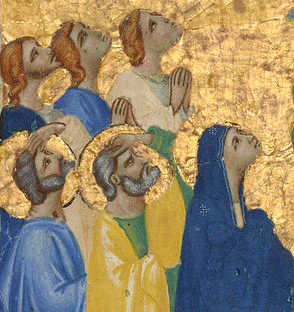
The Ascension of Christ, by Pacino di Bonaguida, c.1340

Theophilus, the first scroll I wrote concerned everything Jesus did and taught from the beginning, right up to the day when he was taken up into heaven. Before he was taken up, working in the power of the Holy Spirit, Jesus instructed the apostles he had chosen. After his suffering, he showed them that he was alive with many convincing proofs. He appeared to them over a period of forty days, speaking to them about God’s kingdom. While they were eating together, he ordered them not to leave Jerusalem but to wait for what the Father had promised. He said, “This is what you heard from me: John baptized with water, but in only a few days you will be baptized with the Holy Spirit.”

As a result, those who had gathered together asked Jesus, “Lord, are you going to restore the kingdom to Israel now?”

Jesus replied, “It isn’t for you to know the times or seasons that the Father has set by his own authority. Rather, you will receive power when the Holy Spirit has come upon you, and you will be my witnesses in Jerusalem, in all Judea and Samaria, and to the end of the earth.”

After Jesus said these things, as they were watching, he was lifted up and a cloud took him out of their sight. While he was going away and as they were staring toward heaven, suddenly two men in white robes stood next to them. They said, “Galileans, why are you standing here, looking toward heaven? This Jesus, who was taken up from you into heaven, will come in the same way that you saw him go into heaven.” (Common English Bible)

It’s been two-millennia since Jesus Christ ascended to heaven. Since then, a lot has changed.

Yet, on the other hand, we’re still in the same situation as the early church: Jesus is still up there; and we are still down here. That means, because we are still awaiting Christ’s return, the original call and practice of the church is still in effect.

As far as experiences go, it’s hard to top being one of the original disciples and seeing Jesus ascend into the clouds to heaven. Now what? How do you go about your life after that?

In the spiritual life, we move back and forth between moments of genuine inspiration and the sheer routine of our daily mundane lives. The uplifting mountain-top experience and the hard slog of walking through the valley are both important. The trick is to channel the energy from one into the other. For that to happen, we need to work out rhythms of grace that connect expectant prayer with the action of being witnesses.

Prayer and witness – both are necessary for the church; and they are closely tied to the risen and ascended Christ. The ascension of the Lord Jesus means Christ is exalted above everything; he’s in charge. By his authority he has made us prayerful witnesses and given us the means of carrying out that job.

Jesus and the disciples, even after forty days together, post-resurrection, were not on the same page. The disciples were anticipating a restoration of David’s kingdom. Their vision for the future was a great apocalypse in which Jesus, as the ultimate mixed martial arts champion, would beat up all their enemies. Then, set up a political kingdom just like King David of old. 

But Jesus had a different agenda. Instead of creating an immediate utopia, where the disciples would be in charge and in control, Jesus bluntly told them that knowing God’s timetable is not in their pay grade. Instead, the disciples were commissioned for a job, which didn’t include gawking at the sky and trying to figure out when the end of the world was happening.

Christ’s Ascension, by Scott Rayl

Although we (understandably and deservedly) want peace and justice now, Jesus avoided handing out prophecy charts detailing when that would happen. He essentially said to quit thinking about that stuff because it’s really none of our business.

Rather, our business is being witnesses of Jesus. The angels came along immediately after Jesus ascended and said to the disciples to stop standing there slack jawed. Jesus is coming back and, meanwhile, there is a job to do – to be witnesses of Christ’s redemptive events. And, the strength of that witness will come from the Holy Spirit. So, hang tight in prayer.

So, what does it mean to be a “witness?” A few years back, I was called to the bedside of an actively dying patient. The patient’s spouse and parents were present. In the space of two hours I watched them in the throes of grief. And I provided all the spiritual support I could. 

The situation had similarities to many emergencies I have attended, with one exception: I noticed that I was different. I did not “do” or “say” a lot. Mostly, I was present. I remember, at times during my encounter, feeling helpless. In some ways I was. I certainly couldn’t fix a thing. Yet, this time, I saw my role in a new way. 

I distinctly remember the sense of bearing witness to this sacred event. There was an entire world outside the patient room that knew nothing of this family’s intense grief. But I knew. I watched the whole thing. I was present for all the struggles of the medical team, the tears of the husband, the grief of a Dad, the angry questions of a mother toward a God that she didn’t know how to approach – who seemed aloof and capricious.  I was there for it all. Even now, I still carry those folks and their story in my heart.

And it was enough. 

Yes, it was enough. This was the first time I ever said that after such a situation. I had a settled sense that the role of witnessing the events in front of me was a blessed and sacred responsibility. Billions of people on planet earth didn’t know the grief of these people. I did. Because I was there. 

There is something both mystical and necessary about this understanding of being a witness with active prayerful observation.

I wonder if that’s how the disciples felt after Christ’s ascension. Perhaps my experience is what Jesus meant when he said, “You shall be my witnesses.” Maybe a witness is one who has the special role of observing the suffering of Christ, his resurrection of the dead, and the ongoing work of the Spirit. 

God is, I believe, the ultimate witness. When no one else sees, God sees. Where there is grief, God is present. Wherever pain, hurt, and brokenness exists, God is there bearing witness to it all. 

And, once in a while, the Lord is gracious to invite me into the scene to witness it along with him. Jesus is our Immanuel – God with us. And that is enough for me. 

In the book of Acts, praying and witnessing was a consistent pattern that the early church practiced. They prayed about whom to choose as leaders and bore witness to the Spirit setting individuals apart for the work of gospel proclamation and service to the church. They prayed for the Holy Spirit to come on people and bore witness to miraculous signs of the Spirit’s work. They prayed for the courage to preach and heal and bore witness to the saving work of God.

As the book of Acts unfolds, we see Peter imprisoned for being a witness. So, the church went to prayer. Peter was released, and when he showed up at the prayer meeting, the believers at first did not believe it was him.  Even with their little faith they were able to witness God answer their prayers. (Acts 12:1-18)

It was at a prayer meeting where Paul and Barnabas were set apart by the Spirit to bear witness in other locations. (Acts 13:1-3)

While traveling from city to city, Paul constantly devoted himself to prayer and listened to the Spirit. (Acts 16:1-35)

People came to Christ because of prayerfully listening to the Spirit and the obedient action that followed by Peter, Paul, and the other believers giving witness to how the risen Christ saved their lives. This was possible because of the risen and ascended Christ.

There is not one square inch of this earth that Jesus is not Lord. This means we can be alive with devotion to prayer and to being witnesses in this world for Jesus. Just as a cup of coffee needs a warm-up, so our prayers need to be refreshed so that God’s purposes will be accomplished. And his purposes are that all of creation comes, in a real and practical way, under Christ’s lordship.

What does the ascension of Jesus Christ mean for us today? That we belong to God and have the wondrous privilege of prayer and witness in a world that so desperately needs to connect with the transcendent and divine.