Be Prepared, For the Lord Is Coming (Luke 1:5-17)

The Angel Appearing to Zechariah, by William Blake, 1800

In the days of King Herod of Judea, there was a priest named Zechariah, who belonged to the priestly order of Abijah. His wife was descended from the daughters of Aaron, and her name was Elizabeth. Both of them were righteous before God, living blamelessly according to all the commandments and regulations of the Lord. But they had no children because Elizabeth was barren, and both were getting on in years.

Once when he was serving as priest before God during his section’s turn of duty, he was chosen by lot, according to the custom of the priesthood, to enter the sanctuary of the Lord to offer incense. Now at the time of the incense offering, the whole assembly of the people was praying outside. 

Then there appeared to him an angel of the Lord, standing at the right side of the altar of incense. When Zechariah saw him, he was terrified, and fear overwhelmed him. 

But the angel said to him, “Do not be afraid, Zechariah, for your prayer has been heard. Your wife Elizabeth will bear you a son, and you will name him John. You will have joy and gladness, and many will rejoice at his birth, for he will be great in the sight of the Lord. He must never drink wine or strong drink; even before his birth he will be filled with the Holy Spirit. He will turn many of the people of Israel to the Lord their God. With the spirit and power of Elijah he will go before him, to turn the hearts of parents to their children and the disobedient to the wisdom of the righteous, to make ready a people prepared for the Lord.” (New Revised Standard Version)

We have the story of John the Baptist in the New Testament Gospels. In today’s Gospel lesson, we have the events surrounding his conception.

John’s birth story and life’s narrative are deeply rooted in Old Testament promises of deliverance and divine connection.

John’s ministry was one of preparing people for the Lord. John was, in many ways, the prophet Elijah who was to come, as Jesus said about him:

As they were coming down the mountain [of Transfiguration], Jesus ordered them, “Tell no one about the vision until after the Son of Man has been raised from the dead.” And the disciples asked him, “Why, then, do the scribes say that Elijah must come first?” He replied, “Elijah is indeed coming and will restore all things, but I tell you that Elijah has already come, and they did not recognize him, but they did to him whatever they pleased. So also the Son of Man is about to suffer at their hands.” Then the disciples understood that he was speaking to them about John the Baptist. (Matthew 17:9-13, NRSV)

Just as John’s story only has meaning because of Israel’s history, so the story of Jesus is deeply connected to the Old Testament, as well. Jesus is very much related to Israel’s God.

Furthermore, the coming salvation that the Gospel writer Luke wrote about is not only for the glory of Israel; it will also be a revelation of light available to Gentiles.

So it ought to be no surprise to the reader that the angelic birth announcement of John is reminiscent of similar messages in the Old Testament about the coming of a special child. (Genesis 16:7-13; 17:1-22; Judges 13:3-20)

John’s parents, Zechariah and Elizabeth, appear in the narrative as solid citizens of Israel, reminiscent of ancient heroes like Abraham and Sarah. And much like their faithful ancestors, Zechariah and Elizabeth are told they will have a child in their old age.

Elizabeth having been barren all her life is no problem or issue for God. The Lord had done it before; and would do it again.

And the child to come, John, will resemble Old Testament heroes, especially the prophet Elijah. (Malachi 4:5-6)

The visitation to the old couple was a message designed to be lifted up for the entire world: The Lord is coming! Be prepared!

All of us find ourselves getting on in years. Certainly, I do, as a father and grandfather. Yet, at any age, even younger persons feel this. We grow as people. We move on from being a baby to a toddler to an adolescent, a teenager, a young adult, middle-aged, older, geriatric.

We continually age. Hopefully, with the aging process comes a bit of wisdom.

I’d like to think that old Zechariah and Elizabeth had learned enough wisdom over their life’s journey to embrace both the meaning and mystery of that life.

I believe they had a sense of what is, and had an acceptance of it. Yet, at the same time, they had a sense of hope and of what could be. And that’s because they knew something of God’s promises.

Not everything will remain as it presently is. All will change. Acceptance entails knowing this, that all things will be different. And this helps open us to all the possibilities of prayers rooted in ancient promises.

The angel told Zechariah that his prayer had been heard. We aren’t told exactly what Zechariah had prayed. But it seems it was a rather “pregnant” prayer, full of asking for a child of his own, as well as a Messiah to come, and an Elijah to come.

In that sense, Zechariah’s very full prayer was answered magnanimously.

Now, in the spirit of old Zechariah and Elizabeth, we have our own opportunity to offer an advent prayer. We have the privilege of hearing the message.

The Lord is coming. Be prepared.

“Surely I am coming soon.”

Amen. Come, Lord Jesus!

The grace of the Lord Jesus be with all the saints. Amen. (Revelation 22:20-21, NRSV)

Gracious God, guard our hearts and minds by the power of Christ Jesus. Speak to our anxieties with the peace that passes understanding and let our gentleness and joy be a sign of Christ’s gracious presence.

Through Christ, with Christ, in Christ, in the unity of the Holy Spirit, all glory and honor are yours, almighty God, now and forever. Amen.


Immortal God and Mortal Humanity (Psalm 90)

Digital artwork by Bruce Butler

Lord, you have been our dwelling place
    in all generations.
Before the mountains were brought forth
    or ever you had formed the earth and the world,
    from everlasting to everlasting you are God.

You turn us back to dust
    and say, “Turn back, you mortals.”
For a thousand years in your sight
    are like yesterday when it is past
    or like a watch in the night.

You sweep them away; they are like a dream,
    like grass that is renewed in the morning;
in the morning it flourishes and is renewed;
    in the evening it fades and withers.

For we are consumed by your anger;
    by your wrath we are overwhelmed.
You have set our iniquities before you,
    our secret sins in the light of your countenance.

For all our days pass away under your wrath;
    our years come to an end like a sigh.
The days of our life are seventy years
    or perhaps eighty, if we are strong;
even then their span is only toil and trouble;
    they are soon gone, and we fly away.

Who considers the power of your anger?
    Your wrath is as great as the fear that is due you.
So teach us to count our days
    that we may gain a wise heart.

Turn, O Lord! How long?
    Have compassion on your servants!
Satisfy us in the morning with your steadfast love,
    so that we may rejoice and be glad all our days.
Make us glad as many days as you have afflicted us
    and as many years as we have seen evil.
Let your work be manifest to your servants
    and your glorious power to their children.
Let the favor of the Lord our God be upon us
    and prosper for us the work of our hands—
    O prosper the work of our hands! (New Revised Standard Version)

All of the psalms are prayers. Most of them are prayers of David. Today’s psalm is a prayer of Moses.

Moses acknowledged and affirmed that God is eternal, and we humans are not. We are frail and in need of God. We are dependent upon God for health, hope, and happiness in life.

There are observations to notice in today’s Psalm lesson, that are then followed by prayerful petitions which arise from those observations.

First Observation: God Is Eternal

God is immortal. God has always been, and will always be. Therefore, the Lord’s rule and reign existed way before this world was ever created, and shall extend way beyond the lifespan of creation. God’s dwelling place is without beginning or end – which means that God isn’t going anywhere. That is a great comfort to me.

Second Observation: Humans Are Finite

Whereas God is immortal, we humans are mortal beings. We are creatures with limited time on this earth. We all eventually die. Everyone returns to the dust from which they came – which isn’t even a blink of an eye when compared to God’s eternal existence.

This isn’t meant to be a downer for us, but rather to help us. It is necessary to work within our limitations while living in this world. To live as if we are immortal has grave consequences (pun intended).

Third Observation: The World Is Broken

Our world is fundamentally messed up. Another way of saying this is that everything in creation is under a curse. Things are not as they should be. And that’s on us, not God. Because of our own human proclivity to sin, our world is beset with a great deal of suffering and toil.

Hopefully, in the best scenario, people learn to understand the brevity of life, and gain wisdom on how to live a humble, just, and good life with one another, and with their God.

Now notice the petitions which Moses offered to God, based upon the observations of God’s nature, human nature, and the world’s situation.

First Petition: Turn, O Lord!

Moses was pleading with God to turn away from divine judgment and wrath, which was more than deserved for a group of people who were chronically complaining and disobedient. Moses was well aware of all Israel’s sins, and was counting on the Lord’s mercy for God’s covenant people.

Second Petition: How long, O Lord?

Moses was asking one of those questions that we ask, knowing that he wasn’t really going to get an answer. Yet, in the asking, there is an understanding that human misery won’t go on forever. Our suffering is temporary.

In this petition of Moses, he was also calling for a change, for God to deal with the people in a different way. Moses wanted gladness to replace affliction, and the sufferings of this life to give way to the joy of living in a good world.

Third Petition: Prosper the work of our hands

This wasn’t a petition for God to simply make everyone healthy and wealthy. It was a focused prayer that God’s work and our human work would be one seamless activity. That is, this is a prayerful longing for what we do in our lives to completely synchronize with God’s law in this world we all inhabit together.

Whenever we sin, we cause damage, not prosperity. Yet, with a divine/human cooperative in which we acknowledge and affirm God’s sovereignty over our lives, and take up our own human responsibility, then humanity thrives and flourishes in the goodness we were meant to enjoy as God’s creatures.

Christian Observations

In Christianity, the immortal and invisible God comes to us in the mortal and visible life of Jesus. In Christ, the sovereignty of God and the responsibility of humanity is not only synchronized; it is perfectly united and harmonized so that there is deliverance from the power of evil and from God’s judgment.

God’s steadfast love is brought to us with skin on.

For the Christian, Jesus is the answer to the prayers and petitions of Moses. Christ is the prophet foretold by Moses who was to come:

I [Yahweh]will raise up for them [the Israelites] a prophet like you [Moses] from among their own people; I will put my words in the mouth of the prophet, who shall speak to them everything that I command. (Deuteronomy 18:18, NRSV)

The incarnation, life, ministry, crucifixion, death, resurrection, ascension, and glorification of Jesus Christ has dealt with the weeds and overgrowth of guilt and shame that has taken over the garden of this world.

In Christ, we can begin to hack through all the stuff, in order to see the beauty underneath all of the spiritual neglect which has occurred for so long.

May the grace of the Lord Jesus Christ, the steadfast love of God the Father, and the encouragement of the Holy Spirit be with you, now and forever. Amen.

Divine Judgment and Human Judgmentalism (Luke 21:20-24)

Jesus Wept Over It, by Enrique Simonet, 1892

“When you see Jerusalem surrounded by armies, then know that its desolation has come near. Then those in Judea must flee to the mountains, and those inside the city must leave it, and those out in the country must not enter it, for these are days of vengeance, as a fulfillment of all that is written. Woe to those who are pregnant and to those who are nursing infants in those days! For there will be great distress on the earth and wrath against this people; they will fall by the edge of the sword and be taken away as captives among all nations, and Jerusalem will be trampled on by the nations, until the times of the nations are fulfilled. (New Revised Standard Version)

Judgment is coming… and is already here…

To be more specific, God’s judgment is coming; and humanity’s judgmentalism is already here.

Because of our judgmental spirits, we ought not be surprised that the judgment of God will be here soon.

I cannot get through a day – barely an hour – without hearing judgmental statements coming from another’s mouth. And sometimes, it’s my own mouth.

Judgmentalism is rife. It’s everywhere. And there’s no way to escape it. In a “normal” day (if there is such a thing for me) I hear all sorts of statements, without even trying to hear them. And when I do, I usually have a thought about it (in the parentheses):

  • “They did it because they don’t care about anything.” (And you don’t seem to give a rat’s rear end about understanding why they did it.)
  • “They deserved all the bad stuff they received.” (And you don’t?)
  • “The only reason they got the job to begin with is because of their connections.” (I didn’t realize that you are all-seeing, like God)
  • “You don’t know what you’re talking about!” (Maybe, but neither do you.)
  • “The rain is terrible.” (That’s your assessment. But it isn’t the local farmer’s assessment of the rain. He thinks it’s wonderful.)

Judgmentalism is the tendency to make quick and excessively critical judgments of others, especially moral judgments which characterize another’s thinking or way of being as immoral, unethical, monstrous, and/or harmful.

Our human judgmentalism of one another tends to detract from the sort of judgment we ought to be paying attention to.

Ultimately, none of us sits as Judge to arbitrate what who deserves punishment, or not. That is the job of Judge Jesus. So, when the true judge speaks, it behooves us to listen and follow through with what he (Christ) says about upcoming divine judgment.

When Jesus said his words of Jerusalem’s impending destruction, he was making it clear that these would be days of God’s vengeance, of divine judgment against the people. It would not last forever, because the wrath of God never does.

Yet, judgment is imminent. God will not let times of injustice, unrighteousness, and hatred last without end.

Therefore, Jesus was warning his disciples, and all who would follow him, about how they are to live while they await the end of all things.

We are not to be led astray, and be fooled by anyone who claims the name of Christ, yet lives like a devil. Unfortunately, some will foolishly succumb to falsehood. Everyone will suffer in some way.

Believers are to be watchful and prayerful. This is not passivity on our part, but actively putting a great deal of energy into becoming wise and interceding on behalf of others.

If we cannot sit still in silence, in contemplative prayer, for even 20 minutes, then we have a problem. It will be quite difficult to discern the good, right, and just.

If we cannot go half the day without making a judgmental statement about another person, then we have an addiction which needs to be broken.

If we continue to have reasons why we cannot (and therefore will not) read or listen to Holy Scripture, especially the New Testament Gospels of Jesus, then we are likely following someone else other than Christ.

If we keep moaning about the state of the world, the problems in our families, and all the local issues of our communities, then it is imperative that we come back to examining the words and ways of Jesus and deal with our own junk, instead lamenting everyone else’s.

If you know how to prepare for a zombie apocalypse, a new movie that’s coming out, or a birthday party for someone, but don’t have any idea about how to make life preparations for a coming disaster (let alone your own eventual death) then the last thing that ought to be happening is judging another person for anything at all.

You’ve got some work to do to get ready for the coming of Christ.

“Let us be alert to the season in which we are living. It is the season of the Blessed Hope, calling for us to cut our ties with the world and build ourselves on this One who will soon appear. He is our hope—a Blessed Hope enabling us to rise above our times and fix our gaze upon Him.”

A.W. Tozer

It’s possible that you may want to judge me for saying not to be judgmental. It’s happened more than once in my life. Yet, if we can learn to distinguish between the person and the behavior, then we can deal with unjust behavior, and leave any condemnation of the person to God.

If ever we struggle to know what to do, one can never go wrong with showing grace.

Gracious God, I repent for being quick to pass judgement both in speech and thought. For every time my words or actions of judgment and condemnation have hurt someone, I repent. Lord, I pray that I will not focus on the faults or shortcomings of others. Help me to see others through the eyes of grace. Amen.

Don’t Assume (Job 32:1-22)

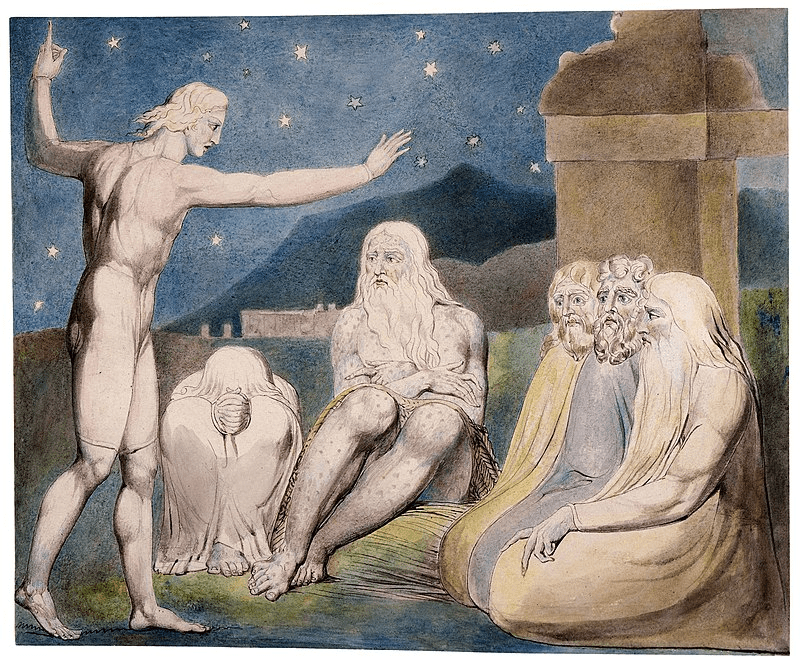
The Wrath of Elihu, by William Blake, 1805

Finally, these three men stopped arguing with Job, because he refused to admit he was guilty.

Elihu from Buz was there, and he had become upset with Job for blaming God instead of himself. He was also angry with Job’s three friends for not being able to prove that Job was wrong. Elihu was younger than these three, and he let them speak first. But he became irritated when they could not answer Job, and he said to them:

I am much younger than you,
so I have shown respect
    by keeping silent.
I once believed age
    was the source of wisdom;
now I truly realize
    wisdom comes from God.
Age is no guarantee of wisdom
    and understanding.
That’s why I ask you
    to listen to me.

I eagerly listened
    to each of your arguments,
but not one of you proved
    Job to be wrong.
You shouldn’t say,
“We know what’s right!
    Let God punish him.”
Job hasn’t spoken against me,
and so I won’t answer him
    with your arguments.

All of you are shocked;
    you don’t know what to say.
But am I to remain silent,
just because you
    have stopped speaking?
No! I will give my opinion,
because I have so much to say,
    that I can’t keep quiet.
I am like a swollen wineskin,
and I will burst
    if I don’t speak.
I don’t know how to be unfair
    or to flatter anyone—
if I did, my Creator
    would quickly destroy me! (Contemporary English Version)

Job and his three friends had talked themselves out. There were plenty of words and frustration, with nothing left but an impasse. We anticipate hearing from God….

But there is yet another who was present with Job and his companions. Elihu was a young man in tow with the older three friends. He respectfully held back and observed all the proceedings between the four men. As he watched, the angrier he became, to the point of feeling the need to speak up and offer his own voice concerning Job’s terrible suffering and trouble.

Elihu was angry because he believed Job was setting up himself as more righteous than God. And he was also perturbed with the three friends. He viewed them as bungling their argument against Job, offering no convincing answers.

Within the scope of what Elihu and the friends were talking about, the arguments were indeed found lacking. No one had the necessary wisdom to handle Job’s case.

But therein lies the problem. The assumptions are presuppositions which underlie all the arguments and speeches were off. The friends simply assumed Job was sinful, because they presupposed that anyone undergoing such terrible suffering is being punished by God.

Therefore, all of the bluster was doomed to go nowhere. Underneath all of the exhausting chaos was a cosmic drama which none of the human actors were privy to. In other words, nobody knew what they were talking about.

God only seems to be silent and absent from the perspective of us humans. We are an impatient people. Much like Elihu, we sit on our hands and bite our lips, waiting to get out what we want to say.

I wonder how much of Elihu’s listening wasn’t actually listening, but was thinking about what he was going to say when he got his chance. Job’s friends were ineffective in proving Job wrong and guilty before God, according to Elihu.

But if any of us begin our thinking and our speaking with assumptions and presuppositions which are off base, then it’s likely that nearly all of our thoughts and words will be unhelpful and even hurtful.

Too many people have a compulsion to speak and get their own opinions out. Few persons, however, have the same sort of compulsion to truly observe, listen, and learn. So, what we typically get are Elihu-like belching of speech – which may make the person speaking feel better, yet leaves everyone else groaning for them to keep their mouth shut.

An unteachable spirit which values one’s own thoughts and opinions over others is the mark of a fool, and not a sage. There ought never to be more wind coming from someone’s mouth than from the weather.

Unfortunately, many people claim to know and understand more than they actually do. And just because someone occupies a high position does not necessarily mean they know what they’re talking about.

In our anger and perturbed states of mind, we vent and talk too much, as if we have the corner on truth. Yet, how much of our talking is really worth others listening to us?

Instead of assuming we already know what is happening with another, there are questions we can ask ourselves, which may help guide us to speak more truthfully with helpful, not hurtful, words.

The following few questions can help orient us with compassion toward what another is saying:

  • What is the main point being made?
  • What might be going through their mind when they say that?
  • What need do they have that they are trying to satisfy?
  • What is the motivation of the person speaking?

Just as important is our own self-awareness. These questions can help us monitor ourselves as we listen and respond to others:

  • How am I feeling right now in this moment?
  • What do I need right now?
  • Why does that particular statement or opinion irritate me so much?
  • How am I presenting myself right now – my affect, posture, and eye contact?

We can also ask questions of God during a conversation:

  • Will you please help me to understand the person and what is being said?
  • How does this square with my understanding of you and your Word?
  • Which values – that are important to You – apply to this discussion?
  • What do you want me to say and do?

You will say the wrong thing
    if you talk too much—
so be sensible and watch
    what you say. (Proverbs 10:19, CEV)

The Book of Job would likely look a lot different if Job’s friends had taken such a wise saying to heart.

The following is a prayer from St. Francis of Assisi:

Lord, make us instruments of your peace.
Where there is hatred, let us sow love;
where there is injury, pardon;
where there is discord, union;
where there is doubt, faith;
where there is despair, hope;
where there is darkness, light;
where there is sadness, joy.
Grant that we may not so much seek to be consoled as to console;
to be understood as to understand;
to be loved as to love.
For it is in giving that we receive;
it is in pardoning that we are pardoned;
and it is in dying that we are born to eternal life. Amen.