Anti-Intellectualism

Everyone with good sense
    wants to learn. (Proverbs 18:15, CEV)

Anti-intellectualism:

  1. opposition to or hostility toward intellectuals and the modern academic, artistic, social, religious, and other theories associated with them
  2. the belief or doctrine that intellect and reason are less important than actions and emotions in solving practical problems and understanding reality

Holy Scripture encourages knowledge, understanding, and wisdom. In order to be a truly wise and understanding person, there must be a combination of knowledge and experience. When these two elements come together, and are practiced over a long period of time, then spiritual maturity is realized.

In every church I’ve ever served across the decades there have been individuals and groups of people in my congregations who are anti-intellectual. They were not big fans of seminaries. They often mistrusted highly educated persons with multiple degrees. And they had a hard time submitting to any authority structure that smacked to them of being elitist.

Unfortunately, the majority of those persons, in my experience, refused to learn in any other way other than their own personal experience. I don’t think I need to tell you the many pitfalls such a stance creates: constant misinterpretation of situations; prejudice toward others whom they don’t understand; and chronic disobedience to every authority in their life.

It likely wouldn’t surprise you to know that these sorts of parishioners rarely, if ever, read their Bibles, or even seek to learn other than hearing Sunday sermons. They reek of spiritual immaturity and pride, being puffed-up with themselves that they aren’t like the elites in power.

Now imagine what a group of people like this would be like if they were in the highest levels of government… But we need not imagine; the reality is in front of us every day.

To understand the current political climate in the United States, it seems to me we need to see that the present governmental administration, at its heart, is an anti-intellectual movement.

Now please know that I am not saying that everyone in the administration is stupid. What I am saying is that many if not most Republicans have a deep seated problem with educational elites – hence the sustained attention on American universities, especially Harvard.

They believe themselves to be practical, no nonsense people who can get things done without umpteen committees and eggheaded reports. The problem, however, is that in their belief of experiential superiority, they’ve refused to listen. They end up making snap judgments of situations and other people. In other words, they can quickly make a disaster of things whenever they’re in charge.

Furthermore, what the anti-intellectuals end up doing most is grasping for as much worldly power as they can gain.

For Protestant Evangelicals, their desire for power stems from their perceived loss of a golden age of Christendom. Back then they were in power – prayer in schools, no abortion, the Ten Commandments in every court house, riding your bike in the neighborhood with safety, etc.

Yet, because there is such a paucity of listening and seeking to understand, the anti-intellectuals fail to understand that their own golden age was a bronze age of Jim Crow laws, failed reservation promises, and the need to operate in the shadows for all sorts of other persons.

Holy Scripture’s Book of Proverbs – which is a combination of accumulated knowledge and lived experience – has something to say about those who refuse to listen and learn from others:

With wisdom you will learn
what is right
    and honest and fair.
    with knowledge. (Proverbs 2:9-10, CEV)

Fools think they know
    what is best,
but a sensible person
    listens to advice. (Proverbs 12:15-16, CEV)


Stupidity leads to foolishness;
    be smart and learn. (Proverbs 14:18, CEV)

Fools have no desire to learn,
instead they would rather
    give their own opinion. (Proverbs 18:2, CEV)

Pride leads to destruction;
    humility leads to honor.
It’s stupid and embarrassing
to give an answer
    before you listen. (Proverbs 18:12-14, CEV)

An ignorant fool learns
    by seeing others punished;
a sensible person learns
    by being instructed. (Proverbs 21:11, CEV)

If we apply our hearts to wisdom, we will learn:

  • the pursuit of power at all costs creates stupidity
  • the disdain and/or ignorance of others has adverse consequences for all
  • there has always been an anti-intellectual strain throughout the history of the world (including U.S. history)
  • the act of placing blame on others (such as the so-called “elites”) will come back to bite us

It does no good to reason with an anti-intellectual, namely because they will not avail themselves of logic nor learning.

Instead, it is wise to treat an anti-intellectual like we ourselves would want to be treated: to have another listen to us and be curious about why we hold to what we hold, without judgment; and to have another respect our ability to choose for ourselves.

Can you imagine a world where we would all commit ourselves to listening and learning, acquiring knowledge, understanding, and wisdom? We would likely live in a very different world than the one we are in today.

May the course of this world be peaceably governed by divine providence. And may the church everywhere joyfully serve God in confidence and serenity. Amen.

How Do You Want To Be Remembered?

Someday when I am dead and buried, I would be fine with my gravestone stating, “He was humble and wise.” For I have always sought (however imperfectly) to embrace and live a life characterized by poverty of spirit, largeness of heart, and a sage mind.

Yet, most of all, I’d like to be remembered by the phrase, “He loved God.” The Great Command of Jesus to love God and each other is something I pray and seek in my daily life. And I hope that at the end of my earthly life, the love of God within me has made the world a better place.

In saying this, it means I forsake a lot of other ambitions to be remembered by. I don’t really care if I am remembered for any other virtues or abilities other than love, humility, and wisdom.

For the times that I have unknowingly pursued other things above what is of concern to my Lord Jesus, I admit and renounce those things. Because that is what humility and love does. And it’s the wisest thing a person could do.

That is in direct contrast and opposition to worldly ambitions for wealth and financial resources, power and authority, attention and greatness. Such desires arise from pride, not humility. With arrogance, ignorance and hate are not far behind.

Such virtue is itself the good life. And it is not out of touch for any of us. For Christ himself repeatedly told and reminded his disciples that the kingdom of God is near, so near as to be within us.

“The time has come, and God’s kingdom is near. Change the way you think and act, and believe the Good News.” (Mark 1:15, God’s Word Translation)

“The Kingdom of God is near you now.” (Luke 10:9, New Living Translation)

And we are told to make God’s kingdom a priority. We are to humble ourselves before God and seek the reign of God and the values of how God operates, rather than putting all our equity into material possessions.

“Seek first the kingdom of God and his righteousness, and all these things (material resources) will be given to you as well.” (Matthew 6:33, New International Version)

The super-rich of this world have a super difficult time ever humbling themselves to anyone, including God, because they can so easily rely upon their vast earthly resources.

“Truly I tell you, it will be hard for a rich person to enter the kingdom of heaven. Again I tell you: It is easier for a camel to go through the eye of a needle than for someone who is rich to enter the kingdom of God.” (Matthew 19:23-24, New Revised Standard Version)

God’s kingdom is not something that is so far out of touch for us, or way out there somewhere, as if we could not, and therefore need not, pay much attention to it. No, it is much closer than any of us realize.

You and I have the light within us. For some people (maybe most people) this light has diminished to a tiny little flame or spark. They themselves either cannot or will not perceive there is something right and good that exists down deep in this soul created in the image and likeness of God.

Phrases such as “Let us rely upon our better angels,” and “Get in touch with our nobler instincts,” are more modern ways of expressing that there is inherent worth within us that we can tap into. It doesn’t even take a Christian or a religious person to recognize this reality.

We really do have a higher self, a conscience containing a moral compass, a given benevolent nature, altruistic impulses, and a compassionate side to us. Will we seek this part of ourselves? Will we tap into it? Will we allow it to come out into the world in order to bless it, not curse it?

Yet, as we know all too well, we also a have within us a depraved part which wants to rule over others and acquire as much wealth and power as possible. As with most things, we ourselves are a paradoxical conundrum of competing desires.

How do you want to be remembered? We can pursue the kingdom of God within us, or we can seek the kingdoms of this world outside of us. It’s your choice. But you will need help, if going after such things as humility, wisdom, and love as your way of life – not only help from God, but also help from others.

“Ask, and it will be given to you; search, and you will find; knock, and the door will be opened for you. For everyone who asks receives, and everyone who searches finds, and for everyone who knocks, the door will be opened. Is there anyone among you who, if your child asked for bread, would give a stone? Or if the child asked for a fish, would give a snake? If you, then, who are evil, know how to give good gifts to your children, how much more will your Father in heaven give good things to those who ask him!

“In everything do to others as you would have them do to you, for this is the Law and the Prophets. (Matthew 7:7-12, New Revised Standard Version)

What is true of you, that you would like engraved on your gravestone? How do you want to be remembered? That’s what we need in this world, for this time and for this place.

The Divine Gardener

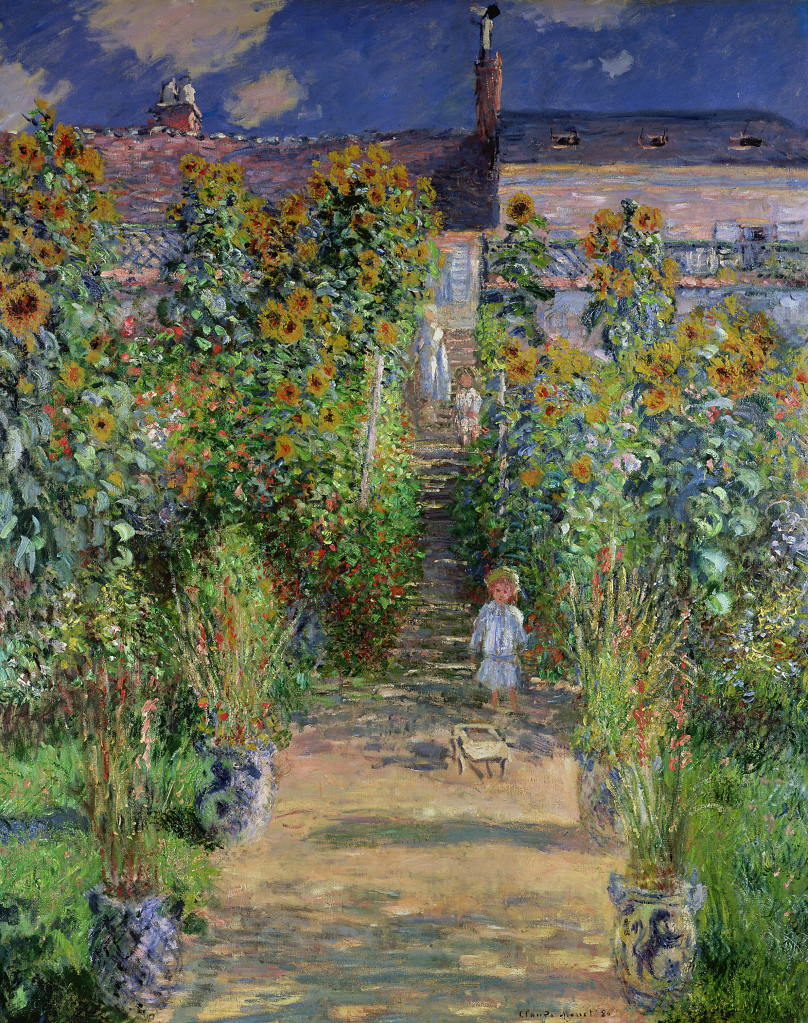
The Artist’s Garden at Vétheuil, by Claude Monet, 1881

The fruit of the Spirit is love, joy, peace, patience, kindness, goodness, faithfulness, gentleness, and self-control. (Galatians 5:22-23, Common English Bible)

Soon it will be Spring. Many people are already planning for the soil in fields and gardens to be turned over for planting and cultivating.

Healthy plants grow and feed many. They don’t simply occur by happenstance. And neither does things like morality, ethics, and living an altruistic life; they don’t just happen.

Virtue and a good life are the result of solid and robust inner work within the soul.

The daily overall trajectory of personal and institutional life demonstrates whether they are driven by egoistic desires, or influenced from an inner garden of delectable fruit which has been wisely plucked for others to enjoy.

 “A good tree doesn’t produce bad fruit, nor does a bad tree produce good fruit. Each tree is known by its own fruit. People don’t gather figs from thorny plants, nor do they pick grapes from prickly bushes. A good person produces good from the good treasury of the inner self, while an evil person produces evil from the evil treasury of the inner self. The inner self overflows with words that are spoken.”

Jesus (Luke 6:43-45, Common English Bible)

The Apostle James learned well from his Teacher when he said:

My brothers and sisters, can a fig tree produce olives? Can a grapevine produce figs? (James 3:12, Common English Bible)

The soul is a garden which must have a faithful gardener to continually attend to it. There is a constant need for paying attention to the plants through consistent weeding, watering, and nurturing the seeds placed in good rich soil.

If we will but only allow it, the Holy Spirit of God can be our Divine Gardener, being the elements we need for growth, maturity, and a good life which produces good succulent fruit for many to enjoy.

Apart from the Spirit’s warming, watering, and protecting, people can easily degenerate into all kinds of illicit thinking and behavior such as immorality, moral corruption, doing whatever feels good, idolatry, substance abuse, casting evil spells, hate, fighting, obsessive behaviors, violent anger, competitive opposition, conflict, selfishness, group rivalry,jealousy, and lying.

The Christian virtues which flower and produce the fruit of love, joy, peace, patience, kindness, goodness, faithfulness, gentleness, and self-control occur through a close intimate connection with the Divine Gardener. 

Our Divine spiritual Gardener knows that all things are connected – that below the surface the roots of every plant become connected with one another. There is really no such thing as a person who is disconnected from the rest of humanity.

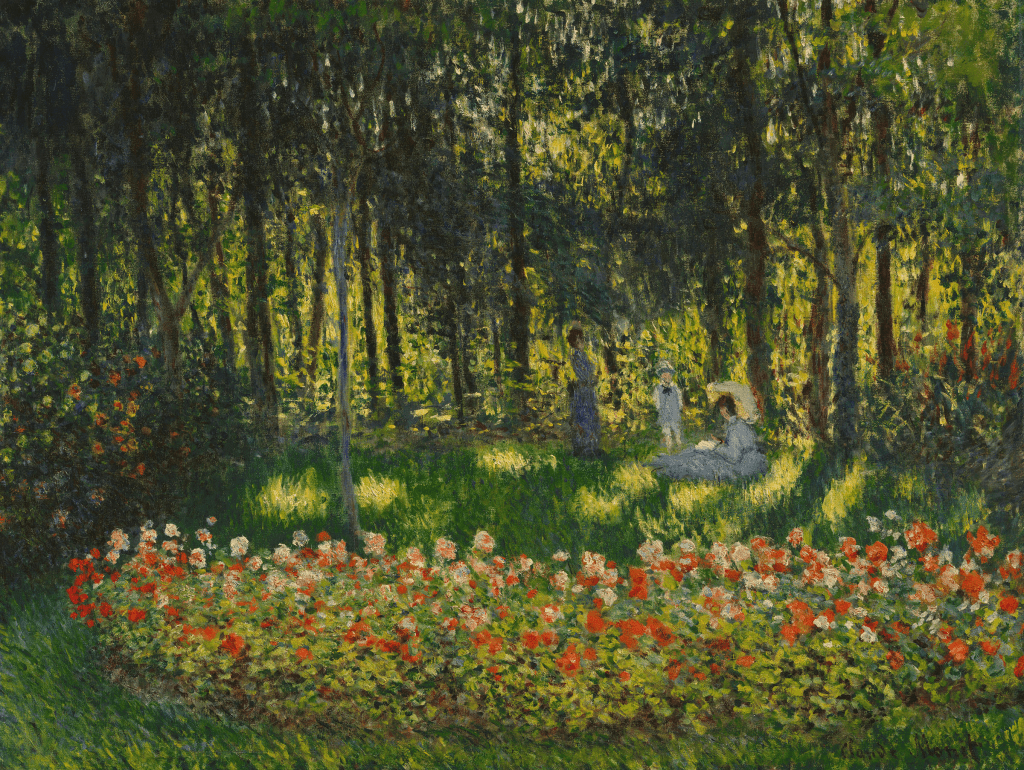
The Artist’s Family In the Garden, by Claude Monet, 1875

Thus, the Apostle Paul, having also learned well, understood that there are not spiritual “fruits,” but only spiritual “fruit.” That is, the nine virtues Paul mentioned are the “fruit of the Spirit,” not “fruits.”

In other words, all virtuous words and behavior are connected with each other. When a person or an organization has the Divine Gardener attending to them, all nine of the Christian values are a collective basket of fruit which cannot be separated from one another.

So then, if we look at the list of spiritual fruit in the New Testament book of Galatians and say something like, “Well, I’m pretty good at kindness and goodness, but I don’t have much peace or patience,” then what this really means is that we are likely doing kindness and goodness from a different place than by means of the Holy Spirit.

Because when the Spirit is manifested in us, we exhibit spiritual fruit. We cannot separate the nine spiritual virtues any more than we can separate the Trinity. They’re all one spiritual fruit, cultivated and produced within the inner person by the agency of God’s Spirit, our Divine Gardener.

Perhaps we need to consider what is happening in the ground, underneath the surface, which is the shadow side of our lives that no one sees.

For example, it could be that we are driven far more by our ego and our anxiety about most things than about genuine altruism and love. The results of our actions and words may look the same or similar, but the motivation might be far from truly altruistic.

Any sort of “fruit” will simply not last if our actions spring from a place of ego control and worry – because it is not of the Spirit.

Both persons and institutions must mortify (put to death) the deeds and the weeds of the sinful nature.

I have been crucified with Christ and I no longer live, but Christ lives in me. And the life that I now live in my body, I live by faith, indeed, by the faithfulness of God’s Son, who loved me and gave himself for me.

The Apostle Paul (Galatians 2:20, Common English Bible)

The Spirit will always have us in the good rich soil of Christ, so that when we are planted and receive the proper amounts of spiritual sun and living water, we will most certainly produce a hundredfold crop.

Then, we learn to make proper and right judgments about what is happening in our world. We are able to see the thief in the garden who cares only to pick fruit he has neither planted nor cared for, having no intention of sharing anything, but instead seeks to amass a gluttonous basket for his own self.

There is a great need for virtuous living, ethical sensibilities, and wise discernment among everyone in this world.

We are now observing what happens when a people are ignorant of how true righteousness, justice, goodness, and peace are grown and developed in any culture, society, and government. Fools are allowed to roam the garden, and they make a complete mess of things.

Let us all do our part in ensuring that genuine spiritual fruit is produced, coming from the true self. Disconnection, destruction, and chaos are the fruit of a bad tree. Then, it is only fit to cut down and thrown into the fire.

Jesus said:

“Every good tree produces good fruit, and every rotten tree produces bad fruit. A good tree can’t produce bad fruit. And a rotten tree can’t produce good fruit. Every tree that doesn’t produce good fruit is chopped down and thrown into the fire. Therefore, you will know them by their fruit.” (Matthew 7:17-20, Common English Bible)

Therefore, beware, watch out, and be wise in the way your own soul is cultivated, and how you discern the souls of others.

For the Christian, the season of Lent is the best and most appropriate time to focus upon spiritual disciplines which help connect us with Christ and with one another.

Daily attention to the garden of our soul prepares us for Holy Week by participating with Jesus in both his crucifixion and resurrection. All that is wrong and sinful in this old fallen world is put to death, and a new life of virtuous and altruistic living is enjoyed.

And the beauty of it all is that it will organically spring from the depths of a well-cultivated soul garden. The Divine Gardener stands ready with both hose and hoe to bring about the fruit of the Spirit.

Soli Deo Gloria

Beginnings and Endings

Forest Sunset, by James Naughton

I’ve always thought it strange that we have New Year’s celebrations on January 1 at midnight when the year begins. The year hasn’t even happened yet, and we’re celebrating it. I understand celebrating a live birth and all the possibilities of a new baby in a family; but having worldwide blowouts about an upcoming New Year just strikes me as weird.

For some reason, we don’t celebrate the year we’ve just lived. We “take a look back” at the significant events and happenings. But there’s certainly no party around it. I suppose it’s because a lot of terrible things happen in a year. Yet, a lot of good things happen, too, that we could center some joy around.

What I’m getting at, in a round about way, is that we humans don’t do well with endings. And then we quickly become discouraged with our new beginnings – likely because we put little to no thought and preparation into how important and necessary our endings really are.

This is yet another roundabout way of saying that I (and we together) are experiencing something of an ending. For the past 1,750 days, I have provided a daily reflection upon a text from Holy Scripture. And those reflections haven’t been just a few sentences of devotional drivel, nor a measly daily crumb. I’ve written thousand-word-posts which I believe have been thoughtful and truly reflective on the text and our human condition.

However, all things must end. And this is my last post – at least for a while. I won’t be posting every day, as I’ve done for nearly 5 years! Yet, in order for me to have a proper new beginning of my own (one that I neither wanted nor asked for) I must let go of my daily blog posts.

Although I have been blogging for the past 15 years, I started doing the daily reflections at the beginning of COVID, as a way of remaining connected with my then church congregation, and with others. My thought was to give up doing it every day, once things got back to some sort of normalcy – whatever the heck that is.

Yet, when the masks initially came off and we all began seeing one another again, I found that the daily routine of writing biblical reflections had gotten into my spiritual bones. I was no longer simply writing for others; I was writing for myself. It buoyed my own faith to rise early in the morning and put some intentional focus upon crafting some scriptural thoughts on the Bible.

But that is no longer possible. My life can no longer sustain the practice. I intend to keep up the occasional post of maybe once a week. I might not even be able to do that. It might be once or twice a month. I don’t yet know.

Yet, what I do know is that I want to take the opportunity to celebrate the reality that I spent 1,750 straight days writing and posting impactful blog posts! Many of you were gracious to send me private notes of appreciation and encouragement. I especially treasure the ways some of you explained your story of how your own relationship with God has been helped.

When you boil down life to its essence, all any of us really have is our stories. Behind every event, each encounter, and all of the numbers which get crunched and the stuff that gets done and achieved, there is a story.

Stories bring just as much healing to us as modern medicine and surgeries. And they encourage, inspire, and change us in ways we cannot imagine.

The Bible, at its core, is a collection of stories. It seems God has created us as story-driven people, and so, in order to reveal something of God’s personhood and nature, we were given a grand and unfolding story of redemption.

I love reading and meditating on Holy Scripture, mainly because I love the Holy God of whom I belong and gladly serve.

I’ll continue writing the occasional post, but I will miss the daily meetings I’ve had with the Lord and with you in these past few years. Thank you for your faith, and for listening to God’s Word. What’s more, you can always avail yourselves of the nearly 2,700 blog posts on the website.

I pray that we all may learn to end things well, so that we might begin new things with some needed wisdom, humility, and grace.

May you live this day compassionate of heart, gentle in word, gracious in awareness, courageous in thought, and generous in the love of God through Jesus Christ our Lord and in the strength of the Holy Spirit. Amen.