Proverbs 2:1-5 – Have Common Sense

My child, you must follow
and treasure my teachings
    and my instructions.
Keep in tune with wisdom
and think what it means
    to have common sense.
Beg as loud as you can
    for good common sense.
Search for wisdom
as you would search for silver
    or hidden treasure.
Then you will understand
what it means to respect
    and to know the Lord God. (Contemporary English Version)

“Common sense is not so common.”

Voltaire

Sometimes it seems as if common-sense has taken a vacation or gone into quarantine.

We may even be in some sort of common-sense crisis or pandemic.

Perhaps we are emoting when we should be thinking. Maybe we’re thinking when we ought to be feeling. It could be we’re doing both or neither. Whatever the heck is going on, it’s a bunch of gobbledygook that isn’t getting us anywhere.

Much to my sadness, many Christians brazenly splash their ignorance across large swaths of social media. It’s not surprising that more and more people want nothing to do with the Church nor Christianity. 

Common sense does not necessarily imply any great quality of mind or intelligence; it’s common, not extraordinary.

We need some sound practical discernment for common everyday matters.

What shall we do?

I propose we liberally inhale the biblical proverbs – because suspicion, gullibility, extreme vitriol, and downright stupidity now characterize vast sections of our world, especially in the so-called intellectual West. In the wise sayings of the Proverbs, we shall find that:

Humility and reverence are the beginning of wisdom.

A teachable spirit is of more value than any amount of money or physical resources.

Developing the life of the mind is of critical importance.

Every good thing in life comes through blood, sweat, and tears – and doesn’t just fall into your lap.

Prayer matters.

Ultimate control belongs to God.

There is peace in being comfortable with mystery.

Knowing God helps us pursue the right questions, rather than always trying to have the right answers.

Becoming more self-aware creates greater awareness of God and others.

Smart choices come from both mental learning and practical action.

The mind can be clouded and untrustworthy, and the heart can be desperately wicked; the gut, however, is always right.

Mentally overthinking and researching things to death can disconnect us from a good old fashioned sage response.

Our own personal view is just that; it isn’t necessarily the best or right perspective.

Feedback, advice, consultation, and collaboration are necessary, not optional.

Perfection isn’t the goal.

Proverbs aren’t ironclad promises; they’re short pithy statements of experiential truth.

Observation and listening are valued by God as the primary means of gaining understanding.

Most things in life are both/and, not either/or.

We all have two ears and one mouth. There needs to be twice as much listening as talking.

We must go hard after wisdom.

“Common sense is genius dressed in its working clothes.”

Ralph Waldo Emerson

Having experience makes all the difference.

Action and reflection go hand-in-hand.

It’s okay to be afraid. It’s not okay to let fear stop us from action.

Simplicity and complexity are not necessarily antithetical.

Complete control is the glory of God. Self-control is the glory of humans.

“Common sense is the knack of seeing things as they are and doing things as they ought to be done.”

C. E. Stowe

If we are going to raise our voices about something, then let us shout loudly in prayer for some basic wisdom and common sense from God. Any common fool can be won over by a podcast rant or get sucked into some blogger who vehemently damns everyone opposing his views. 

The wise believer, however, will humbly cry out to God for the wisdom to live well and make good decisions with both mind and mouth.

May it be so to the glory of God.

All-wise and everlasting God:

You know the number our of hairs and determine our days.

You hang the stars and feed the sparrows.

You open doors no one can shut and shut doors no one can open.

Surely, we can trust you when the time comes for making big decisions, or for that matter, any decision. We need your sagacity and discernment for all things. We will trust you for generous wisdom, straight paths, and peaceful hearts.

Blessed God:

We plan, seeking you to order our steps.

We pray, asking you to bend our prayers toward your benevolent purposes.

We seek counsel, counting on you to direct our words and actions more than trying to please someone else.

We search the Scriptures, looking to know Christ better.

It’s not our decisions, but yours that make all the difference. 

Gracious God:

Free us from the paralysis of analysis. We confess we are often more concerned with the perfect decision that impresses everybody, rather than being a righteous person.

Free us from idolatry. We confess we are often more concerned for our reputation than saying and doing what is right, just, and fair.

Free us from living in fear of disapproval. We confess we are often people-pleasers, rather than God-pleasers.

Free us from cheap and easy solutions to complex problems. We confess we often want speedy outcomes to our difficulties, rather than seeking to learn everything we can from the circumstances you give us.

Free us from continually second guessing ourselves and not trusting our gut. We confess that we often ignore the still small voice of wisdom within.

Sovereign God:

No matter the situation or the relationship, we affirm that your will and way for us is supreme.

Give us the desire and means of acquiring your will for all things.

Make us more and more like Jesus, even as we trust you for the opening and closing of doors that are in front of us.

May we live to your glory – Father, Son, and Spirit – the Holy Trinity we serve. Amen.

Psalm 1 – Two Different Ways

Oh, the joys of those who do not
    follow the advice of the wicked,
    or stand around with sinners,
    or join in with mockers.
But they delight in the law of the Lord,
    meditating on it day and night.
They are like trees planted along the riverbank,
    bearing fruit each season.
Their leaves never wither,
    and they prosper in all they do.

But not the wicked!
    They are like worthless chaff, scattered by the wind.
They will be condemned at the time of judgment.
    Sinners will have no place among the godly.
For the Lord watches over the path of the godly,
    but the path of the wicked leads to destruction. (New Living Translation)

Today’s psalm presents us with two differing ways we can choose to shape our lives: The way of the upright and virtuous, or the way of the unethical and depraved. 

The way of the right and just person leads to human flourishing and life – whereas the way of the wicked and unjust person leads to human degradation and death. 

Distinguishing between the righteous and the wicked is not always as easy as it looks.

Only at the end of the age, when the Day of Judgment comes, will we know for certain the righteous and the wicked.

The magisterial Reformer, Martin Luther, contrasted these two ways with his Heidelberg Disputation of 1518. Luther called the way of the wicked a theology of glory – and described the way of the righteous as the theology of the cross.

The cross of Christ, as expressed by Luther, is God’s attack on human sin. Christ’s death is central to Christianity, and one must embrace the cross and rely completely and totally upon Christ’s finished work on the cross to handle human sin. Through being crucified with Christ, we find the way to human flourishing and life. In other words, righteousness is gained by grace through faith in Christ.

Conversely, the theology of glory is the opposing way of the cross. For Luther, the wicked person, and the vilest offender of God, is not the person who has done all kinds of outward sinning and heinous acts. The worst of sinners do good works.

Specifically, the wicked person is the one who does all kinds of nice things – yet does them disconnected from God by wanting others to see their good actions. Another way of putting this: The wicked person is one who seeks to gain glory for self, rather than giving glory to God.

Our good works can be the greatest hindrance to righteousness.

It is far too easy to place faith in our good works done apart from God, rather than having a naked trust in Christ alone. And it is far too easy to do good things for the primary purpose of having others observe our goodness, rather than do them out of the good soil of being planted in God’s Word. 

The remedy for sin is the cross, and the sinner is one who lives apart from that cross, trusting in self so that people can recognize and give them their perceived due respect and accolades.

“It is impossible for a person not to be puffed by his good works unless he has first been deflated and destroyed by suffering and evil until he knows that he is worthless and that his works are not his but God’s.”

Martin Luther

We are not to avoid good works but do them from the good soil of being planted in the law of God and connected to the vine of Christ. When the psalmist uses the term “law” he is referring to Scripture as a whole, to all the acquired wisdom about how life is supposed to be lived in God’s big world.

The righteous are those who immerse themselves in the law; secretly rise early to meditate on God’s Word; privately pour over Scripture’s message and pray to put it into practice because they want to delight in God. Their fruit will be abundant and sweet.  

The wicked, however, are simply too busy to take note what the law says; only serve to be seen; and publicly desire to be recognized for their charity and works. Such works will not stand when Judgment Day comes.

You’re nothing but show-offs. You’re like tombs that have been whitewashed. On the outside they are beautiful, but inside they are full of bones and filth. (Matthew 23:27, CEV)

Truly righteous people have a humble sense that they could easily drift from God, if not staying connected and rooted in Jesus and the way of the cross. 

The wicked, in contrast, are like chaff – worthless, and not adding value to anything. They are arrogant and annoying – wanting all the attention that God rightly deserves. The wicked have nothing to contribute to God’s kingdom. They hinder the harvest of souls God is working toward with their irritating attitudes.

Generosity marks the righteous because God is generous. Grace defines the righteous because God is gracious.  Gentleness is the way of the righteous because Christ is gentle. Spiritual prosperity is the result of a righteous relationship cultivated with Jesus Christ. The Lord watches over the way of such persons.

The way of the wicked will perish.

We have sixteen prophetic books in the Old Testament, all given to a single message: Judgment is coming because of wickedness.  And the wicked turn out to be God’s covenant people, because they selectively did their good works to gain glory for themselves. They withheld the good they could have done because it did not add any value to their reputation or their personal goals.

God desires genuine spiritual growth for us. That will only happen if we avoid the theology of glory and embrace a theology of the cross – delighting in God and the law.

Every day, we have a choice to make: The way of connection and life, or the way of disconnection and death. 

Look here! Today I’ve set before you, life and what’s good versus death and what’s wrong. If you obey the Lord your God’s commandments that I’m commanding you right now by loving the Lord your God, by walking in his ways, and by keeping his commandments, his regulations, and his case laws, then you will live and thrive, and the Lord your God will bless you…. But if your heart turns away and you refuse to listen, and so are misled, worshipping other gods and serving them,I’m telling you right now that you will definitely die…. I have set life and death, blessing and curse before you. Now choose life—so that you and your descendants will live—by loving the Lord your God, by obeying his voice, and by clinging to him. That’s how you will survive and live long…. (Deuteronomy 30:15-20, CEB)

The idols of our hearts can so easily draw us away from God so that our own good works are done for an audience who will recognize and affirm. Instead, our daily choice must be to love God supremely and give God glory for everything good in our lives. 

What will you choose this day?

Ecclesiastes 3:1-13 – It’s Time

For everything there is a season,
    a time for every activity under heaven.
A time to be born and a time to die.
    A time to plant and a time to harvest.
A time to kill and a time to heal.
    A time to tear down and a time to build up.
A time to cry and a time to laugh.
    A time to grieve and a time to dance.
A time to scatter stones and a time to gather stones.
    A time to embrace and a time to turn away.
A time to search and a time to quit searching.
    A time to keep and a time to throw away.
A time to tear and a time to mend.
    A time to be quiet and a time to speak.
A time to love and a time to hate.
    A time for war and a time for peace.

What do people really get for all their hard work? I have seen the burden God has placed on us all. Yet God has made everything beautiful for its own time. He has planted eternity in the human heart, but even so, people cannot see the whole scope of God’s work from beginning to end. So, I concluded there is nothing better than to be happy and enjoy ourselves as long as we can. And people should eat and drink and enjoy the fruits of their labor, for these are gifts from God. (New Living Translation)

Maybe we enjoy celebrating the first day of a new year because it gives us a sense of having a clean slate. Perhaps we internally and/or unconsciously realize we wasted great chunks of time in the past year. So, we look forward to amending our ways and making new resolutions.

Time Is Finite

We cannot get it back once we lose it – hence, the lamenting of so much squandered time. We want to use our time in ways that reflect our most cherished values and commitments. For that, we need wisdom to know what to do, what not to do, and when to do it.

There needs to be a sense of purpose – of values which drive our goals and our actions – if we are to use our time in redemptive ways. Time is a gift, bestowed to us by a Creator who desires we steward that precious gift with sage understanding and wise discernment.

Time is a temporary commodity to be used for good purposes before the end of all time comes.

One of the realities of time is that our lives are full of seasonal rhythms and change over time. These are built into the life God has given us. The book of Ecclesiastes, throughout its contents, explains that nothing we pursue has any permanence to it. We throw ourselves into some work or activity, but what does that activity really do for us in the end?

Time Marches On

Time marches inexorably forward, no matter what we do or don’t do. Therefore, we must respect, and learn to work with, it’s slow and constant movement.

When I was twenty years old, I thought nothing of playing a round of golf in the morning, three sets of tennis in the afternoon, then staying up late at night with friends. If I did that same thing today, I would be in the hospital well before the sun sets.

We all, at some point, try to defy time and act like we can do the things we once did in the past. Sometimes it takes a lot for us to accept our limitations, whether it is our play or our work. Ecclesiastes teaches us that outside forces always seem to dictate what we can do and not do.

Time Is In Control

The cycles and rhythms of life can appear meaningless. We may feel as if we are prisoners of time. Yet, for the believer, time can be redeemed with godly purpose and meaning, no matter what the season of life is.

Because there is time, and all things will someday come to an end – all activity, or the lack of it, will be judged according to how we denied or accepted our limitations due to time. 

Ecclesiastes also offers to us what seems a subversive perspective that is counter-cultural to our society. Many Americans believe that by working hard and doing the right thing, we can shape our own destiny and prosperity.

However, the Teacher of Ecclesiastes insists we submit and move with the events, rhythms, and seasons God has established. Apart from God, time is futile and meaningless. In our denial of the power and effects of time, it is no wonder many Americans are so unhappy with their lives.

In the experiences we have from birth to death, the conclusion of Ecclesiastes is that everything is out of our control. Too many of us try to exert control over events, people, and circumstances when, in truth, any control we have is an illusion. I call this the “c-clamp syndrome,” trying to clamp down on others to get them to submit to our agenda.

Self-Control

Instead, Holy Scripture directs us to practice self-control – to focus on myself and my own actions:

Moderation is better than muscle, self-control better than political power. (Proverbs 16:32, MSG)

Prepare your minds for action and exercise self-control. Put all your hope in the gracious salvation that will come to you when Jesus Christ is revealed to the world. (1 Peter 1:13, NLT)

The end of everything has come. Therefore, be self-controlled and clearheaded so you can pray. (1 Peter 4:7, CEB)

Do your best to improve your faith. You can do this by adding goodness, understanding, self-control, patience, devotion to God, concern for others, and love. If you keep growing in this way, it will show that what you know about our Lord Jesus Christ has made your lives useful and meaningful. (2 Peter 1:5-7, CEV)

We cannot force time to stand still. So, instead, we must focus on how we spend our time now.

It is time for us to lay aside lesser pursuits and diligently pursue what is right, just, and good. We each must give ourselves to the unforced rhythms of grace and let God redeem the time.

What time is it?  It’s time to live in harmony with the clock, with God, and with others.

God of all time help us to know ourselves. Teach us to recognize our weaknesses and work to walk in holiness. Let us follow you in all things, submitting to the times you have for us. Thank you for your unending grace and mercy toward us when we need it most. Help us to trust you with our lives through Jesus Christ our Lord in the power of the Holy Spirit. Amen.

1 Kings 3:5-14 – A Prayer for Discernment

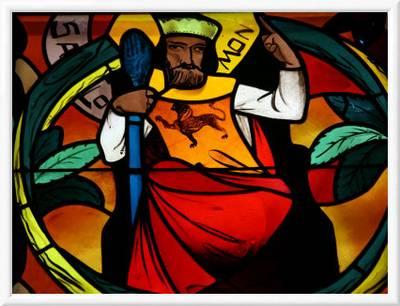
Stained glass window of King Solomon in Saint-Joseph Des Fins Church, France

The Lord appeared to Solomon at Gibeon in a dream at night. God said, “Ask whatever you wish, and I’ll give it to you.”

Solomon responded, “You showed so much kindness to your servant my father David when he walked before you in truth, righteousness, and with a heart true to you. You’ve kept this great loyalty and kindness for him and have now given him a son to sit on his throne. And now, Lord my God, you have made me, your servant, king in my father David’s place. But I’m young and inexperienced. I know next to nothing. But I’m here, your servant, in the middle of the people you have chosen, a large population that can’t be numbered or counted due to its vast size. Please give your servant a discerning mind in order to govern your people and to distinguish good from evil, because no one is able to govern this important people of yours without your help.”

It pleased the Lord that Solomon had made this request. God said to him, “Because you have asked for this instead of requesting long life, wealth, or victory over your enemies—asking for discernment so as to acquire good judgment— I will now do just what you said. Look, I hereby give you a wise and understanding mind. There has been no one like you before now, nor will there be anyone like you afterward. I now also give you what you didn’t ask for: wealth and fame. There won’t be a king like you as long as you live. And if you walk in my ways and obey my laws and commands, just as your father David did, then I will give you a very long life.” (Common English Bible)

You will recognize today’s Old Testament lesson as being the same as yesterday – just in a different book of the Bible. The books of 1 and 2 Chronicles are a restatement and edited version of 1 and 2 Kings. That’s because each was written in a different time for a particular context. Kings was compiled at the time of the Jewish exile when the Babylonians captured Jerusalem. Chronicles was put together for the exiles returning to Jerusalem.

Both accounts were meant to be lessons in how to live rightly as God’s people. For the people going into exile, the Kings narrative was to serve as a remembrance of how far the people had strayed from their roots in basic life wisdom.

“It is said that wisdom lies not in seeing things, but seeing through things.”

Manly P. Hall

Solomon was a very wise king. And today’s lesson makes it clear why. At the outset of his reign, Solomon could have asked for anything from God. A typical request might be for power in subduing enemies, popularity for appealing to the masses, or perks for maintaining political stability. 

Instead, Solomon asked for understanding and wisdom to govern God’s people so that he could discern between good and evil. It was the kind of asking which the Lord was pleased to hear and to give. All these millennia later, Solomon still has the reputation of being the wisest king that ever lived.

Solomon’s prayer resonates with me. As a church pastor, rather than focusing prayers on a bigger budget, more people reached, or adding programs, I can make the choice to pray for wisdom so that I will have my ministerial ladder on the right wall. 

As a hospital chaplain, instead of praying for greater visibility of the spiritual in healthcare, increased impact within the system, or more healing of patients, I can pray for understanding so that I will be able to make sound ethical, practical, and ministerial decisions in each context and case I encounter.

Solomon’s request was borne of a clear realization of who God is (the One who shows steadfast love) and who he himself is (like a little child with a big responsibility). God’s greatness and Solomon’s humility collided in a wonderful prayer for discernment to carry out God’s will on earth and to bless God’s people.

In this time of year, in which it is vogue to make New Year’s resolutions based upon the individual’s willpower, let’s take a different approach. Let’s pray and invite God to do the kind of deep change needed in our lives so that we can accomplish the will of God on this earth for this time. 

May we pray for discernment to serve well, ask for wisdom to be good stewards of our callings, and seek understanding from the God who delights in answering altruistic requests from humble people.

May you walk in the way of wisdom so that you will make good decisions and act in all good understanding.

Lord God, give me a mind and heart of wisdom so that I might rightly discern good and evil, right and wrong, and the best decisions to made in every situation. I choose to seek your ways and follow the narrow way of Jesus Christ through the enablement of your Holy Spirit. Amen.