Be Wise and Beware (1 Kings 10:1-13)

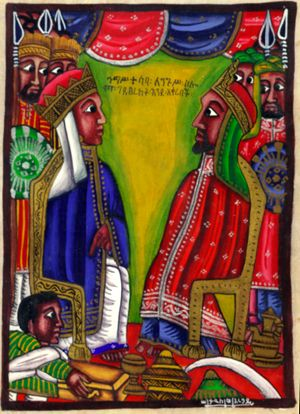
Ethiopian depiction of the Queen of Sheba and King Solomon

The Queen of Sheba heard how famous Solomon was, so she went to Jerusalem to test him with difficult questions. She took along several of her officials, and she loaded her camels with gifts of spices, jewels, and gold. When she arrived, she and Solomon talked about everything she could think of. He answered every question, no matter how difficult it was.

The Queen was amazed at Solomon’s wisdom. She was breathless when she saw his palace, the food on his table, his officials, his servants in their uniforms, the people who served his food, and the sacrifices he offered at the Lord’s temple. She said:

Solomon, in my own country I had heard about your wisdom and all you’ve done. But I didn’t believe it until I saw it with my own eyes! And there’s so much I didn’t hear about. You are wiser and richer than I was told. Your wives and officials are lucky to be here where they can listen to the wise things you say.

I praise the Lord your God. He is pleased with you and has made you king of Israel. The Lord has always loved Israel, so he has given them a king who will rule fairly and honestly.

The Queen of Sheba gave Solomon more than four tons of gold, many jewels, and more spices than anyone had ever brought into Israel.

In return, Solomon gave her the gifts he would have given any other ruler, but he also gave her everything else she wanted. Then she and her officials went back to their own country.

King Hiram’s ships brought gold, juniper wood, and jewels from the country of Ophir. Solomon used the wood to make steps for the temple and palace, and harps and other stringed instruments for the musicians. It was the best juniper wood anyone in Israel had ever seen. (Contemporary English Version)

The ancient Sabeans were a wealthy people. The kingdom of Sheba was geographically located on the southwest corner of the Arabian peninsula (present day Yemen). They were ideally situated to control all the trade in and out of the Red Sea.

Since the Sabeans were a maritime people, the Queen of Sheba made it a habit to engage in trade missions and relations with other kingdoms. King Solomon was making quite a name for himself, and his nation, through his own extensive trade endeavors. It was inevitable that the two would meet.

Solomon had wisdom and wealth because of the divine gift given to him by the Lord. It’s wonderful to have a gracious gift given by God. Most of us can relate to desiring spiritual gifts and blessings from the God we serve.

Yet, what doesn’t usually get talked about is that every divine gift given to us carries with it not only opportunities to bless the world, but also the temptation to avoid proper stewardship and use the gift for personal aggrandizement.

Slowly, over time, it can become rather easy to slip into a mode of getting more and more, of expanding influence, seeking greater honor and accolades, and increasing wealth to exorbitant extremes. For those who know the biblical storyline of Solomon, this is precisely what happened to him. Perhaps in today’s Old Testament lesson, we begin to get a glimpse of the beginnings of that slippery slope into the bottomless abyss of more.

The Queen of Sheba and King Solomon meet

The Queen of Sheba, who herself was one of the wealthiest and most influential monarchs of her day, knew what affluence looked like. So, for her to be breathless over what she observed in Solomon’s kingdom must have been over-the-top abundance and riches.

It’s telling that many contemporary Westerners can read this account and see no problem with it. In fact, some even seem to believe this is something to aspire to – to be just like King Solomon, as if this is what God wants for us.

Yet, it could be that the writer and historian of the biblical kings was leading us to a different conclusion, placing Solomon in the unfavorable light of abusing his divine gift.

After all, it’s clear Solomon used his wisdom and wealth for himself in ways that went well beyond the simple meeting of needs. Solomon was a really smart guy, familiar with God’s Law, so he knew what Moses said about all this stuff:

The king should not have many horses, especially those from Egypt. The Lord has said never to go back there again. And the king must not have a lot of wives—they might tempt him to be unfaithful to the Lord. Finally, the king must not try to get huge amounts of silver and gold.

The official copy of God’s laws will be kept by the priests of the Levi tribe. So, as soon as anyone becomes king, he must go to the priests and write out a copy of these laws while they watch. Each day the king must read and obey these laws, so that he will learn to worship the Lord with fear and trembling and not think that he’s better than everyone else.

If the king completely obeys the Lord’s commands, he and his descendants will rule Israel for many years. (Deuteronomy 17:16-20, CEV)

But Solomon ended up not heeding any of these warnings. And so, it ought to have been no surprise that, after Solomon’s death, the kingdom became divided and was never the same again.

Sheba’s Queen is the one who seemed to have both her head and her heart in the right place. She’s the one who blesses Yahweh and reminds Solomon about the need to rule with integrity and justice. The Queen was able to affirm Solomon’s gift, while at the same time reminding him of what that gift is truly for.

The wise person knows there is always a shadow side to every good gift we have. If we fail to acknowledge this, and not pay attention to it, we will find ourselves doing as much harm as we do benefit.

Generous and loving God, all we are and all that we have is a gift from you. In faith and love, help us to do your will. We offer to you this day all the facets of our lives, whether it be at home, at work, or at school. We seek to be patient, merciful, generous, and holy. Give us the wisdom and insight to understand your will for us and the fervor to carry out our good intentions. We offer to you our gifts of time, abilities, and possessions as a true act of faith, to reflect our love for you and our neighbors. Help us to reach out to others as you have reached out to us. Amen.

Don’t Be Stupid (2 Timothy 2:14-26)

Keep reminding God’s people of these things. Warn them before God against quarreling about words; it is of no value, and only ruins those who listen. Do your best to present yourself to God as one approved, a worker who does not need to be ashamed and who correctly handles the word of truth. 

Avoid godless chatter because those who indulge in it will become more and more ungodly. Their teaching will spread like gangrene. Among them are Hymenaeus and Philetus, who have departed from the truth. They say that the resurrection has already taken place, and they destroy the faith of some. Nevertheless, God’s solid foundation stands firm, sealed with this inscription: “The Lord knows those who are his,” and, “Everyone who confesses the name of the Lord must turn away from wickedness.”

In a large house there are articles not only of gold and silver, but also of wood and clay; some are for special purposes and some for common use. Those who cleanse themselves from the latter will be instruments for special purposes, made holy, useful to the Master and prepared to do any good work.

Flee the evil desires of youth and pursue righteousness, faith, love and peace, along with those who call on the Lord out of a pure heart. Don’t have anything to do with foolish and stupid arguments because you know they produce quarrels. And the Lord’s servant must not be quarrelsome but must be kind to everyone, able to teach, not resentful. 

Opponents must be gently instructed, in the hope that God will grant them repentance leading them to a knowledge of the truth, and that they will come to their senses and escape from the trap of the devil, who has taken them captive to do his will. (New International Version)

Stupidity doesn’t have to do with intellect; it is a matter of character. A fool is stupid. A wise person is smart. One can be a “genius” yet still be as dumb as a bowling ball. And someone who never gets a “A” in school just might be the most knowledgeable person in the room.

Whoever loves discipline loves knowledge, but whoever hates correction is stupid.

Proverbs 12:1, NIV

The Apostle Paul understood this – which is why he put the focus on cultivating and communicating character instead of sheer intelligence. Anytime we purposefully neglect and forget this, we land into Paul’s “stupid” category of people.

Much of church ministry needs to be a memory care unit experience. That’s because too much spiritual dementia happens. There must be continual reminders about the importance of Christian character. It seems believers in Jesus too easily forget their identity and what they are supposed to be doing. This is most certainly not a new issue; it is one that has been endemic throughout the ages. It’s a problem as old as sin itself.

In the Gospels, Jesus miraculously fed a great crowd of people not once, but twice. The second time he called his disciples to remember what had happened the first time in order to understand the second. 

In the Epistles, Paul kept on reminding the Jewish believers to remember the ancient covenant; and he called the Gentile believers to keep in mind that they were once estranged from that very same covenant. Both Jews and Gentiles together needed to collectively remember the death of Christ that unites them into a new covenant community. And much like them, we are to remember Jesus Christ, raised from the dead, descended from David. (2 Timothy 2:8)

Whenever we forget who we are, whose we are, and what it is we are really all about, we get downright stupid. We get lost majoring on the minors and wagging our tongues like a bunch of foolish simpletons.

It’s stupid to say bad things
    about your neighbors.
If you are sensible,
    you will keep quiet.
A gossip tells everything,
but a true friend
    will keep a secret. (Proverbs 11:12-13, CEV)

Christians are blood-bought people of God, belonging to Jesus Christ, and given a mission to make disciples and participate with God in the redemption of all creation through remembering the poor, seeking justice, and being peacemakers in the church and the world. 

And what’s more, we are not to put up with letting others stand around and endlessly argue about lesser things, making every doctrine and dogma a battleground – as if the fine China and paper plates were exactly the same.

“Remember the height from which you have fallen!  Repent and do the things you did at first.” (Revelation 2:5, NIV)

There is a difference between the brains of dementia patients and Christian folk – the mind overtaken by dementia will only worsen, yet the church can recover its collective memory by listening again to the ancient Word of God; any and every congregation can be constantly refreshed with the promises and covenant of God. 

We must neither rely on mere pragmatism nor doing things the way we always have done them without any understanding of why we do it. 

Yet, we must understand that even when we point out what to remember and why we are to remember it to others, they aren’t always going to respond like we want them to – which is why instruction needs to be gentle so that another does not stumble on the messenger instead of the message.

A person of great understanding is patient, but a short temper is the height of stupidity. (Proverbs 14:29, GW)

It takes no effort to be stupid; but it takes a great deal of will and energy to keep learning and growing in the Christian life. Too many persons have unwittingly fallen into the trap of the devil, believing themselves to be godly because of their defense of the faith. Sadly, they’ve been defending their own interpretation of faith instead of the actual faith itself.

Please, don’t do that. Don’t be stupid. Better to focus on having a pure heart of your own rather than always pointing out the impurities of others.

Almighty God, to you all hearts are open, all desires known, and from you no secrets are hid. Cleanse the thoughts of our hearts by the inspiration of your Holy Spirit, that we may perfectly love you, and worthily magnify your holy Name, through Jesus Christ our Lord. Amen.

Letters to the Old and the Young (2 Timothy 2:1-7)

Paul and Timothy by Unknown artist, 1886

As for you, my son, be strong through the grace that is ours in union with Christ Jesus. Take the teachings that you heard me proclaim in the presence of many witnesses, and entrust them to reliable people, who will be able to teach others also.

Take your part in suffering, as a loyal soldier of Christ Jesus. A soldier on active duty wants to please his commanding officer and so does not get mixed up in the affairs of civilian life. An athlete who runs in a race cannot win the prize unless he obeys the rules. The farmer who has done the hard work should have the first share of the harvest. Think about what I am saying, because the Lord will enable you to understand it all. (Good News Translation)

The Apostle Paul was a spiritual father to Timothy. Oh my, how we desperately need Paul and Timothy relationships today!

Too much independence breeds nothing but goofy thinking, messed up emotions, extreme ascetic practices, doctrinal heresy, and shallow spirituality. A good and godly spiritual father or mother is an absolute necessity to properly guide others, pass on sound teaching, and model how we ought to live.

I’m going to address two groups of people: older generations and younger generations….

Dear Older Generations:

Hey, if you are concerned about younger generations, then by God do something about it!

Heed the words of Paul to Timothy and be a spiritual director of souls to those who are like sheep without a shepherd.

Get your mental and emotional energy off of retirement, your economic portfolios, only giving money, and placing your hope in political elections.

You have built a lifetime of knowledge concerning personal piety and ethics, human behavior and community, and divine ways and means of living. Don’t squander it by dying and leaving only a material inheritance. Rather, die to self, and leave a spiritual legacy of mentoring others in the faith.

Guide a younger man or woman in discerning between the workings of the Holy Spirit and the machinations of evil spirits. Help them unlock the mysteries of being united to Christ. Assist them in moving into greater self-awareness and God-consciousness.

Keep learning and growing. Don’t rest on your laurels. Continue navigating the circuitous ways of the interior life – and leading other younger Christian disciples into the life of the Spirit.

Warn and encourage with all spiritual wisdom. Warn against the temptations of wealth, security, and attention. Don’t be the answer guy but learn to ask good and helpful questions which pilot the soul and inspire the spirit – instead of rigid lectures telling others what exactly to do and how to do it.

Don’t be a putz, a schmuck, a curmudgeon, or a blockhead. Be winsome, kind, self-effacing, gentle, and above all, humble. You have learned many things in the school of hard knocks. So, give the space and grace for younger generations of people to fail and be trained by their mistakes. And be there to help them get back up.

With sincerity and humility,

Pastor Tim

Dear Younger Generations:

This may or may not be obvious: You don’t know it all. And you cannot do it all by yourself. You need a spiritual guide.

So, go find one. Actively seek for a spiritual father or mother. In your search, look for a virtuous person, especially looking to see humility, self-control, service toward others, wisdom, deep and prayerful contemplation, a heart for God and a love of neighbor.

This may take a while but that’s okay. The journey is as much or more important than the destination. Once your search finds such a person, take advantage of the opportunity by submitting fully to your mentor with obedience. Follow their advice because they’ve been there, and they know what is useful for you.

You haven’t reached the Promised Land. There is a lot of wilderness wandering that needs to happen, a lot of soul-searching, and many temptations to face down. Your director knows these challenges better than their back door, so don’t think for a moment that everything is going to be victory in Jesus. Suffering can be your greatest teacher.

It isn’t the outer person who needs all the attention; it’s the inner person. And the journey to the heart is fraught with many trials.

Stick with the process. Don’t flame out early. Persevere, endure, and don’t give up. Work hard at not having a “meh” attitude. Expect to struggle with spiritual laziness, emotional heaviness, physical weakness, fearful apprehension, depressing despondency, desertion of hope, and dark thoughts.

Nobody is going to give you a shot in the arm which inoculates you against harm, heresy, or half-baked obnoxious people. Every good thing in life requires a great deal of blood, sweat, and tears, so be willing to roll up your sleeves and put in the work of sanctification.

The Christian life is a marathon, not a hundred meter dash. When the metaphorical bear jumps on your back, and you feel you cannot go on, remember that your spiritual mentor has your back – not the bear.

Be patient and do the consistent practices which will add up to a godly life, blessing both the church and the world.

With encouragement and love,

Pastor Tim

1 Corinthians 1:18-31 – The Sixth Sense of Spirituality

For the message of the cross is foolishness to those who are perishing, but to us who are being saved it is the power of God. For it is written:

“I will destroy the wisdom of the wise;
    the intelligence of the intelligent I will frustrate.”

Where is the wise person? Where is the teacher of the law? Where is the philosopher of this age? Has not God made foolish the wisdom of the world? For since in the wisdom of God the world through its wisdom did not know him, God was pleased through the foolishness of what was preached to save those who believe. Jews demand signs and Greeks look for wisdom, but we preach Christ crucified: a stumbling block to Jews and foolishness to Gentiles, but to those whom God has called, both Jews and Greeks, Christ the power of God and the wisdom of God. For the foolishness of God is wiser than human wisdom, and the weakness of God is stronger than human strength.

Brothers and sisters, think of what you were when you were called. Not many of you were wise by human standards; not many were influential; not many were of noble birth. But God chose the foolish things of the world to shame the wise; God chose the weak things of the world to shame the strong. God chose the lowly things of this world and the despised things—and the things that are not—to nullify the things that are, so that no one may boast before him. It is because of him that you are in Christ Jesus, who has become for us wisdom from God—that is, our righteousness, holiness and redemption. Therefore, as it is written: “Let the one who boasts boast in the Lord.” (New International Version)

Although a lot of people are not religious, I believe every person on planet earth is spiritual. By that I mean we all intuitively know deep in our gut that there are bigger things going on in this world beyond our own existence – that there is a transcendent Someone who is higher than us whom we can connect to and helps us connect with one another as humans.

If our epistemology (the study of how we as humans know things) doesn’t allow for transcendent reality, then it is a deficient and truncated philosophy (the study of truth, knowledge, and conduct); it will not be able to accommodate spiritual realities.

There are times you have no explanation for what is happening – no words to describe the experience you went through. That’s because your five senses (taste, sight, touch, smell, and sound), although alert and reliable with taking-in all kinds of sensory data, are simply inadequate to explain the transcendent situation.

I was once talking with an agnostic (a person who denies that ultimate knowledge can be found, or that knowledge can be located ultimately with a god). This particular guy became a father for the first time. He was fresh off the incredible experience of being in the room with his wife when she gave birth to their son. 

Bill (not his real name) was flush with enthusiasm. He took in the sight of his newborn baby boy, held him and touched him for the first time, and joyfully listened to his very first screams of new life in this great big world.  Bill described it all to me with such awe and reverence. 

Then, Bill said something to me that I haven’t forgotten: “I don’t know how to explain it, Tim. Something spiritual happened when my son was born, something I can’t put into words. All I can say is that I experienced something that was not of this world.”

Something not of this world. That was Bill’s way of saying that he had no mental categories from which to draw from to give him any kind of sensory explanation to the awesome reality of being there at childbirth. 

Our five senses are vital, critical, and significant; yet they do not tell the whole story. As important as our ability to taste, see, touch, smell, and hear is, there are other ways of knowing and experiencing life.

Faith and spirituality are the sixth sense which enable us to discern and know things about ourselves, this world, and God – things that we would not know with only our five senses. 

There is a spiritual reality which transcends the physical. The soul, whether we acknowledge we have one or not, is the place of communion with this unseen reality. The inner person is where we meet-up with God and find a vast world of spiritual resources which boggle the five senses. Somehow, we know this is true, even if we have no language to explain it.

Jesus once said that it is the Spirit who gives life; human strength isn’t even a factor (John 6:63). In other words, God is Spirit, and the One who gives meaning, connection, relationship, and even physical life. Human abilities cannot ultimately do this. Yes, we do have biological explanations for human attraction, marriage, and where babies come from; yet this is not the whole story. 

There is a transcendent reality behind it all that gives life meaning and purpose. There are times, once-in-awhile, when the unique, the astonishing, and the beautiful grab us.

Our souls spring to life. We “see” the transcendent and get an awesome glimpse of this place where the physical and the spiritual “touch.”

We “taste” that the Lord is good, and “hear” the call to a deeper experience of recognizing the care and compassion of Christ. 

We take in a deep breath and “smell” the aroma of him who created us in his image and likeness.

Let your senses draw in all the wonderful information it can. And don’t stop there. Allow your soul to drink in the spiritual dimension of wisdom, and feed your inner person with Jesus Christ, who saves us from the sinful and the mundane, and lifts us to the world of the Spirit where there is life, hope, and infinite love.

Holy God, your knowledge of me exceeds what I grasp or see in any moment; you know me better than I know myself. Now, help me to trust in your mercy, to see myself in the light of your holiness, and grant me the grace that I may have true contrition, make an honest confession, and find in you forgiveness and perfect remission. Amen. – A prayer of St. Augustine