Integrity In All Things (Proverbs 11:3-13)

The Narrow Road, by Debbie Clark

Integrity guides the virtuous,
    but dishonesty ruins the treacherous.
Riches don’t help in the day of wrath,
    but righteousness rescues from death.
The righteousness of the innocent makes their path straight,
    but the wicked fall in their wickedness.
Those who do right are saved by their righteousness,
    but the untrustworthy are caught by their own desires.
When the wicked die, their hope perishes.
    Yes, any hope based on money perishes.
The righteous are saved from distress,
    and the wicked take their place.
The godless destroy their neighbors by their words,
    but the righteous are saved by their knowledge.
When the righteous succeed, a city rejoices;
    when the wicked perish, there are shouts of joy.
A city is honored by the blessing of the virtuous;
    it is destroyed by the words of the wicked.
Whoever despises their neighbor lacks sense;
    a sensible person keeps quiet.
A slanderer walks around revealing secrets,
    but a trustworthy person keeps a confidence. (Common English Bible)

Integrity appears to be in short supply these days. No matter whether it’s a church, a corporation, an institution, organization, or governmental administration, it only takes one person in authority who is without integrity to ruin the whole enterprise.

This is why it is so important to never normalize bad behavior and bad speech. It will do no good to simply say, “Well, that’s just the way he is.” Everyone, no matter who they are, must be held accountable for their words and actions. And if we choose to let the unvirtuous person continue in their lack of integrity, then we ourselves become complicit in their unjust activity.

What the unrighteous person fails to realize, is that watching out for number one and taking advantage of others will eventually come back to bite them. The unscrupulous rich person will lose their wealth. The unjust person will come face to face with what their injustice has done. The slanderous person shall be unmasked and seen by all for what they truly are.

The Teacher of Proverbs informs us that evildoers will suffer in their wickedness; whereas the righteous shall be rewarded. Everyone eventually receives what they deserve – whether it’s the righteous or the wicked.

This sort of karmic sense of justice happens both in this life and the life to come. Those who do and say whatever they want, without any integrity, undergo a double-suffering: They’re tormented now in the present, and likely into the future; that is, unless they undergo some Scrooge-like transformation.

The suffering of the wicked is caused by their own stupid foolish choices without any direct intervention by God. God’s law, much like the natural law of gravity, has consequences if you choose to disrespect it. In that sense, the wicked also suffer divine condemnation.

The Lord favors good people,
    but he condemns schemers. (Proverbs 12:2, CEB)

Even though the wicked prosper, by no means is it permanent. And although the righteous are deeply disturbed and troubled by the constant lies and evil machinations of wicked persons, they shall realize a world that is just, right, and good. Injustice and unrighteousness are temporary.

The evil person will surely not go unpunished,
    but the children of the righteous will escape. (Proverbs 11:21, CEB)

It may drive us batty to see that evil is having its way, and that the wicked are doing quite nicely for themselves, but the Teacher seeks to comfort the righteous with the reality that it will not always be this way.

Stolen bread is sweet,
    but afterward the mouth is full of gravel. (Proverbs 20:17, CEB)

We know we’re living in an upside-down messed-up world because the righteous too often suffer and the wicked too often prosper. But it won’t last.

It’s important we remain honest and above board – no matter the circumstances. Whether its in business dealings, leadership, family relations, community involvement, or political activity, its imperative to be a person of integrity without any hint of duplicity.

Dishonesty may get the wicked person where they want to go in the short term, but it has a devastating price to pay. Deals with the devil always do.

Better a little with righteousness
    than great profits without justice. (Proverbs 16:8, CEB)

The Lord is a just God. That means God does more than show justice in all things; justice is a part of God’s very character and makeup. God cannot be unjust because God is Justice with a capital “J.”

Its way above our pay-grade to seek retribution and revenge on another. Exacting judgment belongs to God, and not you nor me.

Don’t say, “I’ll repay the evildoer!”
    Wait for the Lord, and he will save you. (Proverbs 20:22, CEB)

In the past several months, I have largely abandoned social media and electronic conversations with others. There is too much of the godless (cloaked in godly language) destroying their neighbor with their angry words and ignorant misinformation. I don’t want to get sucked into that vortex of ridiculousness. I’ll let the Lord deal with them. I have bigger fish to fry than to get involved in unhelpful and often harmful communication.

I rather choose to focus my time, effort, and words on reminding myself and others of the need for integrity in all things; always remaining prudent; and practicing self-awareness. When Christ returns, I’d like him to find me patiently waiting in quiet trust – instead of spewing a bunch of nasty vitriol that is consistent with Satan, not God.

For me, Proverbs isn’t simply a nice book of the Bible to read. Rather, it is vital knowledge to internalize and learn from. Without the wisdom of Proverbs, I’m undone and adrift. I need these short pity statements of experiential truth to help me understand how to talk and act in this fallen world.

This is why its important to read Proverbs slowly, carefully, prayerfully; to meditate upon these wise statements; and to reflect on putting them into practice. Integrity in everything – both speech and action – will serve us well, now and forever.

Wise God, may divine wisdom shape my thoughts, decisions, and actions each day as I seek to live by the Spirit. Lead me into all truth as I submit wise teaching; and to You as my Counselor and Guide; through Christ my Lord. Amen.

Keep Wisdom Close (Proverbs 7:1-4)

By Carole Hénaff

My child, keep my words
    and store up my commandments with you;
keep my commandments and live;
    keep my teachings as the apple of your eye;
bind them on your fingers;
    write them on the tablet of your heart.
Say to wisdom, “You are my sister,”
    and call insight your intimate friend. (New Revised Standard Version)

Out of all the words I hear come out of people’s mouths in a day, I don’t think I’ve ever heard someone say something like “Wisdom is my sister.” Indeed, I would argue that wisdom is in short supply these days.

The thing about wisdom is that many people – if they consider wisdom at all – tend to overemphasize one aspect of it over another. For wisdom to truly be wisdom, there must be both a solid body of knowledge and a practical understanding of how to implement learned information into one’s lived daily experience.

The concept of wisdom is truncated whenever one only focuses on book learning and information; or if one solely homes in on individual practice without any instruction.

A truly wise person has a teachable spirit about them, while at the same time, is willing to take the time necessary for action, and reflection on those actions, doing them again and again with learned and helpful information.

If someone tells you something, without any solid evidence to back up their statements, then you are likely hearing a bunch of foolishness, and not wisdom. What’s more, if they are all words and no action, there’s probably nothing worth listening to.

Without a robust evidence-based understanding of a subject, we become vulnerable to every Tom, Dick, and Harry who comes along and makes claims we’d like to hear. Even if it’s a blatant lie, apart from wisdom, we may suck up the bogus information like the bottom of a chocolate shake.

The presence of wisdom is an invitation for all simpletons to come, learn, and get rid of the simplistic ignorance of small personal opinions. Wisdom gives us a rudder to steer the ship of our life; and a map to provide us with direction.

If we eat at wisdom’s table, we shall fill ourselves with abundant life and satisfaction. Then, we will be able to overlook the baloney sandwich of stupidity for the T-bone steak of knowledge.

Wisdom is very much needed in times of temptation. Therefore, the more we are attentive to attaining a sage life, the more we will be able to withstand temptation’s onslaught when it comes to us.

The Teacher of Proverbs makes it clear that none of this is optional nor some sort of suggested teaching. Our Old Testament lesson for today is adamant that we pay attention to these admonitions. The verb “keep” is an inescapable exhortation.

Keeping the Teacher’s commands near to us, as if they were a close relative, is imperative to successful daily living.

Becoming proficient in the ways of the soul is important because the soul thrives on wisdom. Wisdom is soul food. This means we will attend to the small things which keeps our soul engaged and fed.

Carrying out our ordinary activities with mindfulness and a desire to learn is an artful practice which puts us in a position to soak up the wisdom around us.

The emptiness that so many people complain of comes, in part, from ignoring the small things. It puts wisdom way off of our radar. In other words, things like loneliness, boredom, and dissatisfaction come from ignoring one’s soul. The consequence is that wisdom is kept at a distance, and foolishness is allowed to come in and have run of the house.

What’s more, a life out of balance between introverted reading and extroverted activity puts us off kilter, not knowing what direction we ought to go. In this state, we’ll likely never find God’s will in any given situation.

We know we are growing in wisdom whenever loving another becomes more fulfilling than understanding that person.

If we seek wisdom so that we can be free of complexity, confusion, and all mystery, then we’ll never attain it. Instead, we’ll be the wise guy in the room and not the wise sage. Love will be off our radar, and so, wisdom shall be out of reach.

Developing wisdom is no easy endeavor; it’s hard, and requires steadfast commitment. The difficulty of it typically lies in implementing wise choices. That’s because we will inevitably come to a point where discernment tells us that we must let go of something.

And that something we need to let go is our own petty world that we have created. Only when we have made room can we accept a new world order which revolves around wisdom and doing what we can for the common good of all creation.

O God of love, you are the true sun of the world, evermore risen and never going down: We pray you to shine in our hearts and drive away the darkness of sin and the mist of error. We pray that we may, this day and all our lives long, walk without stumbling in the way you have prepared for us, which is Jesus Christ our Lord; who lives and reigns with you and the Holy Spirit, one God in glory everlasting. Amen.

Anti-Intellectualism

Everyone with good sense
    wants to learn. (Proverbs 18:15, CEV)

Anti-intellectualism:

  1. opposition to or hostility toward intellectuals and the modern academic, artistic, social, religious, and other theories associated with them
  2. the belief or doctrine that intellect and reason are less important than actions and emotions in solving practical problems and understanding reality

Holy Scripture encourages knowledge, understanding, and wisdom. In order to be a truly wise and understanding person, there must be a combination of knowledge and experience. When these two elements come together, and are practiced over a long period of time, then spiritual maturity is realized.

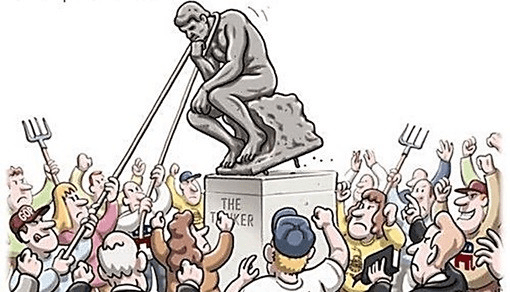
In every church I’ve ever served across the decades there have been individuals and groups of people in my congregations who are anti-intellectual. They were not big fans of seminaries. They often mistrusted highly educated persons with multiple degrees. And they had a hard time submitting to any authority structure that smacked to them of being elitist.

Unfortunately, the majority of those persons, in my experience, refused to learn in any other way other than their own personal experience. I don’t think I need to tell you the many pitfalls such a stance creates: constant misinterpretation of situations; prejudice toward others whom they don’t understand; and chronic disobedience to every authority in their life.

It likely wouldn’t surprise you to know that these sorts of parishioners rarely, if ever, read their Bibles, or even seek to learn other than hearing Sunday sermons. They reek of spiritual immaturity and pride, being puffed-up with themselves that they aren’t like the elites in power.

Now imagine what a group of people like this would be like if they were in the highest levels of government… But we need not imagine; the reality is in front of us every day.

To understand the current political climate in the United States, it seems to me we need to see that the present governmental administration, at its heart, is an anti-intellectual movement.

Now please know that I am not saying that everyone in the administration is stupid. What I am saying is that many if not most Republicans have a deep seated problem with educational elites – hence the sustained attention on American universities, especially Harvard.

They believe themselves to be practical, no nonsense people who can get things done without umpteen committees and eggheaded reports. The problem, however, is that in their belief of experiential superiority, they’ve refused to listen. They end up making snap judgments of situations and other people. In other words, they can quickly make a disaster of things whenever they’re in charge.

Furthermore, what the anti-intellectuals end up doing most is grasping for as much worldly power as they can gain.

For Protestant Evangelicals, their desire for power stems from their perceived loss of a golden age of Christendom. Back then they were in power – prayer in schools, no abortion, the Ten Commandments in every court house, riding your bike in the neighborhood with safety, etc.

Yet, because there is such a paucity of listening and seeking to understand, the anti-intellectuals fail to understand that their own golden age was a bronze age of Jim Crow laws, failed reservation promises, and the need to operate in the shadows for all sorts of other persons.

Holy Scripture’s Book of Proverbs – which is a combination of accumulated knowledge and lived experience – has something to say about those who refuse to listen and learn from others:

With wisdom you will learn
what is right
    and honest and fair.
    with knowledge. (Proverbs 2:9-10, CEV)

Fools think they know
    what is best,
but a sensible person
    listens to advice. (Proverbs 12:15-16, CEV)


Stupidity leads to foolishness;
    be smart and learn. (Proverbs 14:18, CEV)

Fools have no desire to learn,
instead they would rather
    give their own opinion. (Proverbs 18:2, CEV)

Pride leads to destruction;
    humility leads to honor.
It’s stupid and embarrassing
to give an answer
    before you listen. (Proverbs 18:12-14, CEV)

An ignorant fool learns
    by seeing others punished;
a sensible person learns
    by being instructed. (Proverbs 21:11, CEV)

If we apply our hearts to wisdom, we will learn:

  • the pursuit of power at all costs creates stupidity
  • the disdain and/or ignorance of others has adverse consequences for all
  • there has always been an anti-intellectual strain throughout the history of the world (including U.S. history)
  • the act of placing blame on others (such as the so-called “elites”) will come back to bite us

It does no good to reason with an anti-intellectual, namely because they will not avail themselves of logic nor learning.

Instead, it is wise to treat an anti-intellectual like we ourselves would want to be treated: to have another listen to us and be curious about why we hold to what we hold, without judgment; and to have another respect our ability to choose for ourselves.

Can you imagine a world where we would all commit ourselves to listening and learning, acquiring knowledge, understanding, and wisdom? We would likely live in a very different world than the one we are in today.

May the course of this world be peaceably governed by divine providence. And may the church everywhere joyfully serve God in confidence and serenity. Amen.

How Do You Want To Be Remembered?

Someday when I am dead and buried, I would be fine with my gravestone stating, “He was humble and wise.” For I have always sought (however imperfectly) to embrace and live a life characterized by poverty of spirit, largeness of heart, and a sage mind.

Yet, most of all, I’d like to be remembered by the phrase, “He loved God.” The Great Command of Jesus to love God and each other is something I pray and seek in my daily life. And I hope that at the end of my earthly life, the love of God within me has made the world a better place.

In saying this, it means I forsake a lot of other ambitions to be remembered by. I don’t really care if I am remembered for any other virtues or abilities other than love, humility, and wisdom.

For the times that I have unknowingly pursued other things above what is of concern to my Lord Jesus, I admit and renounce those things. Because that is what humility and love does. And it’s the wisest thing a person could do.

That is in direct contrast and opposition to worldly ambitions for wealth and financial resources, power and authority, attention and greatness. Such desires arise from pride, not humility. With arrogance, ignorance and hate are not far behind.

Such virtue is itself the good life. And it is not out of touch for any of us. For Christ himself repeatedly told and reminded his disciples that the kingdom of God is near, so near as to be within us.

“The time has come, and God’s kingdom is near. Change the way you think and act, and believe the Good News.” (Mark 1:15, God’s Word Translation)

“The Kingdom of God is near you now.” (Luke 10:9, New Living Translation)

And we are told to make God’s kingdom a priority. We are to humble ourselves before God and seek the reign of God and the values of how God operates, rather than putting all our equity into material possessions.

“Seek first the kingdom of God and his righteousness, and all these things (material resources) will be given to you as well.” (Matthew 6:33, New International Version)

The super-rich of this world have a super difficult time ever humbling themselves to anyone, including God, because they can so easily rely upon their vast earthly resources.

“Truly I tell you, it will be hard for a rich person to enter the kingdom of heaven. Again I tell you: It is easier for a camel to go through the eye of a needle than for someone who is rich to enter the kingdom of God.” (Matthew 19:23-24, New Revised Standard Version)

God’s kingdom is not something that is so far out of touch for us, or way out there somewhere, as if we could not, and therefore need not, pay much attention to it. No, it is much closer than any of us realize.

You and I have the light within us. For some people (maybe most people) this light has diminished to a tiny little flame or spark. They themselves either cannot or will not perceive there is something right and good that exists down deep in this soul created in the image and likeness of God.

Phrases such as “Let us rely upon our better angels,” and “Get in touch with our nobler instincts,” are more modern ways of expressing that there is inherent worth within us that we can tap into. It doesn’t even take a Christian or a religious person to recognize this reality.

We really do have a higher self, a conscience containing a moral compass, a given benevolent nature, altruistic impulses, and a compassionate side to us. Will we seek this part of ourselves? Will we tap into it? Will we allow it to come out into the world in order to bless it, not curse it?

Yet, as we know all too well, we also a have within us a depraved part which wants to rule over others and acquire as much wealth and power as possible. As with most things, we ourselves are a paradoxical conundrum of competing desires.

How do you want to be remembered? We can pursue the kingdom of God within us, or we can seek the kingdoms of this world outside of us. It’s your choice. But you will need help, if going after such things as humility, wisdom, and love as your way of life – not only help from God, but also help from others.

“Ask, and it will be given to you; search, and you will find; knock, and the door will be opened for you. For everyone who asks receives, and everyone who searches finds, and for everyone who knocks, the door will be opened. Is there anyone among you who, if your child asked for bread, would give a stone? Or if the child asked for a fish, would give a snake? If you, then, who are evil, know how to give good gifts to your children, how much more will your Father in heaven give good things to those who ask him!

“In everything do to others as you would have them do to you, for this is the Law and the Prophets. (Matthew 7:7-12, New Revised Standard Version)

What is true of you, that you would like engraved on your gravestone? How do you want to be remembered? That’s what we need in this world, for this time and for this place.