Be Generous (Mark 12:41-44)

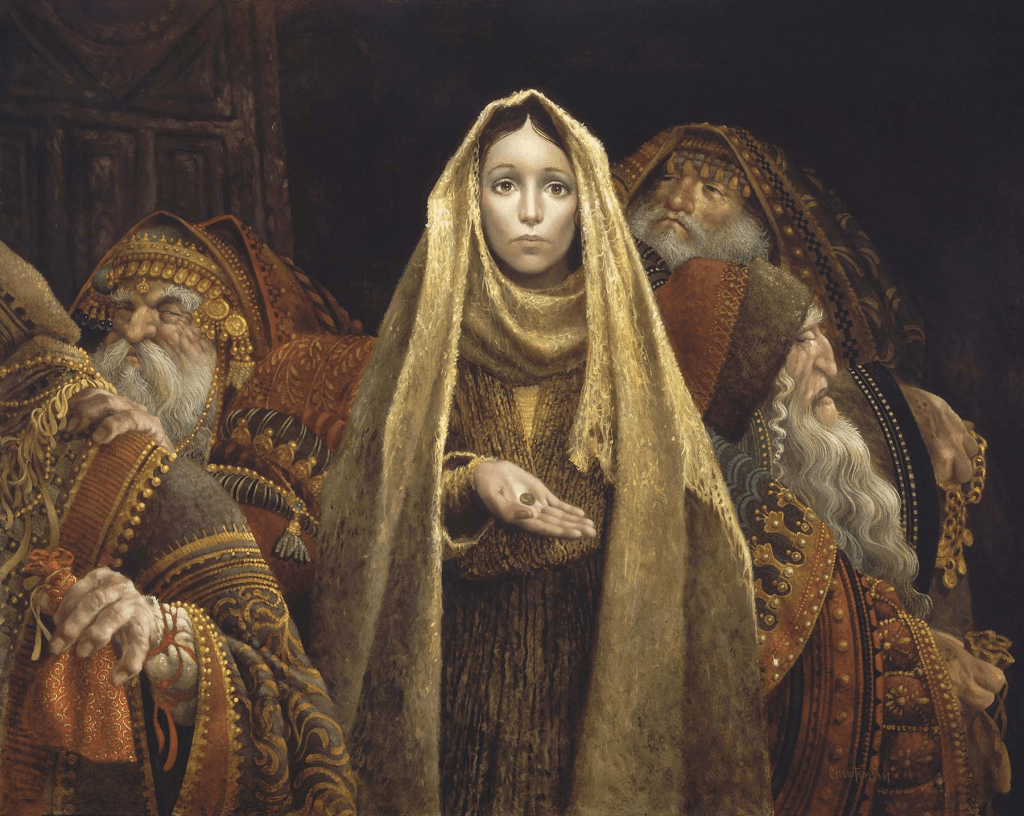
The Widow’s Mite by James Christensen

Jesus sat down opposite the place where the offerings were put and watched the crowd putting their money into the temple treasury. Many rich people threw in large amounts. But a poor widow came and put in two very small copper coins, worth only a few cents.

Calling his disciples to him, Jesus said, “Truly I tell you; this poor widow has put more into the treasury than all the others. They all gave out of their wealth; but she, out of her poverty, put in everything—all she had to live on.” (New International Version)

Money. Can’t live without it; can’t live with it. *Sigh*

If there’s a litmus test of one’s true benevolence and spirituality, it’s how money is handled and/or mishandled. And it isn’t as cut-and-dried as giving large sums of it away.

In today’s short Gospel lesson, the offerings of rich people were unimpressive to Jesus. To him, their big donations are insignificant.

On the other hand, a poor widow’s measly offering is validated as a rich contribution. In giving everything, Jesus holds up the widow as an example for us to follow.

This raises a natural and interesting question: Does this mean everyone should give everything they have? Maybe. Maybe not. Yet perhaps the very question betrays how we tend to think about money – that it’s ours, we earned it, and we can do whatever we want with it.

But the fact of the matter is that we really own nothing. We are merely stewards, entrusted with using that which has been graciously given to us by God. The Lord is the owner of it all. It was never really ours to begin with.

Taken from this perspective, anything we hold onto and refuse to let go, no matter how large or small, is a form of theft. We have taken something that doesn’t belong to us. We aren’t satisfied with being stewards; we want to be owners and masters.

What you do with your money shows your allegiance to the true Owner of it. If it belongs to Caesar, well then, go ahead and give it to him. And if it belongs to God, then there isn’t an issue in distributing money in ways which benefit humanity and uplift the poor.

The widow knew that her money, what little of it she had, belonged to God. She seemed to understand that God’s values are very different from earthly values. The kingdom of heaven expects us to hold all things, money included, with open hands. Whereas the kingdoms of this world fully expect that people will hold their money with tight fists – which is why we have so many layers of cybersecurity around our assets.

Money is a means to an end and not the end itself. It is the means to ensure the welfare of the common good of all persons. It’s a tool to shape a better society, built not on the backs of the poor, but for the benefit of the needy so that everyone can participate fully in the community.

To build a petty kingdom and become master of a small world is nothing more than stealing from God and withholding resources where they are needed.

And to make things more complicated and challenging, in today’s world, time is money. It’s easy to write a check, transfer some funds, or allocate some resources for others. However, it is never easy to grace people with the gift of time. Relational connection takes time and effort – the kind of time many people believe they do not have. Yet, time also belongs to God, and it is to be stewarded with care, just like our money.

The Poor Widow’s Offering by Unknown artist

Let’s come back to the poor widow. After all, she is our example of true generosity.

In ancient Israel, those in poverty were not required to give. So, whenever the poor did so, they simply gave because they believed in the need to maintain all it took for the worship of God to happen. The widow was under no compulsion to give anything, let alone everything she had. She seemed to understand what the Apostle Paul discovered later:

The person who sows sparingly will also reap sparingly, and the person who sows generously will also reap generously. Each one of you should give just as he has decided in his heart, not reluctantly or under compulsion, because God loves a cheerful giver. And God is able to make all grace overflow to you so that because you have enough of everything in every way at all times, you will overflow in every good work. (2 Corinthians 9:6-8, NET)

A spirit of generosity is to be ubiquitous throughout Christianity. It is a spirit that doesn’t let the left hand know what the right hand is giving (Matthew 6:3). A generous spirit rightly discerns that where your treasure is, there your heart will be also (Matthew 6:21).

And the guide of altruistic giving is savvy to the reality that the accumulation of money often leads to the love of money. So, the generous person keeps temptation at bay by withholding love toward things so that love can be lavishly given to people. For some people, eager for money, have wandered from the faith and pierced themselves with many griefs. (1 Timothy 6:10)

Like the poor widow, we are to put our hope in God, who richly provides everything for our enjoyment.

Eternal God, we pray that stewardship will be our way of life. We acknowledge You as the source of all we have and all we are.

Loving Creator, help us to place You first in our lives by being prayerful, loving, and caring for our families neighbors in need, and by becoming less preoccupied with material things.

Sovereign Lord, help us to hear your call to be good stewards, caretakers, and managers of all your gifts by sharing them for your purposes. May Your priorities be our priorities. May we have an active and generous faith.

Blessed God, help us to serve the Church, our communities, and our world with Your good and gracious gifts; and with joyful and grateful heart, through Jesus Christ our Lord. Amen.


Luke 18:18-30 – A Rich Man’s Question

A certain ruler asked him, “Good teacher, what must I do to inherit eternal life?”

“Why do you call me good?” Jesus answered. “No one is good—except God alone. You know the commandments: ‘You shall not commit adultery, you shall not murder, you shall not steal, you shall not give false testimony, honor your father and mother.’”

“All these I have kept since I was a boy,” he said.

When Jesus heard this, he said to him, “You still lack one thing. Sell everything you have and give to the poor, and you will have treasure in heaven. Then come, follow me.”

When he heard this, he became very sad, because he was very wealthy. Jesus looked at him and said, “How hard it is for the rich to enter the kingdom of God! Indeed, it is easier for a camel to go through the eye of a needle than for someone who is rich to enter the kingdom of God.”

Those who heard this asked, “Who then can be saved?”

Jesus replied, “What is impossible with man is possible with God.”

Peter said to him, “We have left all we had to follow you!”

“Truly I tell you,” Jesus said to them, “no one who has left home or wife or brothers or sisters or parents or children for the sake of the kingdom of God will fail to receive many times as much in this age, and in the age to come eternal life.” (New International Version)

The sorts of questions we ask say a lot about us. We might classify all questions into genuine curiosity and self-justification. This includes the tone of voice and affect in which the question is asked.

The wealthy man in today’s Gospel lesson asked a question. Rather than his tone being one of truly seeking to know, and his affect reflecting an authentic desire to know, instead he had his nose held high with a sanctimonious sounding expression. The man was mostly after a divine sanction of his lifestyle and his spirituality.

It doesn’t take the Son of God to know that this guy was pompously trying to angle for some kudos from Jesus about his superior life. But Christ, rather than blowing off the rich man or just blasting him for being a peacock, answered his question and led the man to what is most important.

One way of looking at the interaction between the rich man and Jesus is that it was an intervention. The rich man was addicted to wealth and money, but he didn’t see it. And he wanted validation that his way of life was sanctioned by the Almighty. 

The rich man believed himself to be quite godly and spiritual – an upstanding citizen, a religious man, attentive to God’s law. It’s a sad story because he walked away un-transformed by his encounter with Jesus and refused to follow him. He didn’t see himself as hopeless and desperately needing to change. He held to his denial.

We are all addicted to sin.  If you want to push back on that statement and are thinking, “Well, I don’t have as much money as _____” or, “So-and-so really has a problem with this…” then you are practicing what we call, in terms of addiction, denial. 

Truth be told, all of us are in some sort of denial about how much we really trust in paychecks, bank accounts, investments, and a wealth of stuff. Even people who are truly in poverty can also be addicted to wealth by always thinking about money and wishing for it as the answer to their problems, as if wealth is the highest good to attain in life.

Jesus put the problem out there for us all to see by communicating to us that sin cannot be managed – rather, sin needs to die. 

The good news is that by honestly facing up to our own addiction to things we can find grace. Grace always has the last word. Grace trumps addiction to money, stuff, and anything else. 

God’s love and acceptance is not conditional. Both the wretched sinner and the pompous peacock will find Christ’s forgiveness through the cross. Jesus put sin to death. We are simply invited to bring it out in the open, confess it, and follow Jesus.

One question that delights the heart of God, and reflects a humble and penitent spirit from us is this: “Will you forgive me, Lord?”

Most merciful God, we confess that we have sinned against you in thought, word, and deed, by what we have done, and by what we have left undone. We have not loved you with our whole heart; we have not loved our neighbors as ourselves. We are truly sorry and we humbly repent. For the sake of your Son Jesus Christ, have mercy on us and forgive us; that we may delight in your will, and walk in your ways, to the glory of your Name. Amen.

Luke 12:32-40 – Don’t Be Afraid to Give

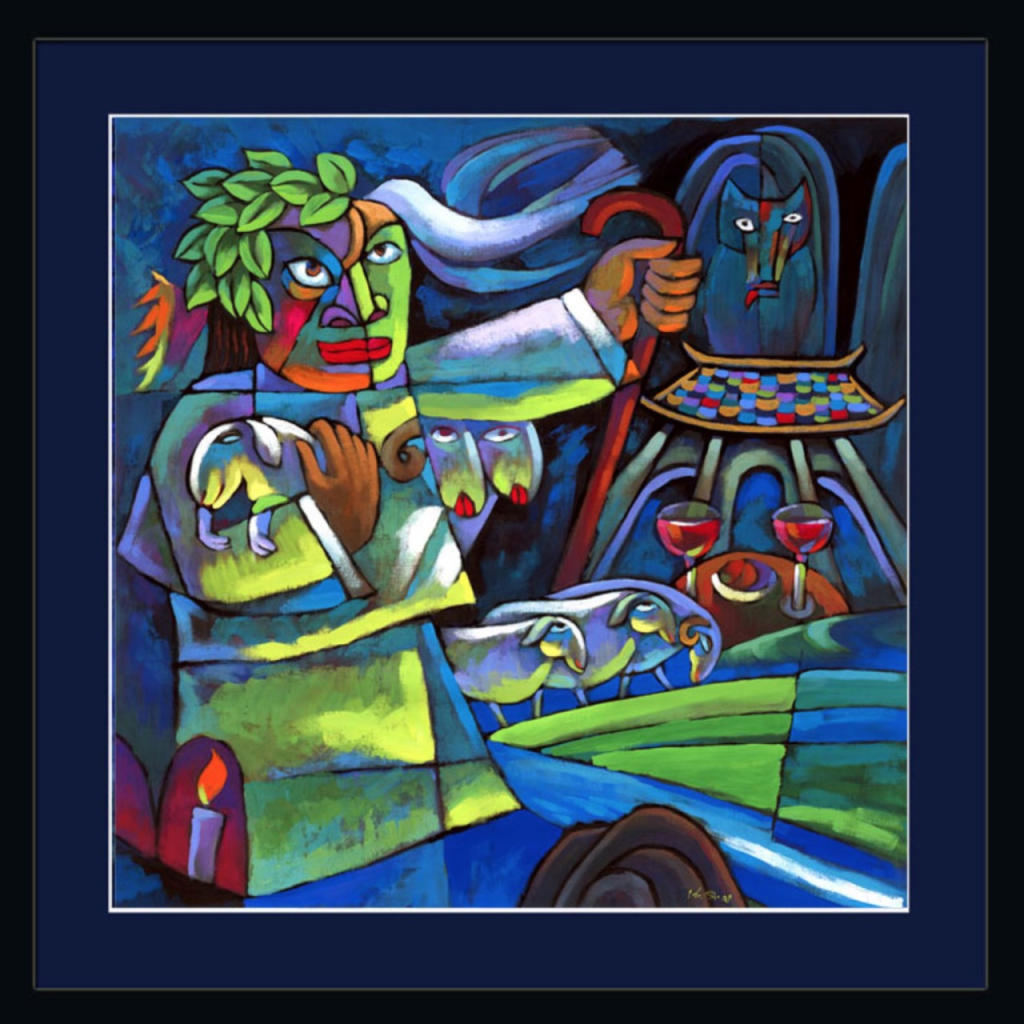
The Good Shepherd by He Qi

“Do not be afraid, little flock, for your Father has been pleased to give you the kingdom. Sell your possessions and give to the poor. Provide purses for yourselves that will not wear out, a treasure in heaven that will never fail, where no thief comes near, and no moth destroys. For where your treasure is, there your heart will be also.

“Be dressed ready for service and keep your lamps burning, like servants waiting for their master to return from a wedding banquet, so that when he comes and knocks they can immediately open the door for him. It will be good for those servants whose master finds them watching when he comes. Truly I tell you, he will dress himself to serve, will have them recline at the table and will come and wait on them. It will be good for those servants whose master finds them ready, even if he comes in the middle of the night or toward daybreak. But understand this: If the owner of the house had known at what hour the thief was coming, he would not have let his house be broken into. You also must be ready, because the Son of Man will come at an hour when you do not expect him.” (New International Version)

The most oft repeated command in all of Holy Scripture is, “Do not be afraid.” The Lord says it 365 times. It seems like we are meant to be reminded of this every day of the year.

The particular stating of the phrase by Jesus is in the context of money and possessions. Christ is telling his disciples to not fear about personal resources. Since we have a kingdom inheritance, we ought to freely give what we have to the poor without fear of being in need ourselves.

And it isn’t something we ought to procrastinate about – because the Lord could return at any time; and he doesn’t want to have to go looking for us underneath a pile of money and possessions in order to find us.

“Inaction breeds doubt and fear. Action breeds confidence and courage. If you want to conquer fear, do not sit home and think about it. Go out and get busy.”

Dale Carnegie

Fear is a real thing. Fear, at its core, is being afraid of losing what we have and getting hurt. Fear can be a helpful emotion, meant to protect us and keep us safe from harm. The problem, however, is that our fears can lead us to some unhealthy behaviors such as:

  • Vilifying another, afraid that others I don’t know or who are different from me might harm me, my family, or my community.
  • Hiding my emotions, afraid my weaknesses or failures will be exposed or exploited.
  • Serving others compulsively, afraid that I won’t have worth, meaning, or purpose without helping.
  • Achieving or winning, afraid that I will be irrelevant or unwanted, if I lose.
  • Smiling and being upbeat, afraid of facing and feeling the deep sadness within me.
  • Procrastinating projects, tasks, or conversations, afraid of being disliked or rejected.

“Fear is the path to the Dark Side. Fear leads to anger, anger leads to hate, hate leads to suffering.”

Yoda

All of those unhealthy practices keeps us at arm’s distance from the poor and needy. Getting close to poor folk creates fear with some people, that is, being afraid they might hurt me, or afraid that they will get my money.

“Fear keeps us focused on the past or worried about the future. If we can acknowledge our fear, we can realize that right now we are okay.”

Thich Nhat Hanh

Faith is the opposite of fear. Faith tethers itself to the promises of God and frees us to be generous. And faith allows us to confidently minister and build relationships with all kinds of people, especially the poor and needy.

One of the great preachers in church history, St. John Chrysostom (the fourth century Bishop of Constantinople) lived in a large city full of both rich and poor. He lamented the large class difference between them. He said this about poverty and wealth:   

“To deprive is to take what belongs to another; for it is called deprivation when we take and keep what belongs to others.  By this we are taught then when we do not show mercy, we will be punished just like those who steal.  For our money is the Lord’s, however we may have gathered it.  If we provide for those in need, we shall obtain great plenty. 

This is why God has allowed you to have more, not for you to waste on… indulgence, but for you to distribute to those in need….  If you are affluent, but spend more than you need, you will give account of the funds which were entrusted to you… for you obtained more than others have, and you have received it, not to spend it for yourself, but to become a good steward for others as well.”

“Whenever you see anyone longing for many things, esteem him of all persons the poorest, even though he possess all manner of wealth; again, when you see one who does not wish for many things, judge him to be of all persons most affluent, even if he possess nothing. For by the condition of our mind and spirit, not by the quantity of our material wealth, should it be our custom to distinguish between poverty and affluence.”

The point that Jesus makes of selling possessions and giving to the poor is not to elevate poverty over wealth – or the poor over the rich – but rather to lift generosity as a significant mark of the Christian life.

In the same way, the watchfulness Jesus commands is not an anxious hand-wringing anticipation of the apocalypse. Instead, it is an eager expectation of God’s final act of doing away with all injustice forever.

In other words, Jesus is extoling a faith that frees us to be generous; enables us to leave fear, worry, and anxiety behind; and that creates in us confidence about how the future is all going to shake-out in the end.

The Lord’s Table is meant to remind us that God is hospitable and generous.

Communion together is meant to show us that we are not alone in faith.

And the Eucharist allows us to celebrate a future we know is coming, that as often as we eat and drink the elements of bread and cup, we proclaim the Lord’s death until he returns to judge the living and the dead.

Like the feeding of the 5,000, there is plenty of bread for all – and the cup will never run dry. That’s because the Lord we serve is a God of abundance. And when we are near to such a generous God, we feel safe and secure, and are able to freely share what we have with others – without fear and without panicking that there isn’t enough. There’s always enough because God is enough.

Generous and gracious God, You came to honor the least, the forgotten, the overlooked and the misjudged. You came to give first place to the last, those left behind, and those who are misunderstood and undervalued. You came to give a warm welcome to the lost, the abandoned, and the destitute.

Help us to be your ears to listen to their cries. Help us to be your voice speaking out love and acceptance. Help us to be your feet walking beside those in need. Help us to be your hands to clothe, feed and shelter them. You came for the least, the lost and last of this world. Lord, hear our prayer. Amen.

Luke 12:13-21 – The Parable of the Rich Fool

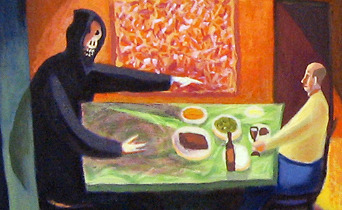
The angel of death surprises a rich man by Jim Janknegt

A man in a crowd said to Jesus, “Teacher, tell my brother to give me my share of what our father left us when he died.”

Jesus answered, “Who gave me the right to settle arguments between you and your brother?”

Then he said to the crowd, “Don’t be greedy! Owning a lot of things won’t make your life safe.”

So, Jesus told them this story:

A rich man’s farm produced a big crop, and he said to himself, “What can I do? I don’t have a place large enough to store everything.”

Later, he said, “Now I know what I’ll do. I’ll tear down my barns and build bigger ones, where I can store all my grain and other goods. Then I’ll say to myself, ‘You have stored up enough good things to last for years to come. Live it up! Eat, drink, and enjoy yourself.’ ”

But God said to him, “You fool! Tonight, you will die. Then who will get what you have stored up?”

“This is what happens to people who store up everything for themselves but are poor in the sight of God.” (Contemporary English Version)

Let’s be honest before God because there’s no way we are going to fool him. The truth is, we all worry. 

And the more stuff we accumulate, the more worried we get. And the more worried we get, the stingier we become – to the point where we encase ourselves around more stuff, which requires bigger places to store all our stuff.

Here’s a bit of a reality check: We are not self-sufficient independent automatons who are meant to function by themselves without ever needing help.

The Rich Fool by Rembrandt, 1627

If we have some success in this independence venture, we then expect that others ought to be able to do it, too. Such thinking leads to a lack of generosity, believing that others just need to work harder or smarter or better. They’re lazy, we may reason. So, I’ve got no responsibility to share any of my largess with slackers.

We seek after whatever it is we desire. If we seek the kingdom of God, we will pursue the Lord Jesus and aim our love toward knowing him. But if we seek materialism, wealth, and the accumulation of stuff, we will never have enough because worry and fear shall always overwhelm the voice of God. 

I make it sound easy, as if the choice were so clear. On one level it is, but, like most things, it’s complicated because we are all a weird hybrid of competing loves and desires.

So, let’s make a few distinctions that might help us clarify our kingdom calling. Materialism is not the same thing as hard work. 

Materialism:

  • Is a shield we lug around to protect us from failure and poverty
  • Puts us on a performance treadmill, and is tied to our self-worth
  • Is a never-ending quest for security and protection
  • Seeks to avoid the criticism of others by seeking their approval with stuff
  • Believes that money will take away feelings of hurt, pain, and discomfort

Whereas hard work:

  • Is about healthy achievement and a patient growth of assets
  • Seeks to improve and is satisfied with a job well done
  • Takes away fear and worry 
  • Brings gratitude and joy

Any worldly fool can make money; but the wise and righteous person is able to manage resources in a way that glorifies God, builds up the church, and blesses the world. 

And it all begins with knowing the difference between depending on God versus depending on self and stuff.

The rich farmer in Christ’s story is a fool not because he is wealthy or because he saves for the future, but because he lives only for himself, and because he believes he can secure his life with his abundant possessions.

In the parable, the rich guy only talks to himself – not to anyone else. The man doesn’t express any gratitude to God. There is neither any thanking the workers who have helped him plant and harvest this bumper crop, nor any sharing his wealth through giving them a bonus.

The farmer has more than he could ever hope to use, yet he seems to have no thought of sharing it. And there is clearly no thought of what God might require of him. The rich man is outright blind to the fact that his life is not his own to secure, that his life belongs to God, and that God can demand it back at any time.

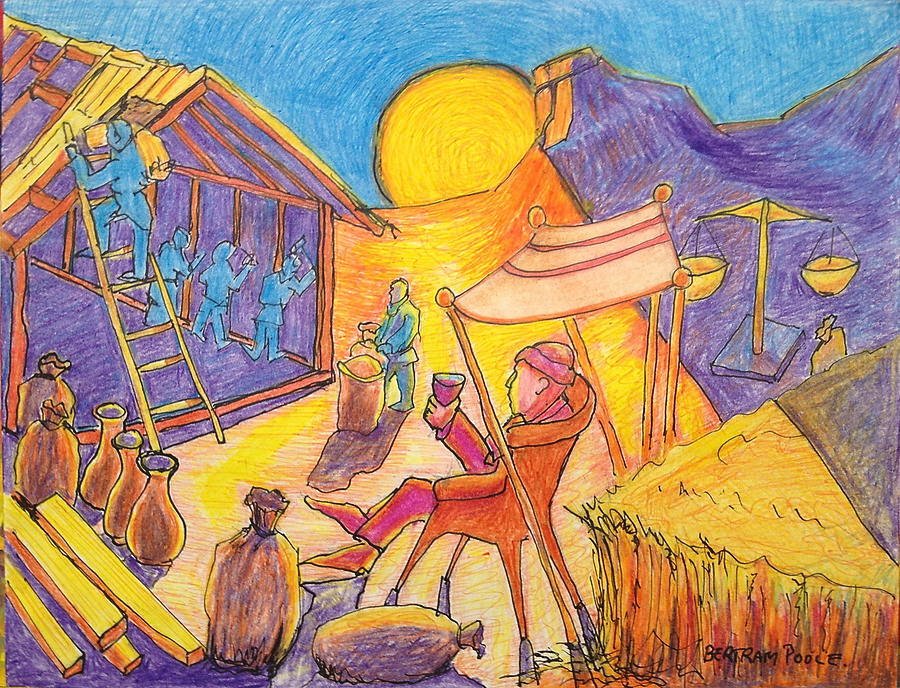
The Rich Fool by Bertram Poole

No amount of wealth can give any of us what we need most in life: healthy relationships, the love and enjoyment of friends and family, or eternal life. Nobody can buy their way into heaven or eternal bliss. What’s more, money cannot provide protection from disease and disaster.

Here’s another reality check: The rich and the poor all die, just the same. And the one who is wealthy cannot take a bit of it with him.

At issue here, for Jesus, is neither saving for retirement or for future needs, nor enjoying the good things in life. In fact, that’s wisdom.

The issue, for Jesus, is about what’s most important to God. It’s about priorities. God cares deeply about how we invest our lives and use the gifts given us. The Lord is vested in us, so he cares about how we love God and neighbor. God wants us to orient our lives toward the divine mission to bless and redeem the world.

In other words, God cares about whether we care, or not, about others.

As a hospital chaplain, I’ve seen my share of death. And I have never once heard anyone say, “Gosh, chaplain, I sure wish I hadn’t given so much money and stuff away. I wish I had kept more for myself.” But I’ve sure heard plenty of the opposite.

A spiritual reality check: We, and our resources, all belong to God.

We are merely stewards of everything we own. God gave it to us. God can take it away. Including our life.

The good news is that, since we, and everything we have, belongs to God, our future is secure in Christ.

Merciful God, thank you for giving me everything I need for life and godliness in this present world. Forgive me for ever doubting your goodness and ability to provide for me. Let my life bless the name of Jesus, and may I steward all that you have given me with care and compassion. Amen.