Divine Providence (Genesis 30:37-43)

Jacob with Laban’s flock, by Jusepe de Ribera, 1632

Then Jacob took some fresh branches from poplar, almond, and plane trees and peeled off strips of bark, making white streaks on them. Then he placed these peeled branches in the watering troughs where the flocks came to drink, for that was where they mated. And when they mated in front of the white-streaked branches, they gave birth to young that were streaked, speckled, and spotted. Jacob separated those lambs from Laban’s flock. And at mating time he turned the flock to face Laban’s animals that were streaked or black. This is how he built his own flock instead of increasing Laban’s.

Whenever the stronger females were ready to mate, Jacob would place the peeled branches in the watering troughs in front of them. Then they would mate in front of the branches. But he didn’t do this with the weaker ones, so the weaker lambs belonged to Laban, and the stronger ones were Jacob’s. As a result, Jacob became very wealthy, with large flocks of sheep and goats, female and male servants, and many camels and donkeys. (New Living Translation)

Jacob had been working for his father-in-law Laban for years. During that time, they both contested with each other in a chess match of trying to gain the upper hand. Mostly, Jacob had been outmaneuvered by Laban. But now he achieves a sort of coup de grace, a checkmate.

Having agreed between them that Jacob’s wages would be only the speckled and spotted sheep and goats, as well as every black lamb, Laban proceeded to remove all those animals from his flock and sent them off away from Jacob. This was yet another unfair practice in the chess game of his life.

Even if Jacob wanted to retaliate, he really had no means to do it – which is why Laban kept taking advantage of him. But Laban underestimated who he was playing against and dealing with.

Using an unusual method, something akin to sympathetic magic – a ritual using an object that resembles the sheep over which Jacob sought influence – he systematically grew his own flock of many strong sheep and goats. Jacob then separated these stronger animals from Laban’s flock. In doing this, Jacob became exceedingly wealthy.

It’s an incredible story, almost like achieving the modern day American dream of rags to riches in the face of adversity. Yet, behind all the success of Jacob, we as the readers know that this happens because God is working out divine promises to the family of Abraham, Isaac, and now Jacob.

The power, sovereignty, providence, and grace of God stand behind every good thing people have in this life. The Lord is the One who is not flummoxed by the impending moves in the chess game; God has the ability to rearrange the chess board, reorder the future, and make restoration possible.

Although separated by more than three millennia from the family of Jacob, we can relate to the ever-present human condition, the personal struggles of overcoming the past, and the wonderings of what will happen in the future.

In whatever way we want the future to shake-out, it ultimately is in the hands of God. We would like to live in a universally closed system where there is predictability with no trickery, posturing, manipulating, or anxiety about what’s next. Many people long for a life free from an uncertain and shadowy future.

But none of us can have the precise future we may wish for. So, some people despair that we are in a closed system in which nothing can change – that systemic evil, broken institutions, fragmented families, and wounded spirits are just the way it is.

There are lots of folks who continually feel the awkward push and pull of both hope and dread – wanting to believe that things can be better, but having a sinking sense that the other shoe is about to drop.

In truth, we do not live in a closed universal system; history is not yet finalized and the Lord has a few tricks up the divine sleeve. We actually live in an open system, where we can find both surety and hope. The future, although appearing bleak for some, shall be shaped and bent by God according to divine promises and good purposes.

And when we take the time to observe this grand open system, we begin to discern that no scheming of humanity nor any human machinations can do anything more than slightly delay the inevitable Day of the Lord. Justice will have its day, and it’s way on this earth; injustice shall not last forever.

In the meantime, we do the best we can with the resources we have, at this present moment. Today is all we have. God’s gracious provision for this day is enough. Tomorrow has enough worries of its own.

An open system says that there is a spiritual force outside of social interaction. A a closed system says there is no outside force influencing our actions and outcomes.

In a closed system, we have the illusion (and delusion) that control is possible because the number of variables remains static. People in this system long for simplicity and sameness – to be able to predict what will happen next. So, they focus on structures and processes that sustain control over organizations and people.

But in an open system, dynamics from other systems impact us, creating and expanding the number of variables. It’s a complex and fluid situation, but folks learn to focus on influence rather than control, knowing there are forces at play which impact the chessboard. That’s because ultimate control belongs to God; we, as people, are called to self-control.

Almighty God, Creator and Sustainer of all things: You uphold, direct, and govern all creatures, actions and objects, from the least to the greatest. Nothing escapes your sovereign and benevolent rule—not the most powerful institution or ruler imaginable, nor the least significant speck just biding its time. You sustain all things by your powerful word.

Help me to see your hand in my life specifically and in history worldwide. Although there is much that remains a mystery in your providence, there is much that is already revealed. Your providence reveals your infinite wisdom, power, justice, goodness, and mercy. To you be all glory and praise, through Jesus Christ our Lord, who with you and the Holy Spirit are one God, now and forever. Amen.

Trust vs. Trickery (Genesis 30:25-36)

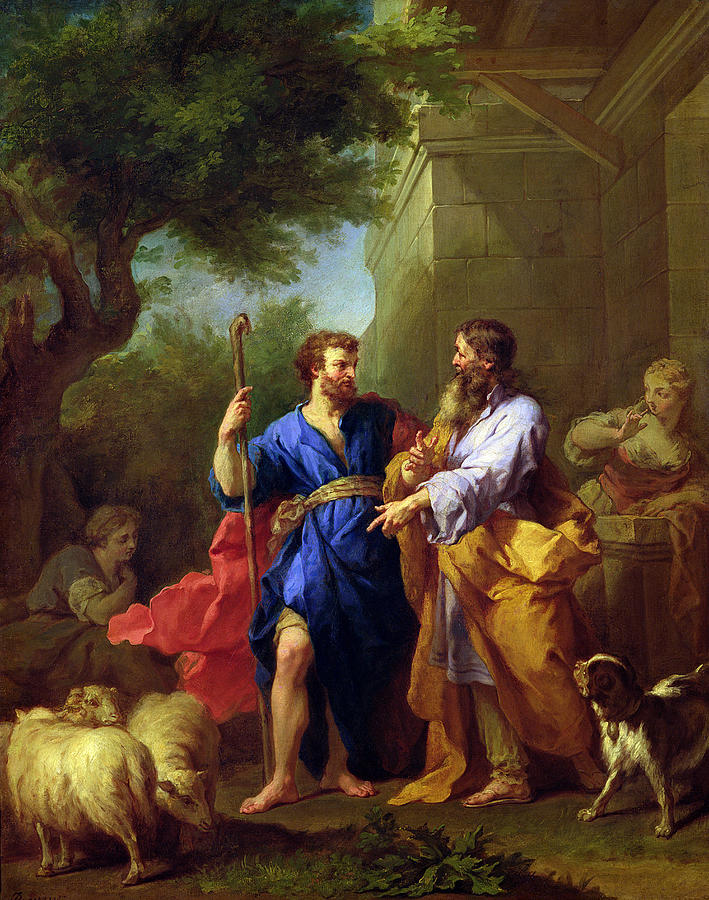
Jacob and Laban, by Pietro da Cortona (1596-1669)

After Joseph was born, Jacob said to Laban, “Release me from our agreement and let me return to my own country. You know how hard I’ve worked for you, so let me take my wives and children and leave.”

But Laban told him, “If you really are my friend, stay on, and I’ll pay whatever you ask. I’m sure the Lord has blessed me because of you.”

Jacob answered:

You’ve seen how hard I’ve worked for you, and you know how your flocks and herds have grown under my care. You didn’t have much before I came, but the Lord has blessed everything I have ever done for you. Now it’s time for me to start looking out for my own family.

“How much do you want me to pay you?” Laban asked.

Then Jacob told him:

I don’t want you to pay me anything. Just do one thing, and I’ll take care of your sheep and goats. Let me go through your flocks and herds and take the sheep and goats that are either spotted or speckled and the black lambs. That’s all you need to give me. In the future you can easily find out if I’ve been honest. Just look and see if my animals are either spotted or speckled, or if the lambs are black. If they aren’t, they’ve been stolen from you.

“I agree to that,” was Laban’s response. Before the end of the day, Laban had separated his spotted and speckled animals and the black lambs from the others and had put his sons in charge of them. Then Laban made Jacob keep the rest of the sheep and goats at a distance of three days’ journey. (Contemporary English Version)

Jacob left home by himself and went to his mother’s family. After twenty years away, he had two wives and twelve sons by four different women. He had worked for his father-in-law Laban for all that time – all to Laban’s advantage. During those twenty years, there was plenty of complicated and awkward family drama.

Now Jacob was ready to be done with all that. He wanted to move on and go back to the place of his family origin. But, of course, Laban had a good thing going and did not want Jacob to leave. So, he did his best to convince him to stay. Jacob was able to set his own terms. And there was some space put between his burgeoning family and his in-law’s.

But returning is a lot more difficult than leaving. When I left home as a young man I had all my worldly possessions in a ’74 Chevy Vega. And when I returned to the land of my origins, it was in a large rental truck with a wife a three kids. There was a lot of logistics involved, not to mention all the relationships we left.

For twenty years, Jacob and Laban did a weird relational dance. They were both tricky dudes, and were continually attempting to maneuver and outmaneuver the other. Yet, Jacob mostly got the brunt of unfairness.

In reality, Jacob owed Laban nothing. He had agreed to work for him fourteen years in total. But he could take nothing with him except his family – which would leave him with no means of support. And Laban was not about to give his son-in-law any support outside of his fatherly-in-law control.

Jacob came up with a strange set of terms concerning the flocks of sheep. Laban logically calculates that Jacob is unlikely to gain much profit from the plan, and can still keep the status quo going. So it becomes a done deal.

In a typical relational dynamic which they have become accustomed to, Laban himself sorts the flock, removes all the spotted and speckled sheep to a safe distance, and leaves Jacob with the rest.

So, if Jacob is to acquire any flock of his own, he needs to discover a way of breeding multicolored sheep from monochrome ones – a task which seems to be improbable if not impossible. But that’s exactly what Jacob does in the end, and that is yet the subject of another Old Testament lesson….

So, exactly what is today’s lesson? Life is anything but a nice, neat trajectory upwards toward achieving goals. Rather, life is a series of twists and turns, leading us to often take three steps forward and two steps backward in a herky-jerky sort of journey. Yet, behind it all, the Lord’s promises are still there, still in effect, still being worked out, in order to be fully realized. Nothing and no one is going to derail the plans and purposes of God.

Sometimes we need to be reminded that God is the giver of prosperity, and not anyone or anything else.

When you become successful, don’t say, “I’m rich, and I’ve earned it all myself.” Instead, remember that the Lord your God gives you the strength to make a living. That’s how he keeps the promise he made to your ancestors. (Deuteronomy 8:17-18, CEV)

To the person who pleases him, God gives wisdom, knowledge and happiness, but to the sinner he gives the task of gathering and storing up wealth to hand it over to the one who pleases God. (Ecclesiastes 2:26, NIV)

If any of you lacks wisdom, you should ask God, who gives generously to all without finding fault, and it will be given to you. (James 1:5, NIV)

We may, at times, feel the need to acquire what we want through trickery or manipulation. However, there is a God in heaven who sees and who cares. The Lord delights is being generous and giving to us, that is, if we are aware and attentive enough to ask. We might not get what we want immediately, and it likely won’t be easy, but we shall nonetheless receive it. We only need to trust.

Heavenly Father, source of all life, we thank you for the many ways in which you have blessed and enriched our lives: Keep us from possessiveness and greed, and lead us into the greater joy of sharing your gifts with others, through Jesus Christ, in whom is perfect peace. Amen.

Be Wise and Beware (1 Kings 10:1-13)

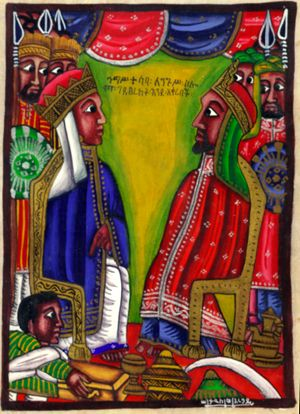
Ethiopian depiction of the Queen of Sheba and King Solomon

The Queen of Sheba heard how famous Solomon was, so she went to Jerusalem to test him with difficult questions. She took along several of her officials, and she loaded her camels with gifts of spices, jewels, and gold. When she arrived, she and Solomon talked about everything she could think of. He answered every question, no matter how difficult it was.

The Queen was amazed at Solomon’s wisdom. She was breathless when she saw his palace, the food on his table, his officials, his servants in their uniforms, the people who served his food, and the sacrifices he offered at the Lord’s temple. She said:

Solomon, in my own country I had heard about your wisdom and all you’ve done. But I didn’t believe it until I saw it with my own eyes! And there’s so much I didn’t hear about. You are wiser and richer than I was told. Your wives and officials are lucky to be here where they can listen to the wise things you say.

I praise the Lord your God. He is pleased with you and has made you king of Israel. The Lord has always loved Israel, so he has given them a king who will rule fairly and honestly.

The Queen of Sheba gave Solomon more than four tons of gold, many jewels, and more spices than anyone had ever brought into Israel.

In return, Solomon gave her the gifts he would have given any other ruler, but he also gave her everything else she wanted. Then she and her officials went back to their own country.

King Hiram’s ships brought gold, juniper wood, and jewels from the country of Ophir. Solomon used the wood to make steps for the temple and palace, and harps and other stringed instruments for the musicians. It was the best juniper wood anyone in Israel had ever seen. (Contemporary English Version)

The ancient Sabeans were a wealthy people. The kingdom of Sheba was geographically located on the southwest corner of the Arabian peninsula (present day Yemen). They were ideally situated to control all the trade in and out of the Red Sea.

Since the Sabeans were a maritime people, the Queen of Sheba made it a habit to engage in trade missions and relations with other kingdoms. King Solomon was making quite a name for himself, and his nation, through his own extensive trade endeavors. It was inevitable that the two would meet.

Solomon had wisdom and wealth because of the divine gift given to him by the Lord. It’s wonderful to have a gracious gift given by God. Most of us can relate to desiring spiritual gifts and blessings from the God we serve.

Yet, what doesn’t usually get talked about is that every divine gift given to us carries with it not only opportunities to bless the world, but also the temptation to avoid proper stewardship and use the gift for personal aggrandizement.

Slowly, over time, it can become rather easy to slip into a mode of getting more and more, of expanding influence, seeking greater honor and accolades, and increasing wealth to exorbitant extremes. For those who know the biblical storyline of Solomon, this is precisely what happened to him. Perhaps in today’s Old Testament lesson, we begin to get a glimpse of the beginnings of that slippery slope into the bottomless abyss of more.

The Queen of Sheba and King Solomon meet

The Queen of Sheba, who herself was one of the wealthiest and most influential monarchs of her day, knew what affluence looked like. So, for her to be breathless over what she observed in Solomon’s kingdom must have been over-the-top abundance and riches.

It’s telling that many contemporary Westerners can read this account and see no problem with it. In fact, some even seem to believe this is something to aspire to – to be just like King Solomon, as if this is what God wants for us.

Yet, it could be that the writer and historian of the biblical kings was leading us to a different conclusion, placing Solomon in the unfavorable light of abusing his divine gift.

After all, it’s clear Solomon used his wisdom and wealth for himself in ways that went well beyond the simple meeting of needs. Solomon was a really smart guy, familiar with God’s Law, so he knew what Moses said about all this stuff:

The king should not have many horses, especially those from Egypt. The Lord has said never to go back there again. And the king must not have a lot of wives—they might tempt him to be unfaithful to the Lord. Finally, the king must not try to get huge amounts of silver and gold.

The official copy of God’s laws will be kept by the priests of the Levi tribe. So, as soon as anyone becomes king, he must go to the priests and write out a copy of these laws while they watch. Each day the king must read and obey these laws, so that he will learn to worship the Lord with fear and trembling and not think that he’s better than everyone else.

If the king completely obeys the Lord’s commands, he and his descendants will rule Israel for many years. (Deuteronomy 17:16-20, CEV)

But Solomon ended up not heeding any of these warnings. And so, it ought to have been no surprise that, after Solomon’s death, the kingdom became divided and was never the same again.

Sheba’s Queen is the one who seemed to have both her head and her heart in the right place. She’s the one who blesses Yahweh and reminds Solomon about the need to rule with integrity and justice. The Queen was able to affirm Solomon’s gift, while at the same time reminding him of what that gift is truly for.

The wise person knows there is always a shadow side to every good gift we have. If we fail to acknowledge this, and not pay attention to it, we will find ourselves doing as much harm as we do benefit.

Generous and loving God, all we are and all that we have is a gift from you. In faith and love, help us to do your will. We offer to you this day all the facets of our lives, whether it be at home, at work, or at school. We seek to be patient, merciful, generous, and holy. Give us the wisdom and insight to understand your will for us and the fervor to carry out our good intentions. We offer to you our gifts of time, abilities, and possessions as a true act of faith, to reflect our love for you and our neighbors. Help us to reach out to others as you have reached out to us. Amen.

A Warning about Wealth (James 5:1-6)

Pay attention, you wealthy people! Weep and moan over the miseries coming upon you. Your riches have rotted. Moths have destroyed your clothes. Your gold and silver have rusted, and their rust will be evidence against you. It will eat your flesh like fire. Consider the treasure you have hoarded in the last days. 

Listen! Hear the cries of the wages of your field hands. These are the wages you stole from those who harvested your fields. The cries of the harvesters have reached the ears of the Lord of heavenly forces. You have lived a self-satisfying life on this earth, a life of luxury. You have stuffed your hearts in preparation for the day of slaughter. You have condemned and murdered the righteous one, who doesn’t oppose you. (Common English Bible)

Everyone’s station in life has its own particular temptations.

In the church for which the Apostle James wrote his letter, the rich had completely succumbed to the temptation of using their wealth to build more wealth on the backs of the poor. And the Apostle called them out on it.

Just because you nor I might not be rich in assets and wealth, doesn’t mean today’s New Testament lesson has nothing to do with us. We all inhabit some position of influence or authority, as well as own something, even if it is not much. So, how we use what has been given to us by God is of utmost importance for everyone.

The poor are tempted to envy the rich. And the rich are tempted to trust in their money, resources, and business acumen with no thought to God. Both rich and poor can identify so closely with their respective situations that their primary identity is defined by wealth, or the lack thereof.

Hoarding Wealth

It’s not unusual for a person who appears middle or lower class to have hundreds of thousands of dollars stashed away. I have met more than a few of them in my life. Some people die millionaires, having been penny pinchers their entire lives.

Stockpiling wealth, whether hiding it or flaunting it, without the intention of using it for godly purposes, is tragic. No one is blessed by it. Money is temporary; but relationships are permanent. A wise Christian focuses on storing heavenly treasure and taking an eternal view of their resources.

Don’t hoard treasure down here where it gets eaten by moths and corroded by rust or—worse! —stolen by burglars. Stockpile treasure in heaven, where it’s safe from moth and rust and burglars. It’s obvious, isn’t it? The place where your treasure is, is the place you will most want to be, and end up being. (Matthew 6:19-21, MSG)

Fraudulent Wealth

A person can become addicted to wealth. People can also desire to be wealthy to the degree that they use illegal and dishonest ways of obtaining it and holding on to it.

Withholding wages from workers is a crime, both legally and biblically. In the ancient world, and still in many places around the globe today, workers are paid daily, at the end of the workday. To not receive their pay means their families will go hungry that night.

Don’t take advantage of poor or needy workers, whether they are fellow Israelites or immigrants who live in your land or your cities. Pay them their salary the same day, before the sun sets, because they are poor, and their very life depends on that pay, and so they don’t cry out against you to the Lord. That would make you guilty. (Deuteronomy 24:14-15, CEB)

Self-Indulgent Wealth

The person who lives completely for self is only building wealth in vain, like a hog being fattened for the slaughter. Daydreaming and fantasizing about possessing money for personal indulgence, at the expense of others, will not end well.

Jesus said, “Be careful and guard against all kinds of greed. People do not get life from the many things they own.”

Then Jesus used this story: “There was a rich man who had some land. His land grew a very good crop of food. He thought to himself, ‘What will I do? I have no place to keep all my crops.’

“Then he said, ‘I know what I will do. I will tear down my barns and build bigger barns! I will put all my wheat and good things together in my new barns. Then I can say to myself, I have many good things stored. I have saved enough for many years. Rest, eat, drink, and enjoy life!’

“But God said to that man, ‘Foolish man! Tonight, you will die. So, what about the things you prepared for yourself? Who will get those things now?’ (Luke 12:15-20, ERV)

Murderous Wealth

Whenever the rich and powerful are bent on accumulating and hoarding wealth, they step all over workers to get what they want. And the poor laborers possess neither the ability nor the authority to handle the injustice. They are helpless.

By withholding wages and resources, or purposefully paying a non-living wage, the neglect puts people in poverty. Then, the poor struggle to survive. They may starve, even die, through no fault of their own. And the ones who put them in such a position will have to answer to a higher authority – God. (1 Kings 21)

Stewarding Wealth

The Lord gives us money, resources, even wealth, for us to enjoy and give to others. We are stewards, accountable for the time, assets, and relationships, given us by God in this life. So, then, we must emulate godly models of asset allocation and thoughtful stewardship.

Command those who are rich in this present world not to be arrogant nor to put their hope in wealth, which is so uncertain, but to put their hope in God, who richly provides us with everything for our enjoyment. 

Command them to do good, to be rich in good deeds, and to be generous and willing to share. In this way they will lay up treasure for themselves as a firm foundation for the coming age, so that they may take hold of the life that is truly life. (1 Timothy 6:17-19)

May we all use whatever resources, gifts, abilities, and time we have to bless others and contribute to the common good of all persons. Amen.