

Against Injustice (Jeremiah 19:1-15)

This is what the Lord says: “Go and buy a clay jar from a potter. Take along some of the elders of the people and of the priests and go out to the Valley of Ben Hinnom, near the entrance of the Potsherd Gate. There proclaim the words I tell you, and say, ‘Hear the word of the Lord, you kings of Judah and people of Jerusalem. This is what the Lord Almighty, the God of Israel, says:

Listen! I am going to bring a disaster on this place that will make the ears of everyone who hears of it tingle. For they have forsaken me and made this a place of foreign gods; they have burned incense in it to gods that neither they nor their ancestors nor the kings of Judah ever knew, and they have filled this place with the blood of the innocent. 

They have built the high places of Baal to burn their children in the fire as offerings to Baal—something I did not command or mention, nor did it enter my mind. So beware, the days are coming, declares the Lord, when people will no longer call this place Topheth or the Valley of Ben Hinnom, but the Valley of Slaughter.

“‘In this place I will ruin the plans of Judah and Jerusalem. I will make them fall by the sword before their enemies, at the hands of those who want to kill them, and I will give their carcasses as food to the birds and the wild animals. I will devastate this city and make it an object of horror and scorn; all who pass by will be appalled and will scoff because of all its wounds. I will make them eat the flesh of their sons and daughters, and they will eat one another’s flesh because their enemies will press the siege so hard against them to destroy them.’

“Then break the jar while those who go with you are watching, and say to them, ‘This is what the Lord Almighty says: I will smash this nation and this city just as this potter’s jar is smashed and cannot be repaired. They will bury the dead in Topheth until there is no more room. This is what I will do to this place and to those who live here, declares the Lord. I will make this city like Topheth. The houses in Jerusalem and those of the kings of Judah will be defiled like this place, Topheth—all the houses where they burned incense on the roofs to all the starry hosts and poured out drink offerings to other gods.’”

Jeremiah then returned from Topheth, where the Lord had sent him to prophesy, and stood in the court of the Lord’s temple and said to all the people, “This is what the Lord Almighty, the God of Israel, says: ‘Listen! I am going to bring on this city and all the villages around it every disaster I pronounced against them, because they were stiff-necked and would not listen to my words.’” (New International Version)
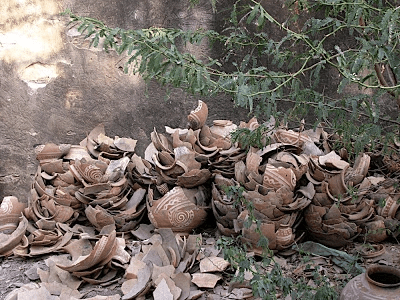
When God wants to get someone’s full attention, the Lord engages the people’s full senses in order to communicate an important message. Through the prophet Jeremiah, we get symbolic action that does just that.

The symbolism, in this case, is a judgment speech, visually and viscerally depicted through the breaking of a pottery jug. The point of the action, and the words, was meant to convey a singular message: God will bring disaster and destruction against Jerusalem and its surrounding towns.

The act of breaking the pottery took place at the entrance to the Potsherd Gate – which was also known as the Dung Gate because that is where the garbage and refuse came out of the city to a dump located in the Valley of Ben Hinnom. It just so happened that this valley was also the location of altars to false gods other than Yahweh. Idolatrous practices – including child sacrifice – were carried on there.

In the ancient Near East, smashing pottery was a ritual act that depicted the destruction of enemies.

I will proclaim the Lord’s decree:

He said to me, “You are my son;
    today I have become your father.
Ask me,
    and I will make the nations your inheritance,
    the ends of the earth your possession.
You will break them with a rod of iron;
    you will dash them to pieces like pottery.” (Psalm 2:7-9, NIV)

The prophet Jeremiah was going to make his oracle against the people both unforgettable and irreversible. He wanted to be clear about what God truly thinks about harming children in religious rituals. But more than that, that it’s absolutely unacceptable for people who worship Yahweh to let it happen, just outside their own city gates, and to even participate in it.

The pottery jar represented Jerusalem. And when a piece of pottery is broken and smashed, there is no opportunity of remaking it from all that destruction. That’s what it would be like for the city who turned their backs on the Lord’s holiness.

Sometimes contemporary people may struggle with the reality that God gets angry – even angry to the point of pouring out wrath on a city. Yet, perhaps we fail to notice the gross and terrible injustice that has been done in the name of religion. The anger of God is always a reflection of God’s love. For love cannot contend with evil perpetrated on innocent people, especially children.

Love is purely subversive. It declares that harming others and hurting people by means of religious violence is not to be accepted nor tolerated. Love is an absolute refusal to settle for the injustice that exists in the world.

Today, and every day, is our opportunity, purpose, and privilege to put love where love is not – to upset the status quo of injustice and establish love as the supreme ethic of God’s commands.

Grant us, Lord God, a vision of your world as your love would have it:
a world where the weak are protected, and none go hungry or poor;
a world where the riches of creation are shared, and everyone can enjoy them;
a world where different races and cultures live in harmony and mutual respect;
a world where peace is built with justice, and justice is guided by love.
Give us the inspiration and courage to build it, through Jesus Christ our Lord. Amen.


Confronting Spiritual and Emotional Pain (Psalm 79)

The Scream, by Edvard Munch, (1863-1944)

God! Barbarians have broken into your home,
    violated your holy temple,
    left Jerusalem a pile of rubble!
They’ve served up the corpses of your servants
    as carrion food for birds of prey,
Threw the bones of your holy people
    out to the wild animals to gnaw on.
They dumped out their blood
    like buckets of water.
All around Jerusalem, their bodies
    were left to rot, unburied.
We’re nothing but a joke to our neighbors,
    graffiti scrawled on the city walls.

How long do we have to put up with this, God?
    Do you have it in for us for good?
    Will your smoldering rage never cool down?
If you’re going to be angry, be angry
    with the pagans who care nothing about you,
    or your rival kingdoms who ignore you.
They’re the ones who ruined Jacob,
    who wrecked and looted the place where he lived.

Don’t blame us for the sins of our parents.
    Hurry up and help us; we’re at the end of our rope.
You’re famous for helping; God, give us a break.
    Your reputation is on the line.
Pull us out of this mess, forgive us our sins—
    do what you’re famous for doing!
Don’t let the heathen get by with their sneers:
    “Where’s your God? Is he out to lunch?”
Go public and show the godless world
    that they can’t kill your servants and get by with it.

Give groaning prisoners a hearing;
    pardon those on death row from their doom—you can do it!
Give our jeering neighbors what they’ve got coming to them;
    let their God-taunts boomerang and knock them flat.
Then we, your people, the ones you love and care for,
    will thank you over and over and over.
We’ll tell everyone we meet
    how wonderful you are, how praiseworthy you are! (The Message)

The temple was destroyed. The conquering army gloats over their victory. That’s the context of today’s psalm. It’s a prayer, an angry cry for God to step in and act on behalf of the humiliated people. The prayer is more than a simple plea for help; it’s a deeply passionate appeal, that says in 1960’s terms, “God, stick it to the man!”

In the face of evil, when there is destruction all around and violence everywhere, prayer does not become some sort of polite knock at the side door of God’s house. Instead, prayer is a pounding on the front door with a demand for God to do something about this terrible trouble.

For the psalmist, the incongruence between who God is and what has happened to God’s people is inconceivable and unacceptable. To profane God’s temple is to profane God; and to kill and maim God’s people is to flip the middle finger at God. The psalmist is beside himself and overwhelmed with emotion.

There is something very instructive here that we ought not miss. When we have been brutalized, victimized, and/or demoralized, we just want someone, especially the Lord we serve, to take notice and feel what we are feeling. Never underestimate the power of empathy and solidarity. To feel alone and bereft of help is an awful feeling.

Perhaps the psalmist’s prayer offends some sensibilities. I wonder, for those who find the language difficult, have ever had a daughter raped, or a house destroyed by fire, or seen a person killed without mercy in front of their own eyes. Methinks they have not. The feelings of helpless despair and sheer anger defy human words. These are not casual affronts; they are malicious destructions of property and people.

We need someone to affirm the raw ruthlessness of it all, to have some understanding of the impossible place we are in, with having to deal with such wanton cruelty. When our very support is ripped from our lives, the madness within is too much to bear. Who will rescue us from this body of death?

God is big enough to handle our rage and our hurt. The Lord is available and hears our desperate voice of prayer. Yet, God is not always going to directly and immediately answer on the terms we stipulate. God acts out of God’s own providence and justice, and not from our expectations. And that is a good thing, not a bad thing.

God sees. The Lord knows. And the Sovereign of the universe feels it all with us. The realization of this divine empathy enables us to recenter and reorient ourselves around faith, hope, and love. New life is never a gift in a vacuum; it comes out of agonizing struggle in having to reckon with the existence of evil.

So, when someone goes through a hellish experience, let us exercise our capacity to listen and witness the horrible spiritual pain of the person. Healing hurts: it is not a pleasant affair. So, hang in there and walk alongside another in their hour of need, even when their vitriol seems over the top to us. For only in telling our story to another will any of us find relief and renewed hope.

The biblical psalms permit us to use language appropriate to what has happened. They also allow us to move beyond the venom to the God who restores broken lives.

Lord Jesus Christ, by your patience in suffering you hallowed earthly pain and gave us the example of obedience to your Father’ will: Be near me in my time of weakness and pain; sustain me by your grace, that my strength and courage may not fail; heal me according to you will; and help me always to believe that what happens to me here is of little account if you hold me in eternal life.

My Lord and my God, as Jesus cried out on the cross, I cry out to you in pain, O God my Creator and Sustainer. Do not forsake me. Grant me relief from this suffering and preserve me in peace, through Jesus Christ my Savior, in the power of the Holy Spirit. Amen.

Leave and Go (Genesis 8:13-19)

In the six-hundred-first year of Noah’s life, on the first day of the first month, the flood had dried up. Noah opened the hatch of the ship and saw dry ground. By the twenty-seventh day of the second month, the Earth was completely dry.

God spoke to Noah: “Leave the ship, you and your wife and your sons and your sons’ wives. And take all the animals with you, the whole menagerie of birds and mammals and crawling creatures, all that swarming extravagance of life, so they can reproduce and flourish on the Earth.”

Noah disembarked with his sons and wife and his sons’ wives. Then all the animals, crawling creatures, birds—every creature on the face of the Earth—left the ship family by family. (The Message)

The ancient story of Noah recounts a devastating universal flood—a story that began with problems akin to those in our present contemporary world. (Genesis 6:5-7:24)

Violence, in the days of Noah, had become so common and widespread, that the very heart of God was pained.

The Lord saw how evil humans had become on the earth. All day long their deepest thoughts were nothing but evil. The Lord was sorry that he had made humans on the earth, and he was heartbroken. (Genesis 6:5-6, GW)

So, God decided to bring judgment, and laid plans to rid the earth of humanity. To start over, God instructed Noah to build an ark to preserve his family and a few of every animal species.

And then, it rained, day and night, for weeks on end. The flood destroyed everything. Yet, God remembered Noah and all the animals, and the waters eventually receded. Noah sent out a raven, and then a dove, to see if they could find land.

Finally, the day came when they could step out of the ark, and the Lord told Noah to step off the big ark of a ship, set the animals free, and start repopulating the Earth.

There are, indeed, a lot of ethical questions that bubble up for us as readers about the entire flood narrative. Why kill everyone, including children too young to know better, and animals who apparently weren’t the problem to begin with? And, if things are so bad, why spare anyone or anything? After all, people started the violence, and they don’t seem very changed after the flood. What’s up with that?

Yet, honestly, just asking those questions puts us on some supposed high ground of morality – something we cannot claim – as if we know better than God.

Perhaps we humans still do not yet have a collective sense of our depravity, that is, of our awful potential for acts of violence (both physical and psychological) as well as our penchant for saying and doing nothing in the face of such evil. We keep offloading the issue onto God, as if the Lord is the problem.

Keep in mind, that by God’s grace, the Lord promised to never again destroy the Earth, as in the days of Noah, and still preserved a remnant of humanity. Yet sadly, that hasn’t stopped us humans from keeping up our violent and destructive ways. Throughout the whole of human history, we seem to have to keep learning the same lesson over and over again: that our actions (and in-actions) have far-reaching consequences for both us and all the rest of creation.

The violence humans do to one another and the violence we do to the natural world come from the same place in the human heart. A good and wise God created us good. And although we are capable of great evil, as the flood story says, and as we know every day, God means for us to be transformed.

God promised not to destroy the world. Now it’s our turn to promise the same.

How can we keep such a promise? I believe we can do it by being obedient to leave the ship and step off the ark. In other words, it’s important that we leave where we presently are, and go where God calls us.

Realizing a better world, a changed life, and a blessed Earth involves our movement to leave something behind, and go to a place we’ve not been before.

The Lord said to Abraham:

Leave your country, your family, and your relatives and go to the land that I will show you.” (Genesis 12:1, CEV)

God said to Moses:

“I have heard the cry of the people of Israel. I have seen how the Egyptians are oppressing them. Now, go! I am sending you to Pharaoh so that you can bring my people Israel out of Egypt.” (Exodus 3:9-10, GW)

And, as a result of Moses obeying God, Pharaoh (eventually) said to the Israelites:

“Get out, you and your Israelites! Leave my country; go and worship the Lord, as you asked.” (Exodus 12:31, GNT)

Later, God clarified the instructions for heading to the Promised Land:

“Leave this place, you and the people you brought out of Egypt, and go to the land that I promised to give to Abraham, Isaac, and Jacob and to their descendants.” (Exodus 33:1, GNT)

Jesus instructed:

“So, what if you are offering your gift at the altar and remember that someone has something against you? Leave your gift there and go make peace with that person. Then come and offer your gift.” (Matthew 5:23-24, ERV)

Jesus said to his disciples:

“All authority in heaven and on earth has been given to me. Therefore go and make disciples of all nations, baptizing them in the name of the Father and of the Son and of the Holy Spirit, and teaching them to obey everything I have commanded you. And surely I am with you always, to the very end of the age.” (Matthew 28:18-20, NIV)

Why does God repeatedly tell us to leave and go? Because we tend to hunker down in our entrenched ways of bigotry and idolatry, which are the fodder for human violence, and refuse to see other people created in the image and likeness of God.

Leaving and going opens us to the possibility of connection, and thus, love. And love is the heat source which melts the polar ice cap of hate and violence.

Almighty Father, who gave your only Son to die for our sins and to rise for our justification: Give me grace to leave malice and wickedness behind, so that I may go and serve you in truth and holiness, through Jesus Christ, your Son, my Lord, who lives and reigns with you and the Holy Spirit, one God, now and forever. Amen.

Against Hate (Genesis 4:1-16)

Cain and Abel by Keith Vaughan, 1946

Adam slept with Eve his wife. She conceived and had Cain. She said, “I’ve gotten a man, with God’s help!”

Then she had another baby, Abel. Abel was a herdsman and Cain a farmer.

Time passed. Cain brought an offering to God from the produce of his farm. Abel also brought an offering, but from the firstborn animals of his herd, choice cuts of meat. God liked Abel and his offering, but Cain and his offering didn’t get his approval. Cain lost his temper and went into a sulk.

God spoke to Cain: “Why this tantrum? Why the sulking? If you do well, won’t you be accepted? And if you don’t do well, sin is lying in wait for you, ready to pounce; it’s out to get you, you’ve got to master it.”

Cain had words with his brother. They were out in the field; Cain came at Abel his brother and killed him.

God said to Cain, “Where is Abel your brother?”

He said, “How should I know? Am I his babysitter?”

God said, “What have you done! The voice of your brother’s blood is calling to me from the ground. From now on you’ll get nothing but curses from this ground; you’ll be driven from this ground that has opened its arms to receive the blood of your murdered brother. You’ll farm this ground, but it will no longer give you its best. You’ll be a homeless wanderer on Earth.”

Cain said to God, “My punishment is too much. I can’t take it! You’ve thrown me off the land and I can never again face you. I’m a homeless wanderer on Earth and whoever finds me will kill me.”

God told him, “No. Anyone who kills Cain will pay for it seven times over.” God put a mark on Cain to protect him so that no one who met him would kill him.

Cain left the presence of God and lived in No-Man’s-Land, east of Eden. (The Message)

For this is the message you heard from the beginning: We should love one another. Do not be like Cain, who belonged to the evil one and murdered his brother. And why did he murder him? Because his own actions were evil and his brother’s were righteous.

1 John 3:11-12, NIV

Despite being brothers, Cain and Abel couldn’t have been any more different.

Abel became a shepherd. He took the absolute best of his flock and made it an offering, with the intent of giving God an appropriate gift. The Lord was pleased and approved of Abel’s actions because they demonstrated a good attitude and a sensitive heart. Abel’s belief and practice worked together.

Cain became a farmer. He cobbled together some of the leftovers from his vegetable harvest and gave them a nonchalant toss to God. The Lord did not look favorably on Cain’s actions because they evidenced a bad attitude and a hard heart. As a result, Cain became sullen, upset, and angry. His emotions reflected his actions. Cain didn’t listen to God. Instead, he let hate takeover and killed his brother.

God sets faithful people apart to demonstrate love and to be the hope of the world. God’s people reflect their divine image when lives are changed for the better; hatreds are overcome; failures are forgiven; grace melts hard hearts; selfishness is diminished; and compassion grows into blessing others – not hating them.

Humanity was created for love, not hate.

We know that we have transferred from death to life, because we love the brothers and sisters. The person who does not love remains in death. (1 John 3:14, CEB)

Love is the distinguishing mark of the spiritual person and the follower of Christ. The person with hate has so many barnacles built up on their underside that they cannot move through the water of life with any joy or fulfillment. What’s more, they drag down the rest of the fleet that seeks to move in concert together in love.

Everyone who hates a brother or sister is a murderer, and you know that no murderers have eternal life in them. (1 John 3:15, NCV)

Yes, we ought to love – which means we also should not put up with hate. You and I are under no obligation whatsoever to listen to hateful speech and allow hateful actions. That’s because people are meant to be a reflection of God’s loving and healing acceptance of people. 

Love doesn’t let others spew hate in front of you, no matter who they are. Maybe you could respond to hateful words by saying, “Sounds to me like you need to let God pressure-wash some barnacles off your heart.”

If someone chronically complains to you, and there is never any love behind what they say, then there is hate behind it. In such a case, the person needs deliverance from the Evil One.

Every institution and organization on God’s good earth must have a zero-tolerance policy toward hate, and a 100% commitment to love. 

God has not called us to hate anyone, but to love. And God’s people are only the hope of the world when they love others. 

The world will know that there is a God in heaven, and a Christ in the church, when people within local congregations love one another, when particular Christian denominations go out of their way to bless others, and when the love of Jesus compels them to drip grace on the most unlovely of people. Indeed, they will know we are Christians by our love.

Cain is Exhibit A of modeling the way of hatred and death. He separated himself from his brother, Abel, in every way possible – relationally, emotionally, mentally, and finally, physically through outright killing of the body.

The message from Holy Scripture is: Do not be like Cain. Be like Abel. Love others. Do not hate them. Live for others. Die to self. Avoid violent speech and actions. Don’t be a murderer.

Lord Jesus Christ, through your death on the cross you disarmed the powers of evil. Help us, we pray you, to enter into your victory and to stand in your authority against all evil. Send forth your light and your truth. Bring to light the deeds of darkness and let plans of violence and murder be revealed. By the power of your Holy Spirit, convict those who have allowed their minds to be dominated by evil. Lead them to repentance so that they may receive new life and rejoice in your forgiving love. Amen.