Stop and Listen (Judges 2:16-23)

Yahweh raised up judges, who saved them out of the hand of those who plundered them. Yet they didn’t listen to their judges; for they prostituted themselves to other gods, and bowed themselves down to them. They quickly turned away from the way in which their fathers walked, obeying Yahweh’s commandments. They didn’t do so. 

When Yahweh raised up judges for them, then Yahweh was with the judge, and saved them out of the hand of their enemies all the days of the judge; for it grieved Yahweh because of their groaning by reason of those who oppressed them and troubled them. 

But when the judge was dead, they turned back, and dealt more corruptly than their fathers in following other gods to serve them and to bow down to them. They didn’t cease what they were doing, or give up their stubborn ways. 

Yahweh’s anger burned against Israel; and he said, “Because this nation transgressed my covenant which I commanded their fathers, and has not listened to my voice, I also will no longer drive out any of the nations that Joshua left when he died from before them; that by them I may test Israel, to see if they will keep Yahweh’s way to walk therein, as their fathers kept it, or not.” So Yahweh left those nations, without driving them out hastily. He didn’t deliver them into Joshua’s hand. (World English Bible)

Listening seems to be a lost art and a forgotten skill. Genuine focused attention on another person through careful listening requires a lot of practice. Maybe that’s one reason there is so little authentic hearing these days – it’s just so doggone hard. Throw into the mix that a lot of folks like hearing their own voice, and you have a recipe for poor communication.

God is good at everything, especially listening. The Lord is the Master Listener. In fact, God is so good at listening, that divine ears hear the prayers of people all over the world. The same careful attention is given to both the little girl in the West who intercedes for her parents and teddy bear at night, as well as halfway around the world with the national leader who requests wisdom for decisions in a heated meeting.

The Lord God Almighty is gracious, merciful, and kind, hearing us when we call, and listening when we our hearts long for the divine. God always bends low in a posture of listening to all creation.

As creatures in the image of God, we were meant from the very beginning of creation to listen well. Yet, ever since humanity fell into disobedience, people have the tendency to talk more than they listen; and to sometimes refuse to hear what another is saying. There are even those who ignore God’s speech.

The ancient Israelites in the book of Judges were fickle in their attention to God. When things were bad, they cried out to the Lord. Because God attentively listens, they were heard, and a merciful divine response came. However, when things were better, the people went about their business, forgot about God’s deliverance, and stopped listening.

For the waywardness of the simple will kill them,
    and the complacency of fools will destroy them;
but whoever listens to me will live in safety
    and be at ease, without fear of harm. (Proverbs 1:32-33, NIV)

God sent judges, rulers, and leaders, to the people for their own welfare. But instead of graciously receiving this gift of leadership from God, the people were quick to be unfaithful; they refused to listen to the divinely sent judges.

Listening, really listening with focused attention, was not a high value to the people. They talked and talked, incessantly droning on, and so could not hear what God through the divinely appointed rulers was saying.

We must learn to listen well because God listens well. We need to pay attention and hear because we are designed by our Creator to do so.

Perhaps our society would not be so perpetually upset and polarized if we would just take the time to notice and receive advice through a posture of humble hearing.

Try this little exercise of listening: Take just ten minutes and do not talk, read, check your phone, or do anything but listen to the sounds around you…. What do you hear?… What do you think God is saying to you through those sounds?… How will you respond?

Stillness reveals the secrets of eternity, allowing us to hear the still small voice of God. Sound is amplified through silence.

If we desire a clear word from the Lord, then stillness and silence are the spiritual practices that allow it to happen. Life’s most precious moments are not always loud or uproarious; silence and stillness have their own virtues which connect us with the divine.

Never underestimate the power of doing nothing, and simple listening.

God of all creation, you have made me with two ears for listening. Help me to so hear and distinguish you through creation, and the voices of others, so that I will follow Christ with confidence in my daily life.

Almighty and everlasting God, you are always more ready to hear than we to pray, and to give more than we either desire or deserve. Pour upon us the abundance of your mercy, forgiving us those things of which our conscience is afraid, and giving us those good things for which we are not worthy to ask, except through the merits and mediation of Jesus Christ our Savior, who lives and reigns with you and the Holy Spirit, one God, forever and ever. Amen.

The Golden Calf (Exodus 32:1-14)

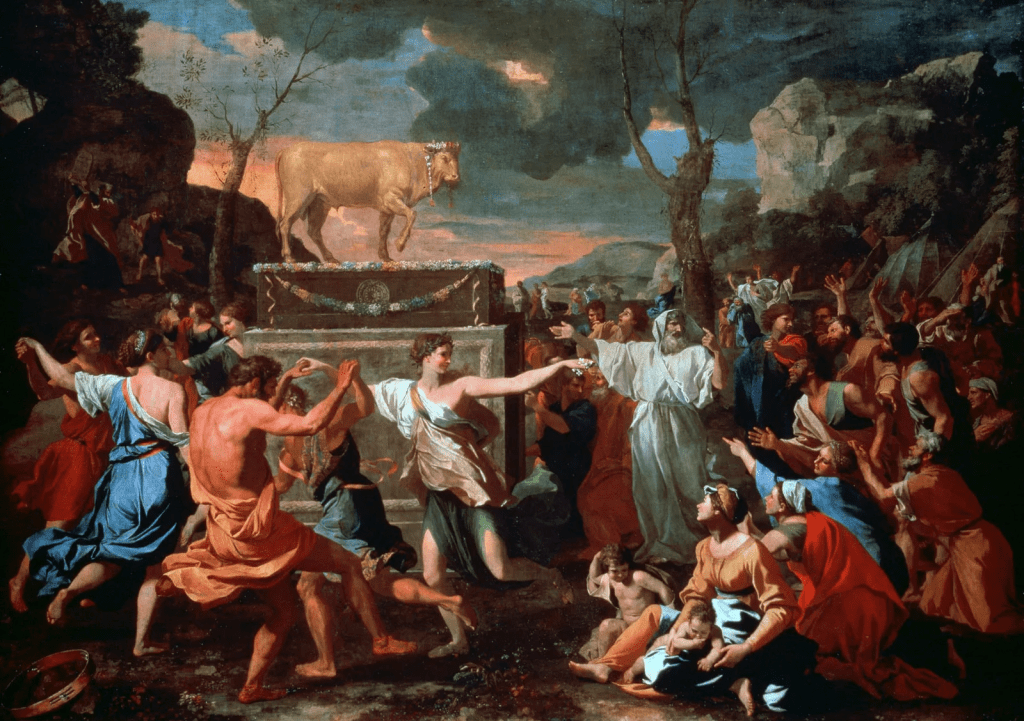
Adoration of the Golden Calf, by Nicolas Poussin (1594-1665)

When the people saw that Moses was so long in coming down from the mountain, they gathered around Aaron and said, “Come, make us gods who will go before us. As for this fellow Moses who brought us up out of Egypt, we don’t know what has happened to him.”

Aaron answered them, “Take off the gold earrings that your wives, your sons and your daughters are wearing, and bring them to me.” So all the people took off their earrings and brought them to Aaron. He took what they handed him and made it into an idol cast in the shape of a calf, fashioning it with a tool. Then they said, “These are your gods, Israel, who brought you up out of Egypt.”

When Aaron saw this, he built an altar in front of the calf and announced, “Tomorrow there will be a festival to the Lord.” So the next day the people rose early and sacrificed burnt offerings and presented fellowship offerings. Afterward they sat down to eat and drink and got up to indulge in revelry.

Then the Lord said to Moses, “Go down, because your people, whom you brought up out of Egypt, have become corrupt. They have been quick to turn away from what I commanded them and have made themselves an idol cast in the shape of a calf. They have bowed down to it and sacrificed to it and have said, ‘These are your gods, Israel, who brought you up out of Egypt.’

“I have seen these people,” the Lord said to Moses, “and they are a stiff-necked people. Now leave me alone so that my anger may burn against them and that I may destroy them. Then I will make you into a great nation.”

But Moses sought the favor of the Lord his God. “Lord,” he said, “why should your anger burn against your people, whom you brought out of Egypt with great power and a mighty hand? Why should the Egyptians say, ‘It was with evil intent that he brought them out, to kill them in the mountains and to wipe them off the face of the earth’? Turn from your fierce anger; relent and do not bring disaster on your people. Remember your servants Abraham, Isaac and Israel, to whom you swore by your own self: ‘I will make your descendants as numerous as the stars in the sky and I will give your descendants all this land I promised them, and it will be their inheritance forever.’” Then the Lord relented and did not bring on his people the disaster he had threatened. (New International Version)

The Golden Calf, by Sefira Lightstone

The ancient Israelites were dramatically delivered from slavery through a series of plagues on Egypt. Then, their lives were saved when God parted the Red Sea and the people fled from the advancing Egyptian army; collapsing the water on the soldiers when they tried to pursue the people.

The Israelites were led to Mount Sinai where God graciously entered into covenant with them; and gave them the law and the commandments. Yet, between receiving the covenant, and waiting for Moses to return from the mountain, the Israelites fell into chaos and a failure of faith. So, how did the relationship between God and Israel go so awfully sideways?

Moses spent a great amount of time with God on Mount Sinai. Apparently, the people believed that the forty days and forty nights on the mountain was too long and assumed that Moses would not return. So, what followed was idolatry, near annihilation, and intercession.

A failure of leadership

Aaron was left to lead the people during Moses’ absence. It didn’t take long for the people to get unruly and start working on Aaron. They asked him to make gods who will go before them, just as Yahweh and Moses had done in the pillar of cloud by day and fire by night.

For whatever reason, Aaron complied with their request. Maybe the people pestered him to death with constant bickering and asking, and he eventually gave-in to their coercion. Perhaps Aaron thought they had a point, and went with it as a willing participant. We aren’t told why. We are told that Aaron ordered the people to remove all the gold earrings they were wearing and bring them to him.

Aaron took all the gold he received and fashioned it into the form of a calf. Again, we aren’t told why Aaron chose to make a golden calf, in particular. Maybe he was forging a false god altogether in the shape of one of the Egyptian gods. After all, there had been a significant “back to Egypt” movement earlier, when circumstances got tough without food or water in the desert. Or perhaps Aaron was making a false image of the one true God. Either way you look at it, it’s not good.

The golden calf was handed to the people and proclaimed as the gods who brought them out of Egypt. If that weren’t bad enough, Aaron made the situation even worse by building an altar for the calf and declaring a feast for the next day. So, it’s no surprise to us as readers when we see poor leadership decision-making that leads to the people getting way out-of-hand in their festivities through drunkenness and sexual immorality.

The consequences of poor leadership

All of the revelry got God’s attention. The Lord saw the people’s depravity and commanded Moses to get back down the mountain, at once. God’s tone of voice and choice of pronouns took a turn. The Lord said to Moses, “Your people have acted perversely,” effectively distancing the divine from the mass of humanity at the foot of the mountain.

God was so upset that he started planning to destroy the whole lot of them and completely start over through the descendants of Moses. Yet, even though the Lord was very angry, and rightly so, Moses stepped in and interceded on the people’s behalf. Moses appealed to God’s reputation rather than God’s compassion. In an interesting twist, Moses turned the responsibility for the Israelites back onto God by saying they are your people, the ones whom you brought out of the land of Egypt.

What’s more, Moses pointed out to God that the Egyptians would question God’s motives for bringing the Israelites into the desert. And then Moses appealed to God’s covenant with Abraham, Isaac, and Jacob (Israel) to make a great nation of their descendants to dwell forever in the land God promised them. Moses actually persuaded the God of the universe to set aside divine anger and let the people live.

The people forgot who rescued them from slavery in Egypt. Regardless whether or not they had good intentions, the people failed in keeping their covenant obligations to God and sought to substitute God’s physical absence with a false image of God.

The implications of leadership for us

Today’s Old Testament story raises many questions for us. Here are just a few to ponder:

  • Which golden calves in our culture today draw our loyalty and love away from God when we get impatient with waiting for God’s timetable? Maybe our grumbling and complaining is a telltale sign that we are not content with God and what God is doing among us – and that we are fashioning (or have already fashioned) a god of our own making in the form of financial budgets, church buildings, or dogmatic theologies.
  • How have we made the God whom we worship into an idol that we try to control and manipulate for our own purposes? Perhaps we have substituted the one true God who is free, untamed, mysterious, and surprising, for a puny humanly constructed image, ideology, institution, or idol.
  • How do we maintain the balance between divine judgment with its consequences for disobedience, alongside God’s mercy, forgiveness, and faithfulness to the people? It could be, we are being led to grace, no matter how we go about answering the question.

Faithful God, you preside over an unfaithful people. Just as the people of Israel doubted your power and turned to other gods to fulfill their needs, we too, turn to other gods, seeking acceptance, power, and independence. Show us how to live humbly and walk in your ways, through the One who offered true power to all humanity, Jesus Christ our Savior and Lord. Amen.

Forgotten, but Blessed (Genesis 40:1-23)

Joseph, the cupbearer, and the baker in prison, by Gerbrand van den Eeckhout, 1643

Sometime later, Pharaoh’s chief cupbearer and chief baker offended their royal master. Pharaoh became angry with these two officials, and he put them in the prison where Joseph was, in the palace of the captain of the guard. They remained in prison for quite some time, and the captain of the guard assigned them to Joseph, who looked after them.

While they were in prison, Pharaoh’s cupbearer and baker each had a dream one night, and each dream had its own meaning. When Joseph saw them the next morning, he noticed that they both looked upset. “Why do you look so worried today?” he asked them.

And they replied, “We both had dreams last night, but no one can tell us what they mean.”

“Interpreting dreams is God’s business,” Joseph replied. “Go ahead and tell me your dreams.”

So the chief cupbearer told Joseph his dream first. “In my dream,” he said, “I saw a grapevine in front of me. The vine had three branches that began to bud and blossom, and soon it produced clusters of ripe grapes. I was holding Pharaoh’s wine cup in my hand, so I took a cluster of grapes and squeezed the juice into the cup. Then I placed the cup in Pharaoh’s hand.”

“This is what the dream means,” Joseph said. “The three branches represent three days. Within three days Pharaoh will lift you up and restore you to your position as his chief cupbearer. And please remember me and do me a favor when things go well for you. Mention me to Pharaoh, so he might let me out of this place.For I was kidnapped from my homeland, the land of the Hebrews, and now I’m here in prison, but I did nothing to deserve it.”

When the chief baker saw that Joseph had given the first dream such a positive interpretation, he said to Joseph, “I had a dream, too. In my dream there were three baskets of white pastries stacked on my head. The top basket contained all kinds of pastries for Pharaoh, but the birds came and ate them from the basket on my head.”

“This is what the dream means,” Joseph told him. “The three baskets also represent three days. Three days from now Pharaoh will lift you up and impale your body on a pole. Then birds will come and peck away at your flesh.”

Pharaoh’s birthday came three days later, and he prepared a banquet for all his officials and staff. He summoned his chief cupbearer and chief baker to join the other officials. He then restored the chief cupbearer to his former position, so he could again hand Pharaoh his cup. But Pharaoh impaled the chief baker, just as Joseph had predicted when he interpreted his dream. Pharaoh’s chief cupbearer, however, forgot all about Joseph, never giving him another thought. (New Living Translation)

Joseph, the cupbearer, and the baker, by Alexander Ivanov (1806-1858)

It is a sinking (and stinking) feeling to be forgotten, as if no one cares. But we know God cares. And we also know Joseph did nothing wrong. How did he get to this point of being left in a prison? What’s up with that?

Joseph’s Story

The story of Joseph (Genesis 37, 39-50) is one of the longest narratives in the Old Testament. Joseph was next to the youngest of 12 sons born to their father Jacob. Rachel was Jacob’s favorite wife and Joseph’s mother – which also made Joseph one Jacob’s favorites. This didn’t go down well with the rest of the sons. Joseph’s brothers (unbeknownst by Jacob) sold him into slavery.

Joseph was taken to Egypt and became the servant of Pharaoh’s captain of the guard, Potiphar. Joseph distinguished himself as competent, skillful, and virtuous. It was actually his integrity which got him into prison. Refusing to sleep with Potiphar’s wife, she became an angry woman and accused Joseph of something he didn’t do. The captain promptly dispatched him to jail.

Human Hatred and Unfaithfulness

Joseph became a slave in Egypt because of jealousy, hatred, and lack of faithfulness on the part of Joseph’s brothers. They disowned him, sold him, and rid themselves of him. The brothers wanted to forget Joseph, and they did.

Furthermore, Joseph became a prisoner in Egypt because of anger, hate, and betrayal of faith. Potiphar’s wife didn’t get what she wanted from Joseph, so she lied and fumed, landing Joseph in a dank prison. He was left without another thought – forgotten and jailed for no fault of his own.

And just when we think the story might turn around, and Joseph will be freed from his unjust imprisonment, the chief cupbearer (wine steward) promptly forgot him and said nothing to Pharaoh after he was out of jail and restored to his position. Once again, Joseph is the undeserved recipient of unfaithfulness. He remains in prison for another two years. Oy.

As much as we might like to get past all these unjust and maddening situations, Holy Scripture does not let us off the hook so easily. We have to sit with Joseph for a while, and feel what he feels, experience what he experiences, so that we can learn our own lessons from him.

Whether we like it, or not, suffering is a reality. And yet, although sometimes forgotten by humanity, we are remembered by divinity….

Divine Presence in the Middle of Suffering

God is present with us through hardship and adversity. Joseph’s story sets up the contrast between fickle humans and a faithful God. A lot of people in Joseph’s life let him down. But God was there as the continual divine presence throughout every circumstance, both good and bad…

  • God gifted Joseph and had special plans for him. God was with Joseph in his dreams. (Genesis 37:5-11) 
  • God was with Joseph, so that he succeeded in everything he did; the Lord caused all that Joseph did to prosper. (Genesis 39:2-3)
  • God showed Joseph steadfast love, and gave him favor in the sight of the chief jailer. The jailer did not worry about anything, because the Lord was with Joseph and made him successful in all that he did. (Genesis 39:21, 23)
  • God was present with Joseph in helping him interpret dreams, even in difficult situations. (Genesis 40:8)

God’s presence makes a difference. The Lord met Joseph in his suffering – yet did not leave him there. God entered Joseph’s suffering, was present with him while in it, and eventually brought him out of it, to another and better place. And in the process, God blessed others through Joseph.

Not only did Joseph survive, but he also thrived in the middle of injustice. God quietly went about the business of using Joseph as an agent of blessing everywhere he was sent: To Potiphar and his household; to the chief jailer and all those in prison; and then to Pharaoh and all of Egypt.

In the end, even the conniving and caballing brothers receive blessing — through Joseph. In this way, the Lord was fulfilling the divine promise to Abraham — that he and Sarah and their descendants would be blessed; and that through them, all the nations of the earth would also be blessed.

God is present with those in suffering. Yet, the way God works almost never seems fast enough for those who are suffering. We, along with the psalm writers, cry out, “How long, O Lord!?”

In situations, such as Joseph’s, it won’t do to offer platitudes to “Let go, and let God,” “Everything works for good,” or “God never gives us more than we can handle.” Sheesh. I doubt anyone in life-or-death situations relies on nifty phrases. They want God, and they understandably want God now.

Whether quick or slow, hard or unbearable, the biblical promise nevertheless stills stands that God meets us in our suffering. And God does not leave us there. God also calls us and moves us to more pleasant places. And know this: In the process and in the journey, God will bless others through us.

O God:
Give me strength to live another day;
Let me not turn coward before its difficulties or prove passive to its duties;
Let me not lose faith in other people;
Keep me sweet and sound of heart, in spite of ingratitude, treachery, or meanness;
Preserve me from minding little stings or from giving them;
Help me to keep my heart clean, and to live so honestly and fearlessly that no outward failure can dishearten me or take away the joy of conscious integrity;
Open wide the eyes of my soul that I may see good in all things;
Grant me this day some new vision of truth;
Inspire me with a spirit of joy and gladness;
and make me the cup of strength to suffering souls;
in the name of the strong Deliverer, our Lord and Savior, Jesus Christ. Amen.

Jeremiah 7:1-15 – Holding People Accountable

The prophet Jeremiah, Basilica of St Vitalis, Ravenna, Italy—Photo by mountainpix

The word that came to Jeremiah from the Lord: Stand in the gate of the Lord’s house, and proclaim there this word, and say, Hear the word of the Lord, all you people of Judah, you who enter these gates to worship the Lord. Thus says the Lord of hosts, the God of Israel: Amend your ways and your doings and let me dwell with you in this place. Do not trust in these deceptive words: “This is the temple of the Lord, the temple of the Lord, the temple of the Lord.”

For if you truly amend your ways and your doings, if you truly act justly one with another, if you do not oppress the alien, the orphan, and the widow or shed innocent blood in this place, and if you do not go after other gods to your own hurt, then I will dwell with you in this place, in the land that I gave to your ancestors forever and ever.

Here you are, trusting in deceptive words to no avail. Will you steal, murder, commit adultery, swear falsely, make offerings to Baal, and go after other gods that you have not known and then come and stand before me in this house, which is called by my name, and say, “We are safe!”—only to go on doing all these abominations? Has this house, which is called by my name, become a den of robbers in your sight? I, too, am watching, says the Lord. Go now to my place that was in Shiloh, where I made my name dwell at first, and see what I did to it for the wickedness of my people Israel. 

And now, because you have done all these things, says the Lord, and when I spoke to you persistently, you did not listen, and when I called you, you did not answer, therefore I will do to the house that is called by my name, in which you trust, and to the place that I gave to you and to your ancestors just what I did to Shiloh. And I will cast you out of my sight, just as I cast out all your kinsfolk, all the offspring of Ephraim. (New Revised Standard Version)

One of the dangers of the religious life is slipping into the view that possessing a certain thing protects us from all harm – sort of like a talisman or rabbit’s foot.

Today’s Old Testament lesson is a classic example of succumbing to just such a danger. The ancient Jews in Jerusalem, in the days of the prophet Jeremiah, sincerely believed that because they had God’s temple in their city that this would protect them from any kind of attack from the outside. 

What is more, since they viewed the temple as an incredibly powerful good-luck-charm, the people thought that they could do whatever they wanted; they were covered and protected. So, they had no sense of accountability to the holy God whose temple overlooked Jerusalem and saw all of their unjust ways.

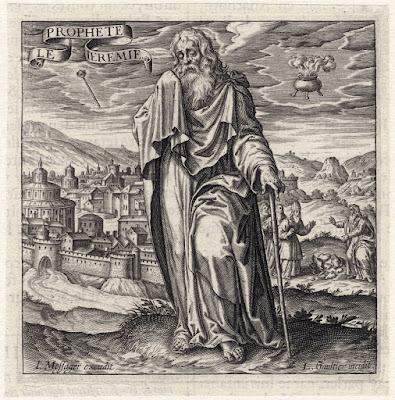
An engraving of the prophet Jeremiah by Léonard Gaultier (1561-1641)

Separated by a few millennia, we might see the folly with this magical type of thinking. Yet, it is just as easy for us to slip into the same mentality. 

Whenever we Americans think that our nation is so great that no one will ever take us over; or when we sincerely believe that because we are a missionary-sending nation that God will protect us; or when we buy into the notion that we can live however we want, but God would never judge us!; after all, we aren’t as bad as other nations!; well, then, we have come under the same condemnation as the Jews of old, we need to hear God’s Word for us today.

Jeremiah’s message was uncompromising. He clearly let the people know that while they have been living their hedonistic lives, God has been trying to talk them. But the people refused to listen. The prophet insisted that having the temple in the city is not some inoculation from keeping enemies at bay.

The prophet Jeremiah asserted that the people must change their ways, start living right, and be fair and honest with each other. They need to stop taking advantage of foreigners, orphans, and widows. They cannot kill innocent people and worship other gods, then turn around and invoke the temple as God’s presence and sanction on their security.

Justice is the responsibility of everyone; there are no favorites with God. The Lord does not favor particular people, ethnicities, or nations above others. Because one is an American, or not, makes no difference. Race and gender don’t come into view.

The sovereign God will hold all people culpable for their violent speech and behavior, no matter who they are or where they are from. Oppression, injustice, and spiritual gerrymandering will be dealt with by Judge Jesus, for both Jew and Gentile, man and woman, Westerner and Easterner, young and old.

For whom God has given much, much will be required. The Lord holds all people accountable for their actions.

Holy God, you still speak today through your Holy Word. Help me to listen well and pay attention to what you are saying so that I might honor you through humility and obedience for the sake of Jesus. Amen.