
Tractor Time with Pastor Tim

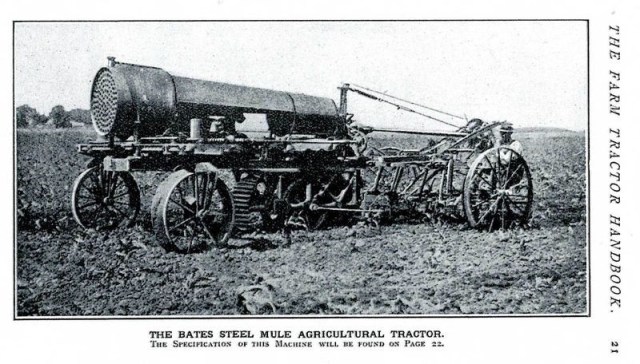
Steel Mule tractor

A tractor is an engineering vehicle specifically designed to deliver at a high tractive effort (torque) at slow speeds for the purposes of hauling mechanized implements used in agriculture.  The word “tractor” comes from a Latin word, trahere, which means “to pull.”  Tractors, like people, come in all sizes, shapes, and colors – exuding both resilience and strength in their existence.

The Bates Steel Mule tractor was one of the most unique and oddest-looking farm machines ever built.  First built in 1913, it was like a cross between a steam boiler, a garden tractor and a Harley-Davidson motorcycle.  Bates Machine Company had the following advertisement for their Steel Mule tractor: “The only machine in the world which you can hitch up to any horse-drawn implement you now have and operate it from the same position you would your horses.”  In other words, you could operate the tractor by sitting in the implement seat, not the tractor seat.  The Steel Mule survived until they became one of the many victims of the Great Depression in 1937.

My grandfather (whom I never knew – he died when I was a year old) owned and operated a Steel Mule tractor (not the particular model shown above).  There was once a picture of him in the local paper using his tractor (I have it packed away somewhere and am still looking for it).  Grandpa was known for being the guy who would try new things and buy unique machinery – all in the quest for better farming methods.

The Steel Mule seems to represent my current state of ministry.  Like Grandpa, I have a drive and a desire for improving my pastoral craft.  I am open to trying new things and entering into a new way of being with the hospital patients I serve as a chaplain, as well as my peers, other staff, and really everyone I encounter throughout a day.  Yet, at the same time, I stubbornly hold to the past – sitting on the implement and not quite ready to fully embrace the new era of machinery instead of horses.  Which brings me to the whole point of this circuitous rambling of Tim’s Tractor Time:  What holds me back?  And, in so asking this question of myself, I also as it of you: What holds you back?

Yes, what does hold you and I back from taking the initiative to be vulnerable and open with our lives, instead of fearful, anxious, and hesitant?  What holds us back from collaborating with others?  Consulting before acting?  Consulting after acting?  Divulging our emotions and not just our thoughts? Speaking without always measuring and analyzing each word before we say it (or write it)?  As a seasoned minister, I can plow deep furrows with my Steel Mule into others’ lives – so, why not let others do the same in my field?  What is it I’m really pulling in that field?

Perhaps it is fear.  When Charlie Brown came to Lucy for a bit of practical psychosocial help, Lucy spouted a litany of various fears which she wondered Charlie Brown might possess.  Finally, she expressed that maybe he has “pantophobia.”  “What is ‘pantophobia’?” Charlie Brown asks.  Lucy responds, “The fear of everything.”  To which Charlie Brown demonstratively pronounces, “That’s it!”

A-Charlie-Brown-Christmas-image

Could be.  Could also be anger.  After all, anger often lurks in the shadows our hearts with a combination of it getting expressed in an unhealthy way or becoming twisted into depression.  There’s plenty of anger under the surface of the topsoil ready to get turned over and exposed.  Too much of it turned inward.  Certainly, it needs some plowing and cultivating, that is, processing outwardly with others… maybe… if we’re brave enough.

Then there’s this thing called liminal space – the space in-between where we can’t go back to the way things were ever again, yet, we aren’t quite where we want/need to be. It’s awkward being caught in the nexus between the past and the future.  Does this hold us back?  Or maybe it’s the fear of imperfection, of not doing something with utmost excellence?  Are we apprehensive about opening up because we don’t understand ourselves fully, so, therefore, I won’t (like a stubborn old Steel Mule) utter half-baked ideas or fragments of thoughts or, God forbid, emotional musings?  Like the Steel Mule, perhaps we are crossing over into a new era with the past very much there with it.

So, perhaps the greater question is: What are you and I really feeling, in this moment?  Figures it would take me all this thinking type verbiage to get to the emotional universe of feelings.  If we’re honest, we all are a diverse jumble of emotions – presently feeling overwhelmed; sad; happy; angry; hopeful; confident; scared; hungry; tired….  Oh, well, let’s just say we’re feeling everything.

Like the interlocutor in the book of Ecclesiastes, the conclusion of the matter is this: “Fear God and keep his commandments; for that is whole duty of everyone.” (Ecclesiastes 12:13).  I hold back because of me.  You are hesitant because of you.  Nobody is twisting my arm.  That old enemy of our souls, the Adversary, would like nothing more than to keep us feeling weak and insecure so that he can keep us under his evil thumb.

No one is forcing you to use the Steel Mule tractor.  Quite the opposite.  In truth, there is nothing holding us back.  Nothing is stopping us from pulling our emotions out and discovering new ways to express them with confidence in healthy redemptive ways.  Nothing outside of our power to act is preventing us from the courage to do what we already know deep in our hearts we need to do…. Nothing.  So, then, I’ll look for you in the next tractor advertisement doing your unique, wonderful, and amazing work which comes from the depths of your love for God and others.

Mark 12:18-27 – Go Ahead, Ask Jesus Anything

q & a

Sadducees, who deny that there is a resurrection, came to Jesus and asked, “Teacher, Moses wrote for us that if a man’s brother dies, leaving a widow but no children, the brother must marry the widow and raise up children for his brother.  Now there were seven brothers. The first one married a woman; when he died, he left no children.  The second married her and died without leaving any children. The third did the same.  None of the seven left any children. Finally, the woman died.  At the resurrection, when they all rise up, whose wife will she be? All seven were married to her.”

Jesus said to them, “Isn’t this the reason you are wrong, because you don’t know either the scriptures or God’s power?  When people rise from the dead, they won’t marry nor will they be given in marriage. Instead, they will be like God’s angels.  As for the resurrection from the dead, haven’t you read in the scroll from Moses, in the passage about the burning bush, how God said to Moses, I am the God of Abraham, the God of Isaac, and the God of Jacob?  He isn’t the God of the dead but of the living. You are seriously mistaken.”

Okay, let’s just dive right in with the observational lessons:

  • Don’t be a dip-wad and try and trip up Jesus with philosophically ethereal questions
  • If you like being rebuked by Jesus as being ignorant, mistaken, and wrong, just try and be in control of how a conversation with him ought to go
  • Abraham, Isaac, Jacob, and Jesus are all alive – Sadducees, not so much
  • Jesus will take the time to listen to you close enough to give you feedback – and maybe the kind you weren’t looking for
  • What we get hung up on, Jesus doesn’t – and what Jesus sticks on, we act like Teflon about
  • Do you really want me to keep going….?

To deny resurrection is to deny Jesus.  He died.  He’s now alive.  Hence, there is a resurrection.  More than that, because Christ lives, others live.  This is the Christian’s hope.  I fully understand that plenty of people don’t believe in resurrection.  Fine.  I would simply point such a person no further than their own mind and heart.  “Search your feelings,” as the Jedi would say, “What do they tell you?”  The evidence you need, you already have.

And this was the penultimate lesson of Jesus to the inquisitive Sadducees.  They already had the answer to their question for Jesus.  It was right under their noses the entire time.  They just didn’t see it.

You already have everything you need for life and godliness in this present evil age.  One of the great sages of the last century, Dorothy from The Wizard of Oz, wisely said:

“If I ever go looking for my heart’s desire again, I won’t look any further than my own backyard.  Because if it isn’t there, I never really lost it to begin with.”

Resurrection has always been there because God has always been around – even when we don’t see him, perceive him, or acknowledge him.  It probably wouldn’t be a good idea to procrastinate the inevitable end of life scenario that awaits us all.  Anytime is the right time to do a bit of personal funeral planning.  But if we mire it all with the esoteric hypothetical questions about what would happen in the most far-fetched of scenarios, methinks God is big and smart enough to see through our puny charade.

Better to ponder what is truly within your own soul, and how Jesus might already be present without you even knowing it.  A good place to start in peering within is to give a straightforward honest reading of the New Testament Gospels and discover what resonates deeply with you about the person and work of Jesus.

Feel free to question him about anything you want; just brace yourself for what kind of answer you might receive.

John 3:31-36

            “The Son was sent to speak God’s message, and he has been given the full power of God’s Spirit.”  Well, there you have it.  This is a statement that every person on planet earth needs to contend with.  I, personally, have found in Jesus grace and truth.  I have come to believe the New Testament Gospel accounts of his birth, life, teaching, death, resurrection, and ascension.  None of that belief and faith came quickly or easily – it came as a result of primarily two things:  plain straightforward reading of the Bible; and, the wooing of the Holy Spirit.
 
            It really isn’t my job to convince you of the veracity of Jesus.  It is my task to point you to him and let God take over.  There is only one thing that I refuse to put up with in talking with people about Jesus:  If you haven’t read the Gospel accounts and you have rejected Christ, then, for honesty’s sake, have the gumption and the integrity to give Jesus an honest real hearing before you dismiss him with a slight of hand.  It is one thing to genuinely not know about Jesus, and it is another thing altogether to ignore him when you have some knowledge about how to find out about him.
 
            Everyone who has faith in Jesus has a life-giving connection with God.  Those who don’t, don’t.  If you do not agree with that statement, then contend with Jesus himself.  Give him a hearing.  Watch him in action.  Observe how he deals with people.  See if he lives up to his words.  Then, come back and we’ll talk.


            Blessed Father, Son, and Spirit, you are the Holy Trinity, the God whom I serve.  Lead me to those you are leading to yourself so that we can talk about Jesus, my Savior and Lord.  Amen.

Isaiah 59:1-15


            “Truth stumbles in the public square.”  That is the prophet Isaiah’s summary phrase of ancient Israel’s moral situation.  He wrote to a post-exile community that was still reeling from losing their land and finding their way among the rule of others.  They were not a free people – by a long shot.  And their deliverance from Gentile dominance was not coming anytime soon, for a reason.  They still had not really dealt with their own problems.  They wanted salvation without confession, and freedom without repentance.  But Isaiah reminded them that their separation from God was a result of their violence, deceitfulness, and corrupt system of justice.  The Jews were neither pursuing peace, nor the common good.  There would be no deliverance apart from facing those sins and renouncing them.
             Without a virtuous citizenry, truth stumbles in the public square.  That is, if national morality and personal ethics are absent, truth erodes and any system of laws and justice devolve into a morass of selfish agendas and lack of concern for all persons.  People might haggle and disagree on what is the best way forward for a given nation, but if they do not begin with the foundation of truth and virtue, then violence is the ultimate outcome because people want what they want and do not give a damn about anything else.  They will kill and covet, but they will not get what they want since their motives are unethical and immoral.
             This is why the spiritual tools of prayer and fasting, confession and repentance, faith and public moral action must be the underlying conscience of a nation.  Without virtue, truth may stumble but will always be present to speak to power.  Government is designed as an institution to promote the common good of all citizens.  If divine intervention is necessary, the proper course of action is acknowledgment of transgressions.  
             Sovereign God, you are the invisible ruler among the nations.  Our sins are many and they bear witness against us that sound judgment has left the room.  Christ, have mercy upon us, and grant us your peace through the blessed Holy Spirit.  Amen.