Integrity In All Things (Proverbs 11:3-13)

The Narrow Road, by Debbie Clark

Integrity guides the virtuous,
    but dishonesty ruins the treacherous.
Riches don’t help in the day of wrath,
    but righteousness rescues from death.
The righteousness of the innocent makes their path straight,
    but the wicked fall in their wickedness.
Those who do right are saved by their righteousness,
    but the untrustworthy are caught by their own desires.
When the wicked die, their hope perishes.
    Yes, any hope based on money perishes.
The righteous are saved from distress,
    and the wicked take their place.
The godless destroy their neighbors by their words,
    but the righteous are saved by their knowledge.
When the righteous succeed, a city rejoices;
    when the wicked perish, there are shouts of joy.
A city is honored by the blessing of the virtuous;
    it is destroyed by the words of the wicked.
Whoever despises their neighbor lacks sense;
    a sensible person keeps quiet.
A slanderer walks around revealing secrets,
    but a trustworthy person keeps a confidence. (Common English Bible)

Integrity appears to be in short supply these days. No matter whether it’s a church, a corporation, an institution, organization, or governmental administration, it only takes one person in authority who is without integrity to ruin the whole enterprise.

This is why it is so important to never normalize bad behavior and bad speech. It will do no good to simply say, “Well, that’s just the way he is.” Everyone, no matter who they are, must be held accountable for their words and actions. And if we choose to let the unvirtuous person continue in their lack of integrity, then we ourselves become complicit in their unjust activity.

What the unrighteous person fails to realize, is that watching out for number one and taking advantage of others will eventually come back to bite them. The unscrupulous rich person will lose their wealth. The unjust person will come face to face with what their injustice has done. The slanderous person shall be unmasked and seen by all for what they truly are.

The Teacher of Proverbs informs us that evildoers will suffer in their wickedness; whereas the righteous shall be rewarded. Everyone eventually receives what they deserve – whether it’s the righteous or the wicked.

This sort of karmic sense of justice happens both in this life and the life to come. Those who do and say whatever they want, without any integrity, undergo a double-suffering: They’re tormented now in the present, and likely into the future; that is, unless they undergo some Scrooge-like transformation.

The suffering of the wicked is caused by their own stupid foolish choices without any direct intervention by God. God’s law, much like the natural law of gravity, has consequences if you choose to disrespect it. In that sense, the wicked also suffer divine condemnation.

The Lord favors good people,
    but he condemns schemers. (Proverbs 12:2, CEB)

Even though the wicked prosper, by no means is it permanent. And although the righteous are deeply disturbed and troubled by the constant lies and evil machinations of wicked persons, they shall realize a world that is just, right, and good. Injustice and unrighteousness are temporary.

The evil person will surely not go unpunished,
    but the children of the righteous will escape. (Proverbs 11:21, CEB)

It may drive us batty to see that evil is having its way, and that the wicked are doing quite nicely for themselves, but the Teacher seeks to comfort the righteous with the reality that it will not always be this way.

Stolen bread is sweet,
    but afterward the mouth is full of gravel. (Proverbs 20:17, CEB)

We know we’re living in an upside-down messed-up world because the righteous too often suffer and the wicked too often prosper. But it won’t last.

It’s important we remain honest and above board – no matter the circumstances. Whether its in business dealings, leadership, family relations, community involvement, or political activity, its imperative to be a person of integrity without any hint of duplicity.

Dishonesty may get the wicked person where they want to go in the short term, but it has a devastating price to pay. Deals with the devil always do.

Better a little with righteousness
    than great profits without justice. (Proverbs 16:8, CEB)

The Lord is a just God. That means God does more than show justice in all things; justice is a part of God’s very character and makeup. God cannot be unjust because God is Justice with a capital “J.”

Its way above our pay-grade to seek retribution and revenge on another. Exacting judgment belongs to God, and not you nor me.

Don’t say, “I’ll repay the evildoer!”
    Wait for the Lord, and he will save you. (Proverbs 20:22, CEB)

In the past several months, I have largely abandoned social media and electronic conversations with others. There is too much of the godless (cloaked in godly language) destroying their neighbor with their angry words and ignorant misinformation. I don’t want to get sucked into that vortex of ridiculousness. I’ll let the Lord deal with them. I have bigger fish to fry than to get involved in unhelpful and often harmful communication.

I rather choose to focus my time, effort, and words on reminding myself and others of the need for integrity in all things; always remaining prudent; and practicing self-awareness. When Christ returns, I’d like him to find me patiently waiting in quiet trust – instead of spewing a bunch of nasty vitriol that is consistent with Satan, not God.

For me, Proverbs isn’t simply a nice book of the Bible to read. Rather, it is vital knowledge to internalize and learn from. Without the wisdom of Proverbs, I’m undone and adrift. I need these short pity statements of experiential truth to help me understand how to talk and act in this fallen world.

This is why its important to read Proverbs slowly, carefully, prayerfully; to meditate upon these wise statements; and to reflect on putting them into practice. Integrity in everything – both speech and action – will serve us well, now and forever.

Wise God, may divine wisdom shape my thoughts, decisions, and actions each day as I seek to live by the Spirit. Lead me into all truth as I submit wise teaching; and to You as my Counselor and Guide; through Christ my Lord. Amen.

Some Relational Wisdom (Proverbs 25:1-28)

Here are some more
    of Solomon’s proverbs.
They were copied by the officials
    of King Hezekiah of Judah.
God is praised
    for being mysterious;
rulers are praised
    for explaining mysteries.
Who can fully understand
    the thoughts of a ruler?
They reach beyond the sky
    and go deep in the earth.

Silver must be purified
before it can be used
    to make something of value.
Evil people must be removed
before anyone can rule
    with justice.

Don’t try to seem important
    in the court of a ruler.
It’s better for the ruler
    to give you a high position
than for you to be embarrassed
    in front of royal officials.
Be sure you are right
    before you sue someone,
or you might lose your case
    and be embarrassed.

When you and someone else
can’t get along,
    don’t gossip about it.
Others will find out,
and your reputation
    will then be ruined.

The right word
    at the right time
is like precious gold
    set in silver.
Listening to good advice
is worth much more
    than jewelry made of gold.
A messenger you can trust
is just as refreshing
    as cool water in summer.
Broken promises
are worse than rain clouds
    that don’t bring rain.
Patience and gentle talk
can convince a ruler
    and overcome any problem.

Eating too much honey
    can make you sick.
Don’t visit friends too often,
or they will get tired of it
    and start hating you.
Telling lies about friends
    is like attacking them
with clubs and swords
    and sharp arrows.
A friend you can’t trust
    in times of trouble
is like having a toothache
    or a sore foot.
Singing to someone
    in deep sorrow
is like pouring vinegar
    in an open cut.

If your enemies are hungry,
    give them something to eat.
And if they are thirsty,
give them something
    to drink.
This will be the same
as piling burning coals
    on their heads.
And the Lord
    will reward you.
As surely as rain blows in
    from the north,
anger is caused
    by cruel words.
It’s better to stay outside
    on the roof of your house
than to live inside
    with a nagging wife.

Good news from far away
refreshes like cold water
    when you are thirsty.
When a good person gives in
    to the wicked,
it’s like dumping garbage
    in a stream of clear water.
Don’t eat too much honey
    or always want praise.
Losing self-control
leaves you as helpless
    as a city without a wall. (Contemporary English Version)

The wise sayings in this chapter of the Book of Proverbs have to do with relational topics such as: relating to a leader; relating to others; and relating to oneself (self-control).

Relating To a Leader

When it comes to relating to any sort of leader above us, it is best to avoid arrogance and embrace humility.

Whether we realize it, or not, or like it, or not, leaders have a perspective that others don’t. They see the big picture of what is happening, and ideally, make wise decisions based upon all the factors and people involved.

This means that we are not always, maybe not even usually, going to understand what a leader or ruler is doing. This is why it is so important for leaders themselves to consult and collaborate with others, and choose wisely.

Humility isn’t only for followers, it is just as much, perhaps even more, necessary for the leader. Making decisions in a vacuum, or just trusting in one’s own counsel, usually doesn’t work out well. Everyone has character flaws, yet a leader’s flaws, weaknesses, and sins can stick out rather easily to others.

That doesn’t mean, however, that anyone has a right to believe they themselves can do a better job, or know more about how to lead, or have all the information. Because they don’t.

The ways of God are mysterious because it is a very big picture that only the Lord sees. And there are a lot of moving parts and people to all of God’s choices and movements in this world.

The important part, for us, is to recognize the goodness and wisdom of God, and to trust that the Lord – as the God of Love – always does what is right, just, and good, even though it may not always seem that way.

Relating To Others

When it comes to how we generally relate to our fellow humanity, we are to show some empathy and deference. The ability to put yourself in another’s shoes is quite important and necessary, in order to relate well to others.

In failing to do this, and only thinking of oneself, we end up overstaying a welcome from someone who was thinking of us; or not paying attention that my morning blessing feels more like a curse to the night owl; or sharing some juicy tidbit of information that isn’t ours to share, so that others listen and pay attention to me.

Today, in this day and age, many persons fail to think of others when they are driving. Far too many people drive as if they own the road, and as if the traffic laws don’t apply to them. If they think of another driver at all, it’s only to curse them for hindering their ability to get to where they want to go.

Relating to Self

In contrast to all of that, we ourselves are to practice self-control and choose to live differently. Instead of cursing, we bless; and rather than selfishness, we practice selflessness.

If we would but all learn to exercise kindness over revenge, our world would be a very different place than it is today. And if we would but choose to speak the truth in love, rather than tell lies in hate or indifference, then there would be a lot less harm and hurt in this old fallen world.

By practicing self-control, we stop the cycle of hate, injustice, and unkindness. But if we choose the path of escalating verbal and/or physical violence, then this only leaves us vulnerable to harm. And it may open a way of having those you care about be harmed, as well.

I myself am the only person I’m in control of. And so I choose to:

  • be honest, trustworthy, and let God provide the judgment and justice needed for others
  • consider others, and think before talking
  • listen to wise counsel, and not entertain the manipulative words of the foolish
  • walk the patient path of wisdom

O God, grant me the wisdom I need in all my relationships. Help me recognize when things may be unsafe. I pray your protection over me and my family when we feel vulnerable. Thank you for having the power to heal broken relationships. Amen.

A Call to Truth and Justice (Exodus 23:1-9)

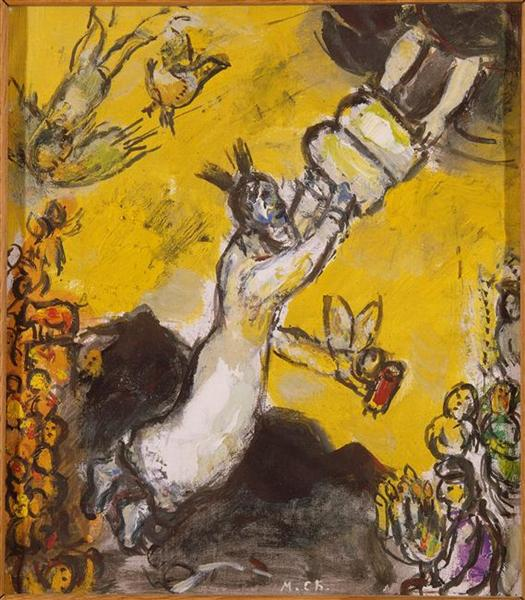
Moses Receives the Law, by Marc Chagall, 1963

“You must not pass along false rumors. You must not cooperate with evil people by lying on the witness stand.

“You must not follow the crowd in doing wrong. When you are called to testify in a dispute, do not be swayed by the crowd to twist justice. And do not slant your testimony in favor of a person just because that person is poor.

“If you come upon your enemy’s ox or donkey that has strayed away, take it back to its owner. If you see that the donkey of someone who hates you has collapsed under its load, do not walk by. Instead, stop and help.

“In a lawsuit, you must not deny justice to the poor.

“Be sure never to charge anyone falsely with evil. Never sentence an innocent or blameless person to death, for I never declare a guilty person to be innocent.

“Take no bribes, for a bribe makes you ignore something that you clearly see. A bribe makes even a righteous person twist the truth.

“You must not oppress foreigners. You know what it’s like to be a foreigner, for you yourselves were once foreigners in the land of Egypt. (New Living Translation)

On Mount Sinai, God gave Moses the Ten Commandments. These laws are basic ethical commands given to the people in their relationship to God and to one another. Following those Ten Words, the next several chapters of Exodus provide detailed instructions and commands for the Israelites in their own social, economic, and cultural context.

Today’s Old Testament lesson is part of this sequence of specific laws for the Israelites. These laws all have to do with being honest in legal matters. There is to be no perversion of justice through perjury, favoritism, bending to dishonest pressure, bribery, and false charges. What’s more, there must be no overlooking of the poor and powerless; and no disregard for the immigrant and foreigner.

All the sequences of commands – covering Exodus chapters 20-25 – are connected back to the basic Ten Commandments. The laws about justice and injustice are the fleshing-out of the ninth command to not testify falsely against your neighbor.

In other words, we are not to lie in public, especially when a person’s life or livelihood is at stake. We are to practice right relations with others; and do justice for all persons without prejudice or favoritism. We do this because God shows no favoritism and judges rightly with proper justice.

He will not judge by what he sees with his eyes,
    or decide by what he hears with his ears;
but with righteousness he will judge the needy,
    with justice he will give decisions for the poor of the earth. (Isaiah 11:3-4, NIV)

The Lord is a just God – it is inherent to the divine character. Therefore, our actions, as people created in the image of God, are to always be just, right, and truthful. There is a special place in God’s heart for the poor and powerless, and so, we ought also to consider their needs and treat them well and with respect – because true religion gives to those who we know cannot pay us back.

This, then, also is why immigrants and foreigners are mentioned. They need proper justice, and not negligence on our part to provide them with what they need. Throughout Holy Scripture we are admonished to not oppress the stranger from another place.

For through him [Christ] we both have access to the Father by one Spirit. Consequently, you are no longer foreigners and strangers, but fellow citizens with God’s people and also members of his household, built on the foundation of the apostles and prophets, with Christ Jesus himself as the chief cornerstone. (Ephesians 2:18-20, NIV)

The Lord watches over the foreigner
    and sustains the fatherless and the widow,
    but he frustrates the ways of the wicked. (Psalm 146:9, NIV)

Jesus picked up on the basic commands of God in his Sermon on the Mount – which, in many ways, is a restatement of the Ten Commandments by getting to the heart of them. Concerning the matter of giving false pledges, he said:

“Again you have heard that it was said to those who lived long ago: Don’t make a false solemn pledge, but you should follow through on what you have pledged to the Lord… Let your yes mean yes, and your no mean no. Anything more than this comes from the evil one. (Matthew 5:33, 37, CEB)

In court, we offer an oath, swearing that we will tell the truth and only the truth – and no lying. This is the only way that injustice can be avoided and justice can be established.

“I swear on a stack of Bibles I won’t…” “I will, if I get around to it….” These are a few of the caveats we give when making a promise or oath. Oaths communicate our truthful intentions of being above board with a high level of integrity.

It’s not okay when we bear false testimony concerning an event or incident that has taken place. There is no excuse for saying something is truthful when you know it isn’t quite true or all true. That makes us liars.

The Lord detests lying lips, but he delights in people who are trustworthy. (Proverbs 12:22, NIV)

Jesus wants us to clarify our values of right and wrong; make wise decisions; identify what we know is truth and error; and follow through on speaking the truth in love.

Any human society cannot stand unless it is committed to justice for all. People everywhere have a universal need for communities and nations which pursue truth, justice, benevolence, and integrity for everyone within their sphere of influence and responsibility.

Almighty God, who created us in your own image: Grant us grace to fearlessly contend against evil; and to make no peace with oppression, so that we may reverently use our freedom. Help us to employ that freedom in the maintenance of justice in our communities and among the nations, to the glory of your holy Name; through Jesus Christ our Lord, who lives and reigns with you and the Holy Spirit, one God, now and forever. Amen.

Spiritual Support (Ezekiel 29:3-7)

Speak and say, The Lord God proclaims:

I’m against you, Pharaoh, Egypt’s king,
    great crocodile lurking
    in the Nile’s canals,
        who says, “The Nile is all mine;
        I made it for myself!”
I will set hooks in your jaws;
    I will make the fish from the Nile’s canals cling to your scales.
I will drag you out of the Nile’s canals,
    and also all the fish from the Nile’s canals
    clinging to your scales.
        I will fling you out into the desert,
        and also all the fish from the Nile’s canals.
You will fall on the open ground,
    and won’t be gathered or retrieved.

I’ve given you to the beasts of the earth
        and the birds in the sky for food.
Everyone living in Egypt will know that I am the Lord.

Because they were a flimsy crutch for the house of Israel—when they took you in hand, you would splinter and make their shoulders sore; when they leaned on you, you would break, bringing them to their knees. (Common English Bible)

“Relying on God has to begin all over again every day as if nothing yet had been done.”

C.S. Lewis

From where, and to whom, do we look to for support?

The Pharaoh of Egypt could open his mouth as wide as a crocodile, but he had no real strength – only talk and no bite – and talk is cheap, especially in the face of a sovereign God.

The Lord had little tolerance for Pharaoh’s bombast, so God decided to don the divine crocodile hunter hat and pull the old creature out of the Nile River.

The reeds that grow along the Nile in Egypt look something like bamboo. They appear as if they might make a decent staff or crutch, but the reeds are not good for that, and if used so, would shatter and put some significant splinters into your hand.

God was warning the Israelites against sizing up Egypt as a significant means of support, and then putting weight on them for help. The leadership of Jerusalem was trusting in Pharaoh and his Egyptian troops to rescue them from the Babylonian army.

But, as we know from history, the Babylonians soundly defeated the Egyptian soldiers. Pharaoh was no support, at all, and became a shattered crutch to Judah, just as God had warned.

We need to be careful about choosing our sources of support. There are a lot of unreliable means of help out there, that people turn to in life.

When going through tough times, we may believe that popularity and power, or alcohol and drugs, or wealth and position will help support us and get us through the hard situation. Yet, they all prove too weak and inadequate in the end.

God is able to carry a person through a crisis, so that we do not just survive it, but grow and thrive through it. We must continually be vigilant and wise to resist the temptation toward the shiny things in life which may draw us to depend upon unreliable things and people. We need God working through God’s people to help support us in a time of need.

Our help is in the name of the Lord,
    who made heaven and earth. (Psalm 124:8, NRSV)

One of the great Christian theologians of the twentieth century, the Protestant Swiss professor Karl Barth, believed that we are not fully human and fully supporting one another apart from:

  • mutual seeing and being seen
  • reciprocal speaking and listening
  • granting one another mutual assistance
  • doing everything with gratitude and gratefulness

Barth used the German term Mitmenschlichkeit (co-humanity) to communicate that we are human and supported with a trusted other person alongside us. In other words, human flourishing requires mutual giving and receiving. Only in relation to each other, including those in need, do we thrive as people.

Christianity is a dependence upon God and an inter-dependence on one another; it’s not an isolated independent venture. Adversity, hardship, and difficulty can become a symbiotic relationship between the care-seeker and the caregiver, within the foundation of Trinitarian love, expressed with grace and hope given by Jesus in the power of the Holy Spirit.

So, when we talk about spiritual support of another, it includes the following alliterated points:

  • Struggle. Enter another’s spiritual and emotional wrestling along with them, without succumbing to the impetus to change or fix, but to empathize, affirm, and validate emotions and experiences.
  • Share. Seek to be emotionally available and aware – to be present in another’s pain and wonderment, understanding that a person cannot go any deeper with me than I have gone with myself.
  • Story. Listen to the story that a person weaves about their own situation, background, family, support, religious milieu, as well as their personal spiritual and emotional world.
  • Salvation. Allow and give permission to the person to name and resolve their own struggle; because I am neither the Savior nor in the saving business, as if deliverance and freedom depended upon me.

“Do not let your hearts be troubled. Believe in God; believe also in me.”

Jesus to his disciples (John 14:1, NRSV)

Trust of another must be given carefully and wisely, not flippantly or thoughtlessly. And becoming a trusting person involves not only a willingness to do so, but also the presence to listen, the place to care, and the passion and commitment to do what is helpful, not hurtful.

Blessed God of support and strength, you have given me the shield of your salvation, and your right hand has supported me. Your divine help has gotten me through, and given me a wide place for my steps under me, so that my fee do not slip.

Gracious God, you have given me an example through the Lord Jesus that we must support the weak, remembering his words, “It is more blessed to give than to receive.” May it be so, in the strength given by the Holy Spirit, to your glory and honor. Amen.