
Messages of Hope (Zechariah 8:1-17)

A 14th century tapestry of the Apostle John’s vision of the New Jerusalem

The word of the Lord Almighty came to me.

This is what the Lord Almighty says: “I am very jealous for Zion; I am burning with jealousy for her.”

This is what the Lord says: “I will return to Zion and dwell in Jerusalem. Then Jerusalem will be called the Faithful City, and the mountain of the Lord Almighty will be called the Holy Mountain.”

This is what the Lord Almighty says: “Once again men and women of ripe old age will sit in the streets of Jerusalem, each of them with cane in hand because of their age. The city streets will be filled with boys and girls playing there.”

This is what the Lord Almighty says: “It may seem marvelous to the remnant of this people at that time, but will it seem marvelous to me?” declares the Lord Almighty.

This is what the Lord Almighty says: “I will save my people from the countries of the east and the west. I will bring them back to live in Jerusalem; they will be my people, and I will be faithful and righteous to them as their God.”

This is what the Lord Almighty says: “Now hear these words, ‘Let your hands be strong so that the temple may be built.’ This is also what the prophets said who were present when the foundation was laid for the house of the Lord Almighty. Before that time there were no wages for people or hire for animals. No one could go about their business safely because of their enemies since I had turned everyone against their neighbor. But now I will not deal with the remnant of this people as I did in the past,” declares the Lord Almighty.

“The seed will grow well, the vine will yield its fruit, the ground will produce its crops, and the heavens will drop their dew. I will give all these things as an inheritance to the remnant of this people. Just as you, Judah and Israel, have been a curse among the nations, so I will save you, and you will be a blessing. Do not be afraid, but let your hands be strong.”

This is what the Lord Almighty says: “Just as I had determined to bring disaster on you and showed no pity when your ancestors angered me,” says the Lord Almighty, “so now I have determined to do good again to Jerusalem and Judah. Do not be afraid. These are the things you are to do: Speak the truth to each other and render true and sound judgment in your courts; do not plot evil against each other, and do not love to swear falsely. I hate all this,” declares the Lord. (New International Version)

The name “Zechariah” means “Yahweh remembers.” The Lord indeed remembers the divine covenant which was established. And God will fulfill all promises made.

The Lord is determined to do good – not really because people so much deserve it but because it is God’s character to be good, and thus, do good, even when there is little goodness on the earth to be found.
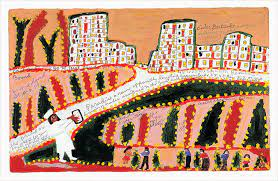
New Jerusalem by Sister Gertrude Morgan (1900-1980)

God’s judgment is but for a moment; but the Lord’s promise, salvation, and peace shall endure forever. God’s wrath is quite real and certain, yet it is a brief extension of the Lord’s steadfast love. Rebellion and judgment are never the last words; forgiveness and grace are:

Many times he [Yahweh] delivered them [the Israelites],
    but they were rebellious in their purposes
    and were brought low through their iniquity.
Nevertheless, he regarded their distress
    when he heard their cry.
For their sake he remembered his covenant
    and showed compassion according to the abundance of his steadfast love.
He caused them to be pitied
    by all who held them captive. (Psalm 106:43-46, NRSV)

All of the Old Testament prophets end their message of impending judgment with the final note of hope. That is, it won’t always be this way. There are better days ahead. The Lord’s coming is not all wrath; it’s mercy and hope. Notice the five brief messages of hope which Zechariah gives the people:

1. Yahweh burns with jealousy for Zion

Throughout the Bible, God likens the relationship to the Israelites much like a lover – as if the Lord were married to them. God’s covenant relationship with people is at the heart of understanding the whole of Scripture. Whenever they stray from divine promises, Yahweh is offended and hurt. 

God is an emotional Being, which is why we have emotions as people created in his image. Early humanity strayed so far from God that it hurt:

The Lord saw that humanity had become thoroughly evil on the earth and that every idea their minds thought up was always completely evil. The Lord regretted making human beings on the earth, and he was heartbroken. (Genesis 6:5-6, CEB)

Yet, God was gracious, sparing Noah and his family. The Lord took a group of Noah’s descendants, Abraham’s family, and set godly covenant affection on them. Through the Israelites, God hoped to lead the entire world to right relations. Yet, they, too, came to fail the gracious covenant made and set their affections on others.

Like a jilted lover, God longed for Israel to remain faithful, and, at the same time, was hurt and angry. Just as the prophet Hosea did not give up on his wife, even though she was brazenly unfaithful, so God looked at Israel as a spouse and could not bear to give her up.

2. Yahweh returns to Zion  

Jerusalem will be known as a faithful city and a holy mountain. The presence of God is what makes that happen. Because even though people can be fickle, inconsistent, complacent, and unfaithful, Yahweh remains true to the divine character of steadfast and immovable love for people.

You will never again be called ‘The People God Left.’
    Your land will never again be called ‘The Land God Destroyed.’
You will be called ‘The People God Loves.’
    Your land will be called ‘God’s Bride,’
because the Lord loves you,
    and your land will be his. (Isaiah 62:4, ERV)

3. The streets of Jerusalem will be full of children playing

The elderly will be sitting there watching the kids play, full of delight at the scene. Much too often we Westerners measure both the significance and success of our cities by its industry, businesses, buildings, wealth, and culture.

Methinks we may be misguided with such measurements. Instead, I suggest, along with the prophet, that we gage our cities by their effect on both the old and the young – because long life and children are signs of blessing from God.

4. Nothing is impossible with Yahweh

Is anything too hard for God? That, my friends, is a rhetorical question. If the Lord can cause old women to bear children (Genesis 18:10-14) and large armies to evaporate (Judges 7:1-25) then there is nothing more preposterous than to always view everything from our puny human perspective. Mary gained such a vantage and believed. We, too, have such an Advent hope within us.

“You will conceive and give birth to a son, and you are to call him Jesus. He will be great and will be called the Son of the Most High. The Lord God will give him the throne of his father David, and he will reign over Jacob’s descendants forever; his kingdom will never end.”

“How will this be,” Mary asked the angel, “since I am a virgin?”

The angel answered, “The Holy Spirit will come on you, and the power of the Most High will overshadow you. So the holy one to be born will be called the Son of God. Even Elizabeth your relative is going to have a child in her old age, and she who was said to be unable to conceive is in her sixth month. For no word from God will ever fail.”

“I am the Lord’s servant,” Mary answered. “May your word to me be fulfilled.” (Luke 1:31-38, NIV)

5. Yahweh renews and restores

Separation, diaspora, and disconnection will become a thing of the past. The Lord sets all things right again, brings people together, and heals, so that everything exists as it is meant to exist.

Deliverance from sin, death, and hell is the means of bringing renewal to the earth and its people. Salvation belongs to God. Righteousness and justice will characterize the future.

For the word of the Lord is upright,
    and all his work is done in faithfulness.
He loves righteousness and justice;
    the earth is full of the steadfast love of the Lord. (Psalm 33:4-5, NRSV)

Hope is fully realized when people put their trust in God and do their part by having strong hands and faithful hearts. We must be truthful and gracious whenever we speak. The Lord expects us to do the right thing by one another, both personally and publicly. We are to never cook up plans to take unfair advantage of others. Instead, we need to keep our lives simple and honest.

The promise of blessing is assured by God. However, the timing of that blessing is conditioned by our response. And there is no better time than the Christian season of Advent to recall what the Lord will do, as well as what God wants us to do.

May we be people of hope and let hope live in our hearts now and always, to the glory of God. Amen.


Grace Changes Everything (Isaiah 12:1-6)

In that day [to come] you will say:

“I will praise you, Lord.
    Although you were angry with me,
your anger has turned away
    and you have comforted me.
Surely God is my salvation;
    I will trust and not be afraid.
The Lord, the Lord himself, is my strength and my defense;
    he has become my salvation.”
With joy you will draw water
    from the wells of salvation.

In that day you will say:

“Give praise to the Lord, proclaim his name;
    make known among the nations what he has done,
    and proclaim that his name is exalted.
Sing to the Lord, for he has done glorious things;
    let this be known to all the world.
Shout aloud and sing for joy, people of Zion,
    for great is the Holy One of Israel among you.” (New International Version)

The Bad News

The reason prophecies are made about better times ahead is because the times now are not so good. That was true of Isaiah’s day, and still remains true today.

It’s easy to identify what’s wrong in this world, especially during a political election cycle! It’s not so easy to recognize the ways we keep ourselves as Christians in bad times. A big reason why, and I unabashedly state it, even though I say it much to my chagrin:

Christianity in our day has mostly failed at spiritual transformation because we have not identified and named the real evils we face, thus leaving us largely irrelevant to a world desperately in need of Jesus Christ.

Jesus, speaking to religious folk who should have known better, said:

“You have neglected the more important matters of the law—justice, mercy and faithfulness… You blind guides! You strain out a gnat but swallow a camel.” (Matthew 23:23-24, NIV)

The tragedy of our age, which was the same tragedy of Isaiah’s age, is that there are so many godless followers of God. They fuss about trifles while ignoring more serious matters. Many Christians’ faith is not much more than conforming to cultural Christian norms while mostly ignoring the realities in front of their faces.

We say we need God but then turn to Google for answers and solutions.

We bemoan the lack of righteousness in the nation, then obnoxiously argue with others and create unnecessary relational wedges.

We decry the injustice of our cities and our world, then do nothing to address the problems and change it.

We talk about the need for others to change rather than first looking in the mirror. Yet, even when we do that, we walk away and forget what we look like.

“For it is time for judgment to begin with God’s household; and if it begins with us, what will the outcome be for those who do not obey the gospel of God?” (1 Peter 4:17, NIV)

The Good News

However, judgment is not the last word. Even though the prophecy of Isaiah is thick with it, and I started out with less than uplifting words, there is one word that transcends every word: grace.

The grace of God is remarkable! The Lord made promises to Israel in Isaiah’s day not based upon what they would or would not do; God made promises to the people by God’s own radical and scandalous grace. It wasn’t a matter of playing Let’s Make a Deal, with God saying, “If you get your act together, then I will be good to you.” No, before Israel even had a chance to return to the Lord, God was already choosing to be merciful.

I am absolutely convinced with the firmest conviction possible that the Scriptures of the Old and New Testaments are all about God and God’s own unbounded, unfettered, free, crazy, illogical, and wildly wonderful grace.

Because God is Love, the Lord constantly goes out of the way to be gracious so that we can live up to being the sort of people our dogs think we are already.

If we miss the message of God’s grace in the Holy Scriptures, we have missed salvation – because only grace can save us. Without grace, we are lost. Today’s Old Testament lesson is full of praise because it’s a response to the undeserved grace which God freely gives. 

If grace isn’t the answer, we aren’t asking the right question. Grace is love that seeks you out when you have nothing to give in return. Grace is wildly generous. Grace does not use carrot sticks, scorecards, or power politics. Grace never demands – it only gives. 

Grace is unconditional acceptance given to an undeserving person by an unobligated giver. 

That is what God did for Israel… and for us. And when we get a hold of this truth, even a little bit, our hearts become bubblers of praise.

The Bible is an extended drama of redemption; and Isaiah’s prophecy is an adventure of God’s steadfast love toward unlovable people – which is why Isaiah is one of the most quoted books of the Old Testament by Jesus. Jesus came because of grace. 

Jesus came to release us from our obsessive need to be right, our compulsion to be rewarded, and our demands to be respected. 

Because Jesus came to set sinful captives free, life does not have to be a joyless effort of justifying and validating ourselves before others. The grace of God in Christ is a game-changer. And with but a glimpse of grace, we are forever undone by God’s mercy.

Grace leads us to praise God

“Praise be to the God and Father of our Lord Jesus Christ, who has blessed us in the heavenly realms with every spiritual blessing in Christ. For he chose us… In love he predestined us… to the praise of his glorious grace, which he has freely given us in the One he loves.” (Ephesians 1:3-6, NIV)

Grace causes us to trust God

If God is for us, who can be against us? (Romans 8:31, NIV)

Grace results in our comfort and satisfaction in God

Never again will they hunger;
    never again will they thirst.
The sun will not beat down on them,
    nor any scorching heat.
For the Lamb at the center of the throne
    will be their shepherd;
he will lead them to springs of living water.
    And God will wipe away every tear from their eyes. (Revelation 7:16-17, NIV)

Grace creates in us thanksgiving to God

“We know that the one who raised the Lord Jesus from the dead will also raise us with Jesus and present us with you to himself. All this is for your benefit, so that the grace that is reaching more and more people may cause thanksgiving to overflow to the glory of God.” (2 Corinthians 4:14-15, NIV)

The Lord has seen you at your worst, and still loves you. And if that isn’t something that gets you expressing gratitude to God, then you have failed to see God in your dog. We make known among the nations what God has done because God has really done something in our lives worth babbling our thanksgiving over to everyone. And grace helps us to do it.

Grace causes us to sing together to God

When grace takes hold of a congregation, there is no mumbling of songs – there are loud shouts and singing for joy because God is good! We need times of both silence and contemplative worship and times of becoming unhinged with some noisy worship to the God who has saved us and given us something to sing about. 

Oh, sing to the Lord a new song!
For He has done marvelous things;
His right hand and His holy arm have gained Him the victory. (Psalm 98:1, NKJV)

Conclusion

The world mostly ignores God. Some Christians take God’s grace for granted. The greatest sin of all is the sheer absence of grace – because where there is no grace, there is no God. God is the expert in transforming apathetic people into caring, compassionate, and concerned citizens of the kingdom who raise their voices and declare the works of the Lord.

Isaiah’s entire prophecy is about returning to the Lord. And the upcoming season of Advent is all about God’s relentless pursuit of wayward people – the anticipation of grace coming in the form of an infant – and the bringing of grace to a people living in darkness.

Let us, then, return to the Lord… be captivated by grace… renew our love for Jesus… lose ourselves in praise and adoration of the One who gave everything for us.

Let us worship Christ the King and proclaim the name of Jesus as exalted over everything and everyone.

Gracious God, we come with nothing but ourselves and our baggage of sin. Forgive, cleanse, renew, revive, refresh, and reform us according to the ways of Jesus Christ. Thank you for your undeserved grace. We give you praise for the lengths you went to secure our forgiveness. With a joy too deep for words, we humbly offer to you our lives so that the name of Jesus will be exalted through us, to your glory and honor. Amen.

Get Me Out of This Scary Dungeon Cave! (Psalm 142)

I pray to you, Lord.
    I beg for mercy.
I tell you all my worries
    and my troubles,
and whenever I feel low,
    you are there to guide me.

A trap has been hidden
    along my pathway.
Even if you look,
    you won’t see anyone
who cares enough
    to walk beside me.
There is no place to hide,
    and no one who really cares.

I pray to you, Lord!
    You are my place of safety,
and you are my choice
    in the land of the living.
Please answer my prayer.
    I am completely helpless.

Help! They are chasing me,
    and they are too strong.
Rescue me from this prison,
    so I can praise your name.
And when your people notice
your wonderful kindness to me,
    they will rush to my side. (Contemporary English Version)

The modern holiday of Halloween is kitschy with a funny sort of scary. But there’s nothing funny about being truly frightened and feeling helpless. Its anything but a holiday.

The psalmist, David, was in both a literal and a metaphorical cave. Before he ever became king of Israel and Judah, David was on the run from King Saul. He hid in a cave. He had more suspense and was on the edge of his seat much more than any horror slasher film could portray.

David was hiding and just trying to stay alive. There was nothing in his life which deserved such maltreatment. It was sheer jealousy on Saul’s end of things that caused him to give his soul over to oppressive pride. And David was the brunt of that oppression.

As biblical readers, we know the end of the story. Saul is eventually killed in battle and David is exalted as the new king. Yet, here, in today’s psalm, we have the genuine cry of a desperate man who longed for the justice of God – not knowing what the end of it all would be.

One of the reasons David was a person after God’s own heart is that he was humble and remained connected to God without succumbing to the bitterness of his situation. I strongly suggest that David was able to keep his life free from pride because he regularly liberated his spirit through real and raw expressions of his emotions and experiences to God.

Spiritual confidence cannot be ginned-up through pretending that all is well, and everything is okay. Rather, spiritual courage is forged in the most awful of circumstances through loud cries of emotional pain to the God who truly hears it all.

Anyone who tells you different is flimsily trying to maintain their puny sense of delusional power. God sees you in the dark place and he hears your cry for mercy. He knows your dark cave better than you know it yourself.

One of the reasons I love the psalms so dearly is that they know the human condition. There is no pretense with the psalmist, David. He opens his mind and heart. He lets the genuine feelings of his life pour out in an offering to the God who pays attention to the humble and contrite.

The proud and arrogant will forever be flummoxed by the psalms, not understanding why they are even in the canon of Holy Scripture.

Yet, here they are, for all to examine and experience. Whereas the piously insincere are continually putting up a false front of godliness and keeping up appearances of superior spirituality, here we have authentic religion smack in front of our faces.

For me, the psalms liberate us from the shackles of trying to be someone I am not and enable us to connect with a God who encourages us in our strange wonderings, our emotional pain, and our sometimes horrific situations.

The Lord is perfectly at home with hearing loud cries, agonizing shouts, and desperate prayers directed to heaven.

Those who oppress others, I believe, are easy to spot because they:

  • Ask rhetorical questions to make a point.
  • Assume their thoughts and ways are always best.
  • Accuse without evidence based on their faulty assumptions.
  • Seek to harm and destroy.
  • Enjoy chaos and thrive on taking advantage of others’ misfortune.
  • Refuse to listen and learn from others.
  • Suppress all competing voices contrary to their own.

Autocrats are too smug and too far into their delusions of power, authority, and self-righteousness to be able to hear any voice other than their own.

A self-absorbed despot in power feels like being in a dingy dank prison cave with no ability to leverage a release.

A self-abnegated deliverer in authority feels like being in a wide open field with freedom to help others in bondage.

God hears when others don’t. The Lord advocates on behalf of those caught in the crosshairs of tyrannical injustice and maltreatment. Divine benevolence is always on the lookout for those being oppressed.

The Almighty uses power to listen and respond when distressed persons are scared silly with maltreatment. Voices raised to heaven shall never go unheard.

Since God listens to those in need of mercy, this is precisely the disposition we are to adopt, as well.

The proud, convinced of their superiority, either cannot or will not see those languishing underneath unjust power structures. There is no space within arrogant hearts to accommodate the cries for justice from people beneath them.

Therefore, recourse for the oppressed comes from God – because God acts with equity, integrity, and justice.

It is not the oppressed who need our pity; it is the ungodly, because they don’t know anything about pity, or empathy, or mercy. Oppressors have no stomach for any of that. So, they keep people locked in systems of oppression. They maintain relational distance and turn a blind eye to the genuine frightened screams of those under their boot.

The weak, the distressed, and the spiritually tired in this corrupt world, however, have the chance for appeal. They can call out to the God who knows them and their situations.

Although cries for deliverance may not happen immediately, we can be assured that divine help is forthcoming. And that is scary good stuff.

Lord Jesus Christ, by your patience in suffering you made my earthly pain sacred and gave me the example of humility. Be near to me in my time of weakness and pain; sustain me by your grace so that my strength and courage may not fail. Heal me according to your will. Loving Jesus, as you cried out on the cross, I cry out to you in my desperation. Do not forsake me. Grant me relief and preserve me in your perfect peace. Amen.

How to Cope with Trials of Faith (James 1:2-11)

Consider it pure joy, my brothers and sisters, whenever you face trials of many kinds, because you know that the testing of your faith produces perseverance. Let perseverance finish its work so that you may be mature and complete, not lacking anything. If any of you lacks wisdom, you should ask God, who gives generously to all without finding fault, and it will be given to you. 

But when you ask, you must believe and not doubt, because the one who doubts is like a wave of the sea, blown and tossed by the wind. That person should not expect to receive anything from the Lord. Such a person is double-minded and unstable in all they do.

Believers in humble circumstances ought to take pride in their high position. But the rich should take pride in their humiliation—since they will pass away like a wild flower. For the sun rises with scorching heat and withers the plant; its blossom falls, and its beauty is destroyed. In the same way, the rich will fade away even while they go about their business. (New International Version)

Where do you turn when unwanted circumstances leave you wondering how to cope?

The Apostle James, no stranger to adversity and stressful situations, likened our position in hard situations as faith being on the witness stand, put to the test. Faith is being examined and cross-examined. And it must stand the test. 

Our attitude toward such trials, in all their varied forms, determines whether we will become upset, hard-hearted, and calloused, or, come through having our faith confirmed with newfound peace and joy.

Christians are to view their adverse situations as an opportunity for their faith in Christ to develop and grow.

Rejoice in the midst of trials

Telling someone to consider their tough situation as pure joy is a really hard pill to swallow. 

James, however, was looking to fortify the believers’ faith. Whenever we get a cut or a laceration, the first thing needed is to apply peroxide to the wound so there will be no infection from the injury. It might seem insensitive because peroxide applied to an open wound, frankly, hurts like hell. Yet it must happen. It’s a necessary part of healing. 

The Apostle cared enough about the people to tell them what they needed to hear, up front. Without a positive, godly, and wise perspective on their difficulties, their faith would fail. Infection would set in and destroy the fledgling church.

Suffering is a significant part of the Christian life. God never promised that life would be or should be all cupcakes and unicorns. 

In fact, Christ promised just the opposite – that everyone who wants to live for Jesus in this present broken world will have a hard time of it. It’s not a matter if you will face the testing of your faith, but of whenever you face trials.

The good news is that adversity can become our teacher. We can learn patient endurance, which is necessary to the development of our faith. Spiritual growth only matures through the testing of faith through adversity.

These troubles come to prove that your faith is pure. This purity of faith is worth more than gold, which can be proved to be pure by fire but will ruin. But the purity of your faith will bring you praise and glory and honor when Jesus Christ is shown to you.

1 Peter 1:7, NCV

Faith is not a neutral or static thing. Faith is active and dynamic. It’s always either developing or degenerating.  Without spiritual peroxide, faith degenerates and becomes rancid. Eventually, gangrene sets in, and an amputation will happen. To avoid this, we need to learn how to experience joy in the middle of hard things.

Faith is challenging, and often hard. Yet, even within the pain, faith is incredibly invigorating and joyful.

Do not avoid trials

We need perseverance. Only through endurance is spiritual maturity realized. Let your hard situation do its necessary work. Immature people avoid hard things and instead put their energy into keeping up appearances.

Conversely, the mature person perseveres through the test and trial of faith. They understand that there must be pressure for spiritual maturity to occur.

God is looking to do something beautiful in our lives. So, if we constantly run away and do not deal with our hard situations, there will never be a pearl. It takes about ten years for a pearl to form in an oyster in the ocean.  Observing an oyster every day, you never notice any movement is happening. But it’s there.

In the Christian life, the consistent daily choices over a long period of time (perseverance) form the eventual beauty.

Pray for wisdom in the trials

Ask God for wisdom to see the adverse circumstance from a different angle – of its positive good, and for what God is accomplishing in and through it. The truth is, God is developing within people a strong vibrant faith, if we allow it.

Within a hardship, it does little good to ask, “Why is this happening to me?” It is much better to ask, “Why is this trial here for me? What can I learn from it?”

With no meaningful prayers, there is no meaningful wisdom for our circumstances.

Believe God is good no matter the trial

God is not mean, but generous. The Lord gives with no questions asked, and without giving us a hard time about our situation. Yet, there is a condition….

We must believe – that God is good, answers prayer, and gives wisdom. We may doubt a lot of things. Yet we are always to be secure in the knowledge that God has our best interests at heart. This is why there can be joy and perseverance, even when everything around us is going to hell.

Christians in humble circumstances actually have a high position because their poverty enables them to be open to God; and the pressures of poverty lead them to rely on God’s enablement and provision.

Whenever you find yourself with few material possessions; work hard but struggle to keep food on the table; and find it difficult to pay the bills – then, you are stripped of the illusion of independence and are left vulnerable before God. Trust isn’t optional, but absolutely necessary for survival.

Will we pour our lives into things, or into people?

Will we look for ingenuity and technical solutions in order to make our budgets budge, or will we come to God?

Will we define success as worldly wealth, or will we define success as acting justly, loving mercy, and walking humbly with our God?

Do not trust in wealth during a trial

In the midst of hard times, those who love the Lord Jesus are realize their true position and draw strength from it. Yet, for those who do not trust God alone but trust in their wealth and resources, things will not end well.

“Watch out! Guard yourself against all kinds of greed. After all, one’s life isn’t determined by one’s possessions, even when someone is very wealthy.” Then he told them a parable: “A certain rich man’s land produced a bountiful crop. He said to himself, What will I do? I have no place to store my harvest! Then he thought, Here’s what I’ll do. I’ll tear down my barns and build bigger ones. That’s where I’ll store all my grain and goods. I’ll say to myself, You have stored up plenty of goods, enough for several years. Take it easy! Eat, drink, and enjoy yourself. But God said to him, ‘Fool, tonight you will die. Now who will get the things you have prepared for yourself?’ This is the way it will be for those who hoard things for themselves and aren’t rich toward God.” (Luke 12:15-21, CEB)          

Such persons fade away even while they go about their business. Those who trust in things are the real underprivileged people. They may grow up and look beautiful. And yet, the next day, they’re gone – annihilated by a hot wind. 

Like a cornfield in a massive hailstorm, or a flower in a severely hot sirocco wind, the rich cannot stand in the judgment, that is, if they are trusting in their wealth to provide power, control, attention, and status.

The upwardly mobile path of worldly success and financial security, never stopping to lay up treasure in heaven, will have a rude awakening with a major career change in hell.

Conclusion

Where are you on the spectrum of faith? 

Do you need to turn from trust in stuff, and trust in Christ? 

Confess to God a love of things over love of Christ.

Declare to God that you want to change.

Believe in forgiveness through the cross of Christ.

Tell a trusted person about your decision.

Grant, O God, that we may never lose our way through stubborn self-will, and never abandon the struggle but endure to the end. Help us never to choose the cheap way of avoiding or circumventing our trials but embrace the Via Dolorosa. May we never forget that sweat is the price of all things, and that without the cross, there cannot be the crown. Amen.