The Transfiguration of Jesus (Mark 9:2-9)

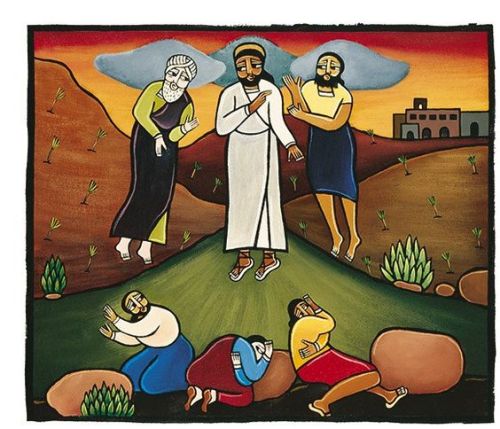
The Transfiguration of Jesus, by Armando Alemdar Ara, 2004

After six days Jesus took Peter, James and John with him and led them up a high mountain, where they were all alone. There he was transfigured before them. His clothes became dazzling white, whiter than anyone in the world could bleach them. And there appeared before them Elijah and Moses, who were talking with Jesus.

Peter said to Jesus, “Rabbi, it is good for us to be here. Let us put up three shelters—one for you, one for Moses and one for Elijah.” (He did not know what to say, they were so frightened.)

Then a cloud appeared and covered them, and a voice came from the cloud: “This is my Son, whom I love. Listen to him!”

Suddenly, when they looked around, they no longer saw anyone with them except Jesus.

As they were coming down the mountain, Jesus gave them orders not to tell anyone what they had seen until the Son of Man had risen from the dead. (New International Version)

It may be that reading this account of Christ’s transfiguration (metamorphosis) seems a bit strange, even confusing. Perhaps you have no categories of thought to explain such an encounter.

In a Peanuts cartoon, Charlie Brown, Lucy, and Linus were lying on their backs looking at the sky. Lucy says, “If you use your imagination you can see lots of things in the cloud formations. What do you think you see, Linus?” 

Linus replied, “Well, those clouds up there look to me like the map of the British Honduras on the Caribbean… That cloud up there looks a little like the profile of Thomas Eakins, the famous painter and sculptor… And that group of clouds over there gives me the impression of the stoning of Stephen… I can see the Apostle Paul standing there to one side…” 

Lucy responds, “Uh huh… that’s very good… what do you see in the clouds, Charlie Brown?”

To which Charlie Brown replied, “Well, I was going to say a ducky and a horsy, but I changed my mind.”

Maybe your spiritual life seems more like Charlie Brown than Linus. Compared to the experiences of others, you have not had any defining moments of ecstasy; no shining Jesus in front of you; or no spectacular vision of Christ.

Perhaps your life seems rather mundane and ordinary in light of the many stories we have in the Gospels of Jesus doing the miraculous. 

Most of life is lived in the daily grind. In the monotony of life, we need some hope, an occasional mountain top experience that helps us glimpse into the future of what it will be like someday when the kingdom of God comes in its fullness.

Christ’s transfiguration came after a hard frank discussion Jesus had with the disciples about his impending death. Jesus was up front with them, saying that he must suffer, be rejected, and killed. But in three days he will rise again. The disciples did not want to hear that; Peter even rebuked Jesus for saying it. In response, Jesus said:

“If anyone would come after me, he must deny himself and take up his cross and follow me. For whoever wants to save his life will lose it, but whoever loses his life for me and for the gospel will save it.”

Jesus (Mark 8:34-35, NIV)

Jesus identified himself as the Suffering Servant, the One who must suffer and die. Yet, he is also the One to be glorified. For Jesus, there has to be suffering before glory. And it is the same for us.

The Christian life includes walking through the valley of the shadow of death. But it is also punctuated with mountain top experiences that give us hope. The nature of the Christian journey is up and down, with both the mountain and the valley as spiritual realities of great importance.

We may have a lot of questions about Christ’s transfiguration. Jesus had a metamorphosis smack in front of the disciples’ eyes. Why? What’s the significance of this? Was it just a demonstration to get their attention? Why are Moses and Elijah there? What’s really going on?
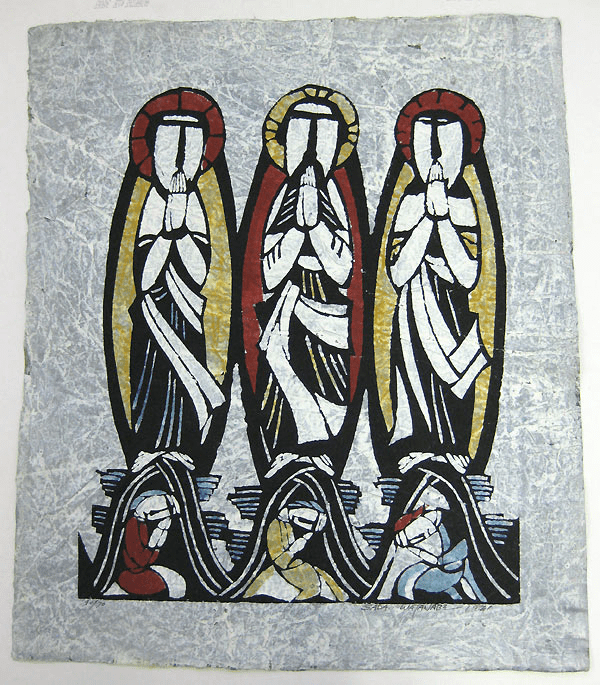
Transfiguration, by Sadao Watanabe, 1971

Jesus intentionally took Peter, James, and John up the mountain to have this experience. Up to that point, a lot of rumors were circulating about Jesus – that maybe he was Elijah come back, or some other prophet, perhaps even Moses himself. But Moses and Elijah showing up next to Jesus, meant that Jesus is not them. 

In the Old Testament, Moses was used by God to deliver the Israelites out of slavery in Egypt and to bring them to the Promised Land. Centuries later, Elijah was used by God to bring about a great repentance of the people from the false god Baal, and a mighty revival to the exclusive worship of the Lord.

As good as Moses and Elijah were, having them with Jesus on the mountain meant that it gets even better with Christ. Jesus is the Messiah, the True Deliverer, who saves people from their sins. What’s more, Jesus is the ultimate revivalist, bringing truth, grace, and the love of God to people, calling them from legalistic religion back to the true worship of God.

Deliverance and revival were integral to Christ’s earthly ministry. And Jesus expects his followers to do the same. In Christian ministry, there will be suffering, because we must take up our cross. There will also be glory, experiencing and seeing deliverance from sin that comes with revival. 

When I was in college, a group of us Christians met each week for encouragement and prayer. For a two year period, at least one person a week was added to our group, having had a dramatic conversion to Christ. That was an incredible time of being on the mountain with Jesus, seeing him manifested in all his glory through changing people’s lives.

Yet, inevitably, we descend to the valley. What goes up must come down. And how we handle the valley is crucial. On the mountain, things seemed effortless; but in the valley, it’s all different.

Coming off the mountain may lead to various temptations, like wishing you were back on the mountain – looking back to some Golden Age where everything seemed so great, and people were enthused and excited about God and the group you were in. Yet, there are times when the revival fires wane, and the glory departs. Then what?…

God’s Word to us today, given by God the Father, is: “This is my Son, whom I love. Listen to him!”

A 12th century Mosaic of Christ’s Transfiguration

Here is what Jesus has said to us, as recorded by the Evangelist Mark:

“The time has come. The kingdom of God is near. Repent and believe the good news!” (Mark 1:15)

“Come, follow me, and I will make you fishers of men.” (Mark 1:17)

“It is not the healthy who need a doctor, but the sick. I have not come to call the righteous, but sinners.” (Mark 2:17)

“Why are you so afraid? Do you still have no faith?” (Mark 4:40)

“Everything is possible for him who believes.” (Mark 9:23)

“If anyone wants to be first, he must be the very last, and the servant of all.” (Mark 9:35)

“I tell you the truth, anyone who will not receive the kingdom of God like a little child will never enter it.” (Mark 10:15)

“…the Son of Man will be betrayed to the chief priests and teachers of the law. They will condemn him to death and will hand him over to the Gentiles, who will mock him and spit on him, flog him and kill him….” (Mark 10:33-34)

“For even the Son of Man did not come to be served, but to serve, and to give his life as a ransom for many.” (Mark 10:45)

“I tell you, whatever you ask for in prayer, believe that you have received it, and it will be yours. And when you stand praying, if you hold anything against anyone, forgive him, so that your Father in heaven may forgive you your sins.” (Mark 11:24-25)

“My God, my God, why have you forsaken me?” (Mark 15:34)

“Go into all the world and preach the good news to all creation.” (Mark 16:15)

If you have had a mountain top experience with Jesus, let that encounter give you the drive and the hope to keep carrying the bucket through the valley, without living in the past.

If you have never been on the mountain, then today, listen to Jesus and follow what he says.

If you are vexed in your spirit, go to Jesus. Listen to him. Do what he says.

Know the word of the Lord, and bank on it. For our light and momentary sufferings will result in praise, honor, and glory when Jesus Christ is revealed. Amen.

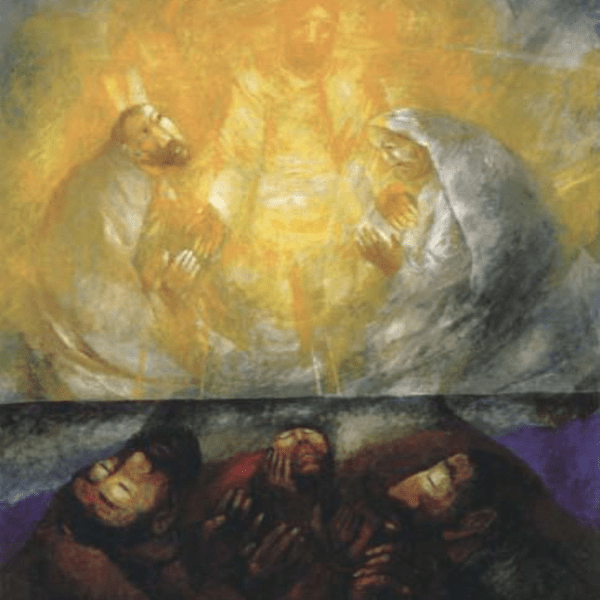
Don’t Be Afraid (Matthew 17:1-9)

Transfiguration by Sieger Köder (1925-2015)

After six days Jesus took with him Peter, James and John the brother of James, and led them up a high mountain by themselves. There he was transfigured before them. His face shone like the sun, and his clothes became as white as the light. Just then there appeared before them Moses and Elijah, talking with Jesus.

Peter said to Jesus, “Lord, it is good for us to be here. If you wish, I will put up three shelters—one for you, one for Moses and one for Elijah.”

While he was still speaking, a bright cloud covered them, and a voice from the cloud said, “This is my Son, whom I love; with him I am well pleased. Listen to him!”

When the disciples heard this, they fell facedown to the ground, terrified. But Jesus came and touched them. “Get up,” he said. “Don’t be afraid.” When they looked up, they saw no one except Jesus.

As they were coming down the mountain, Jesus instructed them, “Don’t tell anyone what you have seen, until the Son of Man has been raised from the dead.” (New International Version)

Fear is a universal feeling and experience. None of us has to work at being afraid – but we all have to work at being brave and having the courage to face our fears.

Sometimes, we adults teach children not to fear because we assume they are afraid of the dark, high places, and monsters in the closet. But I tend to think a lot of our own adult fear is projected on kids. Why? Because some of the bravest folks I have ever known are children. 

Kids don’t understand near as much as we adults do, yet they conquer their fears every day by facing the world with courage. If you were to go to any children’s hospital today, I believe you would be amazed at the kind of courage you would find amongst kids. We adults have a whole lot to learn about being brave because we have become far too sophisticated in hiding our fears and avoiding courage.

This is why the most repeated exhortation is all of Holy Scripture is to not be afraid. We need courage to live the way God wants. Every day is a fresh opportunity to practice courage.

We need the courage to stand alone

Korah son of Izhar, the son of Kohath, the son of Levi, and certain Reubenites—Dathan and Abiram, sons of Eliab, and On son of Peleth—became insolent,and rose up against Moses. With them were 250 Israelite men, well-known community leaders who had been appointed members of the council. They came as a group to oppose Moses and Aaron and said to them, “You have gone too far! The whole community is holy, every one of them, and the Lord is with them. Why then do you set yourselves above the Lord’s assembly?” (Numbers 16:1-3, NIV)

When Moses heard this, he responded with prayer to God – because he clearly understood that this was all a big power play by Korah, who got others stirred up to take action against him. 

Moses stood alone. Out of the millions of Israelites, not one single person stood with Moses. To be sure, the majority of Israelites did not side with Korah; but neither did they come and stand with Moses. Why? They were too afraid to be involved and took the posture of bystanders. 

God did a miraculous thing, never done before or since, by opening up the ground and having the earth swallow Korah and his followers. The Lord wasn’t only upset with Korah; God was also angry with the people for fearfully standing in the safety of numbers and doing nothing. In fact, God was so mad that he was ready to wipe them all off the face of the earth. But, yet again, Moses, in humility, prayed and pleaded with God to spare them – and God did.

There will always be someone opposing you when you are just trying to obey God and do the right thing. And there will always be a crowd of people who do not want to be involved because they are afraid.

The church everywhere needs to be what Jesus wants it to be, and not what a particular person or group of people want it to be. Courageous people need to stand up to people who want positions of power in order to lead in self-serving ways.

We need the courage to love people

Now while he was in Jerusalem at the Passover Festival, many people saw the signs he was performing and believed in his name. But Jesus would not entrust himself to them, for he knew all people. He did not need any testimony about mankind, for he knew what was in each person. (John 2:23-25, NIV)

Jesus did not get carried away with his own press. Whether people responded to him by the hundreds, or whether they refused him altogether and tried to throw him off a cliff, Jesus was consistently the same. He did not need people’s responsive affirmation in order to do his mission on earth. Christ loved people just because he wanted to, and not because he was trying to get them to love him in return, like insecure and fearful people do.

We need the courage to love the unlovely. And we must understand that perfect love casts out fear.

“We should not only love our brothers and sisters, but also not consider ourselves better than them. Instead, we should show compassion and acceptance to others. We want to have others strictly reprimanded for their offenses, but we will not be reprimanded ourselves. We are inclined to think the other person has too much freedom, but we ourselves will not put up with any restraint to our freedom. There must be rules for everyone else, but we must be given free rein. It is seldom that we consider our neighbor equally with ourselves. If everyone was perfect, what would we have to endure for the love of God?… for we cannot live in this world without adversity. Those who can suffer well will enjoy the most peace, for such persons are brave, courageous, not afraid of pain, have Christ as their friend, and heaven as their reward.”

Thomas à Kempis, The Imitation of Christ, c.1425, C.E.

It is no test of virtue to be on good terms with easy-going people. And, of course, all of us want to live in peace and prefer those who agree with us. Yet, in this mortal life, our peace consists in the humble bearing of suffering and contradictions, not in being free of them.

We need the courage to please God

The devil took him to a very high mountain and showed him all the kingdoms of the world and their splendor. “All this I will give you,” he said, “if you will bow down and worship me.” Jesus said to him, “Away from me, Satan! For it is written: ‘Worship the Lord your God, and serve him only.’” (Matthew 4:8-10, NIV)

Jesus is our model of courage. He sought to please the Father, and not anyone else. Jesus bravely resisted becoming someone other than he was called to be. 

On the Mount of Transfiguration, Jesus courageously refused to remain on the mountain, instead choosing to go into the valley and undertake a new and risky ministry. 

Christ fearlessly came to this earth in the incarnation and resisted the comfort of security. He valiantly confronted sin, overturned the money-changers’ tables, and did his Father’s will, instead of shrinking in fear about what people would think. 

Jesus heroically faced crucifixion, even though he was terribly stressed about it, in order to offer forgiveness in the face of persecution. Jesus gallantly said “No!” to the power of sin by rising from death. And he boldly ascended to heaven and confidently passed the work of ministry to a motley group of people who did not show any promise to carry the mantle of his teaching.

The Son found his identity in relation to the Father. For us to please God, we need the courage to play to an audience of One. 

If we need other people’s acceptance and approval in order to do anything, then we will never have the courage to act for God. 

We must live by conviction, and not by sticking our finger to the wind to see which way popular opinion is blowing.

Conclusion

History is filled with men and women who said “no” to destructive fear and changed the world. But imagine if they had succumbed to the paralyzing effects of fear in their lives. Imagine if…

The Apostle Paul, fearing resistance or rejection, chose to stay home rather than embarking on the missionary journeys that took the message of Christ throughout the known world.

Martin Luther King Jr. gave speeches filled with gentle hints about the evils of segregation, because he feared pushing too hard.

Jackie Robinson refused to enter major league baseball so as to not rock the boat; or Branch Rickey, the owner of the Brooklyn Dodgers, just going with the way baseball had always operated. But neither of them went that way. In the film, “42,” Robinson asks Rickey:

“You want a player that doesn’t have the guts to fight back?” “No. No.” replies Rickey. “I want a player who has the guts not to fight back. People aren’t going to like this. They’re going to do anything to get you to react. Follow a curse with a curse and they’ll hear only yours. Follow a blow with a blow and they’ll say the Negro lost his temper; that the Negro does not belong. Your enemy will be out in force and you cannot meet him on his own low ground. We win with hitting, running, fielding—only that. We win only if the world is convinced of two things: That you are a fine gentleman, and a great ball player. Like our Savior, you’ve got to have the guts to turn the other cheek. Can you do it?”  Robinson replies, “You give me a uniform; you give me a number on my back; and I’ll give you the guts.”

42 (2013 film)

Now imagine yourself, fully aware of the mission and vision God has placed in your heart to advance his gracious and benevolent rule in this world – and yet there is also present all the phobias, irrational worries, and destructive fears of failure, harm, or rejection. So I ask:

If you don’t fulfill the mission God assigned to you, who will?

Luke 9:28-43 – Transfiguration Sunday: Listen to Jesus

Transfiguration by Laura James

Jesus took Peter, John and James with him and went up onto a mountain to pray. As he was praying, the appearance of his face changed, and his clothes became as bright as a flash of lightning. Two men, Moses and Elijah, appeared in glorious splendor, talking with Jesus. They spoke about his departure, which he was about to bring to fulfillment at Jerusalem. Peter and his companions were very sleepy, but when they became fully awake, they saw his glory and the two men standing with him. As the men were leaving Jesus, Peter said to him, “Master, it is good for us to be here. Let us put up three shelters—one for you, one for Moses and one for Elijah.” (He did not know what he was saying.)

While he was speaking, a cloud appeared and covered them, and they were afraid as they entered the cloud. A voice came from the cloud, saying, “This is my Son, whom I have chosen; listen to him.” When the voice had spoken, they found that Jesus was alone. The disciples kept this to themselves and did not tell anyone at that time what they had seen.

The next day, when they came down from the mountain, a large crowd met him. A man in the crowd called out, “Teacher, I beg you to look at my son, for he is my only child. A spirit seizes him, and he suddenly screams; it throws him into convulsions so that he foams at the mouth. It scarcely ever leaves him and is destroying him. I begged your disciples to drive it out, but they could not.”

“You unbelieving and perverse generation,” Jesus replied, “how long shall I stay with you and put up with you? Bring your son here.”

Even while the boy was coming, the demon threw him to the ground in a convulsion. But Jesus rebuked the impure spirit, healed the boy and gave him back to his father. And they were all amazed at the greatness of God. (New International Version)

When Jesus is around, extraordinary things happen. And yet, sometimes we just don’t perceive it. The three disciples of Jesus – Peter, James, and John – experienced something incredible, yet they were not really aware of what it meant, at the time. The Transfiguration of Jesus on the mountain was unimaginable and awesome. The disciples, however, were confused, sleepy, and walked away silent about the whole affair. 

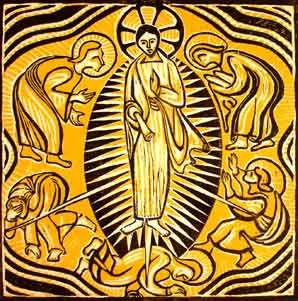
Woodcut of the Transfiguration by Sister Mary Grace Thul

Coming down from the mountain, the other disciples were found scratching their heads about a boy in need of healing. Jesus seemed rather perturbed about the all-around lack of faith. After curing the boy, everyone was amazed, as if they did not expect such a thing to occur.

We are not always told in the Gospels why Christ’s disciples often did not understand or perceive the significance of the miraculous, supernatural, or extraordinary events that took place right in front of them. Maybe their minds were somewhere else.

It could be that Peter had ADD (Attention Deficit Disorder) and was having trouble focusing.

Perhaps James trying to do some sort of ancient multi-tasking. 

Maybe John had some road rage on his way to the meeting on the mountain and was having a hard time thinking straight.

It could be that the three disciples were caught up in the anxiety of wondering where their next shekel was coming from.

Perhaps they were just up too late the night before binge watching the fishermen on the lake. But whatever was going on with the disciples, they were distracted.

So, we actually have God the Father step into the scene at the Transfiguration of Jesus on the mountain and speak. God isn’t typically in the business of exhorting people to listen unless they are not paying attention. The heavenly Father is clear, succinct, and to the point:

“This is my Son, whom I have chosen; listen to him.”

We are to listen to Jesus because he is God’s Son. Everything centers round him. 

Jesus is the full bodily and human representation of God on earth. Jesus is Savior, Lord and Master, Teacher and Healer.

Jesus is the complete fulfillment of all the Old Testament promises, and the one who will come again to judge the living and the dead.

Jesus is the mid-point of history, the hinge upon which all the universe swings. Jesus is the one whom we must listen to when he speaks and acts.

Therefore, our identity is to be fully bent, molded, and shaped in Jesus Christ. This spiritual formation of our lives happens as we intentionally seek to be with Jesus, listen to him, and do what he says. 

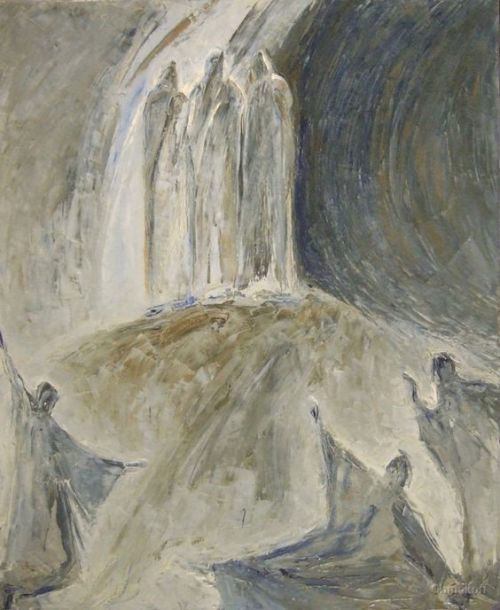
Transfiguration by Macha Chmakoff 

Jesus took Peter, James, and John up the mountain to experience his Transfiguration in a prayer meeting. Extraordinary things happen in prayer meetings. The early church gathered often in prayer meetings, following the example of their Lord Jesus. As the church listened to God and responded (in a rhythm of revelation and response) they saw Peter miraculously delivered from jail; ordinary people delivered from empty lives and demonic influence; and guidance in how to proceed as followers of Christ. 

Prayer is as much or more about listening to God as it is talking to him. It is in listening to God that we are filled with God’s Spirit and empowered to come down from the mountain and engage in God’s mission.

Jesus wanted the disciples to learn and discern something on the mountain. Jesus was changed in front of them. Moses and Elijah showed up and talked with him about his “departure,” that is, his “exodus.”

Moses was the one who listened to God and led the people in a mass exodus from slavery in Egypt to the freedom of the Promised Land.

Elijah was a prophet who listened to God and led the people out of centuries of idol worship and dead religion into the freedom of spiritual and national revival in Israel. 

And Jesus came to lead people in an exodus out of sin, death, and hell so that they can experience a new life of freedom, hope, peace, and joy.

Changed lives are God’s goal for us.  And a changed life will occur when we listen to God’s Son, Jesus, learn from him, and lean into faith in him – all of which takes humility.

Eventually, Jesus and his disciples came down from the mountain. Prayer meetings are great, but there is a time to descend the mountain and engage in God’s mission.

We are to participate with God in seeing changed lives through the work of Jesus.

We must bear witness to the redemptive saving events of Jesus to a world which desperately needs him – his healing work of both body and spirit.

The glory of God is presently here among us. We need to perceive it and be aware of it.  But to do so, we must listen well. 

Erik Weihenmayer is blind, yet on May 25, 2001, he reached the peak of Mount Everest. Suffering from a degenerative eye disease, he lost his sight when he was thirteen years old. But that did not stop him from mountain climbing. On a mountain where 90% of climbers never make it to the top—and 165 have died trying since 1953—Erik succeeded in large measure because he listened well. 

He listened to the little bell tied to the back of the climber in front of him, so he would know what direction to go. He listened to the voice of teammates who would shout back to him, “Death-fall two feet to your right!” so he would know what direction not to go. He listened to the sound of his pick jabbing the ice, so he would know whether the ice was safe to cross. 

When we journey through this life, listening well makes all the difference. So, how might we listen well to Jesus?  Here are some basic principles of active listening:

  1. Stop talking.  It was Mark Twain who said: “If we were supposed to talk more than we listen, we would have two tongues and one ear.” Proverbs 12:15 says, “The way of a fool seems right to him (therefore he has no need to listen) but a wise person listens to advice.”
  2. Prepare yourself to listen to God.  One of the ways I do this is by sitting in a quiet spot, free of distraction, and repeat several times to God, “Speak Lord, for your servant is listening” (1 Samuel 3:10). Then, I am quiet… and listen….  If this practice is way off your radar then I would recommend, at first, being quiet for only a few minutes. Then, after a few weeks, be quiet in longer stretches so that you can go 20-30 minutes or even an hour. We might even consider a silent retreat in which the sole purpose is to listen to what God is saying to us.
  3. Slowly and carefully read God’s Word. Scripture is meant to be digested in small bites and thoroughly savored. Slow down and be quiet enough to hear God speak through the Word. A contemplative and meditative readings of Holy Scripture will always yield spiritual health and vitality.
  4. Pray back to God what you hear him saying to you. This is active listening – a genuine dialogue between us and God. “Come, now, let us reason together,” the Lord has said (Isaiah 1:18). God wants a conversation with us.

God speaks, if we have ears to hear, through so much more than an audible voice.

The Lord’s Supper is a tangible proclamation of the person and work of Jesus Christ. It speaks to us, and, so, we must listen well. The Table proclaims Christ’s identity as God’s Son, the one who came to live a holy life, teaches us the way to live, and how Jesus died a cruel death so that we might be born again and experience new life. 

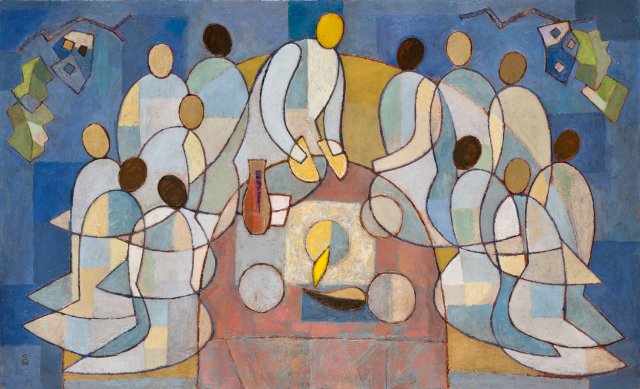
We Are All One in Jesus Christ by Soichi Watanabe, 2009

The Table proclaims our mission, that as often as we share in communion, we proclaim the Lord’s death until he comes again. That is, we witness to the reality of Christ’s redemption in our own lives. We share our own changed lives with others. We pray for them so that they will experience new life, as well. 

The Table proclaims our spiritual formation in Christ. At the Table, we are lifted and joined with Christ through the Holy Spirit. It is a mysterious joining that defies description, just as the disciples had a mysterious encounter that they could not fully explain. Yet they experienced it, nonetheless.

May we listen well, without distraction, to God’s Son. May we know God’s purpose for our life. And may we encounter Jesus at the Table, and in all of life, so that we experience new life. 

O God, teach us to listen to those nearest to us, our family, our friends, our co-workers. Caring God, teach us to listen to those far from us – the whisper of the hopeless, the plea of the forgotten, and the cry of the anguished. Holy Spirit of God, teach us to listen for your voice — in busyness and in boredom, in certainty and doubt, in noise and in silence. Gracious God, teach us to listen well to the message of your Table. May you change and transform us to be like Jesus. Teach us, Lord, to listen. Amen.

Mark 9:2-9 – The Transfiguration of Jesus

Welcome, friends! On this Transfiguration Sunday for Christians everywhere around the world, let us celebrate the good changes which come from our Lord Jesus Christ, who is our ultimate Deliverer and Revivalist to new hope and new life. Click the videos below to worship Christ and listen to Jesus…

Mark 9:2-9, Pastor Tim Ehrhardt
“Transfiguration” by Hillsong Worship. From the album “Open Heaven / River Wild”. Written by Scott Ligertwood, Aodhan King, Brooke Ligertwood, and Taya Smith. Worship leader is Taya Smith.

Not all is as it seems. There is glory hidden in everything, waiting to be revealed to the eyes of those who believe, beyond what seems inevitable, who do not want to live in the status quo but in the promises of God.

Hold onto this vision as we turn towards Lent and walk the more difficult path. There is yet a greater glory still to be revealed. Go in peace. Go in hope. Go in love, to serve the Lord Jesus, who is love incarnate. Amen.