Called To a Way of Being – Fourth Sunday of Advent (Romans 1:1-7)

Paul, a servant of Christ Jesus, called to be an apostle, set apart for the gospel of God, which he promised beforehand through his prophets in the holy scriptures, the gospel concerning his Son, who was descended from David according to the flesh and was declared to be Son of God with power according to the spirit of holiness by resurrection from the dead, Jesus Christ our Lord, through whom we have received grace and apostleship to bring about the obedience of faith among all the gentiles for the sake of his name, including you who are called to belong to Jesus Christ,

To all God’s beloved in Rome, who are called to be saints:

Grace to you and peace from God our Father and the Lord Jesus Christ. (New Revised Standard Version)

To be a Christian is to be a servant of Jesus, called to a specific way of being in the world, and set apart for the gospel of God.

Concerning this gospel, this good news, it is all about God the Son, Jesus Christ, who is also fully human. Jesus is the singular person – both God and human at the same time, all the time. His human credentials are linked to the genealogy of the ancient King David, who was promised by God that one of his descendants would sit on throne forever. And as for Christ’s divinity, it was confirmed and established through his resurrection from death.

It is through Christ that we are called to belong to him; we have received the grace to be called children of God; and we are called to holiness for God. We all, therefore, have a calling. Every one of us is important. All of us receive the grace of God to fulfill that calling in this world.

In our contemporary society, we put a lot of stock into what we do, to the point of identifying ourselves primarily by our job titles and positions. But in God’s society, our primary identification is that we belong to God, and specifically to Jesus Christ.

Belonging to Christ means we are to have a certain way of being – not just doing – on this earth. We are first and foremost human beings, and not human doings. What we do is to flow from our being, and not the other way around. We do not gain identity through actions and accomplishments.

Our way of being has a lot to do with the Advent season. Christ’s coming into this world as a vulnerable baby was a deliberate way of being for Jesus in this world. He would go through all the human travails and trials that we do. He would know both joy and suffering, and would know them as coming together into one:

For the joy set before him he endured the cross, scorning its shame, and sat down at the right hand of the throne of God. (Hebrews 12:2, NIV)

It’s normal for us to wonder about the nature of our own personal sufferings. Its hard for us to make sense out of all the nonsensical things in this world, especially when it pertains to us personally.

Indeed, it is hard for us to accept the reality that humble suffering is not only a part of living in this world, but is also an important part of being a Christian who belongs to Jesus.

Whenever we lose something or someone important to us, we struggle with why. We may wonder where God was. We might think there is something wrong with us, as if God is punishing us for some unknown sin we’ve done in the past.

But we would be barking up the wrong tree. Methinks we wrestle so much with adversity and hardship because of our predilection for doing instead of being.

Perhaps our life situations are more about our way of being in this world, rather than what we do on this earth.

Maybe my life is meant primarily to be about being a person who is always loving, kind, compassionate, just, good, righteous, and holy – a saint, set apart as one who belongs to God.

Maybe it has a lot less to do with our vocations and only seeing things through what I’m able to do, or not do.

It could be that I am meant to see God’s grace operating through me by means of love, not hate; kindness, not meanness; compassion and comfort, not indifference and annoyance; justice, not injustice; goodness, not bad attitudes; and holiness, not unrighteousness.

It is quite possible that today (and every day) my Christian life has been about, is about, and will continue to be about my suffering for the sake of Jesus, who suffered for me.

“Why be disturbed of things that do not succeed according to your plans and desires? Who gets everything according to his likes? Neither I, nor you, nor anyone else on this earth. No one in this world is without some trial or illness or affliction, not even a king or a pope. Who, then, has it the best? The one who is willing to suffer for God’s sake.” Thomas à Kempis, The Imitation of Christ

The believers in the Roman Church, for whom the Apostle Paul wrote his letter, were focused primarily on what they had and what they did as Jews and as Gentiles. Because of their understanding of identity, they kept wrangling with each other and looking down on one another – namely, because they failed to each other as belonging equally to God as the one people of God. Jews were too hung up on how they kept the Law for centuries without any Gentiles. And Gentiles were too myopic to see that they were not replacing Jews out of some superior activity.

To love one another, and to simply love, is to suffer. Apart from love there is no suffering. Without love, there is no peace, no grace; and there is no belonging to God and having a way of being in the world which pleases God.

Furthermore, one can never have possessions or wealth without a great deal of anxiety and apprehension. Our happiness does not consist in temporal things, but in the permanence of relationships, because relationships are the only things we take with us in the end.

In the spirit and practice of the Lord Jesus whom the Christian serves, we must pass through the fire before we arrive at redemption and be at peace with God and humanity.

To reach the joy of Christmas, we must endure the weeks of Advent, of anticipating the hope to come, of waiting to see the Christ child who humbly comes into the world for us and for our salvation. And that means we may likely have to endure any current adverse and hard circumstances.

We are called – not for selfish gain, and not to look down on others who are different – but for a way of being in this world which emulates the Lord whom we serve, Jesus Christ our Savior.

Shepherd of Israel: May Jesus, Emmanuel and son of Mary, be more than just a dream in our hearts. With the apostles, prophets, and saints, save us, restore us, and lead us in the way of grace and peace, so that we may bear your promise into the world. Amen.

The Time Is Near (Luke 21:5-19)

The Siege and Destruction of Jerusalem, by David Roberts, 1850

When some were speaking about the temple, how it was adorned with beautiful stones and gifts dedicated to God, he said, “As for these things that you see, the days will come when not one stone will be left upon another; all will be thrown down.”

They asked him, “Teacher, when will this be, and what will be the sign that this is about to take place?” And he said, “Beware that you are not led astray, for many will come in my name and say, ‘I am he!’ and, ‘The time is near!’ Do not go after them.

“When you hear of wars and insurrections, do not be terrified, for these things must take place first, but the end will not follow immediately.” Then he said to them, “Nation will rise against nation and kingdom against kingdom; there will be great earthquakes and in various places famines and plagues, and there will be dreadful portents and great signs from heaven.

“But before all this occurs, they will arrest you and persecute you; they will hand you over to synagogues and prisons, and you will be brought before kings and governors because of my name. This will give you an opportunity to testify. So make up your minds not to prepare your defense in advance, for I will give you words and a wisdom that none of your opponents will be able to withstand or contradict. You will be betrayed even by parents and siblings, by relatives and friends, and they will put some of you to death. You will be hated by all because of my name. But not a hair of your head will perish. By your endurance you will gain your souls. (New Revised Standard Version)

The Arch of Titus in Rome, depicting the Roman triumphal march after victory against the Jewish revolt

The temple, central in today’s Gospel lesson, had undergone an impressive and beautiful refurbishment by Herod the Great (appointed as King of Judea by the Roman Emperor).

It took eighty years for the rebuilding project to be completed. It was significantly enlarged; and generous amounts of gold and silver were used to refurbish it, along with ample use of white marble.

So, it was no wonder that people coming to Jerusalem and approaching the temple admired the massive and impressive edifice. In their awe, they commented so to Jesus.

But Jesus was less impressed with all the architectural rebuilding and expansion of grounds, and more concerned about what would be coming soon concerning the temple and the inhabitants of Jerusalem.

Jesus became the wet washrag to the awe of viewing the Jerusalem temple. He stated that the temple would be destroyed; and it would happen soon.

Imagine if you were one of the persons in the crowd listening to Jesus. “What are you talking about? Why in the world would you even bring that up? It’s obvious that God won’t let this temple be destroyed. It’s his house!”

To their credit, Christ’s disciples did not question the words of Jesus. They only asked a follow up question of when this imminent destruction was going to take place. Unlike the crowd, their query was: “When can we expect this to happen?”

Christ responded by warning his disciples not to believe every apocalyptic preacher who comes along trying to tell everyone when the event will happen. Because some of those preachers will be false prophets who only lead people astray.

False prophets tend to prophesy peace and abundance when God has already proclaimed doom. I find it curious and interesting that the current U.S. President keeps up a steady stream of telling the American people that the economy is booming and that everyone can trust him to keep them safe and secure – even though there is zero evidence for such bluster.

(In in fact, there is contrary evidence to his words; which begs the question why anyone would listen to him…). Prophets who ignore truth and proclaim error tend to downplay any sort of doom on the horizon, especially when they are in power.

Yet, with all the doom and gloom proclaimed by Christ, let’s keep in mind that although the temple was indeed destroyed as Jesus said it would in the year 70 C.E., neither Christianity nor Judaism was destroyed along with it.

God transcends any physical sacred religious space in the form of temples and church buildings.

After the temple’s destruction, both religions kept on, with Christianity growing and becoming the world’s most populous religion. Today, Judaism and Christianity have adherents across the entire earth in every nation, and among all sorts of races and ethnicities.

Sometimes the modern church forgets these things. There are many congregations today who identify themselves chiefly by their church building. For them, everything revolves around maintaining the physical plant, keeping the lights on, and having enough people in the pew to pay for it all.

All of this focus on the building means that congregants too often get excited about new people because they see them as potential givers who can help shoulder the load of paying bills and keeping up the building’s maintenance.

It’s no wonder that these same churches are continuing to decline. They are closing their doors at the rate of about 10 churches every day in the United States (nearly 4,000 churches per year).

When a church is struggling, it’s easy to believe that some gifted pastor will come along to renew and refurbish them; or that God will magically intervene and bring dozens if not hundreds of people to fill their empty pews.

They don’t want to hear any message that their building will be demolished by a wrecking crane. Yet, in many circumstances, Jesus has communicated to them what will happen. But the people continue believing the false prophesies of renewed glory days and the building busting at the seams with fresh converts.

If I’m coming across as a wet washrag, I’ll gently point us back to the Gospel story of Jesus for today.

Sometimes grief and lament are more biblical than overt positive thinking which is guised in the language of faith.

However, no matter what, the worldwide church will continue to go on, and the gates of hell shall not prevail upon it. The church will keep going, albeit in new places and in all sorts of new forms. Our task is to be sensitive to the Spirit’s leading, and have discerning men and women of faith who are true prophets with helpful information.

Back to the story, Jesus was even more gloomy about what would happen after the temple was destroyed. Believers would be arrested and persecuted. Circumstances would be dire. Christians would continually be at risk. And yet, a look back at history tells us that the church did not die; rather, it grew and flourished.

I am reminded today that hard circumstances and difficult situations – even including death and destruction – are not the end. In God’s kingdom, up is down and down is up; first is last and last is first. All is not lost, even though it may look that way today.

I am reminded of the words of the medieval priest, Thomas à Kempis, who wisely had his mind and heart in the right place when it came to hardship and persecution:

“Sometimes it is to our advantage to endure misfortunes and adversities, for they make us enter into our inner selves and acknowledge that we are in a place of exile and that we ought not to rely on anything in this world.

“And sometimes it is good for us to suffer contradictions and know that there are those who think ill and badly of us, even though we do our best and act with every good intention. Such occasions are aids in keeping us humble and shield us from pride.

“When men ridicule and belittle us, we should turn to God, who sees our innermost thoughts, and seek His judgment…

“It is when a man of good will is distressed, or tempted, or afflicted with evil thoughts, that he best understands the overwhelming need he has for God, without whom he can do nothing.

“While enduring these afflictions he takes himself to prayer with sighs and groans; he grows tired of this life and wishes to die so that he could be undone in order to live with Christ. It is in such times of trial that he realizes that perfect security and full peace are not to be found in this world.”

May we put our eggs not in the earthly basket of architectures, buildings, and physical plants, but in the heavenly basket of compassionate ministry, uplift for the poor and needy, and proclamation of the gospel of grace to all.

O God, in Christ you give us hope for a new heaven and a new earth. Grant us wisdom to interpret the signs of our times; encourage us to stand in the time of trial; and have faith to witness to your truth and love. Amen.

Monday of Holy Week (Psalm 36:5-11)

The Via Dolorosa (Latin: the way of sorrows) is a narrow path through the streets of the Old Jerusalem, the final route traveled by Jesus of Nazareth on the way to his crucifixion.

Your steadfast love, O Lord, extends to the heavens,
    your faithfulness to the clouds.
Your righteousness is like the mighty mountains;
    your judgments are like the great deep;
    you save humans and animals alike, O Lord.

How precious is your steadfast love, O God!
    All people may take refuge in the shadow of your wings.
They feast on the abundance of your house,
    and you give them drink from the river of your delights.
For with you is the fountain of life;
    in your light we see light.

O continue your steadfast love to those who know you
    and your salvation to the upright of heart!
Do not let the foot of the arrogant tread on me
    or the hand of the wicked drive me away. (New Revised Standard Version)

The desert journey is almost over. The sojourn with Jesus in his life and ministry will soon culminate in the ultimate experience of sorrow and joy. The Christian season of Lent is nearly at the end. We are in it’s final days, known as Holy Week.

We have a Holy Week because of love. There is yet another journey we must take, along the Via Dolorosa to the hill of Golgotha, because of God’s steadfast love.

Love suffers. Every parent knows this. Because of a parent’s committed and faithful love toward a child, they feel not only the joys but also the sorrows and pain of their children. I can say that this feeling does not go away, even with adult children. And it’s compounded with grandchildren. Just as our love is big enough to hold multiple children and grandchildren, so our capacity for experiencing deep emotion for their welfare is equally large.

Holy Week reminds us that God’s committed parental love suffers. It is because of God’s immense and steadfast love that there is a road to the cross and a tortured death for Jesus. The cost of our salvation involves a very bloody affair. Deliverance comes at the price of horrible violence. Jesus Christ lived and died for us, because of love.

He suffered much because he loved much.

God’s people, walking in the way of love, quickly discover that it is simultaneously walking in the way of suffering. From Old Testament times through the New Testament era and into the present day, the faithful have always experienced suffering as a central part of their piety and devotion in showing steadfast love. 

The medieval mystics of the Church understood quite well the connection between suffering and love. They could not imagine a Christian life without hardship, difficulty, and persecution. Thomas à Kempis, a sort of pastor to pastors, wrote in the fifteenth century:

“Sometimes it is to our advantage to endure misfortunes and adversities, for they make us enter into our inner selves and acknowledge that we are in a place of exile and that we ought not to rely on anything in this world.  And sometimes it is good for us to suffer contradictions and know that there are those who think ill and badly of us, even though we do our best and act with every good intention….  When men ridicule and belittle us, we should turn to God, who sees our innermost thoughts, and seek His judgment….  It is when a man of good will is distressed, or tempted, or afflicted with evil that he best understands the overwhelming need he has for God, without whom he can do nothing….  It is in such times of trial that he realizes that perfect security and full peace are not to be found in this world.”

Thomas à Kempis, The Imitation of Christ

And yet, it is because of love that suffering is transformed and endured as something wholly other than sheer pain or hurt. Thomas à Kempis went on to say:

“Love is a mighty power, a great and complete good; Love alone lightens every burden and makes the rough places smooth. It bears every hardship as though it were nothing and renders all bitterness sweet and acceptable. The love of Jesus is noble and inspires us to great deeds; it moves us always to desire perfection. Love aspires to high things and is held back by nothing base. Love longs to be free, a stranger to every worldly desire, lest its inner vision become dimmed, and lest worldly self-interest hinder it, or ill-fortune cast it down…. Love knows no limits, but ardently transcends all bounds. Love feels no burden, takes no account of toil, attempts things beyond its strength; love sees nothing as impossible, for it feels able to achieve all things. Love therefore does great things; it is strange and effective; while he who lacks love faints and fails.”

Thomas à Kempis, The Imitation of Christ

Holy Week’s message is certainly one of suffering love. Jesus went to the greatest lengths possible to give Divine steadfast love to humanity. So, let us not shy away from the cross, but journey with Jesus to Golgotha, embracing the love of God for us. In so doing, we will find the inner resources needed to love the world, even in all its unloveliness.

Grant, we pray, almighty God, that, though in our weakness we fail, we may be revived through the Passion of your Only Begotten Son. Who lives and reigns with you in the unity of the Holy Spirit, God, for ever and ever. Amen.

Don’t Be Afraid (Matthew 17:1-9)

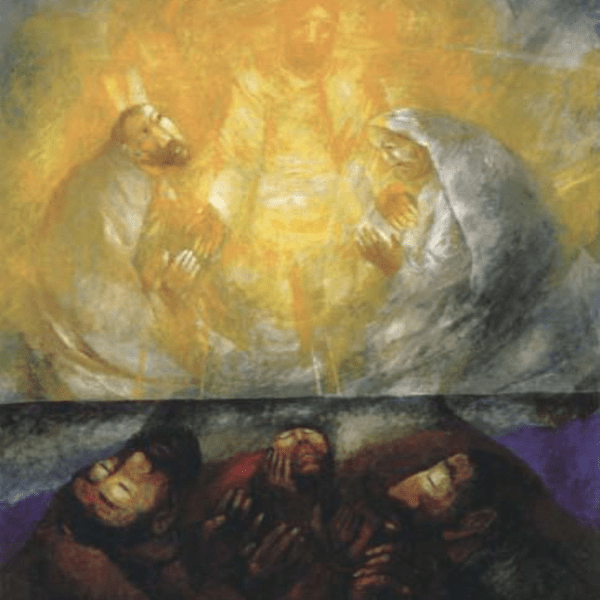
Transfiguration by Sieger Köder (1925-2015)

After six days Jesus took with him Peter, James and John the brother of James, and led them up a high mountain by themselves. There he was transfigured before them. His face shone like the sun, and his clothes became as white as the light. Just then there appeared before them Moses and Elijah, talking with Jesus.

Peter said to Jesus, “Lord, it is good for us to be here. If you wish, I will put up three shelters—one for you, one for Moses and one for Elijah.”

While he was still speaking, a bright cloud covered them, and a voice from the cloud said, “This is my Son, whom I love; with him I am well pleased. Listen to him!”

When the disciples heard this, they fell facedown to the ground, terrified. But Jesus came and touched them. “Get up,” he said. “Don’t be afraid.” When they looked up, they saw no one except Jesus.

As they were coming down the mountain, Jesus instructed them, “Don’t tell anyone what you have seen, until the Son of Man has been raised from the dead.” (New International Version)

Fear is a universal feeling and experience. None of us has to work at being afraid – but we all have to work at being brave and having the courage to face our fears.

Sometimes, we adults teach children not to fear because we assume they are afraid of the dark, high places, and monsters in the closet. But I tend to think a lot of our own adult fear is projected on kids. Why? Because some of the bravest folks I have ever known are children. 

Kids don’t understand near as much as we adults do, yet they conquer their fears every day by facing the world with courage. If you were to go to any children’s hospital today, I believe you would be amazed at the kind of courage you would find amongst kids. We adults have a whole lot to learn about being brave because we have become far too sophisticated in hiding our fears and avoiding courage.

This is why the most repeated exhortation is all of Holy Scripture is to not be afraid. We need courage to live the way God wants. Every day is a fresh opportunity to practice courage.

We need the courage to stand alone

Korah son of Izhar, the son of Kohath, the son of Levi, and certain Reubenites—Dathan and Abiram, sons of Eliab, and On son of Peleth—became insolent,and rose up against Moses. With them were 250 Israelite men, well-known community leaders who had been appointed members of the council. They came as a group to oppose Moses and Aaron and said to them, “You have gone too far! The whole community is holy, every one of them, and the Lord is with them. Why then do you set yourselves above the Lord’s assembly?” (Numbers 16:1-3, NIV)

When Moses heard this, he responded with prayer to God – because he clearly understood that this was all a big power play by Korah, who got others stirred up to take action against him. 

Moses stood alone. Out of the millions of Israelites, not one single person stood with Moses. To be sure, the majority of Israelites did not side with Korah; but neither did they come and stand with Moses. Why? They were too afraid to be involved and took the posture of bystanders. 

God did a miraculous thing, never done before or since, by opening up the ground and having the earth swallow Korah and his followers. The Lord wasn’t only upset with Korah; God was also angry with the people for fearfully standing in the safety of numbers and doing nothing. In fact, God was so mad that he was ready to wipe them all off the face of the earth. But, yet again, Moses, in humility, prayed and pleaded with God to spare them – and God did.

There will always be someone opposing you when you are just trying to obey God and do the right thing. And there will always be a crowd of people who do not want to be involved because they are afraid.

The church everywhere needs to be what Jesus wants it to be, and not what a particular person or group of people want it to be. Courageous people need to stand up to people who want positions of power in order to lead in self-serving ways.

We need the courage to love people

Now while he was in Jerusalem at the Passover Festival, many people saw the signs he was performing and believed in his name. But Jesus would not entrust himself to them, for he knew all people. He did not need any testimony about mankind, for he knew what was in each person. (John 2:23-25, NIV)

Jesus did not get carried away with his own press. Whether people responded to him by the hundreds, or whether they refused him altogether and tried to throw him off a cliff, Jesus was consistently the same. He did not need people’s responsive affirmation in order to do his mission on earth. Christ loved people just because he wanted to, and not because he was trying to get them to love him in return, like insecure and fearful people do.

We need the courage to love the unlovely. And we must understand that perfect love casts out fear.

“We should not only love our brothers and sisters, but also not consider ourselves better than them. Instead, we should show compassion and acceptance to others. We want to have others strictly reprimanded for their offenses, but we will not be reprimanded ourselves. We are inclined to think the other person has too much freedom, but we ourselves will not put up with any restraint to our freedom. There must be rules for everyone else, but we must be given free rein. It is seldom that we consider our neighbor equally with ourselves. If everyone was perfect, what would we have to endure for the love of God?… for we cannot live in this world without adversity. Those who can suffer well will enjoy the most peace, for such persons are brave, courageous, not afraid of pain, have Christ as their friend, and heaven as their reward.”

Thomas à Kempis, The Imitation of Christ, c.1425, C.E.

It is no test of virtue to be on good terms with easy-going people. And, of course, all of us want to live in peace and prefer those who agree with us. Yet, in this mortal life, our peace consists in the humble bearing of suffering and contradictions, not in being free of them.

We need the courage to please God

The devil took him to a very high mountain and showed him all the kingdoms of the world and their splendor. “All this I will give you,” he said, “if you will bow down and worship me.” Jesus said to him, “Away from me, Satan! For it is written: ‘Worship the Lord your God, and serve him only.’” (Matthew 4:8-10, NIV)

Jesus is our model of courage. He sought to please the Father, and not anyone else. Jesus bravely resisted becoming someone other than he was called to be. 

On the Mount of Transfiguration, Jesus courageously refused to remain on the mountain, instead choosing to go into the valley and undertake a new and risky ministry. 

Christ fearlessly came to this earth in the incarnation and resisted the comfort of security. He valiantly confronted sin, overturned the money-changers’ tables, and did his Father’s will, instead of shrinking in fear about what people would think. 

Jesus heroically faced crucifixion, even though he was terribly stressed about it, in order to offer forgiveness in the face of persecution. Jesus gallantly said “No!” to the power of sin by rising from death. And he boldly ascended to heaven and confidently passed the work of ministry to a motley group of people who did not show any promise to carry the mantle of his teaching.

The Son found his identity in relation to the Father. For us to please God, we need the courage to play to an audience of One. 

If we need other people’s acceptance and approval in order to do anything, then we will never have the courage to act for God. 

We must live by conviction, and not by sticking our finger to the wind to see which way popular opinion is blowing.

Conclusion

History is filled with men and women who said “no” to destructive fear and changed the world. But imagine if they had succumbed to the paralyzing effects of fear in their lives. Imagine if…

The Apostle Paul, fearing resistance or rejection, chose to stay home rather than embarking on the missionary journeys that took the message of Christ throughout the known world.

Martin Luther King Jr. gave speeches filled with gentle hints about the evils of segregation, because he feared pushing too hard.

Jackie Robinson refused to enter major league baseball so as to not rock the boat; or Branch Rickey, the owner of the Brooklyn Dodgers, just going with the way baseball had always operated. But neither of them went that way. In the film, “42,” Robinson asks Rickey:

“You want a player that doesn’t have the guts to fight back?” “No. No.” replies Rickey. “I want a player who has the guts not to fight back. People aren’t going to like this. They’re going to do anything to get you to react. Follow a curse with a curse and they’ll hear only yours. Follow a blow with a blow and they’ll say the Negro lost his temper; that the Negro does not belong. Your enemy will be out in force and you cannot meet him on his own low ground. We win with hitting, running, fielding—only that. We win only if the world is convinced of two things: That you are a fine gentleman, and a great ball player. Like our Savior, you’ve got to have the guts to turn the other cheek. Can you do it?”  Robinson replies, “You give me a uniform; you give me a number on my back; and I’ll give you the guts.”

42 (2013 film)

Now imagine yourself, fully aware of the mission and vision God has placed in your heart to advance his gracious and benevolent rule in this world – and yet there is also present all the phobias, irrational worries, and destructive fears of failure, harm, or rejection. So I ask:

If you don’t fulfill the mission God assigned to you, who will?