Real Life (1 Thessalonians 3:6-13)

But Timothy has just now come to us from you and has brought good news about your faith and love. He has told us that you always have pleasant memories of us and that you long to see us, just as we also long to see you. Therefore, brothers and sisters, in all our distress and persecution we were encouraged about you because of your faith. 

For now we really live since you are standing firm in the Lord. How can we thank God enough for you in return for all the joy we have in the presence of our God because of you? Night and day we pray most earnestly that we may see you again and supply what is lacking in your faith.

Now may our God and Father himself and our Lord Jesus clear the way for us to come to you. May the Lord make your love increase and overflow for each other and for everyone else, just as ours does for you. May he strengthen your hearts so that you will be blameless and holy in the presence of our God and Father when our Lord Jesus comes with all his holy ones. (New International Version)

What does it mean to really live? Everyone has their own conceptions of what the good life is. But to live life to the full, to really live in sync with how life actually is (and is supposed to be) brings us true satisfaction, contentment, and meaning.

In the radical individualism of the West, it may seem foreign or strange to us that the Apostle Paul’s life was very much bound up in the lives of others – in the churches he established and with the believers who had come to faith in Christ. For Paul, to really live was to see spiritual growth and development in the places where he ministered.

The thing that really got Paul excited, what really melted his butter, was leading others to Christ, forming them into churches, and watching them carry out their missional mandate by doing the same things that he did with them. I can relate to Paul’s joy and satisfaction over Christian discipleship.

There’s nothing quite like mentoring others in the faith, helping them mature in that faith, and sending them out to live according to the model of faith that you’ve demonstrated for them. To see the Word of God take root in individuals and communities of people is like no other sort of joy and contentment.

In the midst of discouraging circumstances of persecution and distressing situations of opposition, it was gratifying, encouraging, and motivating for Paul to hear a good spiritual report from his protégé Timothy about the Thessalonian church’s faith.

Whether we acknowledge it or not, or like it or not, every one of us is inextricably connected to the other. And that is especially true in families, and in the family of God. The Thessalonian believers’ steadfast commitment to Christ and the Christian faith was a crucial and important dimension of Paul’s own persevering faith.

The Apostle had been on the front lines of faith – taking the good news of grace and forgiveness in Christ to the nations. To have his churches endure through all their own troubles and challenges is a great boon to Paul. They each derive confidence and inspiration from the other. Everyone’s faith is confirmed and strengthened when everyone is striving to live for Christ.

All the believers in Christ were really living because they stood firm in the Lord and were immovable in their faith commitments. Assurance and reassurance comes not in isolation, but through the interdependence and interaction with others who share the same values.

Parents don’t really live, unless they see their children living a life of abundant joy and satisfaction. And it’s the same with spiritual mothers and fathers; they truly live when their spiritual children are walking in faith and patience with the Lord.

This is why Paul was grateful and could not thank God enough for the Thessalonians’ life of faith. God’s powerful and gracious work in the church brought out all kinds of thanksgiving. With that sort of dynamic happening, Paul could face any tribulation with the confidence and trust needed to keep going.

Prayer is the logical response to a healthy spiritual and relational dynamic of faith. The greater the good relations, the greater the desire to come and keep imparting needed teaching and encouragement for the Christian life. In other words, spiritual growth begets spiritual growth.

The best way the Thessalonian converts and all the churches become rooted in faith is by God helping them to have their love increase and overflow for each other, and for everyone else. What’s more, God intends that the love Christians have for one another be a model and a witness to and for the world.

Christian community is the place we learn to love. As we practice again and again how to love one another in the church, we then take this love into the world in loving even our enemies. For if we are to follow our model and leader, Jesus Christ, then we will infuse each word and every action with the love of God in Christ – which is the light that draws others into a healthy spiritual and relational dynamic.

We must pray, as Paul did, for love to increase amongst us, so that our hearts are strengthened with genuine purity and holiness of life. For unless love grows and flowers, selfish desires will increase and turn our love inward to the point of taking love away from God and the world.

It is imperative that we have a genuinely loving stance toward each other as believers, and toward others in the world. Apart from this love – given graciously to us through the cross and resurrection of Christ – there is little hope for anything bad in this old fallen world to ever be better.

The bottom line is that churches wither and die because they lose sight of love; Christians lose faith and go their own way because they forget about love; and believers throughout the world continue on because loving prayers, loving ways, and loving words come their way, despite difficulty and hardship they face.

So, let us love one another as Christ loved us. For this is the way our faith is strengthened and our hope is kindled to keep enduring until Jesus returns to this earth and makes all things new and right. This is real life.

May almighty God give you grace to persevere with joy, so that the work of love begun in you may be completed, through Jesus Christ our Lord. Amen.

Thanksgiving Day (Psalm 100)

By Rochelle Blumenfeld

Make a joyful noise to the Lord, all the earth.
    Serve the Lord with gladness;
    come into his presence with singing.

Know that the Lord is God.
    It is he who made us, and we are his;
    we are his people and the sheep of his pasture.

Enter his gates with thanksgiving
    and his courts with praise.
    Give thanks to him; bless his name.

For the Lord is good;
    his steadfast love endures forever
    and his faithfulness to all generations. (New Revised Standard Version)

On this day, many of us Americans will engage in our annual rituals. Several verbs characterize our activities. We will:

  • “Shout” at that crazy uncle
  • “Serve” the food
  • “Come” to the table and eat
  • “Know” how much preparation went into such a big spread
  • “Enter” the living room with praise because the Dallas Cowboys lost the game
  • “Give thanks” for food, family, and football

And at the end of the day, when everyone has finally quieted down with food comas, and crazy Uncle Frank is mercifully asleep in the recliner, that underneath it all, there really is love and gratitude for everything and everyone – even Uncle Frank and his now crazy snoring.

Today’s psalm is filled with verbs, actions for both believers and unbelievers, for the animate and inanimate, for the entire earth. When the psalmist, David, and other Hebrew writers penned their poetry, they centered what they most wanted to draw attention to in the middle, so that what came before it, and after it, pointed to that central message.

The center of Psalm 100 is this: Know that the Lord is God. There are three verb imperatives (commands) that come before this central encouragement; and then, three imperatives come after it. All six verbs help us to know God better. 

The three verbs that lead up to knowing the Lord:

  • Shout or “make a joyful noise” to the Lord
  • Worship or “serve” the Lord with gladness
  • Come into God’s presence with joyful songs 

The three verbs which follow the exhortation to know God and point back to it:

  • Enter the Lord’s gates and court with thanksgiving and praise
  • Give thanks to God
  • Praise or “bless” God’s name

To “know” God is more than to have some information or some understanding of theology; it is to take that knowledge and fully internalize the Lord, to have an experiential knowledge through relational intimacy. 

We know God by God’s historical work in Holy Scripture, God’s work in other people’s lives, and God’s work in our own lives. 

It’s important to have public opportunities of praising the Lord because it strengthens everyone’s faith. And gratitude to God centers us personally and corporately so that complaints and bitterness don’t take center stage.

Our stories of God’s work helps each other to know the Lord. And knowing God is what brings about life, purpose, hope, and love.

The Lord is worthy of all the praise, adoration, and worship we can offer. So, let us do it with heartfelt thanksgiving and some emotional flavor!

I am thankful for a great many things and a great many people. I am thankful for God’s Holy Word.  It literally is my food and drink. I cannot imagine being without it. I eat it every day and have a steady diet of the Spirit teaching me. 

One of my favorite places in the Bible has to do with knowing God:

I want to [experientially] know Christ—yes, to know the power of his resurrection and participation in his sufferings, becoming like him in his death. (Philippians 3:10, NIV)

Everything in the Christian’s life, whether good or bad, is designed to help us know Jesus better. Sharing our experiences with each other encourages us to keep living for Jesus.

So, in between all the turkey and stuffing, the family drama, and the football games, let us intentionally give thanks today, out loud, for all the ways God has worked and revealed grace to us.

Accept, O Lord, our thanks and praise for all that you have done for us. We thank you for the splendor of the whole creation, for the beauty of this world, for the wonder of life, and for the mystery of love.

We thank you for the blessing of family and friends, and for the loving care which surrounds us on every side.

We thank you for setting us at tasks that demand our best efforts, and for leading us to accomplishments that satisfy and delight us.

We thank you also for those disappointments and failures that lead us to acknowledge our dependence on you alone.

Above all, we thank you for your Son Jesus Christ; for the truth of his Word and the example of his life; for his steadfast obedience, by which he overcame temptation; for his dying, through which he conquered death; and for his rising to life again, in which we are raised to the life of your kingdom.

Grant us the gift of your Spirit, that we may know Christ and make him known; and through him, at all times and in all places, may give thanks to you in all things. Amen.

Give Thanks and Praise (Luke 17:11-19)

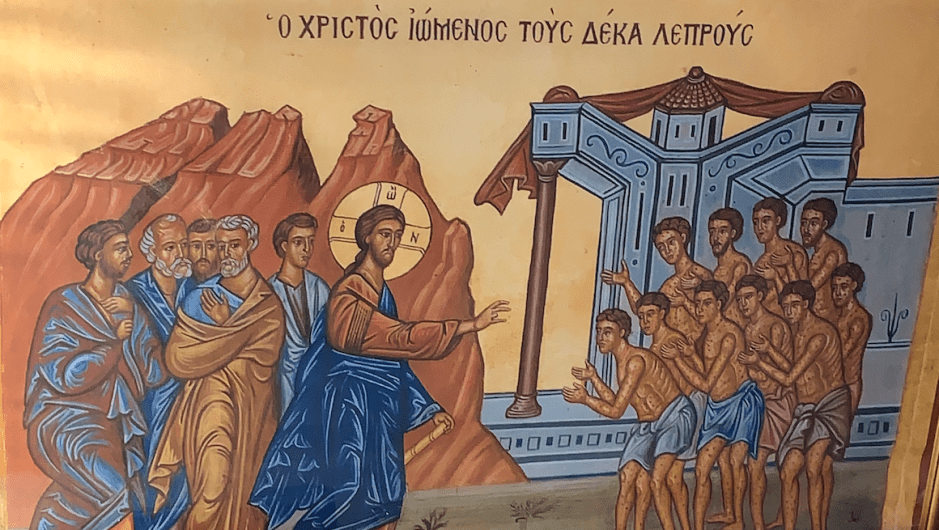
Eastern Orthodox depiction of Jesus Christ healing the ten lepers

Now on his way to Jerusalem, Jesus traveled along the border between Samaria and Galilee. As he was going into a village, ten men who had leprosy met him. They stood at a distance and called out in a loud voice, “Jesus, Master, have pity on us!”

When he saw them, he said, “Go, show yourselves to the priests.” And as they went, they were cleansed.

One of them, when he saw he was healed, came back, praising God in a loud voice. He threw himself at Jesus’ feet and thanked him—and he was a Samaritan.

 Jesus asked, “Were not all ten cleansed? Where are the other nine? Has no one returned to give praise to God except this foreigner?” Then he said to him, “Rise and go; your faith has made you well.” (New International Version)

Today’s Gospel story is both joyous and sad. The healing of ten lepers is astonishing and elicits praise and thanks… from only one. Maybe it’s because they stood at a distance. After all, it’s a close connection to God which causes praise and gratitude to arise within us – and not some appreciation from afar. Therefore, methinks we ought to consider what the nature of our own connection is. 

“Thanksgiving” to most Americans is Thanksgiving Day – a holiday filled with food, football, and family, the trifecta of American celebration. I myself admit to liberally indulging in all three. Although Thanksgiving has become a form of secular liturgical worship, I believe that underneath all the gravy, naps at halftime, and the occasional obnoxious relative, we know why we celebrate: To praise God and give thanks for our abundant blessings. 

It seems that even those who do not readily acknowledge the Divine intuitively know there is a power and source of blessing well beyond themselves which makes all good things occur.

Celebrations are a spiritual activity. God invented parties. When Israel was preparing for a new national life in the Promised Land, God told them to celebrate the Feast of Harvest with the first fruits of the crops (Exodus 23:16). The Levitical law prescribed how to go about giving thanksgiving offerings and offering praise (Leviticus 7:11-34).

Gratitude and praise was commanded, expected, and an important dimension of Old Testament worship. King David established a group of 288 full-time musicians to do nothing but praise and give thanks before God day and night (1 Chronicles 25).

Let us come into his presence with thanksgiving; let us make a joyful noise to him with songs of praise!

Psalm 95:2, NRSV

Enter his gates with thanksgiving
    and his courts with praise.
    Give thanks to him; bless his name.

For the Lord is good;
    his steadfast love endures forever
    and his faithfulness to all generations. (Psalm 100:4-5, NRSV)

It ought to have been reflexive for all ten lepers healed by Jesus to offer their worship to Jesus. A Samaritan, considered by many of the time as the lowliest of the low, a “half-breed,” was the lone person who came and fell at Christ’s feet with effusive praise and heartfelt gratitude. While the other nine went about their lives, free from disease and glad for it, only one guy took the time to thank Jesus and give glory to God. 

The Samaritan leper alone gives thanks to Christ, by Unknown artist

Sometimes we need to be reminded that celebration is a spiritual practice. It’s important to celebrate Jesus and for the ways God has provided and blessed us. In Holy Scripture, it is often the homeless, the sick, the lowly, and the outsiders who lead the way and demonstrate what genuine praise and honest thanksgiving looks like.

We, the Church, who belong to God and possess the Spirit, are to always remember and be mindful of what we truly have in Jesus Christ:

So then, just as you received Christ Jesus as Lord, continue to live your lives in him, rooted and built up in him, strengthened in the faith as you were taught, and overflowing with thankfulness. (Colossians 2:6-7, NIV)

We, like King David of old, are to establish continual worship of God:

Rejoice always, pray continually, give thanks in all circumstances; for this is God’s will for you in Christ Jesus.

1 Thessalonians 5:16-18, NIV

Our sacrifice as Christians is not with the blood of animals but with our lips and our lives:

Through Jesus, therefore, let us continually offer to God a sacrifice of praise—the fruit of lips that openly profess his name. (Hebrews 13:15, NIV)

And the worship service is eternal; it will never end:

And the twenty-four elders, who were seated on their thrones before God, fell on their faces and worshiped God, saying:

“We give thanks to you, Lord God Almighty,
    the One who is and who was,
because you have taken your great power
    and have begun to reign.” (Revelation 11:16-17, NIV)

Praising God and giving thanks to the Lord go together like mashed potatoes and gravy. Since God created everything, and since Jesus has brought healing to us through the cross, every juicy morsel of goodness we have is to be received with the full cognizance that God is behind it all.

Our lives need to be punctuated with times of celebration, praise, gratitude, and even blowout parties. Otherwise, we become dull, boring, lifeless, and bereft of Christ’s lifeblood coursing through our spiritual veins. A joyous and raucous group of healed believers jabbering incessantly with thanksgiving of God’s goodness are winsome and peculiar (in a good way and not in the strange way of your weird uncle who wants the turkey neck to gnaw on at the Thanksgiving meal).

Seems to me that Christians really ought to be at the forefront of having maximum fun because we are forgiven people; we know and experience the presence of God; our lives are hidden with God in Christ; we are confident and can approach the throne of God with boldness; and we possess the power of the Spirit and the shepherding ministry of Jesus.

Remember to give thanks. Plan to praise – out loud and with others – for the God who stands behind every good gift of creation. Let thanksgiving (not complaint) shape your life. Be the person who comes back to Jesus and offers praise and gratitude – and see how such gratefulness and glory can change the world.

Gracious God, Father of all mercies, we your unworthy servants give you humble thanks for all your goodness and steadfast love to us and to all whom you have made. We bless you for our creation, preservation, and all the blessings of this life; but above all praise you for your immeasurable love in the redemption of the world by our Lord Jesus Christ; for the means of grace, and for the hope of glory.

Give us such an awareness of your mercies, that with truly thankful hearts we may show forth your praise, not only with our lips, but in our lives, by giving up ourselves to your service, and by walking before you in holiness and righteousness all the days of our lives, through Jesus Christ our Lord, who with you and the Holy Spirit, be honor and glory throughout all ages and forevermore. Hallelujah! Amen!

Psalm 50:1-8, 22-23 – The Beauty in Brokenness

The Almighty God, the Lord, speaks;
    he calls to the whole earth from east to west.
God shines from Zion,
    the city perfect in its beauty.

Our God is coming, but not in silence;
    a raging fire is in front of him,
    a furious storm around him.
He calls heaven and earth as witnesses
    to see him judge his people.
He says, “Gather my faithful people to me,
    those who made a covenant with me by offering a sacrifice.”
The heavens proclaim that God is righteous,
    that he himself is judge.

“Listen, my people, and I will speak;
    I will testify against you, Israel.
    I am God, your God.
I do not reprimand you because of your sacrifices
    and the burnt offerings you always bring me….

“Listen to this, you that ignore me,
    or I will destroy you,
    and there will be no one to save you.
Giving thanks is the sacrifice that honors me,
    and I will surely save all who obey me.” (Good News Translation)

In the beginning, all of creation was a vessel filled with divine light. Then, it broke, and the shards of holiness were strewn across the earth. Those broken pieces are all around us. Sometimes, maybe oftentimes, we don’t see them because of our own darkness.

Ever since, the Lord has been on a mission, bending down, carefully looking for the broken shards, finding them, and picking them up. From east to west, God has been gathering together everyone on earth – the broken yet divinely lighted humans.

A major theme throughout the entirety of Holy Scripture is that God is reaching all kinds of people all over the world. Indeed, the Bible is a long unfolding drama of redemption in which the Lord does whatever it takes to restore a fundamentally broken world.

“Kintsugi” (literally, in English, “golden joinery”) is a centuries-old Japanese art form of repairing broken pottery with gold. Instead of rejoining broken ceramic pieces with a clear camouflaged adhesive, the kintsugi technique uses a special lacquer dusted with powdered gold. After restoration, beautiful seams of gold glint in the obvious cracks of the ceramic vessel. This also means that every restored ceramic piece has a unique appearance; no two of them are the same.

The Lord is presently in the divine workshop, putting broken shards of humanity together. And God isn’t trying to hide or disguise the cracks and flaws; it’s just the opposite: God celebrates the artifact by emphasizing it’s fractures and breaks. As it turns out, the restoration which the Lord employs brings the vessel to even greater beauty than it originally enjoyed. It’s the transformation of a new existence from the old.

The deepest yearning in every human soul is to become whole again, to return to their spiritual source, to experience belonging and union with the Beloved.

Amidst the human pain all around us, and within us, we can observe the sacred light, and turn in the direction of beauty. We can hear the call of God to respond with gratitude and thanksgiving, instead of relying upon some physical or monetary sacrifice to suffice our spiritual obligations.

We are here to participate with God in redeeming that which is broken. The sacrificial activity that honors the Lord, and gathers the strewn shards, is a grateful heart with lips that speak thankfulness. Humanity can only see the power of God to save and restore, whenever us jars of clay practice gratitude and obedience to the Lord.

The world’s observation of a perfect vessel is not what draws anyone to faith. Rather, it is seeing an imperfect vessel, put together with a divine glue of gold, the cracks visible and showing for all to notice. Perfectionism is repellent to most folk; it smacks of others attempting to appear something they are not; it’s disingenuous and insincere.

Imperfection, however, speaks of being genuine and real; it brings solidarity with others; it relates and seeks to connect. Observing broken pieces put back together through God’s kintsugi communicates that suffering can be changed into beauty.

Today’s psalm is a reminder for us to stay optimistic when things fall apart and to celebrate the flaws and missteps of life. It teaches us that, when God breaks and destroys, this is not necessarily a mark of judgment. It lets us know that we can be calm when all falls apart. It reminds us that the fragility of humanity is not ugly but beautiful. It reminds us that amidst so much complexity, there is simple beauty all around us, if we will but seek and see.

In a world that has a hard time accepting all the breaks, scars, and imperfections of life, there is a God who is undisturbed by it all. The Lord gently, patiently, and skillfully puts us back together again so that a beautiful transformation of heart and life results.

The Lord said to me, “My grace is sufficient for you, for my power is made perfect in weakness.” Therefore, I will boast all the more gladly about my weaknesses, so that Christ’s power may rest on me. That is why, for Christ’s sake, I delight in weaknesses, in insults, in hardships, in persecutions, in difficulties. For when I am weak, then I am strong. (2 Corinthians 12:9-10, NIV)

Grant us, O God, not to be anxious about earthly things but to love things heavenly and, even now, while we are placed among things that are passing away, to hold fast to those that shall endure; through Christ our Lord, Amen.