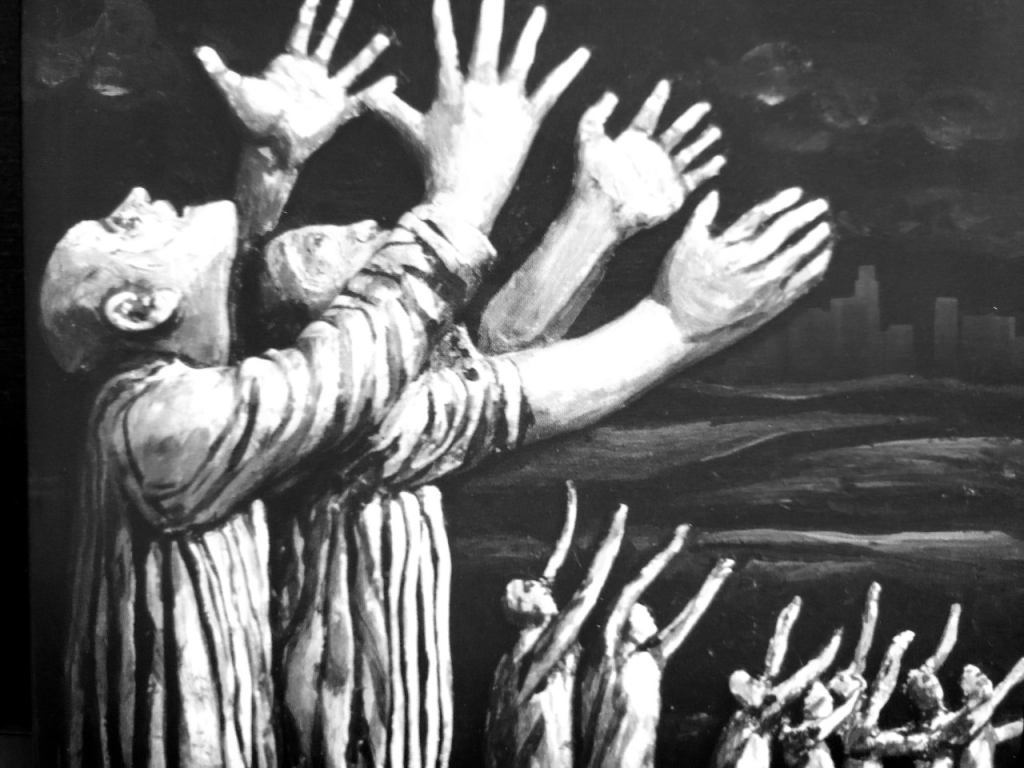
Overwhelmed with Grief (Jeremiah 20:14-18)

Cursed be the day
    on which I was born!
The day when my mother bore me,
    let it not be blessed!
Cursed be the man
    who brought the news to my father, saying,
“A child is born to you, a son,”
    making him very glad.
Let that man be like the cities
    that the Lord overthrew without pity;
let him hear a cry in the morning
    and an alarm at noon,
because he did not kill me in the womb;
    so my mother would have been my grave
    and her womb forever pregnant.
Why did I come forth from the womb
    to see toil and sorrow
    and spend my days in shame? (New Revised Standard Version)

Perhaps you feel as though you must put on a good face, a decent front for others to see. It could be that you don’t like other people seeing you upset or cry because it can be embarrassing. Maybe you believe others don’t need to be burdened with your sadness. The last thing you want is to be a killjoy.

Sometimes you might even put up a front with God. Maybe you think God wants everyone to be perpetually happy and always sing with the birds in blissful joy and gladness, or whistle while you work. However, that would not be an accurate view of God.

One of the most faithful people in Holy Scripture, Jeremiah, freely and unabashedly lamented before God – to the point of wishing he were dead. Jeremiah, the incredible prophet of God, closer to the Lord than anyone of his generation, was so despondent and ashamed that he wished he had never even born. The suffering and the shame were just too overwhelming.

To say that Jeremiah had a difficult ministry is a gross understatement. He literally had the ministry from hell, prophesying to people who neither liked him, nor his message to them. In the middle of it all, Jeremiah threw up his hands and let out his complaint to God. Jeremiah was in such ministerial misery that he wished he had been a stillborn baby.

Lest you think Jeremiah was sinfully depressed or just cuckoo, he is far from alone in the Bible. King David had no scruples about letting God know how he felt about his dire circumstances. Job, likely the most famous sufferer of all, spent time doing nothing but lamenting his terrible losses for months. What all three of them have in common is that they openly grieved with great tears, yet neither cursed God nor forsook the Lord.

Lamentation is the sacred space between intense grieving to God without blaming the Lord for our significant changes and losses in life. I would even argue that lamenting and grieving before God is a necessary spiritual practice which needs full recognition in the Body of Christ. Please sit with that last statement for a bit and consider how it might become a reality in your own life and context.

Grief can and does attach itself to any change or loss. It is the normal emotional, spiritual, physical, and relational reaction to that injury of the heart. There is only one way through grief. We must tell our story to another. It is both biblical and quite necessary.

Bear one another’s burdens, and in this way you will fulfill the law of Christ.

Galatians 6:2, NRSV

We need our own spirituality to support us in such times – not drive us away through a misguided theology of believing you must keep a stiff upper lip. It is critical to have safe and supportive persons in our lives when going through overwhelming circumstances.

“Spirituality is recognizing and celebrating that we are all inextricably connected to each other by a power greater than all of us, and that our connection to that power and to one another is grounded in love and compassion.”

Brené Brown

Our tears are holy. They are not the mark of weakness, but of power. The prophet Jeremiah was doing a very godly thing in expressing his grief. And Jeremiah’s lament is what helped steel him for the several attempts on his life that he faced.

Let the tears do their intended work in your life.

God of all, you feel deeply about a great many things. As your people, we also feel a great depth of emotion when our lives go horribly awry from our dreams and expectations. Hear our lament as we pour out our grief before you, through Jesus, our Savior, with the presence of the Holy Spirit. Amen.

How Can the World Change? (Philippians 1:21-30)

For to me, living is Christ and dying is gain. If I am to live in the flesh, that means fruitful labor for me, yet I cannot say which I will choose. I am hard pressed between the two: my desire is to depart and be with Christ, for that is far better, but to remain in the flesh is more necessary for you. Since I am convinced of this, I know that I will remain and continue with all of you for your progress and joy in faith, so that, by my presence again with you, your boast might abound in Christ Jesus because of me.

Only, live your life in a manner worthy of the gospel of Christ, so that, whether I come and see you or am absent and hear about you, I will know that you are standing firm in one spirit, striving side by side with one mind for the faith of the gospel and in no way frightened by those opposing you. For them, this is evidence of their destruction but of your salvation. And this is God’s doing. For he has graciously granted you the privilege not only of believing in Christ but of suffering for him as well, since you are having the same struggle that you saw I had and now hear that I still have. (New Revised Standard Version)

I believe that one of the greatest tragedies of this contemporary age is that millions of people suffer in silence, alone, with nobody knowing what they’re going through. Countless others cry by themselves, even in public. It’s as if someone who is suffering or sad is a pariah whom we cannot get close to.

It is not supposed to be this way. Suffering by oneself is a tragedy. Suffering with others is a privilege. We are not only meant to be one in spirit when things are going well and it’s a joyous occasion; we’re also to maintain that close unity when the world seems to be falling apart and there are those who are profoundly hurting in either mind, spirit, or emotion.

A few years ago, I stood amongst a gathered group of people, most of whom I did not know.  I was there for a memorial service of a fellow colleague. She received the kind of news that no one wants to hear. In a matter of weeks, she was gone. Not every funeral I attend (or even officiate) is beautiful. This one was, and here’s why: It was a collective experience of both joy and sorrow.

I walked away from my friend’s remembrance with a clear conviction – one that had been percolating and forming within me for quite some time.

This conviction might seem exaggerated, yet it by no means is meant to be. It’s just what I have come to believe about the universal human experience.  It comes from the confidence and experience of a lifetime of observation and ministry.

It is neither merely a heartfelt sentiment nor a passing feeling. No, it really is a conviction, a firm principle or persuasion. It is this:

Crying with strangers in person has the power to change the world.

I think I’ve always known this. It just crystalized for me through that experience. After all, I have watched with awe the privilege of walking into a dying patient’s room, full of tearful family, and be with them in their pain.  The sharing of stories is powerful, eliciting both great joy, reminiscent laughter, and profound gratitude; as well as tremendous sorrow, grinding grief, and sad lament. 

Tears and celebration mix in a sacred alchemy producing a kind of care which transcends description.

It’s one thing to observe other’s joy and sorrow on the evening news, or even from afar. It is altogether a different reality to participate up close and personal. It’s something akin to watching a travel documentary on Yellowstone Park versus visiting the place in person; there’s just no comparison. 

Shared human experiences of suffering will nearly always translate into new and emerging capacities for empathy. And where empathy exists, there is hope for all humanity. 

Being with another person or group of people in their suffering creates a Grinch-like transformation in which our hearts suddenly enlarge. A single tear from a singular small little Who girl in Whoville had the power to penetrate years of hardness of heart and change what everyone thought was a shriveled soul full of garlic and gunk.

Said a different way: The spiritual and emotional heart of a human being is able to shrink or expand. It shrinks from spending far too much time alone and/or holding others at bay, at arms-length, while playing the armchair critic to those who are out rubbing shoulders with real flesh and blood people. 

The Grinch never went back to his isolation. Instead, he did what Whoville thought was the unbelievable: The Grinch fully participated in the joy of the community, up close and personal.  It was a full-bore holding of hands, singing, and eating – which illustrates a conviction I’ve held for a long time:

Hospitality, that is, showing love to outright strangers through celebrative participation with food and drink, has the power to change the world.

Hospitality cannot happen from afar. Sitting around the table with strangers and interacting with them is needed. It alters our perspectives so that we live our shared humanity. It is rather difficult to hate someone when you get to know them and discover their loves and joys, hurts and wounds.

This all leads toward asking one of the most fundamental and basic biblical questions that must be asked by every generation and considered by everyone who respects God and/or the Christian Scriptures:

Am I able to see the image of God in someone very different from myself?

The Christian doesn’t have to go very far to answer this one, at least from an objective cerebral perspective.  Jesus saw the humanity in everyone he encountered, from Jew to Gentile, from sinner to saint.  In fact, Jesus saw this image so deeply within another that he sat around the table and ate with people whom others saw as not worthy to eat with.  Jesus’ willingness to participate in the hospitality of strangers was downright scandalous.  It isn’t a stretch to say that it got him killed.

What’s more, Jesus wept. He cried in public with strangers. For followers of Christ who seek to emulate him in his practical ministry, that point ought to be noticed. After all, we choose to remember and participate in the life of Christ through the elements of bread and wine at the Table. God’s radical hospitality toward us is truly meant to translate to an open heart toward those who look and act differently than me.

The great fourteenth century mystic, Julian of Norwich, a female devotee of Christ and an influential theologian in her own right amongst a world of men who tended to see the image of God in women as flawed, understood what it would take to reawake image-bearing humanity. She stated:

“All that is contrary to peace and love — is in us and not in God. God’s saving work in Jesus of Nazareth and in the gift of God’s spirit, is to lessen our wrath in the power of his merciful and compassionate love.”

Julian of Norwich

Don’t think for a minute that suffering with and crying with strangers is an easy thing for me. Truth is, crying is not something I typically do, or even like to do. Yet, constrained by the love of God in Christ, and putting myself in a position to feel with the emotions of others in front of me, I allow those tears to come.

Yes, collective experiences of emotion have the power to change the world. Yet, this occurs only if we show up.  Perhaps that was the reason for the Christian doctrine of the incarnation: Jesus is our Immanuel, God with us, the One who is present.  He showed up, and salvation happened.

And that is what the Philippian Church needed to remember, tap into, and live as one Body of Christ for the life of the world.

Psalm 6 – Our Tears Find a Better Way

Please, Lord,
    don’t punish me when you are angry;
    don’t discipline me when you are furious.
Have mercy on me, Lord,
    because I’m frail.
Heal me, Lord,
    because my bones are shaking in terror!
My whole body is completely terrified!
        But you, Lord! How long will this last?
Come back to me, Lord! Deliver me!
    Save me for the sake of your faithful love!
No one is going to praise you
    when they are dead.
Who gives you thanks
    from the grave?

I’m worn out from groaning.
    Every night, I drench my bed with tears;
    I soak my couch all the way through.
My vision fails because of my grief;
    it’s weak because of all my distress.
Get away from me, all you evildoers,
    because the Lord has heard me crying!
The Lord has listened to my request.
    The Lord accepts my prayer.
All my enemies will be ashamed
    and completely terrified;
    they will be defeated
    and ashamed instantly. (Common English Bible)

“Don’t ever discount the wonder of your tears. They can be healing waters and a stream of joy. Sometimes they are the best words the heart can speak.”

William Paul Young, The Shack

Sometimes, even oftentimes, our tears find a better way.

It seems as if many folks don’t know this. Whenever someone is distraught, discouraged, or in the throes of despair, the advice given to them is often unhelpful, and even hurtful.

“You just need to be strong,” “Keep your chin up, I’m sure you have a lot to be thankful for,” and “Don’t cry, everything will work out okay,” are statements which betray we are uncomfortable with tears and are unsure what to do with them in others.

It can also be worse than that, with exhortations which only harm and don’t assist. “Dry up those tears or I’ll give you something to really cry about,” “Being sad and depressed like that is a sin, you know,” and “God wants you to be happy, so just put a smile on your face and fake it until you make it,” are a misuse of words and an abuse of language’s power.

So, I say again: Our tears find a better way.

To hold back our tears, to stuff our sadness and grief, does not make it go away. It’s still in there. And, if left there for too long, will come out sideways in harming others or even ourselves.

Whenever we put away our tears, we’re setting aside God’s most powerful means of healing, health, and wholeness. Tears are the conduit of integrating body and soul, where what’s going on inside is expressed on the outside.

Often, you don’t even need words when you have tears. The presence of the tears themselves becomes a form of language. They’re just there, and they are beautiful. Tears are evidence of brokenness, and more importantly, of healing and of strength, not weakness.

Tears are the body’s release valve for stress, sadness, grief, anxiety, and frustration. Like the ocean, tears are saltwater. They protectively lubricate the eyes, remove irritants, and contain antibodies that fight pathogenic microbes.

Dr. William Frey is a biochemist and an expert on human tears at the University of Minnesota. He states that our bodies produce three kinds of tears: reflex, continuous, and emotional. Each kind has different healing roles. Reflex tears allow the eyes to flush noxious particles when they’re irritated by smoke or exhaust. Continuous tears are produced regularly to keep our eyes lubricated and protected from infection.

Emotional tears were the experience of the psalmist. Whereas reflex tears are 98% water, emotional tears contain stress hormones that get excreted from the body through crying. Emotional crying stimulates the production of endorphins – the hormone necessary for happiness and a decrease of pain.

As the only creatures carrying God’s image and likeness within us, humans alone shed emotional tears. And that’s because God cries.

Jesus wept. Real tears. Emotional tears. Tears of genuine feeling and solidarity with the community, lamenting at the death of a dear friend, Lazarus.

“The Teacher is here,” Martha said, “and is asking for you.” When Mary heard this, she got up quickly and went to him. Now Jesus had not yet entered the village but was still at the place where Martha had met him.When the Jews who had been with Mary in the house, comforting her, noticed how quickly she got up and went out, they followed her, supposing she was going to the tomb to mourn there.

When Mary reached the place where Jesus was and saw him, she fell at his feet and said, “Lord, if you had been here, my brother would not have died.”

When Jesus saw her weeping, and the Jews who had come along with her also weeping, he was deeply moved in spirit and troubled. “Where have you laid him?” he asked.

“Come and see, Lord,” they replied.

Jesus wept. (John 11:28-35, NIV)

The Lord Jesus came to the village three days after Lazarus died. He knew exactly what he was about to do: raise Lazarus from the dead in a miraculous resurrection. Yet, he did not come all smiles stating, “Hey, guys, don’t be sad! Watch what I’m going to do!”

No, instead, Christ participated fully in the sisters’ and the community’s grief. Only until he had done this did he proceed to performing the miracle.

The tears, just as much as the resurrection itself, were redemptive.

There was a time, long ago, when the word “loser” meant exactly what the word says – that someone had lost someone. It was a descriptive word recognizing the aching hole in the heart that one experiences from the death of a loved friend or family member.

Now, however, the word “loser” has taken an insidious twist over the years – meaning someone who hasn’t won, somebody who didn’t have what it took to be a winner. It is now a negative term that nobody wants to wear as a moniker, at all.

Perhaps that is one reason why so many people wear plastic smiles, pretend they are strong, and insist on keeping up appearances… And it is killing us with unprecedented numbers of depression, anxiety, and outright despair with nowhere to place it.

Our tears show us a better way. It was the way of the psalmist. It is the way of our Lord. It is the way of life.

You keep track of all my sorrows.
    You have collected all my tears in your bottle.
    You have recorded each one in your book.

Psalm 56:8, NLT

Beloved God, since all communion with You is prayer, my tears are psalms of petition and canticles of praise to You. The prayer You value greatly and always hear is the prayer of my tears; for You are a compassionate and kind God.

Surely, all truly great prayer rises from deep inside and springs spontaneously to the surface in the form of weeping. Perhaps, then, our tears are the purest and best worship of all.

May Your people not be ashamed of their tears; may they flow naturally and freely to You, my Blessed Redeemer. In times of joy or sorrow, blessed be the tears as the holy prayers of our hearts. Amen.

Psalm 6 – Independence Day Celebration or Mourning?

O Lord, do not rebuke me in your anger
    or discipline me in your wrath.
Be gracious to me, O Lord, for I am languishing;
    O Lord, heal me, for my bones are shaking with terror.
My soul also is struck with terror,
    while you, O Lord—how long?

Turn, O Lord, save my life;
    deliver me for the sake of your steadfast love.
For in death there is no remembrance of you;
    in Sheol who can give you praise?

I am weary with my moaning;
    every night I flood my bed with tears;
    I drench my couch with my weeping.
My eyes waste away because of grief;
    they grow weak because of all my foes.

Depart from me, all you workers of evil,
    for the Lord has heard the sound of my weeping.
The Lord has heard my supplication;
    the Lord accepts my prayer.
All my enemies shall be ashamed and struck with terror;
    they shall turn back and in a moment be put to shame. (New Revised Standard Version)

Methinks we Americans, especially on this our national Independence Day, must remember that this has not always been, nor currently is, a day of celebration for a sizable chunk of people in the United States.

Now before you begin offering some mental pushback that I am pouring cold water on a time-honored holiday, or begin believing I’m not a true patriot, I will simply point out that not only is today’s psalm lesson in the Revised Common Lectionary a lament, but also that I’m a guy with two academic degrees in American history.

If we only look at Independence Day from the perspective of white Northern European heritage persons, then it will seem that, speaking like this, I am not grateful for the blessings of being in this incredible country of my birth and the place I’ve lived my entire life.

But I am not looking from that angle today. I choose to acknowledge that on this day, every year for the past 246 years, today’s psalm has been the lived experience and expression of others who looked to the heavens and asked, “How long, O Lord!?”

A true people of compassion are able to suffer with those who suffer. The people of God really ought to be at the forefront of exhibiting empathy and standing in solidarity with suffering folk.

A patriot is one who acknowledges and affirms all it’s citizens, and not only the ones who look like me, talk like me, and act like me. After all, the original documents of the United States made room for this to be so. Empathy, compassion, and solidarity are intentionally built into our nation’s grand experiment of democracy and government.

“We the people of the Unites States, in order to form a more perfect union, establish justice, insure domestic tranquility, provide for the common defense, promote the general welfare, and secure the blessings of liberty to ourselves and our posterity, do ordain and establish this Constitution for the United States of America.”

Preamble of the United States Constitution

The very fact that the previous quotation is true for some, and not for everyone, is a telling testament to the reality that we need to keep striving to live into our heritage as Americans and ensure that welfare for the common good of all citizens is continually sought, even if done so imperfectly.

Grieving, tears, and lament was the response of the former slave Frederick Douglass.

“The rich inheritance of justice, liberty, prosperity and independence, bequeathed by your [white] fathers, is shared by you, not by me. The sunlight that brought light and healing to you, has brought stripes and death to me [a black man]. This Fourth July is yours, not mine. You may rejoice, I must mourn.”

Frederick Douglass, “What to the Slave is the 4th of July?” (An oration on July 4, 1852)

Mourning and weeping was and continues to be the experience of many Native American peoples.

“While the United States and its settlers claimed its independence from Great Britain, this came at a cost of others, including this land’s Indigenous Peoples that were stolen from their own homelands. This patriotic holiday is nothing to celebrate because freedom cannot come at the cost of another’s freedom. America’s Independence Day is a celebration of imperialism, genocide, and American exceptionalism, and there is no pride in genocide.”

Daisee Francour (Oneida Nation of Wisconsin)

We cannot change history, but we can work towards a better future where all of our rights are respected and we all experience freedom and independence equally. Those with non-European ancestry who today in our nation experience racism and anti-ethnic aggression need to be acknowledged and affirmed as Americans with equal standing and an equal voice alongside the white population.

So, I would argue that both celebration and weeping ought to occur on this day. We should weep for the dreams and lives of indigenous peoples who were destroyed through westward expansion, and even today experience the ongoing effects of cultural genocide.

We ought to acknowledge not only our nation’s blessings, but also our curses which are still seen in exploiting others through envy, greed, sloth, pride, lust, and gluttony.

We, the people of the United States of America, ought to actively seek to live in more simple and less harmful ways. We should offer our voices, not in violent speech and language, but with creative and healing words.

On this American Independence Day, the Church should reaffirm her allegiance and citizenship to Christ and God’s Kingdom and renounce any nationalistic, economic, ethnic, and political divisions which are contrary to the words and ways of Jesus.

All of the citizens of the earth should seek to embrace non-violent, self-sacrificial love on behalf of everyone. Today is an opportunity to affirm that Christ is the Friend of all people, not just some.

No one ought to be wasting away in their grief and languishing in their tears when we have the means to acknowledge their suffering and to do something about it.

Our Father who is in heaven,

uphold the holiness of your name.

Bring in your kingdom

so that your will is done on earth as it’s done in heaven.

Give us the bread we need for today.

Forgive us for the ways we have wronged you,

just as we also forgive those who have wronged us.

And don’t lead us into temptation,

but rescue us from the evil one. (Matthew 6:9-13, CEB)