Follow God’s Word (Deuteronomy 6:10-25)

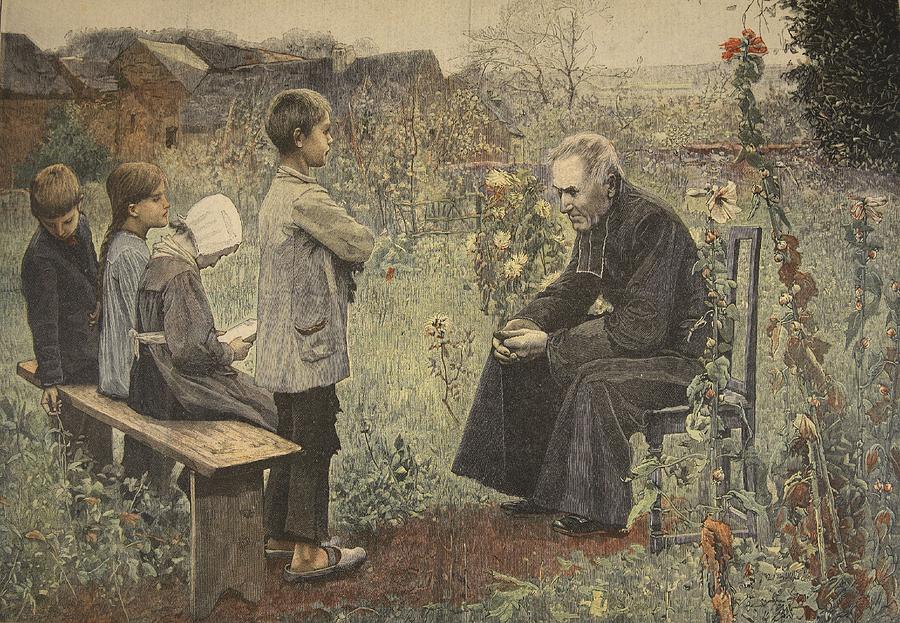
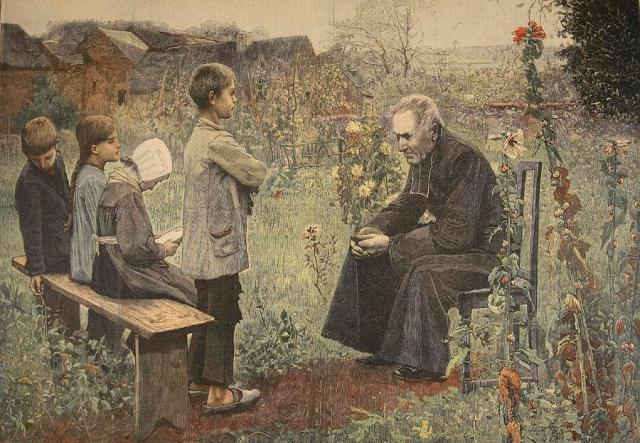
Priest Teaching Children The Catechism, by Jules-Alexis Meunier, 1898

Now once the Lord your God has brought you into the land that he swore to your ancestors, to Abraham, Isaac, and Jacob, to give to you—a land that will be full of large and wonderful towns that you didn’t build, houses stocked with all kinds of goods that you didn’t stock, cisterns that you didn’t make, vineyards and olive trees that you didn’t plant—and you eat and get stuffed, watch yourself! Don’t forget the Lord, who brought you out of Egypt, out of the house of slavery. 

Revere the Lord your God, serve him, and take your solemn pledges in his name! Don’t follow other gods, those gods of the people around you—because the Lord your God, who is with you and among you, is a passionate God. The Lord your God’s anger will burn against you, and he will wipe you off the fertile land. Don’t test the Lord your God the way you frustrated him at Massah. 

You must carefully follow the Lord your God’s commands along with the laws and regulations he has given you. Do what is right and good in the Lord’s sight so that things will go well for you and so you will enter and take possession of the wonderful land that the Lord swore to your ancestors, and so the Lord will drive out all your enemies from before you, just as he promised.

In the future, your children will ask you, “What is the meaning of the laws, the regulations, and the case laws that the Lord our God commanded you?” Tell them: We were Pharaoh’s slaves in Egypt. But the Lord brought us out of Egypt with a mighty hand. Before our own eyes, the Lord performed great and awesome deeds of power against Egypt, Pharaoh, and his entire dynasty. But the Lord brought us out from there so that he could bring us in, giving us the land that he swore to our ancestors. Then the Lord commanded us to perform all these regulations, revering the Lord our God, so that things go well for us always and so we continue to live, as we’re doing right now. What’s more, we will be considered righteous if we are careful to do all this commandment before the Lord our God, just as he commanded us. (Common English Bible)

The Catechism, by Edith Hartry, 1919

Christians often refer to the Bible as “God’s Word.” By that reference we mean that God has graciously revealed the divine nature to us through this Book, the Holy Scriptures. 

The ancient Hebrews referred to the first five books of the Old Testament as the Law of the Lord or the Torah. The Jewish people understood God as a great, high and holy Being who mercifully accommodated or communicated to us on our level by giving the Law. 

Just as a parent coos and babbles and speaks in a very different way to a baby in a crib, so God speaks to us in a way we can understand about the care, concern, and love the Lord has for us. Just as an infant is unable to understand an adult conversation taking place, so God is a lofty Being who is well above our comprehension. We have no ability to understand anything God says unless the Lord graciously and lovingly bends down to speak to us on our level.

God’s Law, the Torah, was the curriculum for Israel’s religious instruction. The Law of the Lord is meant to be a behavior pattern, to be embodied in the lives of God’s people through both teachers and parents who learn God’s Word and, in turn, pass it along to children and others – thereby providing guidance for how to live in God’s world. 

God’s law is an extension of God’s grace, and we are to gratefully accept the grace of God expressed in God’s Word. We are to ingest it, eat it, reflect on it, and dwell with it, in order to know God and be the people God wants us to be.

There are several other words that come from the root word for Law, Torah, in the Hebrew language. A teacher is a “moreh.” A parent is a “horeh.” Parents and teachers are to be living guides in the way of God’s Word. The Hebrew word for teaching is “yarah.” 

So, in other words, the moreh’s and the horeh’s are to yarah the Torah. Parents and teachers are to point and lead others into the ways of the Lord. The fifth book of the Law, Deuteronomy, makes it clear how parents, mentors, teachers, and influencers are to pass on God’s Word:

Israel, listen! Our God is the Lord! Only the Lord! Love the Lord your God with all your heart, all your being, and all your strength. These words that I am commanding you today must always be on your minds. Recite them to your children. Talk about them when you are sitting around your house and when you are out and about, when you are lying down and when you are getting up. Tie them on your hand as a sign. They should be on your forehead as a symbol. Write them on your house’s doorframes and on your city’s gates. (Deuteronomy 6:4-9, CEB)
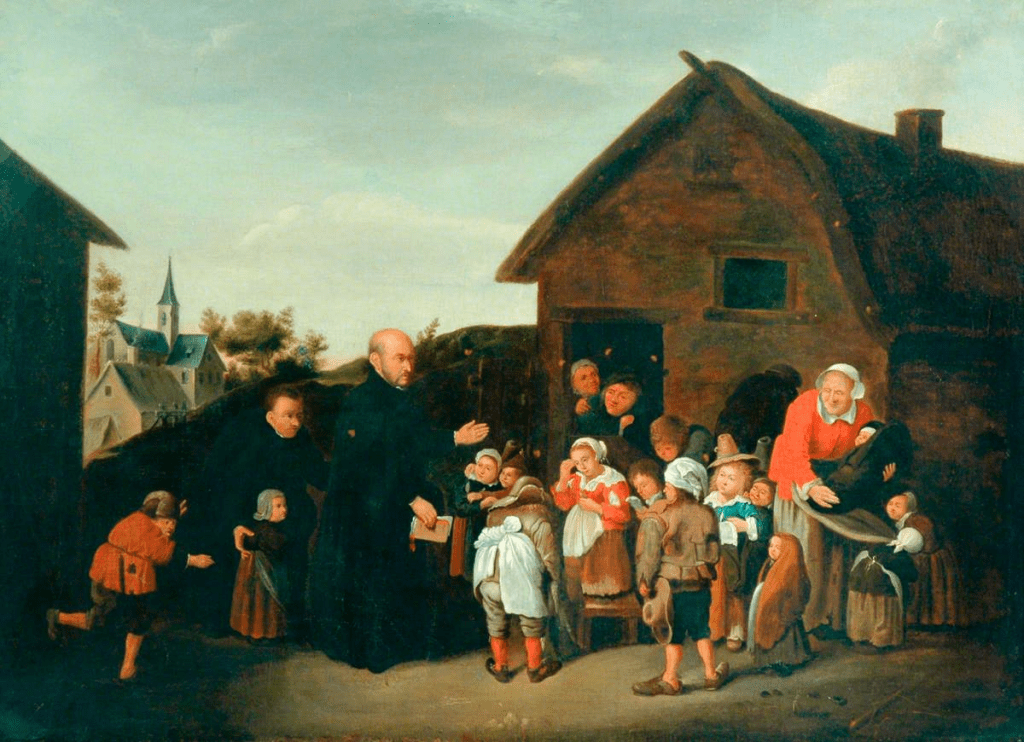
A Village Catechism, by David Rychaert III (1612-1661)

God’s Law, or God’s Word, is to be as familiar to us as our back door and it is to be in front of us all the time. When children ask us anything about God’s commands and regulations, we are to have a ready answer for them, in language and ways that they can understand.

We do this by carefully and systematically engrafting Holy Scripture into our minds and hearts. As we get God’s Word into ourselves, we are to also get it into our children and others. It happens by continually talking about Scripture – at home around the dinner table, as well as when we are working or playing together.

God’s Holy Word is to be continually in front of us, so that we do not forget it. We need to start each day and end each day with God’s Word. We can put the words of God on our refrigerator and our car’s dashboard. There is always an opportunity refer to God’s Word and incessantly chatter about it with others.

Someone may say, “That’s pretty radical – I don’t need to do all that!” Then I would say that you are missing out on living a blessed life because people are blessed when they walk according to God’s Word and keep God’s Law in front of them and seek God through God’s Word with all their heart. 

Let us not be so busy, pre-occupied, nor worried, that we end up pushing God’s Word to the margins of our lives as only a Sunday activity – or something for our discretionary time (which doesn’t actually exist). 

Let’s take the time to carefully look at God’s Word and let God speak to us through it.

Let us be intentional about connecting with the God who has so graciously given us a guide for grateful living. 

And let us lay solid plans to catechize people into the basics of faith and holy living in the church. Amen.

Work Together (Acts 18:24-28)

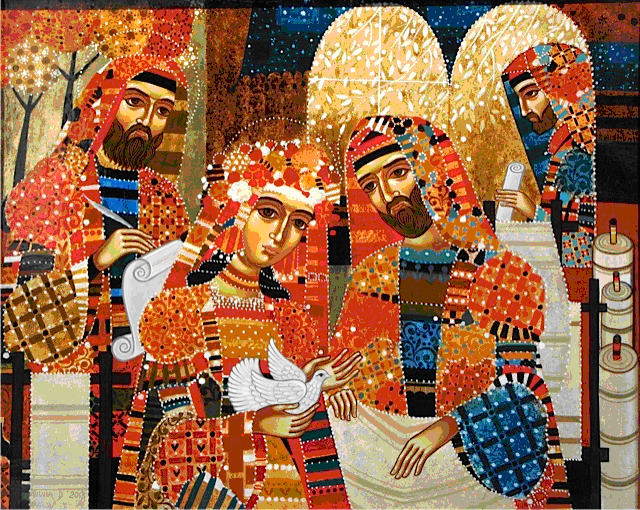
Priscila and Aquila host Paul and train Apollos, Unknown artist

Meanwhile a Jew named Apollos, a native of Alexandria, came to Ephesus. He was a learned man, with a thorough knowledge of the Scriptures. He had been instructed in the way of the Lord, and he spoke with great fervor and taught about Jesus accurately, though he knew only the baptism of John. He began to speak boldly in the synagogue. When Priscilla and Aquila heard him, they invited him to their home and explained to him the way of God more adequately.

When Apollos wanted to go to Achaia, the brothers and sisters encouraged him and wrote to the disciples there to welcome him. When he arrived, he was a great help to those who by grace had believed. For he vigorously refuted his Jewish opponents in public debate, proving from the Scriptures that Jesus was the Messiah. (New International Version)

I really like this story. I like it for two reasons:

  1. Apollos, although a very learned and gifted guy, nonetheless had the humility to listen and accept the counsel of the couple, Priscilla and Aquila. He had a teachable spirit and a submissive heart.
  2. Priscilla and Aquila, a woman and a man, wife and husband, shared equally in taking the initiative to practice hospitality and make a significant contribution to the learning of Apollos. They had teachers’ spirits and caring hearts.

An intelligent mind doesn’t do much good if it isn’t accompanied by humility – a willingness to be taught, and a heart that is open to receive.

And instructing others accomplishes nothing if it isn’t directed by an egalitarian mindset – a desire to love strangers of all backgrounds and walks of life, and give, in any sort of way that is helpful to the other.

Who was Apollos?

Apollos was an educated man from the city of Alexandria in Egypt. He was well acquainted with Old Testament Scripture and familiar with John the Baptist’s teachings. In the middle of the first century C.E. he came to the city of Ephesus in Asia Minor (present day Turkey) where he began to teach in the Jewish synagogue.

Priscilla, and her husband Aquila, were followers of Jesus in Ephesus and they heard Apollos speaking. They hospitably took him aside and told him the rest of the story. After this, Apollos went to preach in Achaia, having been highly recommended by the Ephesian Christians. His effectiveness was unprecedented.

Apollos was in Corinth (Acts 19:1) where he was useful in watering the spiritual seed which the Apostle Paul had planted (1 Corinthians 3:6). He was such a skilled teacher and so much appreciated by the believers there that, unfortunately, many of the Corinthian believers became attached to him in an unhealthy way, creating schisms within the church, much to the chagrin of Apollos (and Paul). (1 Corinthians 1:12, 16:12)

Who were Priscilla and Aquila?

Priscilla and Aquila were tentmakers native to Rome. After the persecution of the Jewish people under the Emperor Claudius, they made their way to Greece, where they encountered the Apostle Paul and tutored Apollos. Their impact on these Christian leaders – and the bravery they demonstrated within the early church—became legendary, and Priscilla and Aquila are referenced in four different New Testament books.

What’s interesting about the references to this couple in Holy Scripture is the order in which their names are mentioned. In the seven references to the married couple, the wife is mentioned before the husband five times. This is somewhat uncharacteristic of the naming conventions in the Bible and suggests that Priscilla played a leading role in their ministry work.

It was in Corinth that Priscilla and Aquila first encountered the Apostle Paul. They welcomed him into their workplace, providing him with meaningful employment that facilitated his missionary activities. When Paul determined to return to Syria, they accompanied him across the Aegean Sea to Ephesus, where their ministry continued – and it was there that Priscilla and Aquila met Apollos.

In his catalog of greetings to the Roman church, Paul sent his regards to Priscilla and Aquila, indicating that they eventually returned to Rome – which was quite a risky thing to do considering the political climate of the time. Paul notes that Priscilla and Aquila stuck out their necks for him. (Romans16:3)

What do we learn from Priscilla, Aquila, and Apollos?

The story of Priscilla and Aquila holds out a cache of important truths. For one, it demonstrates the added value of men and women partnering over the long term for the cause of Christ. It’s important to collaborate and be willing to consult each other and accept instruction and even correction.

The interaction of these early believers points to the importance of true Christian hospitality. When Paul arrived in their community, they gathered in a worn-out traveler. They provided shelter, company, and income for him, advancing his missionary ventures.

In Ephesus, they followed the same template with Apollos, perhaps sharing what they had learned from Paul to strengthen the witness of this remarkable young preacher. Their table and living room became sources of encouragement and instruction for those who would teach the church at large.

Priscilla, Aquila, and Apollos are good models for all men and women called to Christian mission and service. They longed to serve Christ and the Church in whatever ways they could. They sought to help the next generations of believers in their walk with Christ. And they displayed the sort of qualities needed for the burgeoning church to work together and reach the world with good news.

God of grace and might, who gave to your servants Apollos, Priscilla, and Aquila gifts of zeal and eloquence to make known the truth of the Gospel: Raise up, we pray, in every country, heralds and evangelists of your kingdom, so that the world may know the immeasurable riches of our Savior Jesus Christ; who lives and reigns with you and the Holy Spirit, one God, now and forever. Amen.

Romans 12:1-8 – On Being Worshipers and Servants

Brothers and sisters, in view of all we have just shared about God’s compassion, I encourage you to offer your bodies as living sacrifices, dedicated to God and pleasing to him. This kind of worship is appropriate for you. Don’t become like the people of this world. Instead, change the way you think. Then you will always be able to determine what God really wants—what is good, pleasing, and perfect.

Because of the kindness that God has shown me, I ask you not to think of yourselves more highly than you should. Instead, your thoughts should lead you to use good judgment based on what God has given each of you as believers. Our bodies have many parts, but these parts don’t all do the same thing. In the same way, even though we are many individuals, Christ makes us one body and individuals who are connected to each other. God in his kindness gave each of us different gifts. If your gift is speaking what God has revealed, make sure what you say agrees with the Christian faith. If your gift is serving, then devote yourself to serving. If it is teaching, devote yourself to teaching. If it is encouraging others, devote yourself to giving encouragement. If it is sharing, be generous. If it is leadership, lead enthusiastically. If it is helping people in need, help them cheerfully. (God’s Word)

China and Clay

Every person is important. Everyone is needed. Each individual is to offer their entire lives to God through worship and using their spiritual gifts. Every believer is to be active in building up others. 

When I was growing up, we had a fine China set that my parents kept in a beautiful China cabinet.  The set and the cabinet are old and were a prominent part of our house. However, we almost never used it. I can only remember once or twice that my Mom got the China out to use.

God is not looking for fine China believers who sit unused in a cabinet church. Instead, the Lord is looking for rough-and-tumble clay pots—the kind that can be used every day. God wants ordinary table-wear that can be handled in a crash-and-bang world.

Followers of Jesus Christ are to be like a working kitchen, where well-worn pots are filled again and again to dispense their life-giving contents to a thirsty world; and, where common plates and cups are used again and again to provide a hungry population with the Bread of Life.

Jews and Gentiles

Within the ancient Roman Church were both Jews and Gentiles – two groups vastly different from each other.  They tended to keep to themselves and only operate within their familiar and comfortable circles of friends and relatives.  But the Apostle Paul wanted them united through using their spiritual gifts for the benefit of the entire congregation, and not only within their respective groups.

We are to give ourselves in service to one another because of God’s mercy in Christ. Since God has saved us from our guilt and shame, we are to have a grateful response of worship that is dedicated to serving everyone. 

Worship and Service

The word “worship” in today’s New Testament lesson is where we get the word “liturgy.” That is, Paul’s vision for the church was to have daily liturgical rhythms of spiritual worship, not just on Sunday when we might pull out the fine China and try to impress people.

Paul did not guilt people into serving. Rather, he straightforwardly exhorts all Christians to appropriately respond to God’s grace by offering their lives in sacrificial service as a form of gratitude to God. For this response, our mental faculties must be renewed through saturation in Scripture. It is here we discern our spiritual gifts, know what God wants us to do with those gifts, and use them effectively in the church and the world. 

Grace and Gifts

Grace is given to every believer in Jesus, not just a select few. We all have different gifts and are graced with abilities for the benefit of other, without exception. When everyone collectively exercises their spiritual gifts, then there is clarity in knowing the will of God.

All Christians must share and work together by utilizing God’s grace, instead of getting burned-out because others are not serving. Grumbling about what others are not doing begs the question of whether we are over-functioning, or not.

It could be that we have succumbed to the danger the Apostle Paul warned us about: thinking so highly of ourselves that we believe our gifts are superior to others, so we need to maintain our control and hegemony in the group. This is a terribly misguided notion. 

Each of you should use whatever gift you have received to serve others, as faithful stewards of God’s grace in its various forms. If anyone speaks, they should do so as one who speaks the very words of God. If anyone serves, they should do so with the strength God provides, so that in all things God may be praised through Jesus Christ. To him be the glory and the power for ever and ever. Amen.

1 Peter 4:10-11, NIV

We belong to one another. Therefore, one major way of giving to God is through offering ourselves to each other with equity and without favoritism. We must not separate Christ from his church. To say that we need God, but do not need the church is to really say that we do not need God because the two are inseparable. Nowhere in Holy Scripture do we find individual Christians doing their own thing, isolated from a committed group of people, the church.

When Jesus called people to follow him in service to God and a world in need, some gave him excuses that they were busy and had other pressing matters to attend to before they could follow him. Jesus simply left them and told them they were not fit for the kingdom of God. (Luke 9:57-62)

When people were pre-occupied with building wealth, or gaining power, or jockeying for influence, Jesus told them to stop it, exercise some faith, and seek first the kingdom of God.  Build your treasure in heaven, Jesus said, because it will be permanent; and, not on earth where it is temporary. (Matthew 6:19-34)

Spiritual Gifts and Abilities

We are graced by God with abilities which God fully expects us to use. “Cheap grace” is merely embracing Christ as a personal Savior but not welcoming him as the Lord in whom we must sacrificially give our lives to service in the church and the world. Spiritual health and vitality cannot exist apart from every person using God’s given grace to contribute to the functioning of the Body of Christ. 

The list of spiritual gifts Paul provided is not exhaustive but represents a combination of speaking and serving gifts necessary to bless humanity. Paul exhorted the church not to restrain people’s service but let them go at using their spiritual gifts, full bore:

  • Speak what God has revealed. Prophets do not foretell the future. Rather, they have “inspired speech” from God that addresses what God’s people are to do in consideration of Scripture. 
  • Serving. Servants give themselves to all types of hands-on service. 
  • Teaching. Teachers instruct the faithful in all the revealed will of God. 
  • Encouraging others. Encouragers both speak and serve, coming alongside others and helping them to do something with both verbal coaching and tangible help. 
  • Sharing. Givers live a simple life so they can give generously and contribute to the needs of others. 
  • Leadership. Leaders get out in front and show the way in obtaining the will of God. 
  • Helping people in need. Helpers show mercy by seeing down-and-out hurting people and being a conduit of God’s grace to them.

There is no one person who possesses all these gifts. That’s why everyone must work together to have a spiritually healthy community. A spiritually toxic community is the inevitable result of only a few people using their giftedness.

To avoid relational toxicity, and embrace communal harmony, our minds need transformation through renewing practices of godly sacrifice, regular worship, pursuing unity, and becoming aware of our spiritual gifts.

Here’s three ways we can discover our gifts:

  1. Pay attention.  Every spiritual gift reflects God’s grace and character, and so, you will find joy and satisfaction in expressing it. Your spiritual gift will be a place of deep spiritual formation and growth in your life, as God uses it both to powerfully connect you spiritually and to expose areas of your soul that need forgiveness and redemption. 
  2. Try. Give it a whirl. Volunteer. Connect with a service or ministry or try doing what you feel might be something God wants you to do. Gifts are primarily discovered from others observing and affirming your gift and not so much by going through a research process. The encouragers among us will be happy to affirm the gifts of others.
  3. Develop. All spiritual gifts need growth, cultivation, and development. Paul told his young protégé, Timothy, to fan into flame the gift of God. (2 Timothy 1:6)

We will find our greatest delight in life through engaging in worship of God and service to others. That leads to a spiritually healthy Christian community that loves God, loves one another, and loves the world.

God of grace, stir up the spiritual gifts of your people. May the gifts your Holy Spirit has decided to give us be activated and used for your glory and the edification of others. May you grant peace and joy in churches everywhere so that no one will be jealous or covetous about anyone else’s gifts. May these gifts grow and develop in love so that the fruit of the Spirit will be truly manifested. May you receive all praise honor and glory through Jesus Christ, our Lord.  Amen.

Proverbs 22:1-21 – Teach and Train the Children

Priest teaching children the catechism by Jules-Alexis Meunier, 1898

Choose a good reputation over great riches;
    being held in high esteem is better than silver or gold.

The rich and poor have this in common:
    The Lord made them both.

A prudent person foresees danger and takes precautions.
    The simpleton goes blindly on and suffers the consequences.

True humility and fear of the Lord
    lead to riches, honor, and long life.

Corrupt people walk a thorny, treacherous road;
    whoever values life will avoid it.

Direct your children onto the right path,
    and when they are older, they will not leave it.

Just as the rich rule the poor,
    so the borrower is servant to the lender.

Those who plant injustice will harvest disaster,
    and their reign of terror will come to an end.

Blessed are those who are generous,
    because they feed the poor.

Throw out the mocker, and fighting goes, too.
    Quarrels and insults will disappear.

Whoever loves a pure heart and gracious speech
    will have the king as a friend.

The Lord preserves those with knowledge,
    but he ruins the plans of the treacherous.

The lazy person claims, “There’s a lion out there!
    If I go outside, I might be killed!”

The mouth of an immoral woman is a dangerous trap;
    those who make the Lord angry will fall into it.

A youngster’s heart is filled with foolishness,
    but physical discipline will drive it far away.

A person who gets ahead by oppressing the poor
    or by showering gifts on the rich will end in poverty.

Listen to the words of the wise;
    apply your heart to my instruction.
For it is good to keep these sayings in your heart
    and always ready on your lips.
I am teaching you today—yes, you—
    so you will trust in the Lord.
I have written thirty sayings for you,
    filled with advice and knowledge.
In this way, you may know the truth
    and take an accurate report to those who sent you. (New Living Translation)

As a pastor, I have seen my share of parents broken over their particular son’s or daughter’s lifestyle and/or behavior. In some cases, the parents have a great deal of work to do with their own shortcomings. In many other scenarios, there are godly mothers and fathers experiencing the heartache of a wayward child through no real fault of their own. 

Yet, some of them feel tremendously guilty because of a famous (or infamous) verse tucked away in our Old Testament lesson for today, to train children in the way they should go, and when they are old, they won’t depart from it.

Keep in mind, there are many different literary genres in Holy Scripture. Narratives, parables, gospel, epistles, poetry, and even apocalyptic literature all occur in the Bible. The book of Proverbs is a collection of wisdom sayings. 

A proverb is a short pity statement of experiential truth. 

In other words, a proverb expresses a general truth in which, all things considered, a particular outcome will likely occur. Proverbs were never designed to be ironclad promises of how things always are or will be. Rather, they are meant to teach wisdom, to give guidance in how to apply reality to a range of life circumstances.

So, when it comes to directing, guiding, and training children, it cannot be claimed that if a parent does a certain set of practices or disciplines that the child will always come out living a certain way. Neither people, nor Scripture, operates in that manner. 

Biblical proverbs on parenting are designed to place emphasis on the necessity of intentional training and instructing children in the ways of God. And, more than likely, all things being equal, that training in the law of God will kick-in when the child is an adult, living on their own, needing wisdom to navigate a difficult world. Yet, remember, it is not a guarantee.

Even God, as the perfect parent, had rebellious children. 

Adam and Eve disobeyed and went their own way. The ancient Israelites, God’s people, were often fickle about their commitment and obedience to the God who consistently showed them steadfast love.

Proverbs encourage us to put significant effort into developing children to be responsible people who live into their full humanity. We teach, train, exhort, live by example, and discipline our kids. We do it all because we love them and seek to be faithful in our own faith commitments.

And we live with the hope that our maternal and paternal efforts are not in vain. So, it is good for parents, teachers, and all who work with kids to have a gracious, wise, well-thought-out plan for training those children. 

As we do so, we trust God, the One who ultimately does the needed renovations of the heart, and transformation of the mind.

Lord of life, you shape us in your image, and by your gracious gift the human family is increased. Grant to all parents everywhere the blessing of teaching and training children. Fill them with wisdom and love as they care for their family, so that they and their children may know and love you. Give us all, whether parents or not, wisdom so that we might always pray intelligently, live circumspectly, and speak lovingly to all the children in our lives, through Jesus Christ our Lord. Amen.