Amos 2:4-11 – Pay Attention to the Poor

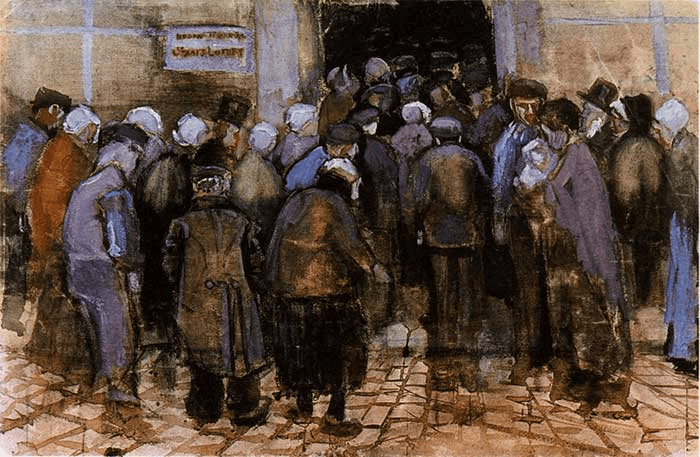
The Poor and Money by Vincent van Gogh, 1882

This is what the Lord says:

“For three sins of Judah,
    even for four, I will not relent.
Because they have rejected the law of the Lord
    and have not kept his decrees,
because they have been led astray by false gods,
    the gods their ancestors followed,
I will send fire on Judah
    that will consume the fortresses of Jerusalem.”

This is what the Lord says:

“For three sins of Israel,
    even for four, I will not relent.
They sell the innocent for silver,
    and the needy for a pair of sandals.
They trample on the heads of the poor
    as on the dust of the ground
    and deny justice to the oppressed.
Father and son use the same girl
    and so profane my holy name.
They lie down beside every altar
    on garments taken in pledge.
In the house of their god
    they drink wine taken as fines.

“Yet I destroyed the Amorites before them,
    though they were tall as the cedars
    and strong as the oaks.
I destroyed their fruit above
    and their roots below.
I brought you up out of Egypt
    and led you forty years in the wilderness
    to give you the land of the Amorites.

“I also raised up prophets from among your children
    and Nazirites from among your youths.
Is this not true, people of Israel?”
declares the Lord. (New International Version)

It’s not a sin to be poor. It is a sin to oppress, take advantage of, or exploit the poor.

Social justice isn’t something fabricated in the minds of progressive Christians. Social justice is biblical and at the heart of all sixteen prophetic books of Holy Scripture’s Old Testament.

The reason the prophets address poverty so often is that God hates injustice. God is not okay with an entire group of disadvantaged people having needed resources beyond arm’s reach – and the Lord’s ire is especially roused whenever the wealthy and powerful extort what little the poor have to begin with.

Even if there are some who tend to believe the poor are poor because of laziness or an unwillingness to work hard, you will not find that idea amongst the biblical prophets. You will, in fact, find just the opposite: fat cats who lie around with their privileged lives, not lifting a finger to help the underprivileged.

The Church does have a role in combating systemic oppression of the poor and needy, and the prophet Amos wants those who claim the name of the Lord to know it.

Amos not only harangued the nations who surrounded Israel and Judah of their sinful stances toward the poor, he leveled the very same message at God’s people who did the same things. Although the Israelites enjoyed a special status with God, that did not mean the Lord had a different set of values or expectations for them when it came to basic human justice.

Mistreating one another is a universal sin and all nations everywhere will be held accountable by God for how they treat the least persons among them. There is such a thing as universal human rights – and the godly person will care about this, at the least, because God cares.

Amos almost exclusively hones-in on the economic sins of the wealthy: taking away needed clothing from those who default on loans; assessing unnecessary and exorbitant fines; taking levies of grain; and living a lavish lifestyle on the backs of the less fortunate.

It was these continually repeated sins against one another which eventually led to both Israel and Judah being conquered by pagan nations and carried into exile.

Today, you will still easily find people being used by others, as if they were mere inhuman machines, here on this earth to make money for those who already have plenty of it. They’d sell their own grandmother if they could get a good price on her. Extortion and oppression are like eating and drinking to them.

Yet, such persons, groups, even entire governments are only stockpiling judgment upon themselves for the God whom they must eventually give an account in how they lived their lives on this earth.

Instead, intentionally paying attention to the poor and treating them with equity will involve the following:

  1. Donating to charitable causes, such as church denominational relief funds, and respected international organizations who can make your contributions count.
  2. Agitating politicians for better policies toward the poor. Writing letters, sending emails, and making phone calls are simple ways of letting your voice be heard in a democratic society.
  3. Learning about worldwide and local poverty. It’s hard not to be involved whenever there is pertinent information. Putting names and faces to struggling people is a must, as well as understanding some of the dynamics that go into poverty.
  4. Raising awareness of significant issues related to poverty and how it impacts the poor. Find others who care about this and share insights and understanding about how to educate others.
  5. Volunteering at a local organization who works with the poor.

There are many more ways to make a difference. As biblically informed people, care of the poor and being concerned for issues of poverty is a must, because the Lord is a Just God with a heart of justice for the disadvantaged, underprivileged, and needy among us.

Now if there are some poor persons among you, say one of your fellow Israelites in one of your cities in the land that the Lord your God is giving you, don’t be hard-hearted or tightfisted toward your poor fellow Israelites. To the contrary! Open your hand wide to them. You must generously lend them whatever they need. (Deuteronomy 15:7-8, CEB)

Just and merciful God, you give honor to the least, the forgotten, the overlooked, and the misjudged.

You give first place to the last, the left behind, the misunderstood, and the undervalued.

You give a warm welcome to the lost, the orphaned, the abandoned, and the destitute.

Help us, your people, to be your ears in listening to their cries.

Help us to be your voice speaking words of encouragement, affirmation, and acceptance.

Help us to be your feet walking beside those in need; and your hands to clothe, feed and shelter them.

You came for the least, the lost and last of this world. Lord, in your mercy, hear our prayer. Amen.

John 12:20-33 – Life By Death

Welcome, friends! Jesus let us in on how the world can be changed. For that to happen, there are some things we will need to die to. Click the videos below, and let’s find out….

John 12:20-33, Pastor Tim Ehrhardt
From the album by the Oslo Gospel Choir, “We Lift our Hands, Part 2” 2006

May the peace of God which surpasses all understanding, keep our hearts and minds in the knowledge and love of God, and of his son Jesus Christ our Lord; and the blessing of God almighty, the Father, the Son, and the Holy Spirit be amongst us and remain with us forever. Amen.

Jeremiah 26:1-9, 12-15 – How to Use Our Voice

The Prophet Jeremiah by Marc Chagall (1887-1985)

Early in the reign of Jehoiakim son of Josiah king of Judah, this word came from the Lord: “This is what the Lord says: Stand in the courtyard of the Lord’s house and speak to all the people of the towns of Judah who come to worship in the house of the Lord. Tell them everything I command you; do not omit a word. Perhaps they will listen, and each will turn from their evil ways. Then I will relent and not inflict on them the disaster I was planning because of the evil they have done. Say to them, ‘This is what the Lord says: If you do not listen to me and follow my law, which I have set before you, and if you do not listen to the words of my servants the prophets, whom I have sent to you again and again (though you have not listened), then I will make this house like Shiloh and this city a curse among all the nations of the earth.’”

The priests, the prophets and all the people heard Jeremiah speak these words in the house of the Lord. But as soon as Jeremiah finished telling all the people everything the Lord had commanded him to say, the priests, the prophets and all the people seized him and said, “You must die! Why do you prophesy in the Lord’s name that this house will be like Shiloh and this city will be desolate and deserted?” And all the people crowded around Jeremiah in the house of the Lord….

Then Jeremiah said to all the officials and all the people: “The Lord sent me to prophesy against this house and this city all the things you have heard. Now reform your ways and your actions and obey the Lord your God. Then the Lord will relent and not bring the disaster he has pronounced against you. As for me, I am in your hands; do with me whatever you think is good and right. Be assured, however, that if you put me to death, you will bring the guilt of innocent blood on yourselves and on this city and on those who live in it, for in truth the Lord has sent me to you to speak all these words in your hearing.” (NIV)

Although much attention is given to Christmas Day, the Christian season of Christmas spans twelve days from December 25 through January 5. Celebrating Christmas as a season helps us immerse ourselves in Christ’s incarnation more fully than merely celebrating for one day.

Perhaps today’s Old Testament lesson is a curious choice for a Christmas season Scripture text. Yet, although we hold in one hand the joy and celebration of Christ’s birth, in the other hand we hold the deep sadness of recognizing that not everyone was or is excited about Jesus. For Christ is both the cornerstone of faith and the stone which causes people to stumble and fall. (1 Peter 2:8)

The fact of the matter is that God is not okay with cruel injustice, hollow worship, and an inattention to both the divine and human. Jesus came to make things right. But not everyone wants that. Systemic evil persists because there are always people who benefit from how power and resources are structured – and they care little about how it impacts those on the underbelly of their control.

Therefore, just as important it is to recognize the inbreaking of God into this world and celebrate the incarnation of Christ, it is equally necessary to acknowledge that the world is broken and that we must speak truth to power. This is no easy task because rarely are things simply black and white, all good or all bad.

Jeremiah by Marc Chagall, 1956

In Jeremiah’s day, it was not that his opponents were pure evil with no acknowledgment of God. Rather, the problem was that the power brokers in Judah tried to keep a strict separation of religion from everything else. In other words, they were perfectly fine with God, that is, if the Lord would stay in the temple where he belonged. But Jeremiah would have none of it. Keeping Yahweh out of matters of social justice, geopolitics, and institutional governance led to great humanitarian problems. Jeremiah became God’s voice to a generation of people who ignored the divine in everything but religious ritual.

Bifurcating worship and work disconnect daily life from divine resources. Without God infused in all of life, a lack of grace fills the empty places. What is more, the sovereign Lord of all can neither be silenced nor dismissed; God will find a way to accomplish peace and justice for the common good of everyone, and not just the few.

The heart of Jeremiah’s message was for king and people to be obedient in all of life, to recenter themselves around God’s law – not just the religious bits but the social ones, as well. Jeremiah did not proclaim something new. He was just calling the powers that be to Torah observance.

The true needs and interests of our communities can never be addressed and lifted-up in the narrow self-serving interests of persons in power who turn a blind eye to anyone unlike them. The needs and interests of our world lie in becoming who we were designed from the beginning to be: A people belonging to God, tapping into the deep reservoir of spirituality inside us.

For the Christian, we are to acknowledge the baby born as a king and follow in the way of grace and truth. There is to be no division between sacred and secular because Jesus is Lord of all. We are to continually use our voice for both praise and prophecy, for shouting celebration to God and speaking truth to power.

Holy God, Sovereign of all, we give you praise for sending your Son, our Savior, Jesus as a baby, a human just like us. Keep us grounded in humility, sensitive to sin, attentive to that which is just and right, merciful in all things, pure in worship, and peace-loving through Christ our Lord in the strength of your Spirit. Amen.

Numbers 12:1-9 – Against Racism

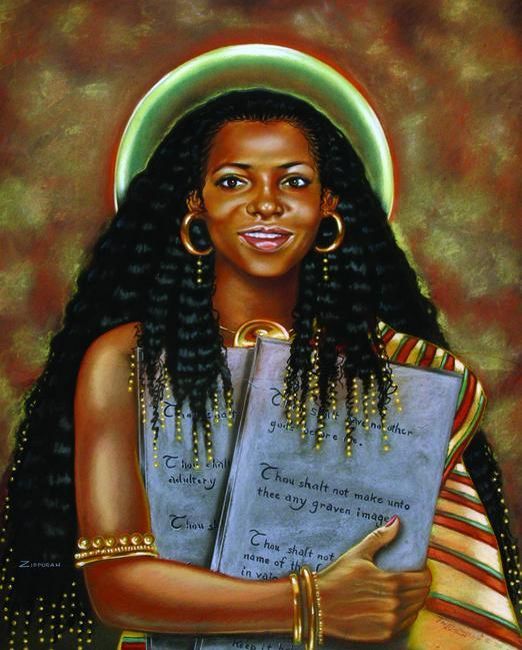
American artist Alan Jones depiction of Moses’ wife Zipporah

While they were at Hazeroth, Miriam and Aaron criticized Moses because he had married a Cushite woman. They said, “Has the Lord spoken only through Moses? Hasn’t he spoken through us, too?” But the Lord heard them. (Now Moses was very humble—more humble than any other person on earth.)

So immediately the Lord called to Moses, Aaron, and Miriam and said, “Go out to the Tabernacle, all three of you!” So, the three of them went to the Tabernacle. Then the Lord descended in the pillar of cloud and stood at the entrance of the Tabernacle. “Aaron and Miriam!” he called, and they stepped forward. And the Lord said to them, “Now listen to what I say:

“If there were prophets among you,
    I, the Lord, would reveal myself in visions.
    I would speak to them in dreams.
But not with my servant Moses.
    Of all my house, he is the one I trust.
I speak to him face to face,
    clearly, and not in riddles!
    He sees the Lord as he is.
So why were you not afraid
    to criticize my servant Moses?”

The Lord was very angry with them, and he departed. (NLT)

There are three observations about today’s Old Testament lesson I want to point-out and lift-up, and they are crucial observations for us in our present world.

First, the older siblings of Moses, Miriam the eldest and Aaron the other brother, had a problem with their sister-in-law (whose name was Zipporah). She was a Cushite. Cush was an ancient country which encompassed present day northern Sudan and much of Ethiopia in Africa. In other words, Zipporah was black, and Miriam and Aaron were critical of their little brother for marrying her.

Second, although having a black sister-in-law was the real issue, Miriam and Aaron confronted Moses not about this, but went after him concerning his role as a prophet. In other words, the siblings engaged in the age-old practice of ostensibly presenting a concern which was not really the matter on their hearts.

Third, the omniscient God knew what was happening. God was fully cognizant of Miriam and Aaron’s cloak-and-dagger attack at Zipporah through her husband Moses. In other words, God was incensed with this coup attempt because it was unjust, unfair, ungodly, and frankly, racist. And so, the text states that God, with divine anger aroused, “immediately” addressed the situation.

Racism is insidious. It tends to get expressed most often through the methods used by Miriam and Aaron on the level of criticizing another somewhat related issue. So, I offer the following questions with as much humility from Moses I can muster:

Are we aware of our own inheritance of centuries and even millennia of dominance language which keeps other human beings docile and subservient to another’s authority?

Have we chosen to challenge points of order and procedure in the attempt to marginalize certain persons?

Are we detached from our own needs and, so, unable to listen well?

Is there secret fear in our hearts, believing that we must maintain our hegemony, or else, there will be chaos?

Is the end game using whatever tools available for others to become like us, as if we were the Borg who talk about how resisting us is futile?

Are we willing to do the hard work of pulling out our own roots of racial segregation and injustice?

Do we want cheap diversity or true solidarity?

Will we work toward creating a new liberated humanity, championing equity in all things for all people, instead of attempting to sanitize existing systems?

For far too long, too many have relied upon individualism and anti-structuralism and it has not served us well in addressing our contemporary problems. Individualism sees only individual racist words and actions and is blind to systemic issues. It views social problems as merely a reflection of broken relationships, and, so, again, makes it impossible to see the systemic and nature of our racialized society.

Anti-structuralism, that is, not addressing racism as an organizing structure, is the assumption that racism is only individual racial prejudice and hatred. Thus, the approach in dealing with racism is to always be on the lookout for “bad racists.” This avenue, however, diverts attention from upholding biblical justice, forming policies of liberation, and establishing equitable care and opportunity for the common good of all persons.

As an historian, I tend to view things through historical lenses and, so, I resonate deeply with the late twentieth-century essayist James Baldwin when he said, “White people are still trapped in a history which they do not understand; and until they understand it, they cannot be released from it.”

I want my history to be with Moses and freedom. I want God to show up and put racism to an end. I want to be part of the solution, and not the problem. I want justice and fairness to flow like a river that never runs dry.

Lord, Jesus Christ, you reached across ethnic boundaries between Samaritan, Roman and Jew. In your earthly ministry you offered fresh sight to the blind and freedom to captives. Gracious Savior, help us to break down walls and barriers in our community; enable us to see the reality of racism and bigotry; and free us to challenge and uproot it from ourselves, our faith communities, our society, and our world. Amen.