Accept the Situation (Jeremiah 30:12-22)

“This is what the Lord says:

“‘Your wound is incurable,
    your injury beyond healing.
There is no one to plead your cause,
    no remedy for your sore,
    no healing for you.
All your allies have forgotten you;
    they care nothing for you.
I have struck you as an enemy would
    and punished you as would the cruel,
because your guilt is so great
    and your sins so many.
Why do you cry out over your wound,
    your pain that has no cure?
Because of your great guilt and many sins
    I have done these things to you.

“‘But all who devour you will be devoured;
    all your enemies will go into exile.
Those who plunder you will be plundered;
    all who make spoil of you I will despoil.
But I will restore you to health
    and heal your wounds,’
declares the Lord,
‘because you are called an outcast,
    Zion for whom no one cares.’

“This is what the Lord says:

“‘I will restore the fortunes of Jacob’s tents
    and have compassion on his dwellings;
the city will be rebuilt on her ruins,
    and the palace will stand in its proper place.
From them will come songs of thanksgiving
    and the sound of rejoicing.
I will add to their numbers,
    and they will not be decreased;
I will bring them honor,
    and they will not be disdained.
Their children will be as in days of old,
    and their community will be established before me;
    I will punish all who oppress them.
Their leader will be one of their own;
    their ruler will arise from among them.
I will bring him near and he will come close to me—
    for who is he who will devote himself
    to be close to me?’
declares the Lord.
“‘So you will be my people,
    and I will be your God.’” (New International Version)

Jeremiah, by Marc Chagall, 1956

Once in a while, I get a response from a patient in the hospital who was given a poor diagnosis, or a very challenging prognosis, that goes something like this: “These doctors are always focusing on the negative. I’m only going to listen to the positive. I don’t need all that negative talk and energy.”

I believe in things like hope, optimism, and confidence. Yet, those qualities can only be acquired through the purgative force of hard circumstances and suffering. That means, in order to truly embrace the positive and encouraging, we need to first sit with the negative and discouraging realities in front of us.

Bottom line: It hurts to heal. Cuts need peroxide. Serious wounds need to be vacuumed. Severe internal issues require a surgery – being opened up – with a surgical knife, in order to get the body in a position to heal itself.

I find it curious that so many folks who believe in the Bible have never read the Old Testament prophets.

And very few preachers have never even given a sermon from the prophets. “It’s too gloom and doom, too negative. I focus on the positive and build up the church with New Testament truth!”

So, how’s that working for you? If there is a spiritual cancer that needs removal, it’s going to take some pain and hard treatment. And that is a lot of “negative” stuff.

There wouldn’t be a New Testament without an Old. I am suggesting that perhaps one reason why there is so much spiritual immaturity amongst many churches and Christians is that there is a lot of biblical illiteracy, due to the neglect of the prophets.

Without the prophets, we do not get a true feel for the pathos of God; that is, the Lord’s spiritual and emotional energy against injustice and oppression. And, practically speaking, it leaves us with neither resources nor skills to cope with adversity and trouble when it comes.

What do you do when you – or someone you love – hears that they have an incurable disease or condition?

Those without a solid grounding in the biblical prophets will likely want to rush to the places in Scripture that talk of answers to prayer and miracles and resurrections. But little do they realize that one cannot experience life apart from death, that there is no resurrection without a crucifixion, no positive glory without negative suffering.

No healing can take place if there is no pain of a cross.

Conversely, those who have become familiar with the message of the prophets are sure to respond to the incurable situation with expressions of personal grief and public lament, with humility and submission to the will of God.

Prayers will arise from deep within them that are grounded in the justice of God, and rely upon the promises of God. They will look to their inner spirit, without outwardly blaming God and medical staff for being uncaring and negative.

And, most of all, the spiritually and prophetically aware person will lean into their prodigious support system of a loving and gracious God, as well as the many persons who want to help.

The mature believer engages in a combination of submission and subversion – submitting completely to the will and ways of God, while simultaneously praying against the unfairness of disease, disaster, and death.

Healing and restoration will happen. The kicker is that we just don’t know the timing of any of it. We may not realize healing until the next life. Then again, we might experience a dramatic restoration of health and happiness, far beyond what we could ever ask or imagine.

The wise person learns to be patient, and wait for the proper time. They are comfortable with whatever timetable the Lord has for them. For what is most important to them is that they are close to the God who is near to the brokenhearted.

If we are guilty, we admit it, and seek to repair whatever damage may have been done. And if we are innocent, well then, we admit that we are not our own, but belong, both body and soul, to our faithful Creator.

Even in pain, we rest; even though suffering, we are at peace.

Accept the situation as it is, and not as you want it to be.

O God of love, you are the true sun of the world, evermore risen and never going down: We pray you to shine in our hearts and drive away the darkness of sin and the mist of error. We pray that we may, this day and all our lives long, walk without stumbling in the way you have prepared for us, which is Jesus Christ our Lord; who lives and reigns with you and the Holy Spirit, one God in glory everlasting. Amen. – A prayer of Erasmus of Rotterdam (1466-1536)


Submission Is an Attitude (1 Peter 2:13-17)

For the sake of the Lord submit yourselves to every human authority: to the Emperor, who is the supreme authority, and to the governors, who have been appointed by him to punish the evildoers and to praise those who do good. For God wants you to silence the ignorant talk of foolish people by the good things you do. Live as free people; do not, however, use your freedom to cover up any evil, but live as God’s slaves. Respect everyone, love other believers, honor God, and respect the Emperor. (Good News Translation)

Submission is a word a lot of people would like to do without. And that’s understandable. We’ve all likely had the experience of being under the authority of someone who either didn’t know what they were doing, or who gaslighted us, took advantage of us, and maybe was even downright mean and nasty toward us. What’s more, it’s hard to obey someone or some institution who we aren’t quite sure has our best interests at mind.

And then there’s an association with the word “submission” as being forced to do something you don’t want to do. That sort of understanding of submission is actually slavery and oppression, not submission.

Simply put, to submit is the informed and willing choice to place oneself under the authority of another. If it isn’t a willing and informed choice, then it’s either manipulation or coercion by another.

The Apostle Peter was referring to submitting to human authority by a volitional choice of our will. And what he was encouraging believers to do was no small thing.

The Roman Empire was an ancient behemoth. At the time of Peter’s writing, the Romans were firmly in charge of Palestine – Gentile rule in a Jewish land – and they did not take kindly to any ideas of rebellion. The Jews wanted their own autonomy and rule. To be subject to the Romans was, for many, humiliating and unacceptable.

So, why in the world should anyone willingly choose to submit to an empire that doesn’t align with their values, aspirations, and goals in life?

Peter made it clear why: Submission helps clear away the obstacles to freedom (both personal and corporate) and doesn’t give the persons in authority a reason to speak or act foolishly.

It’s hard to submit; it’s not an easy thing to do. Yet, if we will continually connect submission with why we are doing it, this helps us persevere, especially under leadership which is less than stellar.

The real issue is how we deal with unwanted circumstances in our lives. Although we didn’t ask for many of the unfortunate situations in life, our response to them is critical, and makes all the difference.

“Evil is changed into good when it is received in patience through the love of God; while good is changed into evil when we become attached to it through the love of self. True good lies only in detachment, and abandonment to God. You are now in the trial; put yourself confidently and without reserve into his hand.”

François Fénelon, Let Go: To Get Peace and Real Joy

Admittedly, it is maddening when an injustice is done to us, or we observe someone else experiencing something they don’t deserve. Unjust actions and words perpetrated against us are out of our control. What is, however, within our control is our response. We can choose how to react in each and every situation we face.

“Forces beyond your control can take away everything you possess except one thing, your freedom to choose how you will respond to the situation.”

Viktor Frankl, Man’s Search for Meaning

We, indeed, have a range of responses we may choose from: We can react in passive-aggressive anger, become sullen and morose, stuff all our emotions down and ignore them, lash out and verbally attack; or we can choose to accept the situation for what it is (and not what we want it to be) and submit ourselves to God.

All of you must put on the apron of humility, to serve one another; for the scripture says, “God resists the proud, but shows favor to the humble.” Humble yourselves, then, under God’s mighty hand, so that he will lift you up in his own good time. Leave all your worries with him, because he cares for you. (1 Peter 5:5-7, GNT)

Submission to God often comes in the form of submitting to the human authorities in our lives – even when those persons and institutions over us are imperfect. Systemic evil isn’t changed by our response of perpetrating even more evil back upon them. Rather, unjust structures are transformed through godly persons choosing to work within the system to do good, not harm, and to love, not hate.

Christian freedom is never a matter of simply doing whatever the heck you want to do, regardless of how it impacts anyone else. Our freedom is in the ability to make choices about what sort of attitude we are going to have in all the circumstances of life we encounter.

Don’t do anything from selfish ambition or from a cheap desire to boast, but be humble toward one another, always considering others better than yourselves. And look out for one another’s interests, not just for your own. The attitude you should have is the one that Christ Jesus had:

He always had the nature of God,
    but he did not think that by force he should try to remain equal with God.
Instead of this, of his own free will he gave up all he had,
    and took the nature of a servant.
He became like a human being
    and appeared in human likeness.
He was humble and walked the path of obedience all the way to death—
    his death on the cross. (Philippians 2:3-8, GNT)

Therefore, what we’re left with is the willing choice to alter our own life, instead of continually trying to make everyone else change. It comes down to showing respect for all humanity, honoring God with our attitudes, and loving our sisters and brothers in the faith who face the same sorts of challenges we do.

“When we are no longer able to change a situation, we are challenged to change ourselves.”

Viktor Frankl

Be safe. Be strong. Be spiritual. We are all in this life together.

The Who, What, When, Why, Where, and How of Praise (Psalm 148)

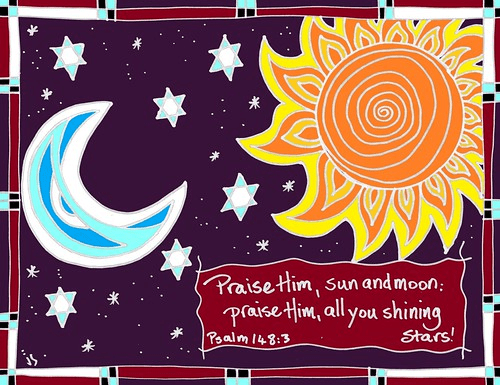
By Stushie Art

Praise the Lord!
Praise the Lord from the heavens;
    praise him in the heights!
Praise him, all his angels;
    praise him, all his host!

Praise him, sun and moon;
    praise him, all you shining stars!
Praise him, you highest heavens
    and you waters above the heavens!

Let them praise the name of the Lord,
    for he commanded, and they were created.
He established them forever and ever;
    he fixed their bounds, which cannot be passed.

Praise the Lord from the earth,
    you sea monsters and all deeps,
fire and hail, snow and frost,
    stormy wind fulfilling his command!

Mountains and all hills,
    fruit trees and all cedars!
Wild animals and all cattle,
    creeping things and flying birds!

Kings of the earth and all peoples,
    princes and all rulers of the earth!
Young men and women alike,
    old and young together!

Let them praise the name of the Lord,
    for his name alone is exalted;
    his glory is above earth and heaven.
He has raised up a horn for his people,
    praise for all his faithful,
    for the people of Israel who are close to him.
Praise the Lord! (New Revised Standard Version)

By Stushie Art

Everything in all creation points to a Creator who cares for us. The 12 days of Christmas (December 25–January 5) are a great celebration. King Jesus has come; he is the rightful Sovereign over all creation. Believers recognize Christ’s incarnation – affirming the identity of Jesus as both full human and fully divine. 

Worshipers praise the Lord. It’s in our spiritual DNA to give adoration, praise, and honor to God. Today’s Psalm is not only meant for good times; it’s also for the despondent, difficult, and downright hard times. There’s always an open season on praising the Lord, no matter what’s going on in and around us. 

Psalm 148 helps to re-orient us around praise to God, instead of remaining stuck in being disoriented.  Whether in good times or bad, we praise the Lord. 

Who should praise the Lord?

Everyone. Everything. 

God has created and continues to impact every nook and cranny of creation. Therefore, the entire universe – every creature and all humanity – acknowledge the Lord with praise. 

The outer reaches of the universe, on everything out there which we cannot even see, praise the Lord. 

The earth and everything in it praise the Lord. 

The forces of nature praise the Lord. 

The landscape, the flora and fauna, animals and humans, together with all creation, praise the Lord. 

Young people, old people, men and women – no matter who they are or where they come from – praise the Lord. 

The proper purpose of everything and everyone that exists is giving adoration and praise to God.

In the Ancient Near East, the sun, moon, and stars were considered gods by the various people groups. This Psalm was, therefore, more than a summons to praise – this was a call to recognize the One true God as the sovereign and the rightful ruler of all. Thus, the ancient peoples understood this psalm as a claim that their gods must bow to Israel’s God.

What is praise to the Lord?

Praise to the Lord is a recognition that God deserves praise from everyone and everything. Praise is physical posture and a heart stance of bowing, yielding, and submitting to God. “Praise the Lord” in the Hebrew language is “hallelujah.” And “hallelujah literally means “to raise the hands.”

We are told 10 times in the 14 verses of Psalm 148 to praise the Lord, that is, to raise our hands. It’s a symbol of submission and joy. To have open hands lifted toward heaven conveys our obedience and commitment to God. 

When do we praise the Lord?

Praising the Lord and lifting the hands, is not only to occur in church or worship setting; praise happens everywhere.

We lift our arms in reverent submission at our workplaces when we land a client or have a good day; and when cranky and critical people demean us. Praising the Lord isn’t limited to good circumstances.

We raise our hands and praise the Lord when our neighbors care about us and look out for us, as well as when they make noise and irritate us with their less than kept up yards and houses. Yielding to God’s purposes for our lives is not dependent upon whether we have good neighbors or not. 

We praise the Lord and raise our hands when our marriages are life-giving and thriving, as well as when our relationship with our spouse is dry, dull, and going nowhere. It’s always open season on praising the Lord and reflecting his image through love. 

By Stushie Art

We praise the Lord for our kids, not only when they do what’s right; but also when they’re complete stinkers and drive us nuts. We are to use our hands for praise and enact obedience, and not for violence through finger pointing or physical punishment.

In adversity, we praise the Lord because it gives us a chance to put our faith into action. In times when someone is being insensitive and callous, it provides the opportunity to praise the Lord and love them because God loves us.

At all times, in all places, in every circumstance, and with each situation we raise our hands in hallelujah to Jesus for saving us from our misguided ways and bringing us back into fellowship with God. 

Lift your hands, always! And when, like Moses, we can no longer lift them, let others help hold them up we so that we can keep praising God. (Exodus 17:11-12)

Why praise the Lord?

Because God created everything and everyone. 

The Lord designed every living thing and fashioned a man and a woman in the divine image as the pinnacle of creative work. 

Adam and Eve walked with God and had perfect praise of the Lord and fellowship with each other. Yet, tragedy happened. The people God formed were deceived into thinking that the Lord was holding out on them by not letting them eat from a certain tree in the garden. So, they disobeyed, ate the fruit, and so plunged the world into darkness.

However, God did not turn away from humanity. Holy Scripture is the revelation of a God who goes out of the way to do whatever it takes to reclaim people back to fellowship so that they can fulfill their original design to praise the Lord. 

The height of God’s love is sending the Son, the Lord Jesus. God became one of us so that he could save us from ourselves. 

Whenever we have exhausted all the avenues this world has to offer in bringing fulfillment, satisfaction, and peace to our lives – there stands Jesus, crucified, risen, ascended, and waiting with open arms for you and me to lift our hands and see that he has the only way for us to live. 

The reason you have felt for so long that you are a square peg in a round hole is that your life is meant to praise the Lord. You are not meant to fit into the world; you are meant for God.

Where do we praise the Lord?

From the heavens and the earth. From everywhere in all creation, and from everyone as creatures, there is to be praise to the Lord.

Humanity is one part of a big grand chorus of praise that arises from all creation. Some of the psalmist’s pairings of praise are quite informative. 

The sun that praises God during the daytime and the moon that offers its praise at night, reminds us that God’s praise is never silenced. 

The highest heavens and waters above the sky, along with the earth and what’s under its waters, helps us recall that God’s creation, from top to bottom, praises the Lord. 

The mountains and hills, with creatures and flying birds on them and circling them, communicates to us that both the noticeable and scarcely noticeable offer their praises to our God and King.

All creation burps out their praise – which means that some folk really are dumber than rocks because even the rocks know enough to praise the Lord. 

We praise the Lord – outdoors, indoors, at home, at work, in the neighborhood, with family, church, from every place there is to be a lifting of the hands to God.

How do we praise the Lord?

Of course, we raise our hands in adoration for the God who gives us life and watches over us in such a way that not a hair on our heads can fall apart from the divine will. 

We praise the Lord by being the people God created us to be – walking in fellowship with the Lord and enjoying the divine/human relationship forever.

No matter our current situation, every day and every situation is a summons to praise the Lord. God’s claim upon our lives leads us toward raising our hands to heaven. 

The person who praises God is marked by a deep humility of understanding that they are not God; expressive gratitude for God’s actions; patient confidence in God’s promises; and a sense of unity, participating in harmony with God, others, and all creation in praising the Lord!

Most High, all-powerful, all-good Lord,
All praise is Yours, all glory, honor and blessings.
To you alone, Most High, do they belong;
no mortal lips are worthy to pronounce Your Name.

We praise You for all Your creatures,
especially for Brother Sun,
who is the day through whom You give us light.
He is beautiful and radiant with great splendor,
of You Most High, he bears Your likeness.

We praise You for Sister Moon and the stars,
in the heavens You have made them bright, precious and fair.

We praise You for Brothers Wind and Air,
fair and stormy, all weather’s moods,
by which You cherish all that You have made.

We praise You, for Sister Water,
so useful, humble, precious and pure.

We praise You for Brother Fire,
through whom You light the night.
He is beautiful, playful, robust, and strong.

We praise You for Sister Earth,
who sustains us
with her fruits, colored flowers and herbs.

We praise You for those who pardon,
or who for love of You bear sickness and trial.

Blessed are those who endure in peace,
by You they will be crowned.

We praise You for Sister Death,
from whom no-one living can escape.
Woe to those who die in their sins!
Blessed are those that She finds doing Your Will.
No second death can do them harm.

We praise and bless You Lord,
give You thanks,
and humbly serve You. Amen.

 – A canticle of praise from St. Francis of Assisi

Worship That Is Fit For a King (Colossians 1:11-20)

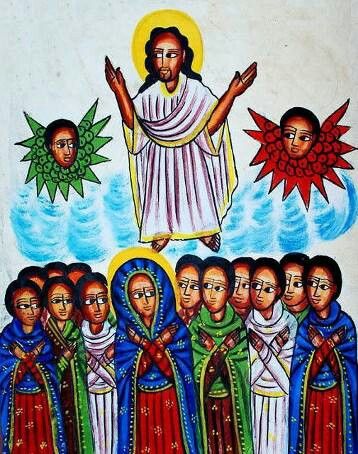
17th century Ethiopian Orthodox depiction of the glorified Christ

[May you be] strengthened with all power according to his glorious might so that you may have great endurance and patience, and giving joyful thanks to the Father, who has qualified you to share in the inheritance of his holy people in the kingdom of light. For he has rescued us from the dominion of darkness and brought us into the kingdom of the Son he loves, in whom we have redemption, the forgiveness of sins.

The Son is the image of the invisible God, the firstborn over all creation. For in him all things were created: things in heaven and on earth, visible and invisible, whether thrones or powers or rulers or authorities; all things have been created through him and for him. He is before all things, and in him all things hold together. 

And he is the head of the body, the church; he is the beginning and the firstborn from among the dead, so that in everything he might have the supremacy. For God was pleased to have all his fullness dwell in him, and through him to reconcile to himself all things, whether things on earth or things in heaven, by making peace through his blood, shed on the cross. (New International Version)

Today is Christ the King Sunday. It is intended to help us see the cosmic reality that Jesus reigns over all creation as the only rightful Sovereign of the universe. This particular Sunday always comes just before Advent so that we remember to anticipate both a baby and a king.

Christ as Lord of all exposes three problems humanity faces:

  1. Building our own petty kingdoms and setting ourselves up as masters over our own small worlds.  People who have been hurt (all of us) often attempt to seize power for themselves in order to avoid ever being hurt again, or in the belief that wielding power could have prevented others from being hurt. The classic villains of movies and literature are ones who seek to destroy the current establishment so that they can rebuild it in their own idea of how the world should operate. The destruction is motivated by protecting loved ones from pain. The irony is that a lot of hurt is inflicted on the protagonists in order to alleviate the antagonist’s pain.
  2. Bowing to other kings besides King Jesus. When distressed, we might rely on alternative authorities to address our hard circumstances – expecting another to give us what only Jesus can. Instead of running to Christ, there is a fleeing to politicians or pundits or pastors. And we rely on them to cope with whatever is going on in our lives.
  3. Lacking awareness of the power we have as subjects of King Jesus. Christians possess authority in Jesus Christ. As believers in Jesus, we reign with him and can exercise authority over every dominion that exists, especially the dominion of darkness.

Jesus is King. Neither you, nor I, are. 

A simple statement; yet, not easily engrafted into daily life. 

Part of the original sin of Adam and Even was rebellion – to break the bonds of loving authority God provided for them. Westerners, especially, tend to have an anti-authoritarian strain which runs rather deep in us.

When my middle daughter was a child and grappling with the implications of faith in Christ, she blurted out an honest cry that we can likely resonate with: “I just don’t want another person in my life telling me what to do!” 

Indeed, Jesus is King; we are not.

Christ the King Sunday reminds us of the pre-eminence and lordship of Jesus Christ: 

  • All things were created through Jesus and for him. 
  • Everything in all creation is held together by Jesus. 
  • Christ is the head of the church. 
  • In Jesus Christ, complete divinity exists and reigns. 
  • Jesus made peace through the cross because he had the authority and the qualifications to do so. 
  • Broken relationships and proper lines of authority are now restored and redeemed in Christ.
Ethiopian Orthodox depiction of the glorified Christ

We can also likely relate to, at times, indulging in the illusion (and delusion!) of being in control and independently dictating the course of our lives. Yet, mercifully, Jesus is the great sovereign King, and this is a good thing – because in Christ we find authority to redeem and reconcile. 

Because Christ is King, we really ought to submit to him. In fact, we need to pay some attention to how our bodies are to submit to his lordship.

When the body moves to animating physical actions of submission, this helps the heart to follow. Whole person worship involves engaging the mind, spirit, emotions, and, yes, the body. To neglect the body in worship is to truncate the ability to connect with God in Christ.

A typical metaphor for the Church is the “Body of Christ.” We can live into that phrase through an embodied spirituality of submission. Our individual bodies are temples of the Holy Spirit, important for expressing worship. (1 Corinthians 3:16)

God created us with literal physical bodies. And Jesus has a literal physical body. Bodies are important for whole person worship. This means the physical postures we take in worshiping King Jesus are significant. We need to pay attention to them.  

A healthy practice for Christians is to kneel in the presence of the Lord. I realize some Christian traditions do it as a part of their worship, and some do not. Some like it, some don’t. Yet, bowing, even prostrating oneself (if you are physically able!) can be a powerful symbol of the heart’s desire and disposition to submit to the lordship and authority of Jesus Christ. 

Crawling out of bed in the morning getting on your knees and beginning the day with submission to live into the will of God; and also ending the day in the same manner, is a practical way of remembering who Jesus is and who we are.

I believe all Christians need to feel free in adopting a physical posture of worship which helps them connect with God in Christ. For some, that will be sitting in a comfortable position in contemplation. Others will want to stand, raise their hands, even dance in praise.

It also behooves us to let our bodies respond to whatever is happening with us spiritually. Exuberant praise needs the expression of hand clapping and toe tapping. Confession of sin needs a bit of bowing, kneeling, even prostrating. For prayer, hands open and palms facing up to receive blessing from God is a good bodily position of worship.

You get the idea. Just remember we need to strive for congruence in our worship, that is, what is happening with our outward bodily movements needs to match what is occurring inward with our spirits. And when the two are in sync, meaningful worship can happen – worship of submission fit for a king.

Sovereign God, in your mercy you have sent your Son, the Lord Jesus, who has brought reconciliation to a once broken relationship. I bow before you in obedience, submission, and worship. Let me live a cross-shaped life through enjoying the peace you have given me in Christ in both body and soul. Amen.