Encouragement to Be Faithful (2 Timothy 1:3-7)

Orthodox icon of St. Timothy
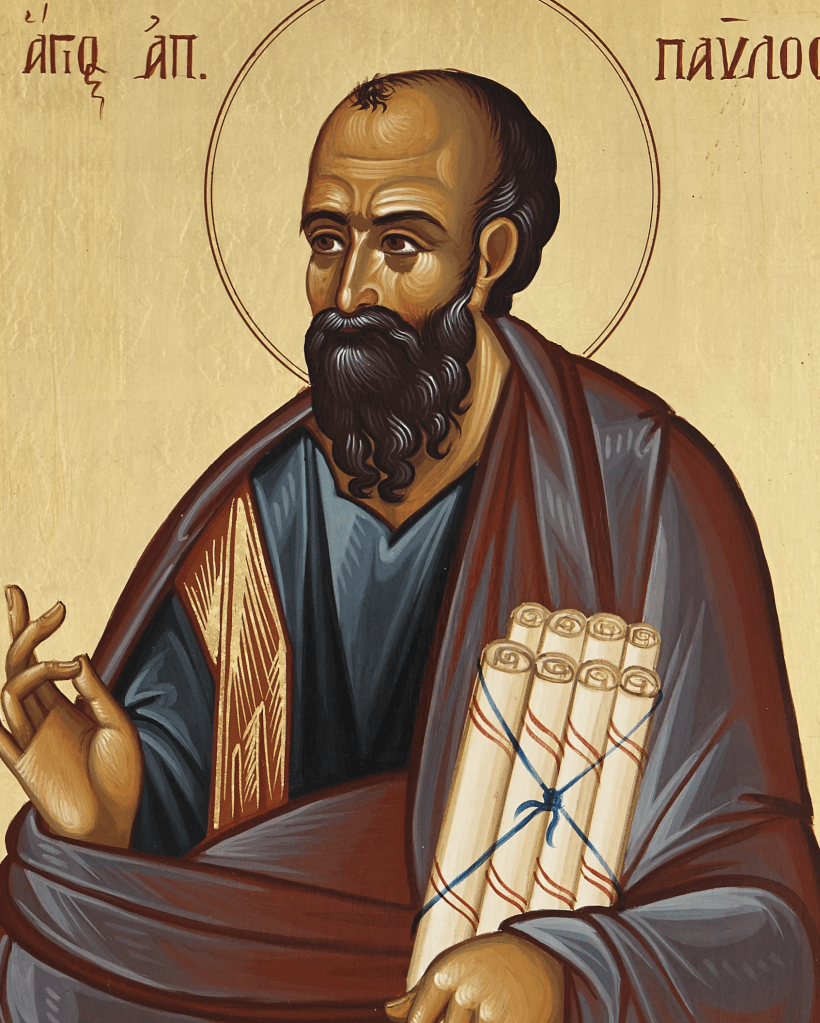
Orthodox icon of St. Paul the Apostle

Timothy, I thank God for you—the God I serve with a clear conscience, just as my ancestors did. Night and day I constantly remember you in my prayers. I long to see you again, for I remember your tears as we parted. And I will be filled with joy when we are together again.

I remember your genuine faith, for you share the faith that first filled your grandmother Lois and your mother, Eunice. And I know that same faith continues strong in you. This is why I remind you to fan into flames the spiritual gift God gave you when I laid my hands on you. For God has not given us a spirit of fear and timidity, but of power, love, and self-discipline. (New Living Translation)

Every individual person I meet is interesting. Everyone has a story. Each person has values which are important to them.  

The Apostle Paul had quite the story of conversion to Christianity. And so, he understandably had a high value of passing on the faith to reliable and competent persons who would then do the same. Timothy was one of those persons, a protégé of his mentor Paul.

Paul reminded Timothy of his identity, rooted in a faithful family, and encouraged him to tap into that robust spirit which resides within him. The Apostle encouraged him to fully express that spirit without fear or timidity.

For example, I care about kids. Children are a high value to both me and my wife. When meeting and engaging a family for the first time, we will inevitably talk to the child before addressing the parents. We care about any issue in the world which has to do with children – and we have a strong sense of morality concerning children because we love kids.

Be faithful to your calling, and to the values and ethics which undergird it. Whatever is important to us is where our sense of morality and ministry lie.

“Wherever your treasure is, there the desires of your heart will also be.”

Jesus (Matthew 6:21, NLT)

Everyone is moralistic because everyone cares about something. And we will live and die by our code of ethics, grounded in the values we most cherish.

In Holy Scripture, although there are hundreds of laws in the Bible, the highest standard of ethics and morality is contained in just a few chapters: The Ten Words (Commandments) found in the Old Testament chapter of Exodus 20; and Christ’s Sermon on the Mount found in the New Testament chapters of Matthew 5-7. 

These few chapters can be distilled into a few short ethical phrases:

“Love God with all your heart, soul, mind, and strength.” And “Love your neighbor as yourself.” (Matthew 22:37-39)

This means that every teaching found in the Bible comes down to love. (Mark 12:30-31)

Throughout the history of the church, the highest ethical values have always had to do with knowing and loving the Creator, Sovereign, and triune God – Father, Son, and Spirit – and the majesty of people who are created in the divine image and likeness.

The movement and trajectory of Holy Scripture is that a good and benevolent God makes and keeps promises to people. Even when they fall and try to create small petty worlds of their own, a gracious God is active, wooing lost people to return to the spirit which resides within them.

Therefore, the Bible is an unfolding drama of redemption in which a loving God goes out of the way to bring back straying, hurting, helpless people. (Luke 15)

Which is why, for me, attending to the inner soul, teaching people the words and ways of Jesus, and providing spiritual care to others is a very high value. I love God, and I love people. It’s easy to understand, then, why I treasure the following:

  1. Practicing solitude, silence, and other spiritual disciplines.
  2. Connecting with God daily in contemplative prayer and meditative Bible reading.
  3. Paying attention to hurting people and bringing them grace, mercy, faith, hope, love, and gentleness.
  4. Seeking to act with civility and respect toward others I disagree with, or just don’t like very well.
  5. Engaging others who don’t share my values of faith in God.
  6. Praying and hoping for people to be healed and whole.
  7. Pursuing the common good of all people, no matter who they are.

My deep conviction is that the care of the soul is just as important as the care of the body; that attention to exercising the mind with Holy Scripture is just as important to overall health and well-being as cardio workouts and sensible eating; and that the hope of the world resides with knowing Jesus Christ (and not with a lesser hope that wishes things will work out in the end if I’m sincere to my personal ethical beliefs).

Paul wanted Christians to engage in the care of souls, to fan into flame the spiritual gifts which already lie within us, even if they may seem dormant or non-existent.

So, be faithful to who you are, to what you have been called to, and especially to the good news:

For there is one God and one Mediator who can reconcile God and humanity—the man Christ Jesus. He gave his life to purchase freedom for everyone. This is the message God gave to the world at just the right time. (1 Timothy 2:5-6, NLT)

Great God and Father of all, remember the multitudes who have been created in your image but have not known the redeeming work of our Savior Jesus Christ; and grant that, by the prayers and labors of your Church, they may be brought to know and worship you as you have been revealed in your Son, who lives and reigns with you and the Holy Spirit, one God, now and forever. Amen.

The Necessity of Mentoring Relationships: Paul, Tom, and Timothy (2 Timothy 3:10-15)

Orthodox icon of St. Paul
Orthodox icon of St. Timothy

You’ve been a good apprentice to me, a part of my teaching, my manner of life, direction, faith, steadiness, love, patience, troubles, sufferings—suffering along with me in all the grief I had to put up with in Antioch, Iconium, and Lystra. And you also well know that God rescued me! Anyone who wants to live all out for Christ is in for a lot of trouble; there’s no getting around it. Unscrupulous con men will continue to exploit the faith. They’re as deceived as the people they lead astray. As long as they are out there, things can only get worse.

But don’t let it faze you. Stick with what you learned and believed, sure of the integrity of your teachers—why, you took in the sacred Scriptures with your mother’s milk! There’s nothing like the written Word of God for showing you the way to salvation through faith in Christ Jesus. (The Message)

Paul and Timothy had a special relationship. Paul, the Apostle and mentor in the faith; and Timothy, the apprentice.

Together, they saw it all – and experienced it all. And through it all, the Christian tradition was passed on because of Paul’s purposeful mentoring of others, especially Timothy, by both verbal teaching and life example. In this, Paul helped set Christianity on a trajectory of modeling the words and ways of Jesus.

Faith is a gift given by God through Scripture and faithful people – and then received by us. Christianity is designed for community; it is not merely a solitary affair between the individual and God. Anyone trying to go it alone in the Christian life will soon discover they are overwhelmed and in over their heads with trouble.

Contemporary pastoral ministry still needs to follow in the footsteps of the Apostle Paul. Just one of the many reasons why churches in the West are in such decline is that Christian leaders are not intentionally focused to passing-on a solid body of teaching, along with a consistent example of how to put it into practice, through close relationships.

Anyone who has been in the pastoral ministry gig for a long time, remaining consistent and faithful, has most certainly had a good spiritual teacher and guide shepherding them through their Christian experience. A good long ministerial life isn’t happenstance; it’s the result of a solid foundation through a Paul-and-Timothy sort of relationship.

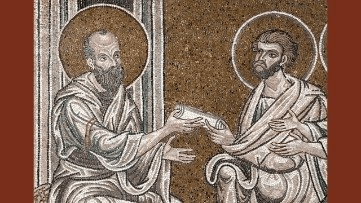
Mosaic of Paul and Timothy, Cathedral of Monreale, Sicily, Italy

By God’s grace, I’ve had several persons influence my life in profound ways in such a relationship. One of the earliest and longest was with Tom – a campus minister on my university who built into my life as an undergraduate and a very young Christian. We remained connected and became good friends for nearly four decades until his untimely death.

Tom knew what he was doing with me. To this day, even with multiple academic degrees and many professional ministry experiences, I attribute most of what I know about Christian faith and practice as simply saying and doing what I saw Tom say and do. And, I might add, Tom consistently saw my true self, even when I didn’t see it myself.

A good model in the faith has the same qualities and insights as the Apostle Paul of old. For example, here are just a few of the important things I learned from Tom:

  • Christian ministry is interpersonal; time must be spent with others, getting to know them and building relationships. Doing pastoral ministry from afar is an oxymoron. From what we know of Paul, at times he had a team of up to seventy persons following him around on missionary endeavors.
  • There are always going to be charlatans and bad apples around. Don’t simply ignore them. Confront them in grace and truth. I still remember a time when I went along with Tom, not knowing where we were going or what he was up to. In retrospect, he probably knew I would bolt if I caught wind of what he was about to do. We went to the dorm room of a believer whom Tom flat-out confronted on his talking and living being inconsistent with his professed Christianity. My eyes got huge when Tom said, “In the name of Jesus Christ I rebuke you and I call you to repent.” This was said in a gracious and conversational tone, not in anger, which communicated concern and love for this individual student.
  • Develop relationships. And the best way of doing this is by having the Timothy tag along with the Paul. Tom continually brought me along to whatever he was doing, whether it was a weekend retreat he was leading, or going to the grocery store. We cannot learn from others if we aren’t around them, and Tom understood this better than most. As a result, I learned more than lessons; I learned a life.
  • It’s not about me. Tom never took himself too seriously. And because of that, I observed him never becoming overwhelmed or obsessing over the trouble he would sometimes get into. In fact, he typically welcomed the trouble whenever he saw it was not of his own making.
  • Openness and vulnerability are necessary. More than once, Tom strolled into a bible study with me and some other guys, flopped down and said, “Man, I really blew it today…” and then went on to explain some boneheaded thing he did. We unpacked the entire situation together. Not once do I ever recall Tom trying to look like the perfect Christian leader. He embraced who he was and was always willing to shine the light on the shadowy places of his heart.
  • Holy Scripture is central to Christian life and ministry. Inevitably, Tom’s question to us, after describing his bonehead move, was to ask, “What are you learning in God’s Word? Do you have any encouragement for me?” On a daily basis, without fail, Tom asked this question of me: “So, what is God teaching you in the Word?”

Through both Holy Scripture and the significant relationships I’ve had throughout my life, I can confidently state that there are two indispensable elements to effective Christian ministry:

  1. It must be firmly grounded in objective theory derived from God’s Word.
  2. It must be intentionally practiced with subjective experience derived from interpersonal relationships.

Objective theory without lived practice leads to being puffed-up with knowledge and no love – because love requires people. And subjective experience without a grounded theory is nothing but a form of spiritual A.D.D. in which whatever shiny thing we see grabs our attention.

I always considered Tom as my spiritual father (and his wife as a dear spiritual mother!). They have shown me not only how to live the faith, but also how to be a spiritual father myself. And as a result, my own dear wife and I have many spiritual children scattered throughout the country.

This is the consummate Christian: Coming to faith by God’s grace, mediated to us through actual flesh-and-blood people; being taught and mentored in that faith by proven Christians; and then, simply saying and doing what you have seen and heard from holy leaders and Holy Scripture.

It’s not rocket science. It’s not abstract art. It’s a life. It’s relationships. And it’s absolutely necessary in order for both the church and the world to be blessed.

But he’s already made it plain how to live, what to do,
    what God is looking for in men and women.
It’s quite simple: Do what is fair and just to your neighbor,
    be compassionate and loyal in your love,
And don’t take yourself too seriously—
    take God seriously. (Micah 6:8, MSG)

Soli Deo Gloria. Amen.

2 Timothy 2:8-13 – The Hound of Heaven

Remember Jesus Christ, raised from the dead, descended from David. This is my gospel, for which I am suffering even to the point of being chained like a criminal. But God’s word is not chained. Therefore, I endure everything for the sake of the elect, that they too may obtain the salvation that is in Christ Jesus, with eternal glory.

Here is a trustworthy saying:

If we died with him,
    we will also live with him;
if we endure,
    we will also reign with him.
If we disown him,
    he will also disown us;
if we are faithless,
    he remains faithful,
    for he cannot disown himself. (NIV)

C.S. Lewis once described God as the Hound of Heaven.  By that phrase he meant that God doggedly pursued him and would not let go.  Lewis came into Christian faith, in his own words, “kicking and screaming” as God’s faithful pursuit won out in his life. 

The Apostle Paul reminded his young protégé Timothy of some basic theology to keep him on track and encouraged in a tough ministry.  Paul gave Timothy a trustworthy saying that he could easily remember and say to himself day after day, especially when the going got tough: 

If we died with Christ,
    we will live with him.
If we don’t give up,
    we will rule with him.
If we deny
    that we know him,
he will deny
    that he knows us.
If we are not faithful,
    he will still be faithful.
Christ cannot deny
    who he is. (CEV)

The beauty, wonder, and distinction of God is his amazing grace. There is no ambiguity with God. The Lord is not fickle but loves and holds tight even when we are unlovely and practice avoidance. When God pursues, God finds; when God holds on, there is no letting go.

This trustworthy saying of Scripture is a good, short, solid expression of theological truth to memorize, meditate upon, and say to ourselves repeatedly.  We belong to Jesus Christ.  God is with us.  The Hound of Heaven will always sniff us out and bring us to himself.

Lewis likely got his phrase “Hound of Heaven” from an English poem of the same name by Francis Thompson (1859-1907). Thompson was a tortured soul who flirted in and out of depression, opium addiction, and suicidal thoughts for much of his adult life. Yet, he understood, perhaps better than most, that a loving God never stops pursuing a wayward heart. The poem’s beginning and end says this:

I fled Him, down the nights and down the days;
I fled Him, down the arches of the years;
I fled Him, down the labyrinthine ways
Of my own mind; and in the mist of tears
I hid from Him, and under running laughter….

How hast thou merited—
Of all man’s clotted clay the dingiest clot?
Alas, thou knowest not
How little worthy of any love thou art!
Whom wilt thou find to love ignoble thee,
Save Me, save only Me?
All which I took from thee I did but take,
Not for thy harms,
But just that thou might’st seek it in My arms.
All which thy child’s mistake
Fancies as lost, I have stored for thee at home:
Rise, clasp My hand, and come.
Halts by me that footfall:
Is my gloom, after all,
Shade of His hand, outstretched caressingly?
Ah, fondest, blindest, weakest,
I am He Whom thou seekest!
Thou dravest love from thee, who dravest Me.

Theology is not an impersonal affair. Personal religion still exists. The individual’s wax and wane between faith and faithlessness shall never negate divine grace. The Lord of the universe loves you. There is a deep Divine desire to shower grace upon you, to shelter and protect you. There is no need to run. Yet, if you do, God remains steadfast in his dogged pursuit. The hunt will continue….

Thank you, O God, for your great faithfulness, even to me.  I believe. Help me in my unbelief! I give unceasing praise and undying devotion to you for your grace of being the One who never lets up, through Jesus Christ my Lord.  Amen.