Promise and Pilgrimage (Genesis 12:1-7)

The Lord said to Abram,

“Leave your land,
your relatives,
and your father’s home.
Go to the land that I will show you.
I will make you a great nation,
I will bless you.
I will make your name great,
and you will be a blessing.
I will bless those who bless you,
and whoever curses you, I will curse.
Through you every family on earth will be blessed.”

So Abram left, as the Lord had told him, and Lot went with him. Abram was 75 years old when he left Haran. Abram set out for Canaan. He took along his wife Sarai, his nephew Lot, and all the possessions they had accumulated and the servants they had acquired in Haran.

They arrived in Canaan, and Abram traveled through the land to the oak tree belonging to Moreh at Shechem. At that time the Canaanites were in the land. Then the Lord appeared to Abram and said, “I’m going to give this land to your descendants.” So he built an altar there to the Lord, who had appeared to him. (God’s Word Translation)

Abram (later having a name change to “Abraham”) knew quite a lot about new beginnings.

It isn’t every day that the Lord comes along and completely upends a person’s life. Abram had lived his entire life in the same city, Ur, in Chaldea (present day Iraq). By all accounts, Abram was completely fine living where he was living. He had neither the ambition nor need to leave his home city.

The Lord, however, had other plans for Abram. And they were radical plans. This was no rearranging of the furniture; it was a wholesale life-altering change. Ur was an important cosmopolitan city, a trade center, located at a pivotal point where the Tigris and Euphrates Rivers run into the Persian Gulf. Thus, Ur was a wealthy city, the citizens enjoying a level of comfort unknown in other parts of Mesopotamia.

Actor Eddie Albert as the out of place city lawyer trying to make it in the country on “Green Acres” which aired on CBS from 1965-1971

So, Abram being called to move from the city and go to some unknown place in the west would be something like growing up in Manhattan, New York and being called by God to head for Brewster, Nebraska – which is pretty much in the middle of nothing. It makes “Green Acres” look like a night out at the opera.

The Lord’s First Promise to Abram

It wasn’t all unknown change; there was a promise attached to the call. Having every family on earth blessed through you is a really big promise. There was a lot riding on Abram’s response.

Perhaps there was some pushback on Abram’s end of things. But we don’t have any record of it if it even happened. Instead, we get a simple statement telling us that he left, just as the Lord told him to do.

Lest we think Abram had some incredible relationship with the Lord before this call came, we need to think again:

“This is what the Lord God of Israel says: Long ago your ancestors, Terah and his sons Abraham and Nahor, lived on the other side of the Euphrates River and served other gods. But I took your ancestor Abraham from the other side of the Euphrates River. I led him through all of Canaan and gave him many descendants.” (Joshua 24:2-3, GW)

The One true God wasn’t even on Abram’s radar. He was merrily serving the pagan gods of Sumer, seemingly without a care in the world. It wasn’t as if Abram was bored watching old reruns of “Green Acres” and wishing for a change. And it sure wasn’t because he was attuned to knowing anything about Yahweh.

Whatever went down between Abram and the Lord was likely so compelling that Abram left willingly and without any pushback.

The Lord’s Second Promise to Abram

To travel from Ur of the Chaldees to the land of Canaan is an approximate distance of 800 miles. That’s slow going when you’re traveling in a caravan by donkey and camel. It took a while to get to the land that the Lord had in mind for Abram.

Once there, God gave Abram another promise: The land that he reached will be his home, the new land, the Promised Land. It would be yet another 500+ years before Abram’s descendants took full possession of that land and the promise realized.

Abram had a lot of time to consider and reflect on the Lord’s calling and promises. And that is precisely why pilgrimage is so very important. Yes, the destination is significant; yet it is the journey itself that really matters.

Pilgrimage

Those who put their strength in you are truly happy;
    pilgrimage is in their hearts. (Psalm 84:5, CEB)
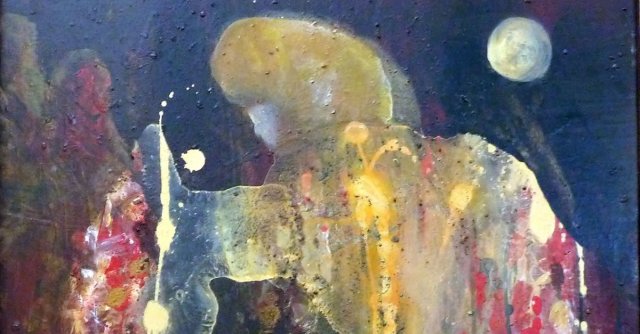
Abram journeys into the unknown by Yoram Raanan

The way of pilgrimage is for all, like Abram, who walk in faith and patience, awaiting the fulfillment of God’s promises.

By faith Abraham obeyed when he was called to go out to the place which he would receive as an inheritance. And he went out, not knowing where he was going. 

By faith he dwelt in the land of promise as in a foreign country… for he waited for the city which has foundations, whose builder and maker is God…. Therefore from one man, and him as good as dead, were born as many as the stars of the sky — innumerable as the sand which is by the seashore.

These all died in faith, not having received the promises, but having seen them afar off were assured of them, embraced them and confessed that they were strangers and pilgrims on the earth. 

For those who say such things declare plainly that they seek a homeland. And truly if they had called to mind that country from which they had come out, they would have had opportunity to return. But now they desire a better, that is, a heavenly country. Therefore God is not ashamed to be called their God, for He has prepared a city for them. (Hebrews 11:8-16, NKJV)

Each day, we have the opportunity to be pilgrims, walking by faith, exercising patient hope, persevering in love for one’s fellow humanity.

Just because we live in a microwave society which values speed and customer service above all else, doesn’t mean our religion has to follow suit. The best things in life are slow in coming; they require a great deal of blood, sweat, and tears.

Go ahead and enjoy an episode or two of “Green Acres;” just remember to listen when the Lord calls and go to make disciples of all nations.

All-powerful God, you always show mercy toward those who you love, and you are never far away for those who seek you. Be with your servants on this pilgrimage and guide their way in accord with your will. Amen.


Perfect Peace (Isaiah 26:1-9)

In that day, everyone in the land of Judah will sing this song:

Our city is strong!
    We are surrounded by the walls of God’s salvation.
Open the gates to all who are righteous;
    allow the faithful to enter.
You will keep in perfect peace
    all who trust in you,
    all whose thoughts are fixed on you!
Trust in the Lord always,
    for the Lord God is the eternal Rock.
He humbles the proud
    and brings down the arrogant city.
    He brings it down to the dust.
The poor and oppressed trample it underfoot,
    and the needy walk all over it.

But for those who are righteous,
    the way is not steep and rough.
You are a God who does what is right,
    and you smooth out the path ahead of them.
Lord, we show our trust in you by obeying your laws;
    our heart’s desire is to glorify your name.
In the night I search for you;
    in the morning I earnestly seek you.
For only when you come to judge the earth
    will people learn what is right. (New Living Translation)

Peace comes through trust; faith is the smooth path to settled rest and wholeness of being.

We all, of course, want peace. Personal peace. Family peace. National peace. World peace. And yet, so many of us lack peace to the degree that we have to medicate ourselves to get any sleep.

Avoiding family seems normal, just to keep the peace. National peace almost sounds oxymoronic. World peace is merely wishful thinking for far too many people. Perhaps we are in such a befuddled conundrum because of this reason:

We already possess what we so desperately want. The search for peace is really the search within.

“I am leaving you with a gift—peace of mind and heart. And the peace I give is a gift the world cannot give. So don’t be troubled or afraid.”

Jesus (John 14:27, NLT)

The Christian needs to understand that Jesus has left us his peace. He gave it to us. We have it. Perhaps we have misplaced it? Maybe its lost in that huge stack on the desk?  Most likely, we plain old forgot about it.

God’s peace is here with us. Right now. This very minute. We have exactly what we want.

This peace is about far more than the absence of war, conflict, and/or infighting. Perfect peace is the settled and restful calm and confidence of being with God, of an intimate union with the divine.

Peace neither occurs by happenstance nor magically appears. Peace was achieved for us; it’s a gift which needs to be unpacked, used, and enjoyed. Practices of peace and peacemaking must be acknowledged and engrafted into our lives if we are going to experience it on the daily practical level (Romans 14:13-15:7).  

Like the delivery guy who leaves a package in an odd place, we could be searching for the ongoing gift of peace somewhere on our property. It’s there – it just seems so darned elusive. Yet, peace, the perfect peace that is harmony and unity, can neither be found in perfect circumstances nor in idyllic families and faith communities. Divine peace is the security of relationship with God, smack in the middle of life’s crud.

As the divine life takes root and grows within us, our hearts are healed with that presence, and we experience peace. It’s the kind of peace which drives fear and anxiety away; the kind of peace which only comes through trusting God.

Therefore, there’s no need to try and miraculously conjure up peace with positive thoughts.

It is the glorious, gracious, and mystical union between the divine and the human which creates peace. All obstacles have been surmounted and tossed into the trash for the garbage guy to haul away. And, no, you did not accidentally throw your peace in the dumpster. There really is no need for any dumpster diving. God’s already done that work for you and me.

In such topsy-turvy times as these, I come back again and again to deep spiritual convictions which inform what I do each day. One of those underlying creeds is this:

The Lord is trustworthy, no matter whether my faith or the faith of others is small or great. It isn’t faith itself that heals, saves, or grants peace – it is God.

It isn’t about the level of faith, but about where the faith is placed.

For the Christian, faith itself doesn’t mean much if it isn’t in Jesus. If I place a large and sincere faith in an inanimate object such as money; in a position of power; or, even in my own independence, my faith isn’t worth much. 

If I have a huge faith in a doctor or a psychiatrist to heal my body or my mind, I will quickly discover there are limits to their abilities. 

If I have a confident faith that my family will meet all my needs, my faith will eventually run into failure when they let me down. 

If all my faith eggs are in the church basket, my faith will eventually face a crisis because it is a misplaced faith.  Furthermore, the answer I provide for others is not simply getting them to attend church or to adopt my moral code.

God’s love remains continually steadfast, even if my trust is fickle and inconsistent.

We know with certainty that circumstances change; everyday seems to bring new levels and permutations of unprecedented alterations to our lives – and through it all, the Lord remains as the ever-present Sovereign, responding to even the slightest mustard seed of faith.

A woman in the crowd had suffered for twelve years with constant bleeding. She had suffered a great deal from many doctors, and over the years she had spent everything she had to pay them, but she had gotten no better. In fact, she had gotten worse. She had heard about Jesus, so she came up behind him through the crowd and touched his robe. For she thought to herself, “If I can just touch his robe, I will be healed.” Immediately the bleeding stopped, and she could feel in her body that she had been healed of her terrible condition.

Jesus realized at once that healing power had gone out from him, so he turned around in the crowd and asked, “Who touched my robe?”

His disciples said to him, “Look at this crowd pressing around you. How can you ask, ‘Who touched me?’”

But he kept on looking around to see who had done it. Then the frightened woman, trembling at the realization of what had happened to her, came and fell to her knees in front of him and told him what she had done. And he said to her: 

“Daughter, your faith has made you well. Go in peace. Your suffering is over.”

(Mark 5:24-34, NLT)

May your trust in the Lord open the way of perfect peace for you, now and always. Amen.

The Blessing (Genesis 17:15-22)

By American artist Julie Lonneman

God said to Abraham, “Don’t call your wife by the name Sarai anymore. Instead, her name is Sarah [Princess]. I will bless her, and I will also give you a son by her. I will bless her, and she will become a mother of nations, and kings will come from her.” Immediately, Abraham bowed with his face touching the ground. He laughed as he thought to himself, “Can a son be born to a hundred-year-old man? Can Sarah, a ninety-year-old woman, have a child?” Then Abraham said to God, “Why not let Ishmael be my heir?”

God replied, “No! Your wife Sarah will give you a son, and you will name him Isaac [He Laughs]. I will make an everlasting promise to him and his descendants. I have heard your request about Ishmael. Yes, I will bless him, make him fertile, and increase the number of his descendants. He will be the father of 12 princes, and I will make him a great nation. But I will make my promise to Isaac. Sarah will give birth to him at this time next year.” When God finished speaking with Abraham, he left him. (God’s Word Translation)

Life can only be lived with faith. We all believe in something, in someone. It’s just a matter of what or whom we place our faith in. Whomever we direct our faith, that is where we give our allegiance and obedience.

As for Abraham and his wife Sarah, they had their faith in the God who called them from Ur of the Chaldees. They demonstrated their belief by doing exactly what the Lord said to do – they went West to the land God would show them. (Genesis 12:1-5)

Abraham and Sarah listened to God and acted accordingly.

I don’t want to cross over into TMI territory (Too Much Information) yet I want us to consider what had to take place when the Lord tells the old couple they will have a baby next year. Here’s where the faith and action comes in: It is highly unlikely that a 100-year-old man and a 90-year-old woman were sexually active. But the Lord essentially told them to get going on conceiving a child. So, they did!

I can’t speak for Abraham and Sarah, but I know as a grandfather that I am really glad I don’t have to raise kids anymore. It makes me exhausted just thinking about it, at my age, so I’ve got to believe it crossed their minds, too. Maybe that’s why Abraham sort of pleaded with God to let Ishmael be the son of promise; the reality of being responsible for a newborn was maybe the last thing on old Abe’s mind.

But faith they had, as the New Testament attests:

Even when Sarah was too old to have children, she had faith that God would do what he had promised, and she had a son. Her husband Abraham was almost dead, but he became the ancestor of many people. In fact, there are as many of them as there are stars in the sky or grains of sand along the seashore. (Hebrews 11:11-12, CEV)

Genuine belief results in decisive action. At Abraham and Sarah’s age, sex may likely have seemed a safety hazard. Yet, they were submissive to God’s plan that divine promises would come through Isaac – who was indeed born the next year, just as the Lord said.

Abraham and Sarah by Marc Chagall, 1956

All this is consistent with the names “Abraham” and “Sarah.” Names were (and still are in most of the world) important identifiers of personal character – particularly toward what sort of person one would become.

God made a name change for the old couple. “Abram,” meaning “exalted father,” was changed to “Abraham,” “father of many nations.” “Sarai” was altered to “Sarah,” yet both names have the same meaning: “Princess.” (Genesis 17:3-8, 15-16)

The change of names was meant to communicate the promise of divine blessing from God for the future. All the world will be blessed through the covenant made with Abraham. Sarah’s alteration of name, though only in form and not substance, brought to the fore that Sarah, too, had a special purpose along with her husband in blessing the world.

Today, this blessing is still unfolding. Throughout all history, since the time of Abraham and Sarah over four millennia ago (c.2100 B.C.E.), the divine ripples of God’s covenant with them have moved across the earth.

Their progeny, through Isaac, the son of the promise, the Jewish people, continue to exist as arguably the most resilient group on the planet. We, especially Christians and Muslims, owe a great debt to the Jews for persevering in faith for such a long stretch of time. They have much to teach us, if we have ears to hear and hearts receptive.

Since the time of Christ, the blessing has extended well beyond the physical descendants of Abraham and Sarah:

Is this blessedness only for the circumcised [Jews] or also for the uncircumcised [Gentiles]? We have been saying that Abraham’s faith was credited to him as righteousness. Under what circumstances was it credited? Was it after he was circumcised, or before? It was not after, but before! And he received circumcision as a sign, a seal of the righteousness that he had by faith while he was still uncircumcised. 

So then, Abraham is the father of all who believe but have not been circumcised, in order that righteousness might be credited to them. And he is then also the father of the circumcised who not only are circumcised but who also follow in the footsteps of the faith that our father Abraham had before he was circumcised….

Therefore, the promise comes by faith, so that it may be by grace and may be guaranteed to all Abraham’s offspring—not only to those who are of the law but also to those who have the faith of Abraham. He is the father of us all. As it is written: “I have made you a father of many nations.” He is our father in the sight of God, in whom he believed—the God who gives life to the dead and calls into being things that were not.

Against all hope, Abraham in hope believed and so became the father of many nations, just as it had been said to him, “So shall your offspring be.” Without weakening in his faith, he faced the fact that his body was as good as dead—since he was about a hundred years old—and that Sarah’s womb was also dead. 

Yet he did not waver through unbelief regarding the promise of God but was strengthened in his faith and gave glory to God, being fully persuaded that God had power to do what he had promised. This is why “it was credited to him as righteousness.” The words “it was credited to him” were written not for him alone, but also for us, to whom God will credit righteousness—for us who believe in him who raised Jesus our Lord from the dead. He was delivered over to death for our sins and was raised to life for our justification. (Romans 4:9-12, 16-25, NIV)

May you know the depth and breadth of your faith, that it stretches far beyond this time and place. And may the blessing of God almighty – Father, Son, and Spirit – be upon you and remain with you, now and forever. Amen.

A Testimony of Faith (John 3:31-36)

The one who comes from above is above all; the one who is of the earth belongs to the earth and speaks about earthly things. The one who comes from heaven is above all. He testifies to what he has seen and heard, yet no one accepts his testimony. Whoever has accepted his testimony has certified this, that God is true. He whom God has sent speaks the words of God, for he gives the Spirit without measure. The Father loves the Son and has placed all things in his hands. Whoever believes in the Son has eternal life; whoever disobeys the Son will not see life but must endure God’s wrath. (New Revised Standard Version)

I, personally, have found Jesus to be precisely whom he claims to be. 

I was raised in the church. But it didn’t stick. The most boring hour of every week for me was having to endure the Sunday morning worship service. It seemed like a major waste of my time. I could be reading the funnies (the comic strips in the Sunday morning newspaper), watching TV, or playing outside. I get a weekend off from school and I have to do this! Sheesh.

There is, I eventually discovered, often a difference between what we humans do in our lives and our institutions, and Jesus. That’s not necessarily a knock on the church. It’s just the observation that we sinful folk very often fall short of the glory of God – which is why we need Jesus in the first place.

We as people know how to love, yet we love imperfectly. We understand that kindness and compassion are needed, but we tend to withhold it from so many of our fellow humans. Jesus, on the other hand, as the divine/human figure who straddles between both heaven and earth, always loves consistently and perfectly; and demonstrates compassionate kindness in ways which connect deeply with us.

It took me a while to see this, but by God’s grace, I mercifully came to experience the love of God in Christ and the powerful enablement of God’s Spirit.

I have come to accept Christ’s enduring testimony as gracious, truthful, and life-giving. I have wholeheartedly embraced the New Testament Gospel accounts of his birth, life, teaching, death, resurrection, and ascension. This belief came neither quickly nor easily for me – it resulted from an honest straightforward reading of the Bible; and the patient wooing of the Holy Spirit.

Oh, I certainly could get quite cerebral and offer a Christian apologetic of the faith that gets down to the nitty gritty of theology, both historical and contemporary. But the older I get, the more I experience that when I get down, I can’t get back up again. There’s much more to Christianity than ideas and philosophical arguments.

Truth is, it really isn’t my job to convince you of Jesus Christ’s authenticity and trustworthiness. That’s the work of the Holy Spirit. Instead, it is my task to bear witness of the things I have seen and heard concerning Jesus. 

My life has been thoroughly turned upside-down because of Jesus. With Jesus, I have been invited into the very life of God. By the wounds of Jesus, I have experienced healing of damaged emotions and recovery from spiritual hurts inflicted by others. Through union with Christ, I have grace and forgiveness of things I have done and left undone. With Jesus as my Friend, I enjoy loving attention and am never dismissed by him, nor do I ever have my experiences and feelings invalidated by him.

For those who have not read the Gospel accounts and refuse Christ, then, for honesty’s sake, please have the integrity to give Jesus a hearing before you dismiss him with a slight of hand. It’s one thing to genuinely not know much about Jesus, and it is quite another thing to ignore him when you have knowledge about how to find out about him.

For those of us who have read the New Testament Gospels and accept the testimony of Jesus, we come back again and again to his life-giving words and seek continually to follow him in his way of mercy, purity, and peace. We bear witness to how Jesus has changed our lives and offers a life worth living.

Everyone with faith in Jesus has a life-giving connection with God. Those who don’t, don’t. If you disagree with this, then contend with Jesus himself. Give him a hearing. Watch him in action. Observe how he deals with people. See if he lives up to his words. Then, bear witness to what you have seen and heard.

In the power of the Spirit and in union with Christ, I pray to you, the God and Father of all:

For empowerment by the Spirit, that I may be a faithful witness

For those who wait on You, that they may find renewal

For all people, that they may acknowledge the kingdom of the ascended Christ

For all who are struggling with broken relationships

I commend myself and all for whom I pray, to Your mercy and protection through Jesus Christ, my Lord and Savior. Amen.