Leave a Supportive Spiritual Legacy (Deuteronomy 11:18-21)

 “So commit yourselves wholeheartedly to these words of mine. Tie them to your hands and wear them on your forehead as reminders. Teach them to your children. Talk about them when you are at home and when you are on the road, when you are going to bed and when you are getting up. Write them on the doorposts of your house and on your gates, so that as long as the sky remains above the earth, you and your children may flourish in the land the Lord swore to give your ancestors.” (New Living Translation)

The biblical book of Deuteronomy is a farewell address by Moses to the Israelites.

Moses was about to die. The Israelites were about to enter the Promised Land.

So, Moses restated God’s law and called the people to remember all that God had done. He exhorted the people to communicate the law and their heritage to the next generations.

If God’s words and God’s ways are continually observed, then the people would prosper in God’s Promised Land.

The overarching call and command of Moses to the people is to love God with everything they have and everything they are.

God’s people are to have a dedicated commitment of mind, body, emotions, and spirit to the law of God. Each ability and gift, and all that makes a person a person, is to have its clear direction and orientation toward loving God through obeying God’s commands.

The love of God is meant to become a habit in the normal daily rhythms of life. How do we do that? Impress God’s commands by talking about them in every sort of context: home and family; neighborhood and workplace; morning and evening. People are even to write out God’s commands and have them in front of us all the time. 

Indeed, the entire day is an opportunity to love God by talking about God’s words. Discussing God’s words and commands doesn’t need to be forced or awkward. Yet, it is something which needs some intention and purpose to it.

Most people like talking about things which are important to them. If someone is really into classic cars, he does not have to try and force a conversation about it because it just comes out of him. Because they go to car shows, maybe own a classic car that they are continually tinkering with, and read up on car magazines, a discussion about the subject is quite natural to them.

So, the best way to live into God’s law is to spend time with God through regular Bible reading, focused and earnest prayer, conversing with others, and taking advantage of opportunities to learn and know about God. For the Christian, talking about Jesus is meant to be organic, springing from a heart which loves God and observes God’s law.

When it comes to family, an expert theologian or biblical scholar is not needed; there just needs to be a willingness and a curiosity to ask questions.

Back when raising my girls, most of our conversations at the table centered around one question I would ask. We discussed it, talked about it, and mulled it over. Sometimes it was a deep theological question. At other times, it was a practical question. My wife and I often had others share a meal with us, so I usually asked our guests to tell their God story or participate with us in the question. If they were not Christian, I would ask them what they thought about Jesus and faith, and why.

God loves it when we have conversation in the home around biblical teaching. God also loves it when we have discussions in public. Some Orthodox Jewish persons still to this day wear a “phylactery” on their foreheads – a small box with little Scripture passages inside of it – testifying to their value of the written Word.

I’m not sure that’s what Moses had in mind when he talked about binding God’s commands on the forehead and tying them as symbols on the hands. Much of the Hebrew language is metaphorical, speaking about concrete things as a way of communicating something intangible. So, I wonder if the big idea here is simply to be open about faith and love for God and the law.

Although I don’t believe we have to take today’s verses quite so literally, there is, however, something to be said for keeping Holy Scripture continually in front of us, in order to remember divine commands and promises.

It’s good to write some Bible verses and place them on your bathroom mirror, the dash of your car, in your pants pocket, or anywhere you will see them on a regular basis. It’s a practical way of remembering to observe all that God has commanded.

Physical reminders of significant spiritual events can help us keep the words of God in our lives. When the Israelites experienced God in some significant way, they built an altar. For example, when they approached the Jordan River to enter the land, God caused the water to stop flowing so that they could cross over. Here is what happen next: 

Joshua erected a monument, using the twelve stones that they had taken from the Jordan. And then he told the People of Israel, “In the days to come, when your children ask their fathers, ‘What are these stones doing here?’ tell your children this: ‘Israel crossed over this Jordan on dry ground.’

“Yes, God, your God, dried up the Jordan’s waters for you until you had crossed, just as God, your God, did at the Red Sea, which had dried up before us until we had crossed. This was so that everybody on earth would recognize how strong God’s rescuing hand is and so that you would hold God in solemn reverence always.” (Joshua 4:20-24, MSG)

Passing the spiritual baton and leaving a heritage for future generations is a sacred trust. One of the best ways for that to happen is within the home, talking about God and Scripture as a daily routine, as well as freely conversing about spirituality in public.

There are several ways churches can impress Scripture to younger generations: 

  1. Train them to lead. Adults do not have to do everything in the church. Every generation can be empowered to engage in ministries on a regular basis. Everyone needs a mentor to do anything well – which means taking others with us along the journey of ministry so they can both shadow and participate.
  2. Empathize with young people and young families. That means avoiding criticism. It’s easy for older generations to be critical about another generation’s lack of involvement; or how they live their lives. They don’t need our criticism, but our help. Empathy means that we recognize others are trying to do the best they can in a crazy world. And it’s a world quite different from the one I grew up in. This is a very competitive world, requiring more energy and drive than previous generations. Being a student today is not like being a student when I was a kid.  Being a young parent is not the same today as it once was. Today’s family structure is completely changed; what we think of as a traditional family only makes up 7% of the American population. The stance to take on this is not to criticize, but to encourage and help.
  3. Take the message of Jesus seriously.  Discussion, conversation, questions, and mutual sharing are the ways Jesus developed his followers; and it’s a way we can reach younger generations. Dialogue goes a lot further than simply telling others what they should believe and do.
  4. Adopt a young person, or a young family. If you consider yourself part of an older generation, consider taking a younger person or family under your wing, who is not related to you. Invite them to a meal, read these verses, and discuss them together. Commit to praying for them daily for a set period.
  5. Look for ways to support children, teens, and young families. Prioritizing younger generations means they don’t have to do everything our way. Rather, it means we will listen to what they need in loving God and building into their own families.
  6. Be great neighbors. Discuss, teach, empower, and develop young people – without criticism – into good neighbors who engage their local community by addressing issues with great love and lots of compassion.

There are many more ways to engage. The idea here is that we think about how to embody the teaching we have in Deuteronomy by passing on God’s love and God’s words. So, where will you start?…

A New Covenant (Jeremiah 31:31-34)

The Lord says, “The time is coming when I will make a new covenant with the people of Israel and with the people of Judah. It will not be like the old covenant that I made with their ancestors when I took them by the hand and led them out of Egypt. Although I was like a husband to them, they did not keep that covenant. The new covenant that I will make with the people of Israel will be this:

I will put my law within them and write it on their hearts. I will be their God, and they will be my people. None of them will have to teach a neighbor to know the Lord, because all will know me, from the least to the greatest. I will forgive their sins and I will no longer remember their wrongs. I, the Lord, have spoken.” (Good News Translation)

It’s important to pass on the faith to future generations of believers. The key to embracing a life of faith is obeying God’s commands and decrees.

Yet, both within the Old Testament and within our own contemporary religious milieu, God’s people persist in going through significant times of unfaithfulness, infidelity, and disobedience.., Oftentimes, people cannot seem to keep their eyes off the glittering gods that surround them, as if they had some sort of spiritual A.D.H.D.

Also persistent is the God who possesses a faithful remnant of people devoted to observing the covenant and living into the divine promises given to them. Yet, the kingdom of Judah in the prophet Jeremiah’s day, floundered in their commitments and broke faith with the teaching provided for them.

Since God’s grace has the last word, the sins and shortcomings of backslidden people who failed to pass on the covenant teachings to their progeny will have a better ending than that of divine judgment. God’s answer to repeated human failings is to establish a new covenant, unprecedented in its audacious mercy.

Rather than rewriting commands on stone tablets (as with Moses on Mount Sinai) and having a remedial class on the divine covenant and promises for the people, God will instead do the extraordinary, by writing the law on human hearts. That way, people will know the Lord in a direct and immediate way.

And on top of that, it will be for everybody; it won’t only be for the remnant, nor for just the spiritual elite. From the least to the greatest, from young to old, even from Jew to Gentile, God will forgive sins and shortcoming, guilt and shame, once and for all with the new covenant.

If that’s not the most gracious act ever decreed, I’m not sure what is. This is a radical move of spiritual amnesty. It’s completely undeserved. And it’s definitely not something any other god from any other nation would ever do. It’s unthinkable – completely off everyone’s radar. Yet, that is exactly what grace does. Grace provides a way where there seems to be none.

From a New Testament (New Covenant) perspective, Jesus is the fulfillment of all God’s good covenant promises to the people. Furthermore, God’s Holy Spirit serves as the continuing presence of Jesus within us, teaching us and guiding us in the ways of God. 

Our only task, then, is to live into those promises – to know them, claim them, and bank on them. We are most obedient when we believe the promises of God and throw all our hope in them.

The implications of the divine decree of a new covenant are enormous. It means:

  • I cannot do a darn thing to earn God’s acceptance, because I already have it! (John 6:37; Colossians 1:21-22; Romans 8:33-39, 15:7-12)
  • I don’t need to be afraid of judgment because Jesus has already taken care of the sin issue, once for all! (Romans 6:5-10; Hebrews 7:27-28, 10:5-10; 1 John 4:17-18)
  • I lack nothing, because God has already given me everything I need for life and godliness in this present evil age! (Philippians 4:19; 2 Peter 1:3-4)
  • I can know God, right now, without jumping through spiritual hoops or over imposed hurdles, because Jesus leveled the way and made it clear! (John 14:6; Ephesians 2:8-9; Hebrews 2:9-18)
  • I can enjoy forgiveness and a clean heart because God has decreed it to be so! (Psalm 103:8-12; Ezekiel 36:25-27; Luke 22:20; Hebrews 8:7-13, 10:14-18)

If this were not enough, Jesus has sent the Spirit to be with us forever, to guide us and lead us into realizing the law written on our hearts. We are never alone. God is with us.

Jesus said, “The Companion, the Holy Spirit, whom the Father sends, will teach you everything and will remind you of everything I told you. Peace I leave with you. My peace I give you. I give to you not as the world gives. Do not be troubled or afraid.” (John 14:26-27, CEB)

In this world of trepidation, fear, uncertainty, and unrest, there is peace, grace, and love because the Father, Son, and Spirit, the one true God, the Blessed Holy Trinity, the Divine Warrior who fights our battles, the Lord of Hosts, has our backs. Yes, this God, and no other god, has the chutzpah to make promises to us and the power to back them up.

Our Father in heaven,
Reveal who you are.
Set the world right;
Do what’s best—as above, so below.
Keep us alive with three square meals.
Keep us forgiven with you and forgiving others.
Keep us safe from ourselves and the Devil.
You’re in charge!
You can do anything you want!
You’re ablaze in beauty!
Yes! Yes! Amen!

1 Timothy 4:6-16 – Train Yourself to Be Godly

If you explain these things to the brothers and sisters, Timothy, you will be a worthy servant of Christ Jesus, one who is nourished by the message of faith and the good teaching you have followed. Do not waste time arguing over godless ideas and old wives’ tales. Instead, train yourself to be godly. “Physical training is good, but training for godliness is much better, promising benefits in this life and in the life to come.” This is a trustworthy saying, and everyone should accept it. This is why we work hard and continue to struggle, for our hope is in the living God, who is the Savior of all people and particularly of all believers.

Teach these things and insist that everyone learn them. Don’t let anyone think less of you because you are young. Be an example to all believers in what you say, in the way you live, in your love, your faith, and your purity. Until I get there, focus on reading the Scriptures to the church, encouraging the believers, and teaching them.

Do not neglect the spiritual gift you received through the prophecy spoken over you when the elders of the church laid their hands on you. Give your complete attention to these matters. Throw yourself into your tasks so that everyone will see your progress. Keep a close watch on how you live and on your teaching. Stay true to what is right for the sake of your own salvation and the salvation of those who hear you. (New Living Translation)

There are several metaphors throughout the New Testament illustrating the nature of the Christian life and Christian community.

God’s people are the temple of the Holy Spirit, the house where the Lord dwells; the Body of Christ, a group working together and strengthening one another in faith; the army of the Lord, advancing with the shared purpose of proclaiming good news and extending God’s benevolent rule – just to name a few.

All the metaphors are embedded with the need for training, for spiritual disciplines and practices which strengthen faith and promote spiritual health.

Just as an army of recruits needs intense basic training and ongoing discipline; and just as the body needs hourly movement and daily exercise of its muscles; so, Christian communities require spiritual development with a variety of forms and functions to elicit and establish a solid godly life.

The curriculum in the school of faith; the liturgy within the spiritual temple; the boot camp for the Lord’s soldier; and the repetitions for Christ’s Body, all involve reading and listening to Holy Scripture. And furthermore, to do so with rhythms of personal and corporate integrity, confident faith, steadfast love, encouraging words, and virtuous behavior.

If we dedicate ourselves to these things, there will be no room for entertaining wacky stories which have no basis in truth. Instead, there will be lush spiritual growth, teachable spirits, humble service, supportive beliefs, compassionate ministry, and open fellowship.

The high values of the worthy servant of Christ need to be both used and guarded. With all of our treasured earthly possessions, whatever they may be, we handle them appropriately and carefully – keeping them in a secure place when not used – and using them with care when out.

Our faith, our life and doctrine, is both a precious possession to be guarded, as well as a necessary tool to do the will of God.

Just as our bodies have physical muscles, so the Body of Christ has spiritual muscles.

Faith is a muscle which needs to be stretched, exercised, rested, and supplied with plenty of protein and necessary nutrients. Overtaxed muscles will fatigue and can be damaged through too much exertion. And underused muscles will wither and atrophy, unable to handle even the smallest of strain when we need them.

So, it is best to have proper spiritual hygiene and exercise through a regimen of tried and true practices designed to improve and maintain healthy faith. If you want to build your faith, consider the following 10 ways:

  1. Increase your amount of reading. There is no substitute for daily repetitions of reading the Bible. Supporting a growing faith will require more voluminous reading.
  2. Focus on listening to the biblical text. Reading is only as good as our listening skills. For the Christian, paying attention to the Holy Spirit’s gentle whispers is a must.
  3. Decrease your media time. For all the good stuff out there, a lot of media information is based in myth, half-truths, and opinions masked as facts – not to mention all the hack and huckster preachers.
  4. Pray more. In fact, pray continually.
  5. Practice gratitude – not complaining. Need I say more?
  6. Snack on good spiritual reading. Consuming a good book before bed keeps the faith muscle fed longer.
  7. Rest! When God created and instituted seven days, the first day was a day of rest; the workdays came after. Don’t flip-flop the divine order.
  8. Supplement with good spiritual conversation. Half-baked theological ideas come from remaining in one’s own cave-like head. Consultation, collaboration, and fellowship help create a rich and full faith.
  9. Don’t overtrain. Good idea: Read the Bible in a year. Bad idea: Read the Bible in a month. Good idea: Digest the contents of ecumenical Creeds and church Confessions. Bad idea: Stuff a bunch of knowledge down your gullet without any love to wash it down. Savor the meal. Don’t be a pig.
  10. Don’t lift too heavy for your faith muscle. The ancient desert fathers spent years developing their faith and could do incredible feats of spiritual strength. Christianity isn’t a competition of keeping up with the Francis of Assisi’s and Martin Luther’s of history. Use the measure of faith given to you and focus on those small daily decisions of trust.

Christianity is a marathon, not a 100-meter sprint. We persevere to the end, not flame out after taxing ourselves with expectations and responsibilities God never gave us.

Be safe. Be strong. Be smart. Be spiritual. We are all in this together.

Gracious God, fill your Church with truth, the truth with peace, and the peace with love. Where our faith is weak, make it strong; where it is misguided and in error, correct and direct it; where it is amiss, reform it; where it is in want, provide for it; where it is divided, reunite it, for the sake of Jesus Christ your Son our Savior. Amen.

Proverbs 22:1-21 – Teach and Train the Children

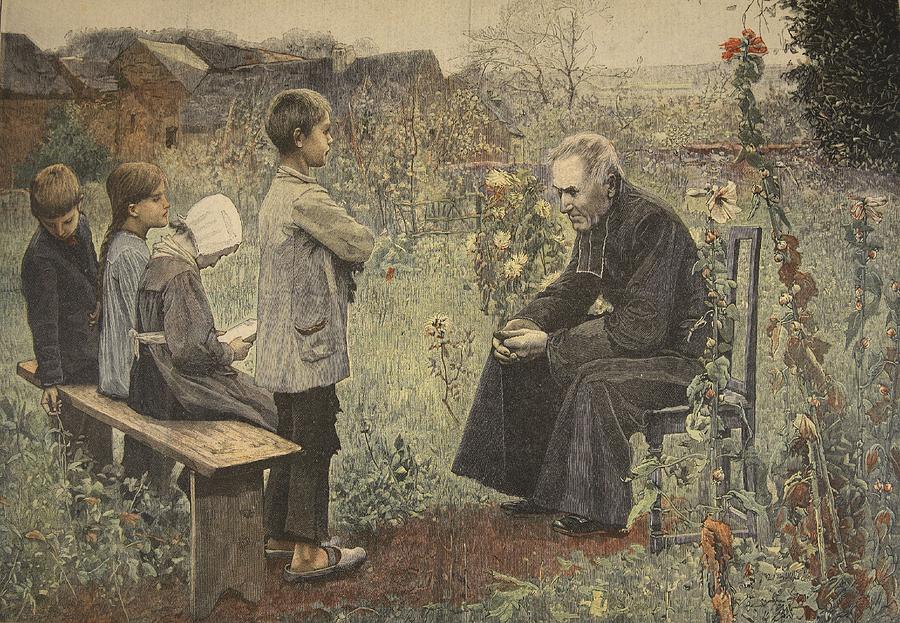
Priest teaching children the catechism by Jules-Alexis Meunier, 1898

Choose a good reputation over great riches;
    being held in high esteem is better than silver or gold.

The rich and poor have this in common:
    The Lord made them both.

A prudent person foresees danger and takes precautions.
    The simpleton goes blindly on and suffers the consequences.

True humility and fear of the Lord
    lead to riches, honor, and long life.

Corrupt people walk a thorny, treacherous road;
    whoever values life will avoid it.

Direct your children onto the right path,
    and when they are older, they will not leave it.

Just as the rich rule the poor,
    so the borrower is servant to the lender.

Those who plant injustice will harvest disaster,
    and their reign of terror will come to an end.

Blessed are those who are generous,
    because they feed the poor.

Throw out the mocker, and fighting goes, too.
    Quarrels and insults will disappear.

Whoever loves a pure heart and gracious speech
    will have the king as a friend.

The Lord preserves those with knowledge,
    but he ruins the plans of the treacherous.

The lazy person claims, “There’s a lion out there!
    If I go outside, I might be killed!”

The mouth of an immoral woman is a dangerous trap;
    those who make the Lord angry will fall into it.

A youngster’s heart is filled with foolishness,
    but physical discipline will drive it far away.

A person who gets ahead by oppressing the poor
    or by showering gifts on the rich will end in poverty.

Listen to the words of the wise;
    apply your heart to my instruction.
For it is good to keep these sayings in your heart
    and always ready on your lips.
I am teaching you today—yes, you—
    so you will trust in the Lord.
I have written thirty sayings for you,
    filled with advice and knowledge.
In this way, you may know the truth
    and take an accurate report to those who sent you. (New Living Translation)

As a pastor, I have seen my share of parents broken over their particular son’s or daughter’s lifestyle and/or behavior. In some cases, the parents have a great deal of work to do with their own shortcomings. In many other scenarios, there are godly mothers and fathers experiencing the heartache of a wayward child through no real fault of their own. 

Yet, some of them feel tremendously guilty because of a famous (or infamous) verse tucked away in our Old Testament lesson for today, to train children in the way they should go, and when they are old, they won’t depart from it.

Keep in mind, there are many different literary genres in Holy Scripture. Narratives, parables, gospel, epistles, poetry, and even apocalyptic literature all occur in the Bible. The book of Proverbs is a collection of wisdom sayings. 

A proverb is a short pity statement of experiential truth. 

In other words, a proverb expresses a general truth in which, all things considered, a particular outcome will likely occur. Proverbs were never designed to be ironclad promises of how things always are or will be. Rather, they are meant to teach wisdom, to give guidance in how to apply reality to a range of life circumstances.

So, when it comes to directing, guiding, and training children, it cannot be claimed that if a parent does a certain set of practices or disciplines that the child will always come out living a certain way. Neither people, nor Scripture, operates in that manner. 

Biblical proverbs on parenting are designed to place emphasis on the necessity of intentional training and instructing children in the ways of God. And, more than likely, all things being equal, that training in the law of God will kick-in when the child is an adult, living on their own, needing wisdom to navigate a difficult world. Yet, remember, it is not a guarantee.

Even God, as the perfect parent, had rebellious children. 

Adam and Eve disobeyed and went their own way. The ancient Israelites, God’s people, were often fickle about their commitment and obedience to the God who consistently showed them steadfast love.

Proverbs encourage us to put significant effort into developing children to be responsible people who live into their full humanity. We teach, train, exhort, live by example, and discipline our kids. We do it all because we love them and seek to be faithful in our own faith commitments.

And we live with the hope that our maternal and paternal efforts are not in vain. So, it is good for parents, teachers, and all who work with kids to have a gracious, wise, well-thought-out plan for training those children. 

As we do so, we trust God, the One who ultimately does the needed renovations of the heart, and transformation of the mind.

Lord of life, you shape us in your image, and by your gracious gift the human family is increased. Grant to all parents everywhere the blessing of teaching and training children. Fill them with wisdom and love as they care for their family, so that they and their children may know and love you. Give us all, whether parents or not, wisdom so that we might always pray intelligently, live circumspectly, and speak lovingly to all the children in our lives, through Jesus Christ our Lord. Amen.