
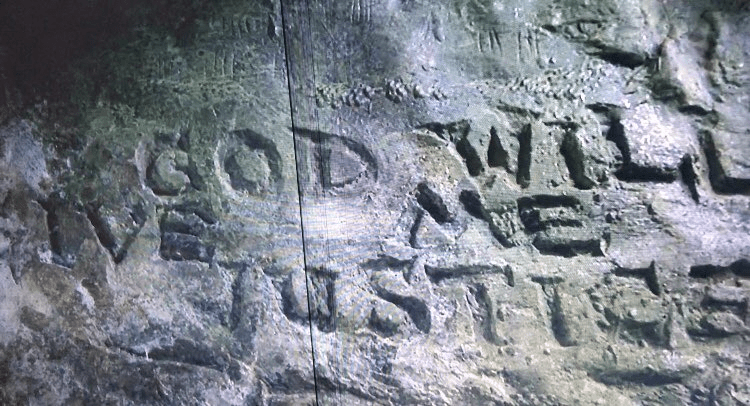
God (Psalm 147:12-20)

Extol the Lord, O Jerusalem!
    Praise your God, O Zion!
For he strengthens the bars of your gates;
    he blesses your children within you.
He grants peace within your borders;
    he fills you with the finest of wheat.
He sends out his command to the earth;
    his word runs swiftly.
He gives snow like wool;
    he scatters frost like ashes.
He hurls down hail like crumbs—
    who can stand before his cold?
He sends out his word and melts them;
    he makes his wind blow, and the waters flow.
He declares his word to Jacob,
    his statutes and ordinances to Israel.
He has not dealt thus with any other nation;
    they do not know his ordinances.
Praise the Lord! (New Revised Standard Version)

The psalmist portrays a God who is clearly in control of all things. This is the Lord God almighty, who is the Creator, and is sovereign over the entire world.

God has no need for bluster, or to leverage knowledge in order to get things done. With only a word, the weather changes completely, and people are invited to participate in the divine will for this earth.

There is no creature, and no human on this earth, who has such power and authority, sovereignty and control, over everything and everyone as God.

Because of God’s great power, the Lord is able to extend gracious and providential care for those who put their hope in God’s steadfast love. Such grace and love of divine blessing is the means for Israel’s praise of Yahweh in the psalm.

The grandest blessing of them all is the gift of the “word.” God’s word of command is what sets in motion all of the natural processes of this earth. It is the divine word that gives and sustains life on this planet.

The same divine word which has been gifted in order for the waters to abundantly flow and the wind to continually blow, is the word given to Israel in the laws and commands for the people.

This gift of word is a wonderful privilege, given to the nation of Israel in the Old Testament. It is what makes them a peculiar people, recipients of the divine will. It is a word of guidance for the covenant people of God.

And that divine word is the primary reason for the human word to respond in praise by extoling the awesome might and mercy of God.

Please understand that today’s psalm is profoundly theological. In other words, it is all about God. We humans and the creation are mentioned and talked about within the psalm, yet all of it is in the context of God’s activity in the world, of God’s actions in history.

The things which God does among us and in this world is a theological reflection, in and of itself. Let me say it another way: God does what God is.

God didn’t simply do some wondrous act in the past. The Lord didn’t merely console and heal someone at some time. Rather, God is constantly binding up the brokenhearted; continually casting down the wicked; and consistently demonstrating steadfast love through right, good, and just actions, all the time.

There is a never a time when God is not God, being holy, loving, and good; and therefore, God’s eternal actions are a non-stop working of justice and righteousness in this old fallen world.

Evil, of course, is continually at work, as well. But we are not talking about opposing powers which are equal to each other. Justice and love will eventually swallow up wickedness and evil.

This is the hope that undergirds the psalmist, and it is the reason that the faithful keep persevering and offering their praise, adoration, and thanksgiving to the God who never slumbers nor sleeps, but is always watching over the righteous.

God’s wisdom and power is matchless. It is impossible for any one of us, or even all of us collectively, to count and number all the stars in the universe. But God can. And God even has them all named, because they all belong to God.

Neither you nor I could ever number the raindrops that fall on our roof in just a few minutes. Yet, God can. And the Lord can count the grains of sand on a beach and the hairs on every head (or in some cases, every hair on a guy’s back).

We humans number in the billions on this earth. Yet, God knows us all by name. And God’s perfection is near and intimate, not distant and remote.

I don’t know about you, my friend, but my encounters with God are nothing like a virtual Zoom meeting. My interactions with the God of the universe are close, intimate, and caring, just as a mother with her newborn baby.

Therefore, matters of renewal, restoration, and even resurrection are not problems for the God of the psalmist. Widows are comforted and rejoice. The poor are lifted up, and not ruined by their poverty.

The confused, the disordered and disoriented, the discouraged and discombobulated, are all held in the hands of the God who knows their confusion and will take care of them.

I might not understand; and, in fact, the older I become, I’ve discovered that the less I actually know. But I believe. I trust God. I do this, daily, because the Lord has demonstrated to me over and over again that God is trustworthy and has the ability to bend everything in this world for redemptive purposes.

That is the sort of God I serve – that the psalmist serves. And this faith, hope, and love is what I want for you, as well, my friend.

Life is too short and precious to squander it, and to flounder in disbelief. So, just listen; and take as much time as you need to hear the word, and experience the presence of life that is around you, and right in front of your face.

Dearest and most gracious Lord:

I thank you for the gift of life, the rising sun, and the promise of the seasons.

I give you thanks for my family and friends and the gifts they share; for my home and all its comforts within; for the abundance you give me and my willingness to share it with others.

I offer my gratitude to you for granting me wisdom, and the ability to listen; for acceptance of the challenges that I face every day; for strength and courage to act for justice and peace.

Most of all, I thank you for the knowledge that, without you, I have nothing; and with you, I possess all things, and have everything I need. Amen.

Living In the Tension of Life (Isaiah 54:1-13)

Shout for joy, O barren one who has borne no children;
    burst into song and shout,
    you who have not been in labor!
For the children of the desolate woman will be more
    than the children of the one who is married, says the Lord.
Enlarge the site of your tent,
    and let the curtains of your habitations be stretched out;
do not hold back; lengthen your cords
    and strengthen your stakes.
For you will spread out to the right and to the left,
    and your descendants will possess nations
    and will settle desolate towns.

Do not fear, for you will not be ashamed;
    do not be discouraged, for you will not suffer disgrace,
for you will forget the shame of your youth,
    and the disgrace of your widowhood you will remember no more.
For your Maker is your husband;
    the Lord of hosts is his name;
the Holy One of Israel is your Redeemer;
    the God of the whole earth he is called.
For the Lord has called you
    like a wife forsaken and grieved in spirit,
like the wife of a man’s youth when she is cast off,
    says your God.
For a brief moment I abandoned you,
    but with great compassion I will gather you.
In overflowing wrath for a moment
    I hid my face from you,
but with everlasting love I will have compassion on you,
    says the Lord, your Redeemer.

This is like the days of Noah to me:
    Just as I swore that the waters of Noah
    would never again go over the earth,
so I have sworn that I will not be angry with you
    and will not rebuke you.
For the mountains may depart
    and the hills be removed,
but my steadfast love shall not depart from you,
    and my covenant of peace shall not be removed,
    says the Lord, who has compassion on you.

O afflicted one, storm-tossed and not comforted,
    I am about to set your stones in antimony
    and lay your foundations with sapphires.
I will make your pinnacles of rubies,
    your gates of jewels,
    and all your wall of precious stones.
All your children shall be taught by the Lord,
    and great shall be the prosperity of your children. (New Revised Standard Version)

Judgment and Grace

Throughout all of the Old Testament prophets, there is a consistent theme within each of them of both judgment and grace.

People continually wax and wane in their faithfulness to God. However, the Lord does not change in being faithful to divine promises and keeping the divine covenant toward Israel.

Judgment comes in order to set things right, and provides justice for oppressed and underprivileged people. The judgment, however, only lasts for a while; whereas grace is continually operative.

Today’s text is one of grace. In the movement and rhythm of God’s judgment and grace, these verses return to the call for celebration and joy in response to divine mercy.

The metaphor of the barren woman refers to the years the city of Jerusalem sat in ruins because of divine judgment. Yet, it will not remain this way. The prophet assures the people that Jerusalem will grow once again. The city will spread out and increase, like a mother with many children.

There is no need for fear, because the Lord is not only the Creator and Maker; God is also Jerusalem’s redeemer and husband. The metaphor is meant to convey the attention and intimacy that God shows to people through divine grace.

Reconciliation and Restoration

Even though the city was like a wife forsaken by her husband, reconciliation is initiated by God through compassion and steadfast love. The Lord will honor the covenant, and not completely toss the people away, never to be seen again.

The Lord scatters; and the Lord gathers. The Lord gives; and the Lord takes away. The Lord extends judgment; and the Lord shows mercy. Blessed be the name of the Lord.

The word “abandon” is not even in God’s lexicon. The Lord is unfamiliar with the concept. There may be natural disasters, terrible diseases, and dilapidated places, but none of these can ever separate us from God’s steadfast immovable love.

Restoration is happening. No matter how bad things get – and things can get awfully bad – nothing can stop the divine band wagon of restoration from coming into town and changing everything.

Renewal and restoration may not happen today, or tomorrow; yet, it is happening, sooner or later. Nothing and no one can stand against the right, good, and just purposes of the almighty and everlasting God.

Redemption and Hope

In Christianity, this hope is focused in the birth of the Christ child. Redemption and new life is a reality in Jesus Christ our Lord. This is the reason for the Christian’s joy and celebration in this season.

On one end of our rubber-band like tension in this present life are the disappointments, brokenness, suffering, and pain we experience. At the other end, is the promise of future glory that is yet to come.

All believers, and every church, lives in this tension between the already and the not yet. We live in an in-between time, an awkward liminal space, that makes hope a sheer necessity in order to make it through the Christian life.

“There is a birth from before the ages, and a birth from a virgin at the fulness of time. There is a hidden coming, like that of rain on fleece, and a coming before all eyes, still in the future.”

St. Cyril of Jerusalem (313-386, C.E.)

The biblical writers, along with the early church fathers and mothers, understood the sacred tension of life:

Without any doubt, the mystery of godliness is great:

He was revealed in flesh,
    vindicated in spirit,
        seen by angels,
proclaimed among gentiles,
    believed in throughout the world,
        taken up in glory. (1 Timothy 3:16, NRSV)

The one who testifies to these things says, “Surely I am coming soon.”

Amen. Come, Lord Jesus!

The grace of the Lord Jesus be with all the saints. Amen. (Revelation 22:20-21, NRSV)

Almighty God, give all of us grace to cast away the works of darkness, and put on the armor of light, now in the time of this mortal life in which your Son Jesus Christ came to visit us in great humility, so that in the last day, when he shall come again in his glorious majesty to judge both the living and the dead, we may rise to the life immortal; through him who live and reigns with you and the Holy Spirit, one God, now and forever. Amen.

Delivery and Deliverance (Isaiah 66:7-11)

Before she was in labor
    she gave birth;
before her pain came upon her
    she delivered a son.
Who has heard of such a thing?
    Who has seen such things?
Shall a land be born in one day?
    Shall a nation be delivered in one moment?
Yet as soon as Zion was in labor
    she delivered her children.
Shall I open the womb and not deliver?
    says the Lord;
shall I, the one who delivers, shut the womb?
    says your God.

Rejoice with Jerusalem, and be glad for her,
    all you who love her;
rejoice with her in joy,
    all you who mourn over her—
that you may nurse and be satisfied
    from her consoling breast,
that you may drink deeply with delight
    from her glorious bosom. (New Revised Standard Version)

Conception. Happiness. Wondering. Uncomfortable. Preparation. Pain. More pain. Delivery. Exhaustion. Joy. Celebration. New life. Bringing children into this world is a process. And its hard work.

Feeding. Pooping. Sleeping. Exhaustion. More feeding. Lots more pooping. Thank God, more sleeping. Still exhausted. So, when does the mother ever get to eat, go to the bathroom by herself, and sleep? Maybe tomorrow, or maybe in another life….

Despite all of this, there are still words which keep mothers (and fathers) going: Satisfaction. Delight. Awe. Praise. Love. Hope. Faith. Yes, faith. Lots of faith. So much faith that it’s as if the parent puts all their weight on it, and leans into it, perhaps more out of sheer necessity than anything else.

The Christian season of Advent has been growing over the past weeks. It is now large and very ready for Christmas Day and the celebration of the Christmas season (the 12 days from December 25 to the Day of Epiphany on January 6).

But we aren’t quite there yet. There is still the anticipation of birth. The Christ child is coming.

It’s quite something to imagine that God would be so humble as to become humiliated. What a wonder it is, that there is such a thing as an incarnation, that Jesus entered this world as both a human baby and a divine king.

God came to this world for us, on our behalf, to redeem, renew, and restore lost humanity. That’s a lot of love. If you think about it, the mother’s incredible love had to come from somewhere.

Love is what sustains the world. So, love must be nurtured. The feelings of it are not always there within us.

Yet, if we will continually seek to maintain the godliness which is love inside of us, we can find ourselves being little incarnations of Jesus walking about this earth providing succor, without any withholding or hatred.

To love is to love. Without conditions. To love a friend but hate an enemy is to cancel out the love. It must be all love, or it isn’t love, at all.

The person, group, organization, institution, community, or church in a miserable and wretched state is in need of restoration. That is, they are in a great need of receiving love and giving love.

If they have responsibilities toward others, and have been neglectful, they must come to the breast of God. And those who did not receive their due justice and fair recompense must also come.

Advent is more than a season in the year to recognize. And Christ’s incarnation is much more than a doctrine to believe. Advent and incarnation are powerful realities which we must live into.

The good news of this season is that God intervenes effectively to do good for those who are faithful. It’s a newness as sudden and as wonderful as the birth of a baby. The Lord does away with barrenness and hopelessness, and brings new life.

It is this good news that brings out joy. Where once there was mourning and sadness, there is now satisfaction, comfort, and consolation. God is the One who brings it about.

Therefore, it is helpful to remember and recall the words of Jesus to his disciples:

Very truly, I tell you, you will weep and mourn, but the world will rejoice; you will have pain, but your pain will turn into joy. When a woman is in labor, she has pain because her hour has come. But when her child is born, she no longer remembers the anguish because of the joy of having brought a human being into the world. So you have pain now, but I will see you again, and your hearts will rejoice, and no one will take your joy from you. (John 16:20-22, NRSV)

The joy and celebration of this first advent will lead to a second advent, the return of Christ. The peace and satisfaction we may enjoy now is only here in part. The fullness of peace will be ushered in at the end of time.

This is the sort of tension that we must continually maintain, holding together in both hands our sorrow and joy, disappointment and hope, hardship and love, at the same time, all the time, until that day when there is not only a delivery, but a deliverance from all evil.

Lord God, we adore you because you have come to us in the past.
You have spoken to us in the Law of Israel.
You have challenged us in the words of the prophets.
You have shown us in Jesus what you are really like.

Lord God, we adore you because you still come to us now.
You come to us through other people and their love and concern for us.
You come to us through people who need our help.
You come to us as we worship you with others.

Lord God, we adore you because you will come to us at the end.
You will be with us at the hour of death.
You will still reign supreme when all human institutions fail.
You will still be God when our history has run its course.

We welcome you, the God who comes.
Come to us now in the power of Jesus Christ our Lord. Amen.

The Day Is Coming (Malachi 4:1-6)

The Great Day of His Wrath, by John Martin, c.1851

“Surely the day is coming; it will burn like a furnace. All the arrogant and every evildoer will be stubble, and the day that is coming will set them on fire,” says the Lord Almighty. “Not a root or a branch will be left to them. But for you who revere my name, the sun of righteousness will rise with healing in its rays. And you will go out and frolic like well-fed calves. Then you will trample on the wicked; they will be ashes under the soles of your feet on the day when I act,” says the Lord Almighty.

“Remember the law of my servant Moses, the decrees and laws I gave him at Horeb for all Israel.

“See, I will send the prophet Elijah to you before that great and dreadful day of the Lord comes. He will turn the hearts of the parents to their children, and the hearts of the children to their parents; or else I will come and strike the land with total destruction.” (New International Version)

These are the final words of the Old Testament, the concluding message of the prophet Malachi.

Malachi’s vision of God’s future action describes a Day of Judgment, a time of utter destruction for all those who devoted themselves to wickedness. The faithful, however, will receive healing by means of bright righteousness. God will restore a good, right, and just order of things.

The divine restoration will cause joy and celebration. In their freedom, the faithful will ensure that the wicked shall not have power and authority ever again.

Therefore, the conclusion to the Book of Malachi – and of all the Old Testament – is a call to obedience, to observe the law. Finally, it is communicated that Elijah – one of the greatest prophets in Jewish history – will return in order to turn the hearts of family members toward one another. And without this change of heart and behavior within the family, there isn’t anything good to look forward to.

In other words, justice and righteousness, humility and gentleness, mercy and peace, all begin within the home. If we are to get things right out in the world, it will be because we have learned how to develop and maintain right relationships and provide for one another in our families.

So, how is that project going? (said in a sarcastic tongue-in-cheek sort of way).

And, how is the religious and spiritual progress going? (said in that same obnoxious sort of tone)

Furthermore, what are you and I doing to help the situation, and not to bring harm to it? (said in an actual serious tone)

It will not do for any of us to simply blame others – even though those others likely have a lot to answer for themselves. You and I cannot control others, especially family members (although some folks do their darndest to try and do it!).

Therefore, we must practice self-control, and do what is within our own power to do in order to help bring blessing – not judgment – to the earth.

All of us need to allow accountability into our lives, so that we may continue in living good and responsible lives.

Yet, that does not always happen. Graciously, the world is not presently spinning on its axis because of me or you. Our mistakes, foibles, screw-ups, and sins are not good, but they are also not going to stop the sun from coming up tomorrow.

It is terribly sad that there is so much war, death, destruction, harm, malevolence, disease, and disaster in this old world. It’s as if the earth is under a curse, which it is. But the world is also loved by God.

The faithful ultimately trust in the grace and mercy of God. The Christian, specifically, looks to Jesus to provide the righteousness and justice that we ourselves have not been able to accomplish.

The judgment of God exists, so that the justice and mercy of God can be fulfilled.

He himself bore our sins in his body on the cross, so that we might die to sins and live for righteousness; by his wounds you have been healed.

1 Peter 2:24, NIV

In union with Christ, the faithful know what a change of heart truly means. And they know what to do in order to affect that change in their lives today:

For we know that our old self was crucified with him so that the body ruled by sin might be done away with, that we should no longer be slaves to sin—because anyone who has died has been set free from sin.

Now if we died with Christ, we believe that we will also live with him. For we know that since Christ was raised from the dead, he cannot die again; death no longer has mastery over him. The death he died, he died to sin once for all; but the life he lives, he lives to God.

In the same way, count yourselves dead to sin but alive to God in Christ Jesus. Therefore do not let sin reign in your mortal body so that you obey its evil desires. Do not offer any part of yourself to sin as an instrument of wickedness, but rather offer yourselves to God as those who have been brought from death to life; and offer every part of yourself to him as an instrument of righteousness. (Romans 6:6-13, NIV)

So then, let us restore right relationships with others, and especially with family. Let us live as people who have been lifted from a curse, and are free from divine judgment.

Let’s get up each day and live into the freedom we possess from the power of guilt, shame, and plain old-fashioned sin.

Let’s be people who choose to look both backward and forward:

  • We look back at the redemptive events of Jesus, to his coming to this earth in a miraculous incarnation, and to his death, resurrection, and ascension.
  • We look forward to the return of Christ, a second advent, when he will save his people, judge all people, and restore all things.

We can do this, my friends. We can live as we ought to live, love as we ought to love, and give as we ought to give – because of the One who has gone before us, is with us, and is coming again.

The Day is coming. Make sure that when it does, we are found faithful.

“For even the Son of Man did not come to be served, but to serve, and to give his life as a ransom for many.”

Mark 10:45, NIV

To him who loves us and has freed us from our sins by his blood, and has made us to be a kingdom and priests to serve his God and Father—to him be glory and power for ever and ever! Amen. (Revelation 1:5b-6, NIV)